11q23 rearrangements (KMT2A) in de novo childhood acute myeloid leukemia
2012-03-01 Eva A Coenen , Jochen Harbott , Christian Michel Zwaan , Susana C Raimondi , Mary M van den Heuvel-Eibrink Affiliation1.Department of Pediatric Oncology/Hematology, Erasmus MC-Sophia Childrens Hospital, Rotterdam, The Netherlands (EAC, CMZ, MMHE); Acute Myeloid Leukemia-Berlin-Frankfurt-Munster Study Group, Department of Pediatric Hematology, Oncology, Justus-Liebig-University, Giessen, Germany (JH); Department of Pathology (Room 4023A), St. Jude Childrens Research Hospital, 332 North Lauderdale Street, Memphis, Tennessee 38105-2794, USA (SCR)
2.Department of Pediatric Oncology/Hematology, Erasmus MC-Sophia Children s Hospital, Rotterdam, The Netherlands (EAC, CMZ, MMHE); Acute Myeloid Leukemia-Berlin-Frankfurt-Munster Study Group, Department of Pediatric Hematology, Oncology, Justus-Liebig-University, Giessen, Germany (JH); Department of Pathology (Room 4023A), St. Jude Children s Research Hospital, 332 North Lauderdale Street, Memphis, Tennessee 38105-2794, USA (SCR)
Clinics and Pathology
Disease
Phenotype stem cell origin
Etiology
Epidemiology
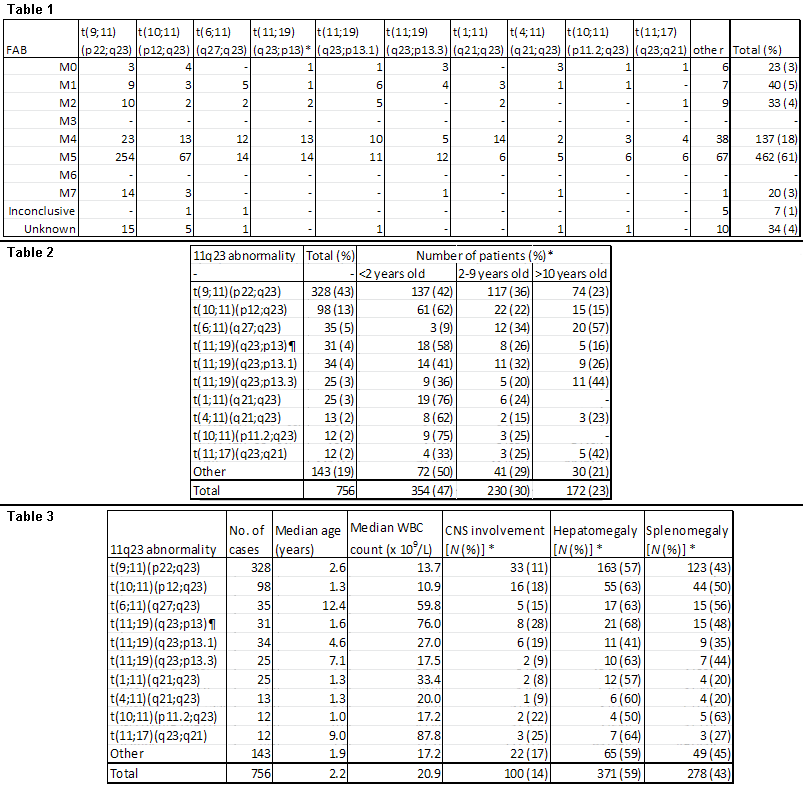
Most of the following information was obtained from a large international collaborative retrospective study consisting of 756 pediatric patients with 11q23 abnormalities and AML in which the overall 5-year event free survival (EFS) rate was 44%. (See Table 2).
Clinics
Treatment
Prognosis
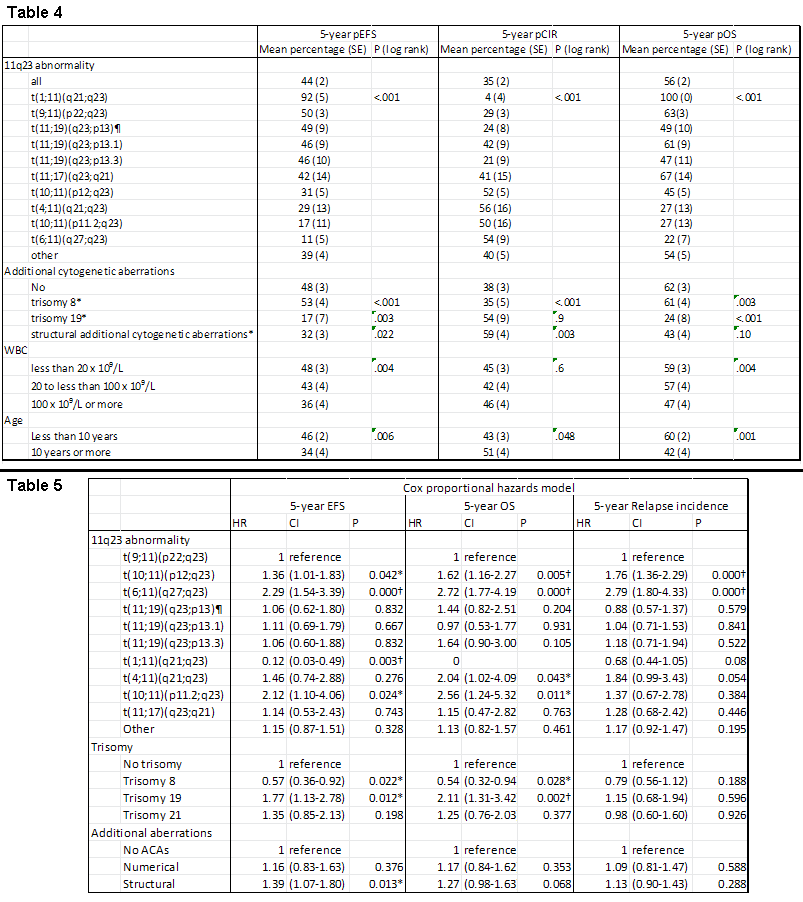
The presence of specific additional cytogenetic aberrations was significantly correlated with outcome. Patients with trisomy 19 and structural additional cytogenetic aberrations had a 5-year EFS of 17% and 32%, respectively, whereas patients with the most frequent specific additional aberration trisomy 8 had a 5-year EFS of 53%. (See Table 4 and Table 5).
Cytogenetics
Cytogenetics morphological
- The t(9;11)(p22;q23) is the most frequent 11q23/MLL abnormality in pediatric AML, occurring in approximately 50% of patients.
- The fusion gene resulting from this translocation involves MLL and AF9 (MLLT3).
- Additional cytogenetic aberrations have been detected by conventional karyotyping in approximately 47% of patients with t(9;11)(p22;q23). The most frequently recurring additional aberration is trisomy 8 (~24%).
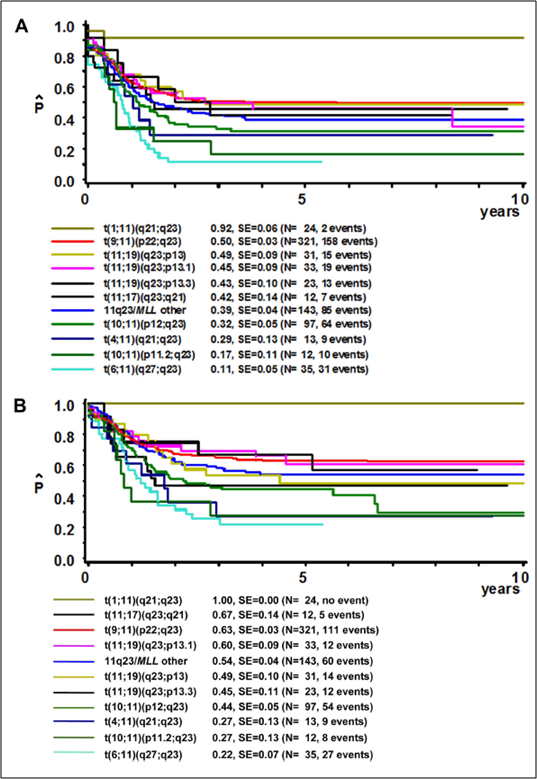
- There is no consensus on the outcome of patients with t(9;11). A 5-year EFS of 50% and a 5-year OS of 63% were reported in an international retrospective study. However, the Nordic countries (NOPHO) and St. Jude Childrens Research Hospital (St. Jude), Memphis, TN, USA, have reported that patients with t(9;11)(p22;q23) had better prognosis than patients with other translocation partners, with a 7-year EFS of 86% in the NOPHO-AML93 trial and a 5-year EFS of 65% in the 4 consecutive St. Jude trials (1980 to 1997).
- In some protocols, treatment of t(9;11)(p22;q23) is done according to low-risk stratification, but this approach is controversial.
t(10;11)(p12;q23)
- The t(10;11)(p12;q23) is the second most frequent 11q23/MLL abnormality in pediatric AML, accounting for approximately 13% of all cases of 11q23/MLL rearranged pediatric AML. However, this percentage is underestimated, because in many instances the generation of the fusion gene is cryptic or complex (see below). It is difficult to accurately establish the breakpoints of 10p in many translocations involving 10p and 11q23.
- The fusion gene resulting from this translocation involves MLL and AF10 (MLLT10).
- To generate an MLL-AF10 fusion, the translocation of chromosome 10 and chromosome 11 has to include at least one inversion. Most t(10;11)(p12;q23) cases are identified by conventional karyotyping, but structural aberrations can be very complex. These aberrations include insertions of 11q material onto the 10p arm and vice versa, some of which are also cryptic. In some instances, FISH using the subtelomeric probes for 10p and 11q can clarify the nature of the abnormality. RT-PCR is also a very useful method to detect the MLL-AF10 fusion transcript.
- In approximately 50% of the t(10;11)(p12;q23) cases, additional cytogenetic aberrations have been detected by conventional karyotyping. The most frequently recurring additional aberration is trisomy 8 (~7%); diverse structural additional aberrations have been detected (36%) and can affect other chromosomes.
- A 5-year EFS of 31% and a 5-year OS of 45% were reported in a large international retrospective study.
t(10;11)(p11.2;q23)
- The t(10;11)(p11.2;q23) is a rare 11q23/MLL abnormality mainly found in young children with AML. However, in the large retrospective study, 3 of 12 (25%) patients were older than 2 years.
- The fusion gene resulting from this translocation involves MLL and ABI1.
- In approximately 58% of t(10;11)(p11.2;q23) cases, additional cytogenetic aberrations have been detected by conventional karyotyping, all cases displaying at least one additional structural aberration.
- A 5-year EFS of 17% and a 5-year OS of 27% were reported in a large international retrospective study.
t(6;11)(q27;q23)
- The t(6;11)(q27;q23) occurs in approximately 5% of all pediatric patients with 11q23/MLL rearranged AML. However, this incidence is underestimated as the DNA exchanged in this translocation is very subtle and may go undetected or be misclassified as a del(11)(q23).
- The fusion gene resulting from this translocation involves MLL and AF6 (MLLT4). RT-PCR is also a very useful method to identify the MLL-AF6 fusion transcript.
- In approximately 46% of t(6;11)(q27;q23) cases, additional cytogenetic aberrations have been detected by conventional karyotyping. The most frequent recurring additional aberrations are trisomy 8 and trisomy 21 (~17% each) and additional structural aberrations (~26%).
- A 5-year EFS of 11% and a 5-year OS of 22% have been reported in a large international retrospective study; t(6;11)(q27;q23) thus represents the subgroup with the worst outcome in pediatric 11q23/MLL rearranged AML, but the reason for the very poor survival rate is unknown.
t(11;19)(q23;p13)
- Translocations of chromosome 11q23 with chromosome 19p13 occur in approximately 12% of pediatric patients with 11q23/MLL rearranged AML. Two common translocation partners are present on 19p13: ELL on 19p13.1 and ENL (MLLT1) on 19p13.3. In approximately 33% of pediatric AML cases, resolution of the karyotype can be insufficient to define the sub-band with certainty, and for this publication these patients are grouped as t(11;19)(q23;p13).
- A 5-year EFS for patients with a t(11;19)(q23;p13), t(11;19)(q23;p13.1), and t(11;19)(q23;p13.3) of 49%, 46% and 46% respectively, and a 5-year OS of 49%, 61% and 47%, respectively, have been reported in a large international retrospective study.
t(1;11)(q21;q23)
- The t(1;11)(q21;q23) occurs in approximately 3% of all pediatric patients with 11q23/MLL rearranged AML.
- The fusion gene resulting from this translocation involves MLL and AF1q (MLLT11).
- In approximately 25% of t(1;11)(q21;q23) cases, additional cytogenetic aberrations have been detected by conventional karyotyping, the most frequent being trisomy 6 (13%).
- A 5-year EFS of 92% and a 5-year OS of 100% have been reported in a large international retrospective study; t(1;11)(q21;q23) thus represents the subgroup with the best outcome in pediatric 11q23/MLL rearranged AML.
Cytogenetics molecular
As mentioned throughout, molecular cytogenetic methods have shown that the frequency of MLL gene rearrangements exceeds that of 11q23 translocations detected by conventional cytogenetic method alone. In AML cases in which aberrations affect the 11q23 band, a complementary FISH study should be done to determine whether a rearrangement of MLL is present, as in rare cases an 11q23 translocation may involve genes other than MLL. In AML patients with normal karyotypes or without an identified type II aberration [such as t(8;21), t(15;17) or inv(16)], FISH might identify a cryptic MLL rearrangement. Because the translocation partners for 11q23 are numerous and markedly heterogeneous, additional molecular methods may be needed to further assess the partner genes for MLL. RT-PCR is suitable to evaluate the most frequently observed MLL fusion transcripts, and, if positive, can also be useful for following the status of the patients minimal residual disease. In other cases, long-distance inverse PCR on genomic DNA can aid the finding of uncommon or novel translocation partners.
MLL-partial tandem duplication is a separate entity that can only be identified by PCR or other techniques, and is not discussed here.
Genetic lesions also occur frequently in 11q23/MLL rearranged pediatric AML. In approximately 43% of cases, a mutation in one of the RAS-pathway coding genes, FLT3 or KIT, has been identified.
Genes Involved and Proteins
Article Bibliography
| Pubmed ID | Last Year | Title | Authors |
|---|---|---|---|
| 11289128 | 2001 | Transplacental chemical exposure and risk of infant leukemia with MLL gene fusion. | Alexander FE et al |
| 21791472 | 2011 | Integrative analysis of type-I and type-II aberrations underscores the genetic heterogeneity of pediatric acute myeloid leukemia. | Balgobind BV et al |
| 20944671 | 2011 | Implementation of array based whole-genome high-resolution technologies confirms the absence of secondary copy-number alterations in MLL-AF4-positive infant ALL patients. | Bardini M et al |
| 19907438 | 2010 | DNA copy-number abnormalities do not occur in infant ALL with t(4;11)/MLL-AF4. | Bardini M et al |
| 7671224 | 1995 | Breakpoint heterogeneity in t(10;11) translocation in AML-M4/M5 resulting in fusion of AF10 and MLL is resolved by fluorescent in situ hybridization analysis. | Beverloo HB et al |
| 21551233 | 2011 | Prognostic significance of additional cytogenetic aberrations in 733 de novo pediatric 11q23/MLL-rearranged AML patients: results of an international study. | Coenen EA et al |
| 21968880 | 2012 | Favorable outcome in infants with AML after intensive first- and second-line treatment: an AML-BFM study group report. | Creutzig U et al |
| 8497319 | 1993 | In utero rearrangements in the trithorax-related oncogene in infant leukaemias. | Ford AM et al |
| 20385793 | 2010 | Refinement of cytogenetic classification in acute myeloid leukemia: determination of prognostic significance of rare recurring chromosomal abnormalities among 5876 younger adult patients treated in the United Kingdom Medical Research Council trials. | Grimwade D et al |
| 20439644 | 2010 | Cytogenetics of childhood acute myeloid leukemia: United Kingdom Medical Research Council Treatment trials AML 10 and 12. | Harrison CJ et al |
| 12886258 | 2003 | Cryptic rearrangement involving MLL and AF10 occurring in utero. | Jones LK et al |
| 21933851 | 2012 | The role of matched sibling donor allogeneic stem cell transplantation in pediatric high-risk acute myeloid leukemia: results from the AML-BFM 98 study. | Klusmann JH et al |
| 12846889 | 2003 | Treatment stratification based on initial in vivo response in acute myeloid leukaemia in children without Down's syndrome: results of NOPHO-AML trials. | Lie SO et al |
| 19262598 | 2009 | New insights to the MLL recombinome of acute leukemias. | Meyer C et al |
| 19277576 | 2009 | LDI-PCR: identification of known and unknown gene fusions of the human MLL gene. | Meyer C et al |
| 11981001 | 2002 | Favorable impact of the t(9;11) in childhood acute myeloid leukemia. | Rubnitz JE et al |
| 20439630 | 2010 | Prognostic impact of specific chromosomal aberrations in a large group of pediatric patients with acute myeloid leukemia treated uniformly according to trial AML-BFM 98. | von Neuhoff C et al |
Summary
Note
Citation
Eva A Coenen ; Jochen Harbott ; Christian Michel Zwaan ; Susana C Raimondi ; Mary M van den Heuvel-Eibrink
11q23 rearrangements (KMT2A) in de novo childhood acute myeloid leukemia
Atlas Genet Cytogenet Oncol Haematol. 2012-03-01
Online version: http://atlasgeneticsoncology.org/haematological/1615/11q23-rearrangements-(kmt2a)-in-de-novo-childhood-acute-myeloid-leukemia
