Polyclonal B Lymphocytosis with Binucleated Lymphocytes (PPBL)
2004-06-01 Hossein Mossafa , Xavier Troussard Affiliation1.Laboratoire d Hématologie, CHU de Caen, 14 000 Caen, France
2.Laboratoire dHématologie, CHU de Caen, 14 000 Caen, France
Clinics and Pathology
Phenotype stem cell origin
Unknown. The polyclonal expansion of B-cells fit into the peripheral CD27+IgM+IgD+ B cell population. Cloning and sequencing of VH genes of PPBL IgVH genes showed a mutated profile suggesting like CD27 expression an expansion of memory B cells.
Etiology
The etiology of polyclonal B lymphocytosis with binucleated lymphocytes (PPBL) remains unknown. An association with cigarette smoking was initially suggested. However PPBL was observed in non smokers patients. The morphology of binucleated lymphoid B-cells could suggest an association with viral infections, such as Epstein-Barr Virus. Biologic studies are not completely achieved to exclude and/or to confirm definitely the role of EBV in the pathogenesis of PPBL. The presence of characteristic binucleated lymphoid B-cells in asymptomatic family members and the description of familial PPBL cases suggest a genetic predisposition as a more likely possibility.
Epidemiology
PPBL was first reported in 1982. We have no epidemiological data on the incidence of PPBL.
Clinics
In a large series we reported on forty-three patients (9 males, 34 females: median age: 40 years, range 28-65), the clinical characteristics were splenomegaly in 16%, hepatomegaly in 0.5% and lymph nodes in 11.5% cases. An absolute lymphocytosis > 4 x 10⁹/l is present in 80% of PPBL patients. A persistent, stable and polyclonal increase of IgM levels is usual and most PPBL patients express HLA-DR7. CYTOLOGY_IMAGE lymphocytosisFig1.jpg
Morphologic features showing typical binucleated cells
Cytology
PPBL is identified in all cases by the presence of a variable (1.5 to 9%) number of binucleated peripheral lymphoid cells (Fig 1). The majority of lymphoid cells are large with abundant faintly and basophilic cytoplasm. Characteristic nuclei with a rounded or more commonly irregular form are observed.
Immunologic markers: Both kappa and lambda light-chain are expressed, indicating a polyclonal expansion of the lymphocyte pool. The lymphocytosis is of the B-cell type: the lymphocytes react with CD19, CD20, CD22 and FMC7 antigens.
Immunologic markers: Both kappa and lambda light-chain are expressed, indicating a polyclonal expansion of the lymphocyte pool. The lymphocytosis is of the B-cell type: the lymphocytes react with CD19, CD20, CD22 and FMC7 antigens.
Prognosis
After a median follow-up of 5.5 years without treatment, 45 PPBL patients are alive.
Cytogenetics
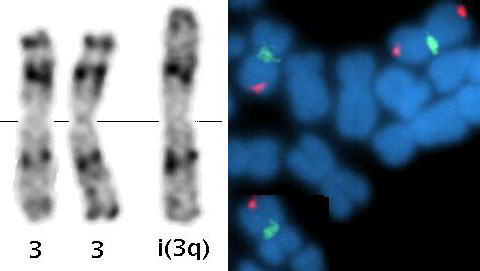
Partial karyotype showing +i(3q) -R-banding (left); Detection of I(3q) with telomere chromosome 3q and alpha satellite specific DNA probes (right)
Cytogenetics morphological
+i(3q) (Fig 2) is the most common abnormality and is observed in 70% cases, occurring as a single aberration in only a few patients. PCC (Fig 3) is observed in 40% cases and occur rarely as a sole abnormality. Both abnormalities associating +i(3q) and PCC are present in 37% cases.
Using alpha-satellite and telomere chromosome 3 specific probes, +i(3q) is more frequently detected by metaphase FISH studies. (Fig 2).
+i(3q) is rarely described as a recurrent cytogenetic abnormality in patients with hematologic malignancy. Trisomy 3 is reported to be associated with marginal zone B-cell lymphoma. Gain of chromosome 3 or 3q was described in patients with typical clonal b-cell chronic lymphoproliferative disorders, chronic lymphocytic leukemia, prolymphocytic leukemia or Waldenström macroglobulinemia.
A chromosomal instability is present in 67.5% patients These patients present various clonal [ del(6q), +der(8) or +8 or polyploid karyotype] and non clonal chromosomal abnormalities with structural and numerical abnormalities.
This chromosomal instability is variable over time but persist in most cases. In spite of genomic instability, a long follow-up of PPBL patients remains essential and chemotherapy unnecessary.
Using alpha-satellite and telomere chromosome 3 specific probes, +i(3q) is more frequently detected by metaphase FISH studies. (Fig 2).
+i(3q) is rarely described as a recurrent cytogenetic abnormality in patients with hematologic malignancy. Trisomy 3 is reported to be associated with marginal zone B-cell lymphoma. Gain of chromosome 3 or 3q was described in patients with typical clonal b-cell chronic lymphoproliferative disorders, chronic lymphocytic leukemia, prolymphocytic leukemia or Waldenström macroglobulinemia.
A chromosomal instability is present in 67.5% patients These patients present various clonal [ del(6q), +der(8) or +8 or polyploid karyotype] and non clonal chromosomal abnormalities with structural and numerical abnormalities.
This chromosomal instability is variable over time but persist in most cases. In spite of genomic instability, a long follow-up of PPBL patients remains essential and chemotherapy unnecessary.
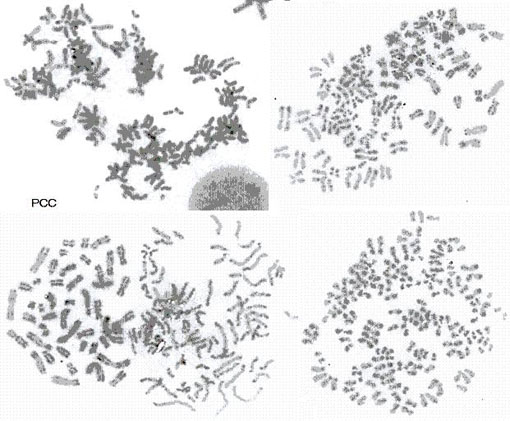
Premature Chromosome Condensation (PCC)
Genes Involved and Proteins
Article Bibliography
| Pubmed ID | Last Year | Title | Authors |
|---|---|---|---|
| 6979709 | 1982 | Persistent polyclonal lymphocytosis of B lymphocytes. | Gordon DS et al |
| 11529864 | 2001 | Persistent polyclonal B-cell lymphocytosis is an expansion of functional IgD(+)CD27(+) memory B cells. | Himmelmann A et al |
| 12516560 | 2002 | Analysis of expressed V(H) genes in persistent polyclonal B cell lymphocytosis reveals absence of selection in CD27+IgM+IgD+ memory B cells. | Loembé MM et al |
| 15359640 | 2004 | Chromosomal instability and ATR amplification gene in patients with persistent and polyclonal B-cell lymphocytosis (PPBL). | Mossafa H et al |
| 7803270 | 1994 | Persistent polyclonal lymphocytosis with binucleated B lymphocytes: a genetic predisposition. | Troussard X et al |
Citation
Hossein Mossafa ; Xavier Troussard
Polyclonal B Lymphocytosis with Binucleated Lymphocytes (PPBL)
Atlas Genet Cytogenet Oncol Haematol. 2004-06-01
Online version: http://atlasgeneticsoncology.org/haematological/2037/polyclonal-b-lymphocytosis-with-binucleated-lymphocytes-(ppbl)
