del(13q) in myeloid malignancies
2001-09-01 Jacques Boyer Affiliation1.Laboratoire d hématologie, CH du MANS, France
Clinics and Pathology
Disease
Chronic myeloid leukemia (CML)
Epidemiology
Deletion of 13q is sometimes found in accelerated phase of the CML disease
CML patients with persistent or relapsed disease following bone-marrow transplantation usually show clonal cytogenetic changes in addition to the translocation t(9;22); in a series of 22 patients with more than 50% philadelphia positive-metaphases, chromosome 13 was involved in 55% of the cases.The chomosome 13 rearrangements comprise both translocations and deletions, a common region of deletion is identified at 13q12-14. The t(12;13) as the sole additional abnormality in CML cases with myeloid blast crisis seems to be directly related to progression of the disease. , Idiopathic myelofibrosis (agnogenic myeloid metaplasia: MM): In a report of 47 cases where 15 cases have had clonal abnormalities (32%), interstitial 13q deletion occurred in three cases (6%). Molecular deletions of 13q14 is detected in a relatively large fraction of BCR/ABL negative myeloproliferative disorders and appear to be more frequent in myeloid metaplasia (MM).
CML patients with persistent or relapsed disease following bone-marrow transplantation usually show clonal cytogenetic changes in addition to the translocation t(9;22); in a series of 22 patients with more than 50% philadelphia positive-metaphases, chromosome 13 was involved in 55% of the cases.The chomosome 13 rearrangements comprise both translocations and deletions, a common region of deletion is identified at 13q12-14. The t(12;13) as the sole additional abnormality in CML cases with myeloid blast crisis seems to be directly related to progression of the disease. ,
Disease
other chronic myeloproliferative diseases (MPD): polycytemia vera (PV), and idiopathic myelofibrosis
Epidemiology
Disease
Myelodysplastic syndromes (MDS)
Epidemiology
Deletion 13q is found in about 2% of cases or less.
Disease
Acute myeloid leukemia (AML)
Epidemiology
Structural abnormalities of the RB gene (at 13q14) with absent protein expression is frequent in all types of human acute leukemia but are particularly common (between 20 and 55 % in several studies) in AML with monocytic differentiation (M4 and M5). The differences in the frequency of attainment of complete remission or lenght of survival observed between patients with normal and abnormal RB expression is controversial but the majority of published sudies found low RB expression to be a negative prognostic predictor.
Disease
Therapy-related myelodysplasia and leukemia (t-MDS and t-AML)
Epidemiology
In a series of 137 cases of t-MDS or t-AML, deletion of the long arm of chromosome 13 involving band q14 is oberved in three patients as single clonal abnormality (2%) and as part of a complexe karyotype in four patients (3%).All seven patients have previously been treated by alkylating agents.
Cytogenetics
Cytogenetics morphological
Cytogenetics molecular
Results of FISH studies show the absence of hybridation signal of the applied probes for 13q13.3-13q14.3
The data indicate the presence of two distinct breakpoint cluster regions : centromeric of RB1 in myeloid malignancies and distal to RB1 in some lymphoid B-cell and T-cell malignancies.
The smallest deleted region common of all myeloid cases repoted correspond to YAC 937C7, the RB1 gene and the YAC 745E3.
The data indicate the presence of two distinct breakpoint cluster regions : centromeric of RB1 in myeloid malignancies and distal to RB1 in some lymphoid B-cell and T-cell malignancies.
The smallest deleted region common of all myeloid cases repoted correspond to YAC 937C7, the RB1 gene and the YAC 745E3.
Additional anomalies
Anomaly of 13q is either the sole abnormality in half cases or as part of a complexe karyotype with trisomy 8, del(5q).
Genes Involved and Proteins
Note
In AML, the RB gene (see below) is not transcribed, whereas it is most often normally transcribed in myelodysplasic syndromes. Southern blot analysis of the RB gene detects no gross gene rearrangements but several restriction enzyme polymorphisms are observed. By western blot analysis, about 20% of patients have no detectable pRb protein and about 10% have truncated pRb bands. Discordance betveen the DNA and protein suggests that there may be minor deletions and point mutations in the RB gene or abnormalities in the expression of the pRb protein at the post-transcriptional level.
Gene name
RB1 (retinoblastoma)
Location
13q14.2
Note
The retinoblastoma gene, RB, is a prototype tumor-suppressor gene
Dna rna description
The RB-gene is divided into at least 27 exons distributed over 180 kb. Transcription : 4,7 kb mRNA, 2,7 kb open reading frame, 2 kb 3-UTR
Protein description
The retinoblastoma protein pRb is a nuclear 110-KD phosphoprotein whose function is closely related to cell-cycle control. The activity of pRb depends on its degree of phosphorylation. The hypophosphorylated form of pRb maintains cell in quiescence by its ability to bind to transcription factors of the E2F family, whereas during the G1-S phase the hyperphosphorylated form of pRb does not bind the E2F factor who becoms active and whose target genes encode proteins (c-myc, dihydrofolate reductase, thymidine kinase, and DNA polymerase alpha, cdk kinases) necessary for progression of the cell cycle from G1 to S-phase. The protein pRb is also involved in the process of cell differentiation (high levels of RB mRNA are found during erythroid differentiation)
Article Bibliography
| Pubmed ID | Last Year | Title | Authors |
|---|---|---|---|
| 8931999 | 1996 | Cytogenetic analysis in patients with primary myelodysplastic syndromes in leukaemic transformation. A report on 94 cases. Groupe Français de Cytogénétique Hématologique (GFCH). | |
| 1683797 | 1991 | Abnormalities of the retinoblastoma gene in the pathogenesis of acute leukemia. | Ahuja HG et al |
| 10953980 | 2000 | Alterations of P53 and RB genes and the evolution of the accelerated phase of chronic myeloid leukemia. | Beck Z et al |
| 10679917 | 2000 | Non-random involvement of chromosome 13 in patients with persistent or relapsed disease after bone-marrow transplantation for chronic myeloid leukemia. | Chase A et al |
| 10379868 | 1999 | Myeloid- and lymphoid-specific breakpoint cluster regions in chromosome band 13q14 in acute leukemia. | Coignet LJ et al |
| 3416075 | 1988 | Cytogenetic studies and their prognostic significance in agnogenic myeloid metaplasia: a report on 47 cases. | Demory JL et al |
| 8348078 | 1993 | Progression of essential thrombocythemia to blastic crisis via idiopathic myelofibrosis. | Emilia G et al |
| 1732669 | 1992 | Cytogenetic findings in primary and secondary MDS. | Heim S et al |
| 8759895 | 1996 | The retinoblastoma gene (rb1) in acute myeloid leukaemia: analysis of gene rearrangements, protein expression and comparison of disease outcome. | Jamal R et al |
| 9614909 | 1998 | Detection of RB1 deletions by fluorescence in situ hybridization in malignant hematologic disorders. | Juneau AL et al |
| 10706451 | 1999 | Altered expression of retinoblastoma (RB) protein in acute myelogenous leukemia does not result from methylation of the Rb promotor. | Kornblau SM et al |
| 9414289 | 1998 | Molecular delineation of 13q deletion boundaries in 20 patients with myeloid malignancies. | La Starza R et al |
| 8527391 | 1995 | Genetic analysis of chromosome 13 deletions in BCR/ABL negative chronic myeloproliferative disorders. | Pastore C et al |
| 7579462 | 1995 | Different genetic pathways in leukemogenesis for patients presenting with therapy-related myelodysplasia and therapy-related acute myeloid leukemia. | Pedersen-Bjergaard J et al |
| 9517499 | 1998 | Expression of the retinoblastoma tumor suppressor gene (RB-1) in acute leukemia. | Sauerbrey A et al |
| 2790773 | 1989 | Cytogenetic analysis in essential thrombocythemia at diagnosis and at transformation. A 12-year study. | Sessarego M et al |
| 10867153 | 2000 | Polysomy 13 with concomitant deletion of 13q13-14 involving the retinoblastoma gene and the D13S25 locus in a case of acute myeloid leukemia. | Stefanova M et al |
| 2717184 | 1989 | Genomic organization of the human retinoblastoma gene. | T'Ang A et al |
| 10482987 | 1999 | Frequent allelic loss of the RB, D13S319 and D13S25 locus in myeloid malignancies with deletion/translocation at 13q14 of chromosome 13, but not in lymphoid malignancies. | Tanaka K et al |
Summary
Note
Chromosomal deletions are among the most common genetic events observed in hematologic malignancies; loss of genetic materiel is regarded as a hallmark of putative tumor suppressor gene localization.
Deletions 13q occurs in lymphoid neoplasias : see del(13q) in non-Hodgkins lymphoma and del(13q) in chronic lymphoproliferative diseases. In myeloid disorders, the most frequently reported deletions affect chromosomes 5, 7 and 20 ( del(5q) , del(7q) , and del(20q) , but deletion of chromosome 13 is another relatively common aberration.
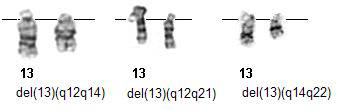
del(13q) G- banding - Courtesy Diane H. Norback, Eric B. Johnson, Sara Morrison-Delap UW Cytogenetic Services
Citation
Jacques Boyer
del(13q) in myeloid malignancies
Atlas Genet Cytogenet Oncol Haematol. 2001-09-01
Online version: http://atlasgeneticsoncology.org/haematological/1096/del(13q)-in-myeloid-malignancies
