Clinics and Pathology
Disease
a very large spectrum of hematological malignancies as myelodysplastic syndromes (MDS), acute myeloid leukemias (AML), polycythemia vera, chronic neutrophilic leukemia
Phenotype stem cell origin
as described in various types of hematological disorders, 20q- appears as a primary karyotypic abnormality occurring in a pluripotential hematopoietic stem cell; the pathogenic mechanism by which 20q- alters the hematopoietic stem cells in hematological disorders remains unknown; 20q- may confer a proliferative advantage to myeloid cells through deletion of a tumor suppressor gene
Epidemiology
an interstitial or terminal deletion of the long arm of chromosome 20 (20q-) has been described as the second most frequent sole clonal structural abnormality (5 %) behind t(9.22)
Prognosis
Cytogenetics
Cytogenetics morphological
the breakpoint on chromosome 20 is not constant; 20q- is frequently associated with other cytogenetic abnormalities as del(5q), trisomy 8, trisomy 21, deletions or translocations involving the long arm of chromosome 13; a newly described translocation t(11;20)(p15;q11) resulting in a NUP98- TOP1 fusion gene was described in therapy-related myelodysplastic syndrome (RAEB); t(11;20)(p15;q11) is a rare recurrent translocation reported in patients with MDS, AML and polycythemia vera
Cytogenetics molecular
a small fragment (around 8 Mb), proximally flanked by D20S206 and distally by D20S119 and UT 654 was identified using FISH
Additional anomalies
Genes Involved and Proteins
Note
genes remaining within this deleted region are topoisomerase 1 (TOP1-OMIN 126420), phospholipase C (PLC1), hepatocyte factor nuclear 4 (HNF4) and adenosine desaminase (ADA); recently, a new gene KRML transcriptional regulator was mapped in the smallest commonly deleted region in malignant myeloid leukemias
Article Bibliography
| Pubmed ID | Last Year | Title | Authors |
|---|---|---|---|
| 10556215 | 1999 | The t(11;20)(p15;q11) chromosomal translocation associated with therapy-related myelodysplastic syndrome results in an NUP98-TOP1 fusion. | Ahuja HG et al |
| 8289501 | 1994 | The prognostic significance of deletion of the long arm of chromosome 20 in myeloid disorders. | Campbell LJ et al |
| 9058730 | 1997 | International scoring system for evaluating prognosis in myelodysplastic syndromes. | Greenberg P et al |
| 8929482 | 1996 | Hematologic disorders associated with deletions of chromosome 20q: a clinicopathologic study of 107 patients. | Kurtin PJ et al |
| 10444328 | 1999 | Human KRML (MAFB): cDNA cloning, genomic structure, and evaluation as a candidate tumor suppressor gene in myeloid leukemias. | Wang PW et al |
| 9491317 | 1998 | Refinement of the commonly deleted segment in myeloid leukemias with a del(20q). | Wang PW et al |
Summary
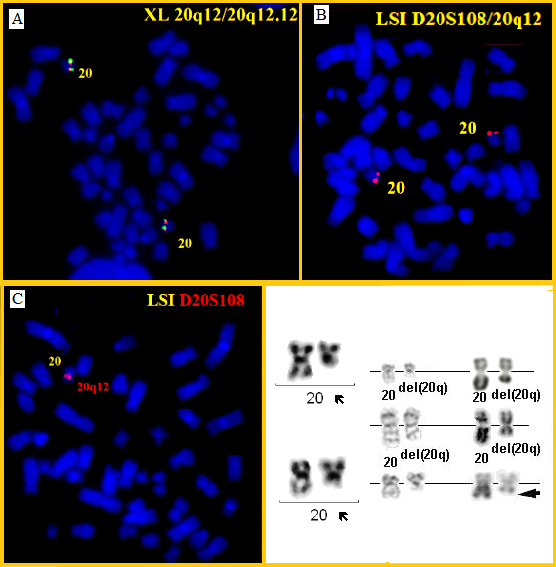
del(20q) Fluorescence in situ hybridization using XL del(20q) probe (Metasystems, Germany) and Vysis LSI D20S108/20q12 probe showing 2 signals on normal A,B) and 1 signal on metaphase with deletion of 20q12 and/or 20qter (red signal) u2013 Courtesy Adriana Zamecnikova. Partial karyotypes with 20q deletions (D): G- banding Left: u2013 Courtesy Adriana Zamecnikova; Center- Courtesy Diane H. Norback, Eric B. Johnson, Sara Morrison-Delap UW Cytogenetic Services; Right: R-banding - Courtesy Hossein Mossafa (top), Jean-Luc Lai (middle), (bottom) Jean Loup Huret.
Citation
Chrystè Bilhou-Nabera
del(20q) in myeloid malignancies
Atlas Genet Cytogenet Oncol Haematol. 2000-12-01
Online version: http://atlasgeneticsoncology.org/haematological/1040/del(20q)-in-myeloid-malignancies
