Clinics and Pathology
Disease
T-ALL
Epidemiology
5-10% of childhood T-ALL
Cytogenetics
Additional anomalies
+17; to be noted that a Ph chromosome (m-BCR) has been found in one case of T-ALL
Variants
t(11;14)(p13;q11) and t(7;11)(q35;p13) are variant translocations of each other
Genes Involved and Proteins
Gene name
LMO2 (LIM domain only 2 (rhombotin-like 1))
Location
11p13
Protein description
cystein-rich protein with two tandemly arranged zinc binding LIM-domain motifs: named Lom2; Lmo2 directly interacts with the basic-loop-helix protein Tal1/Scl and the GATA DNA protein Gata-1; central role in adult hematopoietic pathway regulation.
Gene name
TRA (T cell Receptor Alpha)
Location
14q11.2
Gene name
TRB (T cell Receptor Beta)
Location
7q34
Result of the Chromosomal Anomaly
Description
chromosomal breakpoints occur 25 Kb upstream RBTN2 gene, in a presumed transcriptional start site, inducing truncation of the promoter/control region and leading to inappropriate Lmo2 level especially in T-cells (abnormal T-cell differentiation).
Oncogenesis
Lmo2 is activated after chromosomal translocation by association with either the TRA/D or the TRB.
Article Bibliography
| Pubmed ID | Last Year | Title | Authors |
|---|---|---|---|
| 2034676 | 1991 | The rhombotin family of cysteine-rich LIM-domain oncogenes: distinct members are involved in T-cell translocations to human chromosomes 11p15 and 11p13. | Boehm T et al |
| 8639417 | 1996 | Expression of rhombotin 2 in normal and leukaemic haemopoietic cells. | Dong WF et al |
| 3258538 | 1988 | T-cell acute childhood lymphoblastic leukemia with chromosome 14 q 11 anomaly: a morphologic, immunologic, and cytogenetic analysis of 10 patients. | Lampert F et al |
| 3263151 | 1988 | Cytogenetics of childhood T-cell leukemia. | Raimondi SC et al |
| 9214632 | 1997 | The LIM-only protein Lmo2 is a bridging molecule assembling an erythroid, DNA-binding complex which includes the TAL1, E47, GATA-1 and Ldb1/NLI proteins. | Wadman IA et al |
| 6607116 | 1984 | New chromosomal translocations correlate with specific immunophenotypes of childhood acute lymphoblastic leukemia. | Williams DL et al |
Summary
Note
this t(11;14) must be not confused with the t(11;14)(p15;q11) associated with an immature immunophenotype (CD3-, CD4-, CD8-) and involving respectively RTBN1 gene and TRD locus.
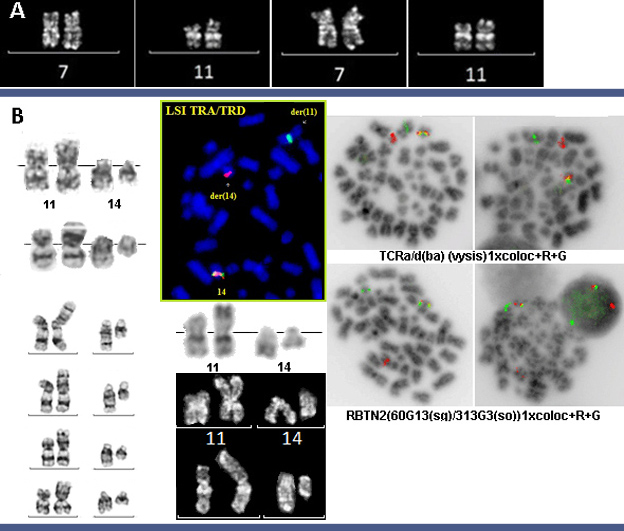
t(7;11)(q35;p13) TRB/LMO2 and t(11;14)(p13;q11) TRD/LMO2 A- t(7;11)(q35;p13) TRB/LMO2, R-banded karyotype, Courtesy Karolien Beel, Peter Meeus and Lucienne Michaux B- t(11;14)(p13;q11) left: G- banding; top - Courtesy Diane H. Norback, Eric B. Johnson, Sara Morrison-Delap UW Cytogenetic Services; middle top - Courtesy Jean-Luc Lai and Alain Vanderhaegen; bottom four - Courtesy Ian Brooks and Jackie Challis, Oncology Cytogenetics, Victorian Clinical Genetics Services, Australia; center left: FISH: Hybridization with Vysis TRA/D Break Apart probe (Abbott Molecular, US) showing rearrangement of the gene on 14q11.2 as a result of t(11;14)(p13;q11) (green signal on der(11) chromosome) - Courtesy Adriana Zamecnikova. R- banding; top - Courtesy Jean-Luc Lai and Alain Vanderhaegen; middle and bottom: - Courtesy Lucienne Michaux, Peter Meeus and Peter Vandenberghe; right: FISH - Courtesy Lucienne Michaux, Peter Meeus and Peter Vandenberghe.
Citation
Chrystele Bilhou-Nabera
t(11;14)(p13;q11) TRD/LMO2
t(7;11)(q35;p13) TRB/LMO2
Atlas Genet Cytogenet Oncol Haematol. 1998-09-01
Online version: http://atlasgeneticsoncology.org/haematological/1070/t(11;14)(p13;q11)-trd-lmo2-br-t(7;11)(q35;p13)-trb-lmo2
