t(11;16)(q23;p13.3) KMT2A/CREBBP
2009-03-01 Elise Labis Affiliation1.Laboratory of Medical Genetics, Hospital Jeanne de Flandre, University Hospital Regional Center-CHRU, Avenue Eugène Avinée, 59037 Lille cedex, France
Clinics and Pathology
Disease
Treatment-related myelodysplastic syndrome (t-MDS) or treatment-related acute leukaemia, usually myeloblastic (t-AML), less often lymphoblastic (t-ALL).
Two case reports describe a de novo leukaemia with t(11;16)(q23;p13.3): an AML-M4 (Glassman et al., 2003) and an infant ALL, which switch into AML with retention of the translocation (Stasik et al., 2006).
Two case reports describe a de novo leukaemia with t(11;16)(q23;p13.3): an AML-M4 (Glassman et al., 2003) and an infant ALL, which switch into AML with retention of the translocation (Stasik et al., 2006).
Phenotype stem cell origin
Variable phenotypes: most often LAM4 in t-AML (but also LAM5a and LAM2); chronic myelomonocytic leukaemia (CMMoL) in t-MDS.
Etiology
Chemotherapy for other primary malignancies (including leukaemia, lymphoma and solid tumors) using topoisomerase II inhibitors (epipodophyllotoxins or anthracyclins).
Epidemiology
Rare translocation (about twenty cases described), found at any age, from infancy to elder age.
Prognosis
Poor, as in other therapy-related leukaemia.
Cytogenetics
Cytogenetics morphological
Can be seen with G-banding: chromosome 11 appears shortened, chromosome 16 enlarged (11q- and 16p+).
Cytogenetics molecular
FISH may be needed.
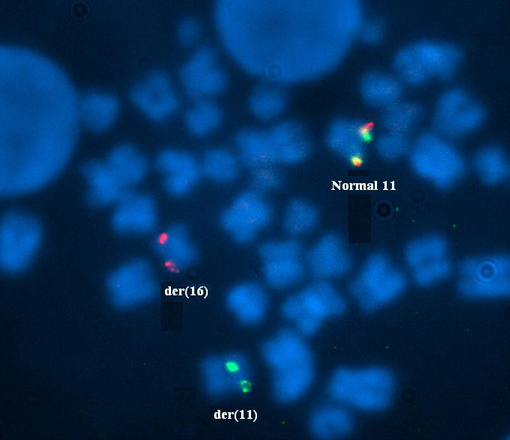
Fish studies using a commercially available MLL break-apart probe (Vysis® LSI® MLL Dual Color). The derivative 11 shows a single green signal indicating rearrangement of the MLL locus. The derivative 16 has the translocated portion of the MLL indicated by a single red signal.
Additional anomalies
In half cases about, no recurrent additional cytogenetic anomalies.
Genes Involved and Proteins
Gene name
KMT2A (myeloid/lymphoid or mixed lineage leukemia)
Location
11q23.3
Dna rna description
37 exons, spanning over 100 kb.
Protein description
MLL is a "multipartner" gene involved in multiple rearrangements: the most frequent partners are AF4 in 4q21, AF6 in 6q27, AF9 in 9p22, ELL in 19p13.1 and ENL in 19p13.3.
MLL is a major regulator of hematopoesis and embryonic development, through HOX genes expression regulation. MLL binds to promotors of HOX genes such as Hoxa7 and Hoxa9 (proteins which regulate hematopoiesis and are normally expressed only in early hematopoietic progenitors) through acetylation and methylation of histones.
MLL is a major regulator of hematopoesis and embryonic development, through HOX genes expression regulation. MLL binds to promotors of HOX genes such as Hoxa7 and Hoxa9 (proteins which regulate hematopoiesis and are normally expressed only in early hematopoietic progenitors) through acetylation and methylation of histones.
Gene name
CREBBP (CREB binding protein)
Location
16p13.3
Dna rna description
About 154 kb, 32 exons.
Protein description
It is a transcriptional coactivator involved in coordonating signal from many sequence-specific activators to modulate transcription and/or cell cycle progression. It has endogenous histone acetyltransferase activity and may contribute to transcriptional regulation via targeted acetylation of chromatin.
Result of the Chromosomal Anomaly
Transcript
5 MLL - 3 CBP on the der(11) and 5 CBP - 3 MLL on the der(16).
Variable breakpoints: In MLL, almost all of the breakpoints occurs in an 8.3-kb fragment known as the breakpoint cluster region (BCR), encompassing exons 8-14. In CBP, the genomic breakpoints clustered in an 8.2-kb region of intron 3 (BCR 8.2kb), which is different of the breakpoints in CBP for patients with t(8;16) clustered in a 2.3-kb region in intron 2 (BCR 2.3kb).
Variable breakpoints: In MLL, almost all of the breakpoints occurs in an 8.3-kb fragment known as the breakpoint cluster region (BCR), encompassing exons 8-14. In CBP, the genomic breakpoints clustered in an 8.2-kb region of intron 3 (BCR 8.2kb), which is different of the breakpoints in CBP for patients with t(8;16) clustered in a 2.3-kb region in intron 2 (BCR 2.3kb).
Description
N-Term from MLL (containing the AT-hooks and repression domain) fused to the C-Term of CBP (almost always including the CREB binding domain, bromodomain, histone acetyltransferase domain).
Highly cited references
| Pubmed ID | Year | Title | Citations |
|---|---|---|---|
| 32006151 | 2020 | t(11;16)(q23;p13)/KMT2A-CREBBP in hematologic malignancies: presumptive evidence of myelodysplasia or therapy-related neoplasm? | 0 |
Article Bibliography
| Pubmed ID | Last Year | Title | Authors |
|---|---|---|---|
| 12956443 | 2003 | Translocation (11;16)(q23;p13) acute myelogenous leukemia and myelodysplastic syndrome. | Glassman AB et al |
| 9226152 | 1997 | All patients with the T(11;16)(q23;p13.3) that involves MLL and CBP have treatment-related hematologic disorders. | Rowley JD et al |
| 16843104 | 2006 | Infant acute lymphoblastic leukemia with t(11;16)(q23;p13.3) and lineage switch into acute monoblastic leukemia. | Stasik C et al |
| 15334549 | 2004 | Characterization of genomic breakpoints in MLL and CBP in leukemia patients with t(11;16). | Zhang Y et al |
Summary
Fusion gene
KMT2A/CREBBP KMT2A (11q23.3) CREBBP (16p13.3) COF 1874 1875 1876 2093 2095 2097 2098 2109 2110 2116 2117|KMT2A/CREBBP KMT2A (11q23.3) CREBBP (16p13.3) TIC
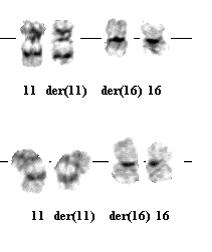
t(11;16)(q23;p13.3) G-banding.
Citation
Elise Labis
t(11;16)(q23;p13.3) KMT2A/CREBBP
Atlas Genet Cytogenet Oncol Haematol. 2009-03-01
Online version: http://atlasgeneticsoncology.org/haematological/1120/t(11;16)(q23;p13-3)-kmt2a-crebbp
