t(14;19)(q32;q13) IGH/CEBPA
2008-05-01 Jean-Loup Huret Affiliation1.Genetics, Dept Medical Information, University of Poitiers; CHU Poitiers Hospital, F-86021 Poitiers, France
2.Leukaemia Research Fund Cytogenetics Group, Cancer Sciences Division, University of Southampton, MP 822, Duthie Building, Southampton General Hospital, Southampton, SO16 6YD, UK
Clinics and Pathology
Disease
Acute lymphoblastic leukaemia (ALL)
Phenotype stem cell origin
B-lineage immunophenotype and FAB L1, mostly CD10+ : B-cell precursor acute lymphoblastic leukemia (BCP-ALL).
Epidemiology
Rare, with only 28 cases reported to date (Heerema et al., 1985; Prigogina et al., 1988; Pui et al., 1993; Andreasson et al., 2000; Robinson et al., 2004; Chapiro et al., 2006; Akasaka et al., 2007). The estimated incidence in childhood and adult ALL is
Clinics
Typically, patients with this abnormality have low white cell count of
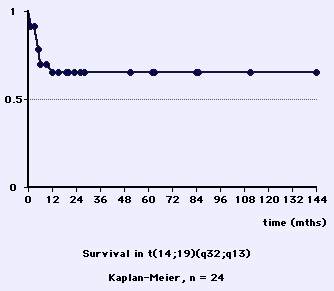
Prognosis
It is difficult to assess the true prognosis of patients with this abnormality given its rarity, however initial data suggest that the prognosis is better than expected for patients of a similar age (see Figure 2).
Cytogenetics
Note
This balanced translocation can usually be identified by G-banding alone. The breakpoint on chromosome 14 is consistently given as 14q32; however the breakpoint on chromosome 19 has, in the past, been more variably attributed, from q11 to q13. It is to be noted, however, that the gene involved on chromosome 19, CEBPA, lies at 38,482,776 bp from pter, very close to the q12 band limit.
Cytogenetics morphological
The t(14;19) has been described as the sole abnormality in 12 out of 28 cases, and is more frequently accompanied by additional structural and/or numerical abnormalities; +21 (acquired) was found in three cases, +6 in two cases. A t(9;22)(q34;q11) was found in one case, a trisomy 8 in one case.
This abnormality has been reported in a single case with Down syndrome. In a closely related translocation, the t(8;14)(q11;q32) with CEBPD/IGH involvement, more than 1/4 of cases were Down syndrome patients.
This abnormality has been reported in a single case with Down syndrome. In a closely related translocation, the t(8;14)(q11;q32) with CEBPD/IGH involvement, more than 1/4 of cases were Down syndrome patients.
Genes Involved and Proteins
Note
The involvement of the IGH gene located at 14q32 has been demonstrated via FISH using the LSI IGH Dual Colour Break Apart Rearrangement Probe in all cases tested. Metaphase and interphase FISH using probes flanking the BCL3 gene have ruled out the involved of this gene; thus distinguishing it from the cytogenetically identical translocation t(14;19)(q32;q13) seen in CLL and other chronic B-cell lymphoproliferative disorders.
Gene name
IGH (Immunoglobulin Heavy)
Location
14q32.33
Gene name
CEBPA (CCAAT/enhancer binding protein (C/EBP), alpha)
Location
19q13.1
Note
Alternatively, CEBPG can be involved instead of CEBPA (one case so far described). It is unknown if they bear the same prognosis, as they differ in their N-term.
Dna rna description
CEBPA is a single-exon gene, CEBPG also.
Protein description
DNA-binding protein. CCAAT enhancer-binding protein (CEBP) transcription factors are a family of 6 multifunctional basic leucine zipper (bZIP) transcription factors. The 4 other CEBPs are: CEBPB (20q13), CEBPD (8q11), CEBPE (8q11), all three equally implicated in leukemias, and DDIT3/CHOP/CEBP zeta (12q13), so far known to be involved in solid tumours (liposarcoma). These transcription factors play a key role in cellular differentiation, in particular in the control of myeloid differentiation. CEBPA is composed of a N-term transactivation domain, a negative regulatory domain, a DNA-binding basic motif, and a leucine-zipper domain in C-term. CEBPA mRNA is translated into two major proteins, p42CEBPA and p30CEBPA. The 30 kDa protein lacks the transactivating domain, and inhibits DNA binding and transactivation by p42CEBPA. CEBPA is essential for the lineage specific differentiation of myelocytic haematopoietic precursors into mature neutrophils. CEBPG only contains a DNA-binding basic motif, and a leucine-zipper domain (Ramji et al., 2002; Nerlov et al., 2007).
Germinal mutations
CEBPA has been found mutated in a familial acute myeloid leukemia (Smith et al., 2004).
Somatic mutations
10% of acute myeloid leukemia (AML) and myelodysplastic syndromes (MDS) cases exhibit a mutation in CEBPA, It seems to bear a good prognosis
Result of the Chromosomal Anomaly
Oncogenesis
Overexpression of the CEBP gene.
Article Bibliography
| Pubmed ID | Last Year | Title | Authors |
|---|---|---|---|
| 17170124 | 2007 | Five members of the CEBP transcription factor family are targeted by recurrent IGH translocations in B-cell precursor acute lymphoblastic leukemia (BCP-ALL). | Akasaka T et al |
| 10914938 | 2000 | Cytogenetic and FISH studies of a single center consecutive series of 152 childhood acute lymphoblastic leukemias. | Andreasson P et al |
| 16873674 | 2006 | Overexpression of CEBPA resulting from the translocation t(14;19)(q32;q13) of human precursor B acute lymphoblastic leukemia. | Chapiro E et al |
| 3857967 | 1985 | Karyotypic and clinical findings in a consecutive series of children with acute lymphocytic leukemia. | Heerema NA et al |
| 17658261 | 2007 | The C/EBP family of transcription factors: a paradigm for interaction between gene expression and proliferation control. | Nerlov C et al |
| 3163259 | 1988 | Nonrandom chromosomal abnormalities in acute lymphoblastic leukemia of childhood. | Prigogina EL et al |
| 8315434 | 1993 | Immunophenotypes and karyotypes of leukemic cells in children with Down syndrome and acute lymphoblastic leukemia. | Pui CH et al |
| 12006103 | 2002 | CCAAT/enhancer-binding proteins: structure, function and regulation. | Ramji DP et al |
| 14603446 | 2004 | t(14;19)(q32;q13): a recurrent translocation in B-cell precursor acute lymphoblastic leukemia. | Robinson HM et al |
| 15575056 | 2004 | Mutation of CEBPA in familial acute myeloid leukemia. | Smith ML et al |
Summary
Mesh
1
Fusion gene
IGH/CEBPA IGH (14q32.33) CEBPA (19q13.11) M t(14;19)(q32;q13)
Note
This abnormality is cytogenetically identical but molecularly distinct from the t(14;19)(q32;q13) seen in chronic lymphoid leukaemia (CLL) and other chronic B-cell lymphoproliferative disorders, which results in the juxtaposition of BCL3 with IGH on the der(14) and subsequent over expression of the BCL3 protein.
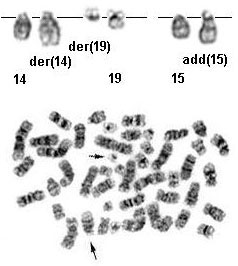
G-banded metaphase (left) showing the t(14;19)(q32;q13). The derivative chromosomes 14 and 19 are arrowed (bottom) G-banded karyogram showing the t(14;19)(q32;q13) and a add(15q) (top) - Courtesy Anthony V Moorman, Hazel M Robinson; R-banding (right).
Citation
Jean-Loup Huret
t(14;19)(q32;q13) IGH/CEBPA
Atlas Genet Cytogenet Oncol Haematol. 2008-05-01
Online version: http://atlasgeneticsoncology.org/haematological/1335/t(14;19)(q32;q13)-igh-cebpa
Historical Card
2004-09-01 t(14;19)(q32;q13) IGH/CEBPA by Hazel M Robinson,Anthony V Moorman Affiliation
Leukaemia Research Fund Cytogenetics Group, Cancer Sciences Division, University of Southampton, MP 822, Duthie Building, Southampton General Hospital, Southampton, SO16 6YD, UK
