t(15;17)(q24;q21) PML/RARA
2016-03-01 Pino J. Poddighe , Pino J. Poddighe Affiliation1.Department of Clinical Genetics, VU University Medical Center, Amsterdam (PJP); Department of Human Genetics, Radboud University Nijmegen Medical Centre (DOW), The Netherlands. [email protected]; [email protected]
2.Laboratoire de Biologie Cellulaire Hématopoïétique, EP-107 CNRS, Institut d Hématologie, Hôpital Saint Louis, Centre Hayem, Paris, France
3.Laboratoire de Biologie Cellulaire Hématopoïétique, EP-107 CNRS, Institut dHématologie, Hôpital Saint Louis, Centre Hayem, Paris, France
Abstract
Review on t(15;17)(q24;q21), with data on clinics, and the genes involved.
Clinics and Pathology
Disease
In sporadic cases the t(15;17) can be present in chronic myelogenous leukemia (CML) in myeloid blast crisis as an additional abnormality to the t(9;22)(q34;q11.2).
Phenotype stem cell origin
Epidemiology
Clinics
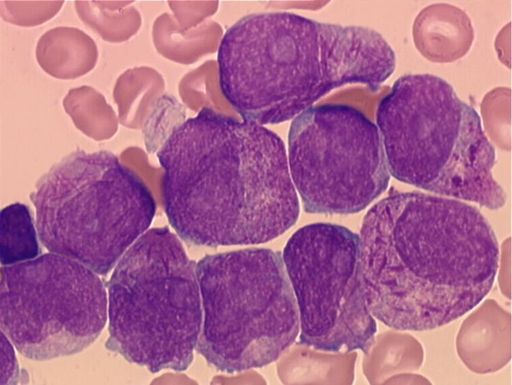
Cytology
Treatment
With the recent differentiation therapy using all-trans retinoic acid ATRA (with combined cytotoxic chemotherapy or arsenic trioxide (ATO)), complete remission (CR) is obtained in more than 90% of cases; this is the only cancer which, to date, can be treated by differentiation therapy.
Prognosis
Cytogenetics
Cytogenetics morphological
Although primary anomaly in most cases, t(15;17) can also occur in rare occurrences at acutisation (of promyelocytic type, of course) of a CML with the usual t(9;22).
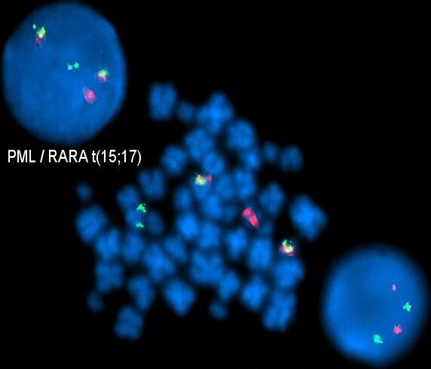
Genes Involved and Proteins
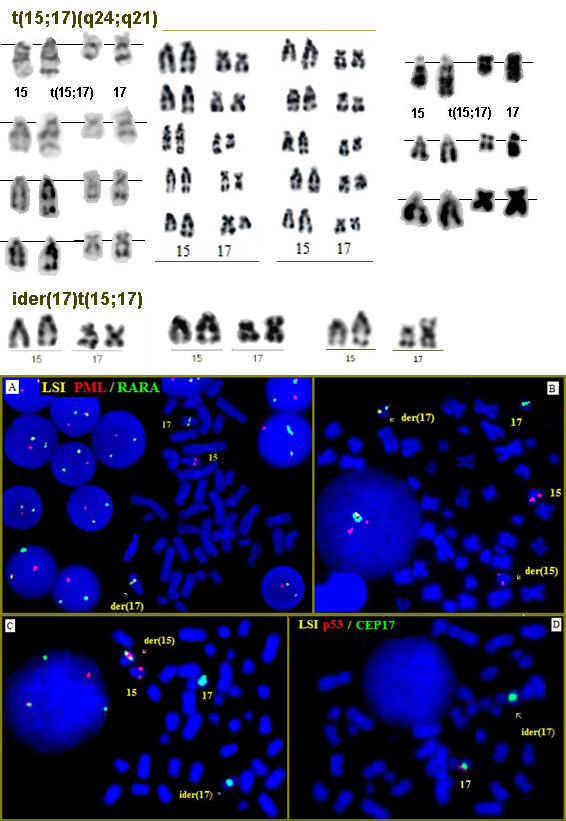
Rare cases of APL lacking the classic translocation in routine cytogenetic studies have been described with complex variant translocations (true variants) involving both chromosomes 15 and 17 with an additional chromosome (three way translocations) or with submicroscopic insertion of RARA into PML leading to the expression of the PML-RARA transcript; these latter cases are considered as cryptic or masked t(15;17)(q24;q21). Morphological analysis shows no major differences between the t(15;17)(q24;q21) positive group and the PML-RARA positive patients without t(15;17)(q24;q21). Three way translocations demonstrated that the crucial event lies on der(15), which receives the end part of chromosome 17.
A subset of patients, often with morphological features resembling APL, show variant translocations involving RARA (17q21). These variant fusion partners include ZBTB16 (previously known as PLZF at 11q23) in t(11;17)(q23;q21), NPM1 at 5q35 in t(5;17)(q32;q12), and NUMA1 at 11q13 in t(11;17)(q13;q21) ID: 1126> and STAT5B at 17q11.2 in dup(17)(q12q21). Some APL variants, including t(11;17)(q23;q12) with ZBTB16-RARA and cases with STAT5B-RARA fusions are resistant to ATRA.
Mutations involving FLT3 occur in 34-45% of APL.
Result of the Chromosomal Anomaly
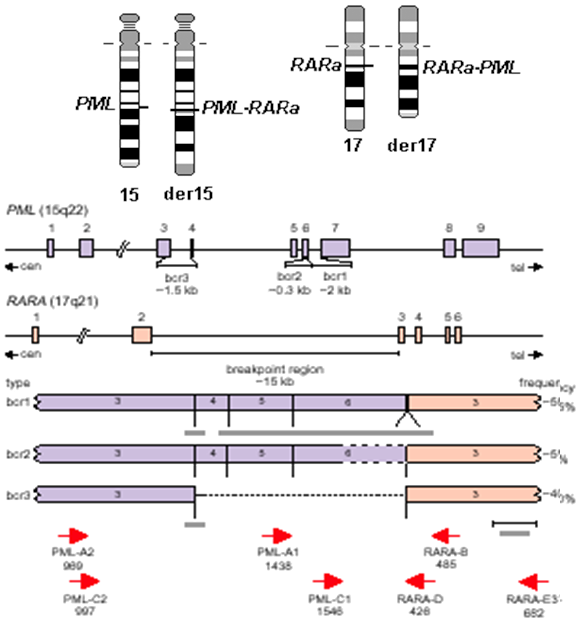
Description
Transcript
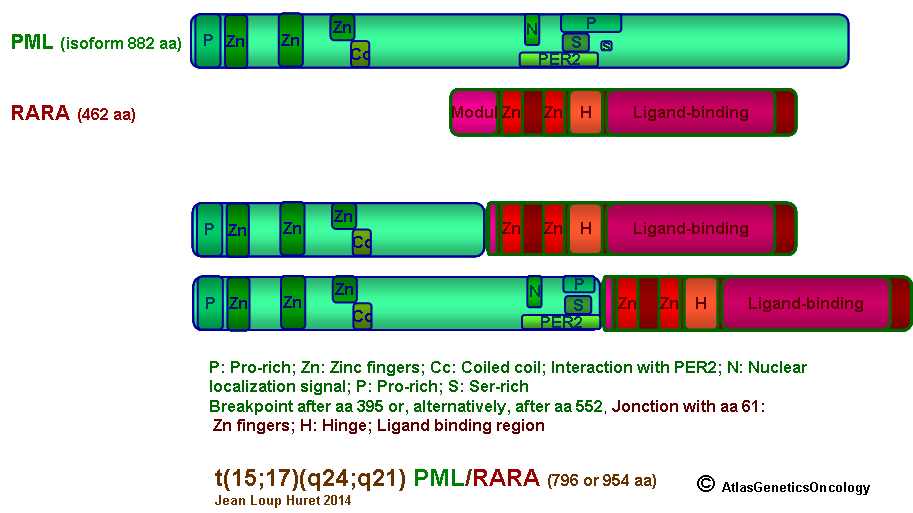
Description
Oncogenesis
Highly cited references
| Pubmed ID | Year | Title | Citations |
|---|---|---|---|
| 32295268 | 2020 | Classic and Variants APLs, as Viewed from a Therapy Response. | 173 |
| 32182684 | 2020 | Acute Promyelocytic Leukemia: A Constellation of Molecular Events around a Single PML-RARA Fusion Gene. | 172 |
| 38503502 | 2024 | Acute Promyelocytic Leukemia, Retinoic Acid, and Arsenic: A Tale of Dualities. | 144 |
| 22778276 | 2012 | The cell biology of disease: Acute promyelocytic leukemia, arsenic, and PML bodies. | 134 |
| 37388925 | 2023 | Biomolecular Condensates in Myeloid Leukemia: What Do They Tell Us? | 131 |
| 31635329 | 2019 | Acute Promyelocytic Leukemia: Update on the Mechanisms of Leukemogenesis, Resistance and on Innovative Treatment Strategies. | 126 |
| 33957999 | 2021 | Current views on the genetic landscape and management of variant acute promyelocytic leukemia. | 121 |
| 38061017 | 2023 | Proteogenomic analysis reveals cytoplasmic sequestration of RUNX1 by the acute myeloid leukemia-initiating CBFB::MYH11 oncofusion protein. | 112 |
| 21258047 | 2011 | Dynamics of epigenetic modifications in leukemia. | 104 |
| 24344243 | 2013 | Synergy against PML-RARa: targeting transcription, proteolysis, differentiation, and self-renewal in acute promyelocytic leukemia. | 103 |
| 23847762 | 2013 | PML, SUMOylation, and Senescence. | 100 |
| 38098967 | 2023 | Different Isoforms of PML-RARA Chimeric Protein in Patients with Acute Promyelocytic Leukemia: Survival Analysis per Demographic Characteristics, Clinicohematological Parameters, and Cytogenetic Findings. | 90 |
| 38648485 | 2024 | PML::RARA and GATA2 proteins interact via DNA templates to induce aberrant self-renewal in mouse and human hematopoietic cells. | 86 |
| 39766302 | 2024 | Rapid Detection of PML::RARA Fusions in Acute Promyelocytic Leukemia: CRISPR/Cas9 Nanopore Sequencing with Adaptive Sampling. | 83 |
| 37655965 | 2023 | Structural Basis of PML-RARA Oncoprotein Targeting by Arsenic Unravels a Cysteine Rheostat Controlling PML Body Assembly and Function. | 78 |
| 34193815 | 2021 | Acute promyelocytic leukemia current treatment algorithms. | 77 |
| 28017614 | 2017 | FTO Plays an Oncogenic Role in Acute Myeloid Leukemia as a N(6)-Methyladenosine RNA Demethylase. | 74 |
| 38539495 | 2024 | Acute Promyelocytic Leukemia: Review of Complications Related to All-Trans Retinoic Acid and Arsenic Trioxide Therapy. | 74 |
| 32024232 | 2020 | Advances in Pediatric Acute Promyelocytic Leukemia. | 73 |
| 28794865 | 2017 | Recent advances in acute promyelocytic leukaemia. | 71 |
| 22817890 | 2012 | The origin and evolution of mutations in acute myeloid leukemia. | 69 |
| 36880596 | 2023 | The p97/VCP segregase is essential for arsenic-induced degradation of PML and PML-RARA. | 67 |
| 34125173 | 2021 | Tumor suppressor function of Gata2 in acute promyelocytic leukemia. | 64 |
| 31905996 | 2019 | PML/RARa Interferes with NRF2 Transcriptional Activity Increasing the Sensitivity to Ascorbate of Acute Promyelocytic Leukemia Cells. | 52 |
| 26595813 | 2016 | PML-RARA requires DNA methyltransferase 3A to initiate acute promyelocytic leukemia. | 51 |
| 15096541 | 2004 | PML-RARA-RXR oligomers mediate retinoid and rexinoid/cAMP cross-talk in acute promyelocytic leukemia cell differentiation. | 48 |
| 36759620 | 2023 | Multi-omics and machine learning reveal context-specific gene regulatory activities of PML::RARA in acute promyelocytic leukemia. | 43 |
| 38304177 | 2024 | Acute promyelocytic leukemia with PML/RARA (bcr1, bcr2 and bcr3) transcripts in a pediatric patient. | 41 |
| 25126724 | 2014 | MIR125B1 represses the degradation of the PML-RARA oncoprotein by an autophagy-lysosomal pathway in acute promyelocytic leukemia. | 41 |
| 23056333 | 2012 | Expression and function of PML-RARA in the hematopoietic progenitor cells of Ctsg-PML-RARA mice. | 40 |
| 36452349 | 2022 | Analytical study of RUNX1-RUNXT1, PML-RARA, CBFB-MYH11, BCR-ABL1(p210) , and KMT2-MLLT3 in Mexican children with acute myeloid leukemia: A multicenter study of the Mexican interinstitutional group for the identification of the causes of childhood leukemia (MIGICCL). | 39 |
| 21364283 | 2011 | PML-RARA can increase hematopoietic self-renewal without causing a myeloproliferative disease in mice. | 38 |
| 27626703 | 2016 | PML/RARa inhibits PTEN expression in hematopoietic cells by competing with PU.1 transcriptional activity. | 37 |
| 25944686 | 2015 | Absolute quantification of the pretreatment PML-RARA transcript defines the relapse risk in acute promyelocytic leukemia. | 36 |
| 30289902 | 2018 | Identification of the novel deletion-type PML-RARA mutation associated with the retinoic acid resistance in acute promyelocytic leukemia. | 32 |
| 22406621 | 2012 | The SUMO E3-ligase PIAS1 regulates the tumor suppressor PML and its oncogenic counterpart PML-RARA. | 32 |
| 25119106 | 2014 | The DNA binding property of PML/RARA but not the integrity of PML nuclear bodies is indispensable for leukemic transformation. | 31 |
| 33614484 | 2020 | Oral Realgar-Indigo Naturalis Formula Plus Retinoic Acid for Acute Promyelocytic Leukemia. | 31 |
| 22090713 | 2011 | Characterization of cryptic rearrangements, deletion, complex variants of PML, RARA in acute promyelocytic leukemia. | 26 |
| 32323584 | 2020 | Clinical significance of increased PML-RARa transcripts after induction therapy for acute promyelocytic leukaemia. | 22 |
| 28028657 | 2017 | PML-RARA mutations confer varying arsenic trioxide resistance. | 14 |
| 34230915 | 2021 | PML/RARA destabilization by hyperthermia: a new model for oncogenic fusion protein degradation? | 10 |
| 33650061 | 2022 | The PML-RARA fusion is not detectable in historical blood samples of acute promyelocytic leukaemia patients. | 10 |
| 35572917 | 2022 | Cytogenetically cryptic PML::RARA fusion in acute promyelocytic leukemia: Testing strategies in the modern era. | 10 |
| 36404334 | 2022 | Adefovir dipivoxil inhibits APL progression through degradation of the oncoprotein PML-RARA. | 8 |
| 29245895 | 2017 | Progress and criticalities in the management of acute promyelocytic leukemia. | 7 |
| 31555723 | 2019 | Educational Case: Acute Promyelocytic Leukemia With PML-RARA. | 6 |
| 37314304 | 2023 | HNRNPC-RARA Fusion Gene in a Case with Acute Promyelocytic Leukemia Lacking PML-RARA Rearrangement Presenting with Abundant Hemophagocytosis. | 3 |
| 32473106 | 2020 | Genotypic and Phenotypic Characteristics of Acute Promyelocytic Leukemia Translocation Variants. | 0 |
| 39017850 | 2024 | Function of PML-RARA in Acute Promyelocytic Leukemia. | 0 |
| 35854096 | 2022 | A novel RARA-SNX15 fusion in PML-RARA-positive acute promyelocytic leukemia with t(11;17;15)(q13;q21.2;q24.1). | 0 |
| 1337847 | 1992 | RARA and PML genes in acute promyelocytic leukemia. | 0 |
| 37598913 | 2023 | PML/RARa leukemia induced murine model for immunotherapy evaluation. | 0 |
| 22056243 | 2012 | Curing APL through PML/RARA degradation by As2O3. | 0 |
| 19808868 | 2009 | Therapy-induced PML/RARA proteolysis and acute promyelocytic leukemia cure. | 0 |
| 35882408 | 2022 | MicroRNA-125b Accelerates and Promotes PML-RARa-driven Murine Acute Promyelocytic Leukemia. | 0 |
| 25258343 | 2014 | Clearance of PML/RARA-bound promoters suffice to initiate APL differentiation. | 0 |
| 30536958 | 2019 | PML/RARA inhibits expression of HSP90 and its target AKT. | 0 |
| 20155840 | 2010 | Atypical mRNA fusions in PML-RARA positive, RARA-PML negative acute promyelocytic leukemia. | 0 |
| 30421475 | 2019 | Identification and monitoring of atypical PML/RARA fusion transcripts in acute promyelocytic leukemia. | 0 |
| 26537301 | 2016 | Varying responses of PML-RARA with different genetic mutations to arsenic trioxide. | 0 |
| 33983418 | 2021 | bcr3 PML-RARA: short fusion, small blasts! | 0 |
| 29136503 | 2017 | Acute Promyelocytic Leukemia: A Paradigm for Oncoprotein-Targeted Cure. | 0 |
| 31281149 | 2019 | [Genetic abnormalities in AML]. | 0 |
| 1486033 | 1992 | Diagnosis of acute promyelocytic leukaemia by RT-PCR: detection of PML-RARA and RARA-PML fusion transcripts. | 0 |
| 20609355 | 2010 | PML/RARA oxidation and arsenic binding initiate the antileukemia response of As2O3. | 0 |
| 35639830 | 2022 | Typical, atypical and cryptic t(15;17)(q24;q21) (PML::RARA) observed in acute promyelocytic leukemia: A retrospective review of 831 patients with concurrent chromosome and PML::RARA dual-color dual-fusion FISH studies. | 0 |
| 15710327 | 2005 | A sumoylation site in PML/RARA is essential for leukemic transformation. | 0 |
| 36112505 | 2022 | How retinoic acid and arsenic transformed acute promyelocytic leukemia therapy. | 0 |
| 27030546 | 2016 | PCGF2 negatively regulates arsenic trioxide-induced PML-RARA protein degradation via UBE2I inhibition in NB4 cells. | 0 |
| 24433507 | 2013 | Novel treatment of acute promyelocytic leukemia: As₂O₃, retinoic acid and retinoid pharmacology. | 0 |
| 26294332 | 2015 | Evaluating frequency of PML-RARA mutations and conferring resistance to arsenic trioxide-based therapy in relapsed acute promyelocytic leukemia patients. | 0 |
| 26374632 | 2016 | PML-RARa modulates the vascular signature of extracellular vesicles released by acute promyelocytic leukemia cells. | 0 |
| 33428799 | 2021 | Identification of a novel TNRC18-RARA fusion in acute promyelocytic leukemia lacking t(15;17)(q24;q12)/PML-RARA. | 0 |
| 31085908 | 2019 | An Atypical PML-RARA Rearrangement Resulting from Submicroscopic Insertion of the RARA Gene at the PML Locus with Novel Breakpoints within PML Exon 7b and RARA Exon 3. | 0 |
| 30026570 | 2018 | Molecular remission as a therapeutic objective in acute promyelocytic leukemia. | 0 |
| 30305503 | 2018 | [State-of-the-art treatment of acute promyelocytic leukemia]. | 0 |
| 29550828 | 2017 | A Paediatric Acute Promyelocytic Leukaemia Patient Harbouring a Cryptic PML-RARA Insertion due to a Complex Structural Chromosome 17 Rearrangement. | 0 |
| 28025581 | 2017 | PML-RARA-associated cooperating mutations belong to a transcriptional network that is deregulated in myeloid leukemias. | 0 |
| 34405393 | 2021 | PML-RARA transcript levels at the end of induction therapy are associated with prognosis in non-high-risk acute promyelocytic leukaemia with all-trans retinoic acid plus arsenic in front-line therapy: long-term follow-up of a single-centre cohort study. | 0 |
| 7858248 | 1995 | Acute promyelocytic leukemia cases with nonreciprocal PML/RARa or RARa/PML fusion genes. | 0 |
| 31204926 | 2019 | [Detection of Exosomal PML-RARA Fusion Gene Expression Level by Droplet Digital PCR]. | 0 |
| 22692509 | 2012 | The arsenic-based cure of acute promyelocytic leukemia promotes cytoplasmic sequestration of PML and PML/RARA through inhibition of PML body recycling. | 0 |
| 8674046 | 1996 | Accelerated degradation of PML-retinoic acid receptor alpha (PML-RARA) oncoprotein by all-trans-retinoic acid in acute promyelocytic leukemia: possible role of the proteasome pathway. | 0 |
| 17613434 | 2007 | RXR is an essential component of the oncogenic PML/RARA complex in vivo. | 0 |
| 16502581 | 2006 | Diagnosis and monitoring of PML-RARA-positive acute promyelocytic leukemia by qualitative RT-PCR. | 0 |
| 22383794 | 2012 | CEBPE activation in PML-RARA cells by arsenic. | 0 |
| 8819070 | 1996 | Variant and masked translocations in acute promyelocytic leukemia. | 0 |
| 9624536 | 1998 | In vitro response to all-trans retinoic acid of acute promyelocytic leukemias with nonreciprocal PML/RARA or RARA/PML fusion genes. | 0 |
| 28183680 | 2019 | Diagnosis of variant RARA translocation using standard dual-color dual-fusion PML/RARA FISH probes: An illustrative report. | 0 |
| 10673742 | 2000 | A mutated PML/RARA found in the retinoid maturation resistant NB4 subclone, NB4-R2, blocks RARA and wild-type PML/RARA transcriptional activities. | 0 |
| 10992301 | 2000 | PML-RARA fusion transcripts in irradiated and normal hematopoietic cells. | 0 |
| 32602127 | 2020 | PML-RARA monitoring in newly diagnosed acute promyelocytic leukemia treated with an entirely oral chemotherapy-free postremission approach: A multiple institution experience. | 0 |
| 32909480 | 2020 | Cytogenetically cryptic and fish negative PML/RARA rearrangement in acute promyelocytic leukemia detected by RT-PCR. | 0 |
| 24673420 | 2014 | PML-RARA fusion resulting from a cryptic insertion of RARA gene into PML gene without the reciprocal RARA-PML fusion: clinical, cytogenetic, and molecular characterization and prognosis. | 0 |
| 17134965 | 2006 | Gene expression regulation and cancer. | 0 |
| 38294534 | 2024 | Identification of a novel fusion gene, RARA::ANKRD34C, in acute promyelocytic leukemia. | 0 |
| 12550769 | 2002 | RARA fluorescence in situ hybridization overcomes the drawback of PML/RARA fluorescence in situ hybridization in follow-up of acute promyelocytic leukemia. | 0 |
| 27899039 | 2017 | Sensitive monitoring of acute promyelocytic leukemia by PML-RARA DNA Q-PCR. | 0 |
| 19273155 | 2009 | PML nuclear bodies in the pathogenesis of acute promyelocytic leukemia: active players or innocent bystanders? | 0 |
Article Bibliography
| Pubmed ID | Last Year | Title | Authors |
|---|---|---|---|
| 1848017 | 1991 | Translocation breakpoint of acute promyelocytic leukemia lies within the retinoic acid receptor alpha locus. | Alcalay M et al |
| 1797083 | 1991 | Cytogenetic studies in acute promyelocytic leukemia: a survey of secondary chromosomal abnormalities. | Berger R et al |
| 2218500 | 1990 | Molecular analysis of acute promyelocytic leukemia breakpoint cluster region on chromosome 17. | Borrow J et al |
| 7787753 | 1995 | Treatment of newly diagnosed acute promyelocytic leukemia (APL) by all transretinoic acid (ATRA) combined with chemotherapy: The European experience. European APL Group. | Fenaux P et al |
| 17217041 | 2007 | Treatment of acute promyelocytic leukemia by retinoids. | Fenaux P et al |
| 1314166 | 1992 | Genomic variability and alternative splicing generate multiple PML/RAR alpha transcripts that encode aberrant PML proteins and PML/RAR alpha isoforms in acute promyelocytic leukaemia. | Pandolfi PP et al |
| 8515790 | 1993 | Acute promyelocytic leukemia. | Warrell RP Jr et al |
| 2170850 | 1990 | The t(15;17) translocation of acute promyelocytic leukaemia fuses the retinoic acid receptor alpha gene to a novel transcribed locus. | de Thé H et al |
Summary
Fusion gene
Note
Citation
Pino J. Poddighe ; Pino J. Poddighe
t(15;17)(q24;q21) PML/RARA
Atlas Genet Cytogenet Oncol Haematol. 2016-03-01
Online version: http://atlasgeneticsoncology.org/haematological/1035/t(15;17)(q24;q21)-pml-rara
Historical Card
1998-04-01 t(15;17)(q24;q21) PML/RARA by Christine Chomienne,Jean-Loup Huret Affiliation
