+3 or trisomy 3 in non Hodgkins lymphoma (NHL)
2001-01-01 Antonio Cuneo , Gianluigi Castoldi Affiliation1.Hematology Section, Department of Biomedical Sciences, University of Ferrara, Corso Giovecca 203, Ferrara, Italy
Clinics and Pathology
Disease
trisomy 3 occurs more frequently in T-cell lymphomas than in B-cell lymphomas globally, 20-30% of T-NHL may carry trisomy 3, the highest incidence having been noted in lymphoepithelioid lymphoma, in low-grade peripheral T-cell lymphoma, in angioimmonoblastic lymphadenopathy and in adult T-cell leukemia-lymphoma trisomy 3 is relatively rare in B-NHL, with the exception of marginal zone lymphomas (MZL) and mantle cell lymphoma (MCL); in MZL, total or partial trisomy 3 may occur in 50-70% of cytogenetically abnormal cases, with a reported incidence by interphase FISH in the 50-85% range; the incidence does not appear to vary according to the clinicopathologic features, with similar frequency in the extra-nodal MALT lymphoma, in the nodal and the splenic form of MZL; trisomy 3/3q was reported in 10-15% of MCL with an higher incidence (up to 40%) by molecular cytogenetic techniques; sporadically, other low-grade and high grade B-lymphoid tumors may carry trisomy 3/3q
Prognosis
the prognostic significance of trisomy 3 in T-cell and B-cell lymphomas is unknown; there does not appear to be a role for trisomy 3 in tumor progression from low-grade MALT lymphoma to the high grade form, whereas gains of 3q may be associated with the aggressive blastoid variant of MCL
Cytogenetics
Cytogenetics morphological
trisomy 3 may be total or partial; commonly overrepresented segments in partial trisomy 3 include the q21-23 region and the q25-29 region; total/partial trisomy 3 may occur as an isolated anomaly in a minority of cases
Cytogenetics molecular
the anomaly is readily detectable by G- and R-banding in most cases; however, FISH using a centromeric probe is more sensitive than conventional cytogenetics, allowing for the study of non-dividing cells and for the detection of partial trisomy in complex karyotypes with marker chromosomes
Genes Involved and Proteins
Note
the gene(s) involved in the transformation process by gene dosage effect or by other mechanisms are not known
Article Bibliography
| Pubmed ID | Last Year | Title | Authors |
|---|---|---|---|
| 2889485 | 1987 | Correlation of chromosome abnormalities with histologic and immunologic characteristics in non-Hodgkin's lymphoma and adult T cell leukemia-lymphoma. Fifth International Workshop on Chromosomes in Leukemia-Lymphoma. | |
| 10361135 | 1999 | Increased number of chromosomal imbalances and high-level DNA amplifications in mantle cell lymphoma are associated with blastoid variants. | Beà S et al |
| 11426530 | 2001 | Secondary chromosome changes in mantle cell lymphoma: cytogenetic and fluorescence in situ hybridization studies. | Bigoni R et al |
| 8547655 | 1996 | Marginal zone B-cell lymphomas of different sites share similar cytogenetic and morphologic features. | Dierlamm J et al |
| 10374886 | 1999 | Gastric low-grade MALT lymphoma, high-grade MALT lymphoma and diffuse large B cell lymphoma show different frequencies of trisomy. | Hoeve MA et al |
| 9671133 | 1998 | Trisomy 3q11-q29 is recurrently observed in B-cell non-Hodgkin's lymphomas associated with cold agglutinin syndrome. | Michaux L et al |
| 8286748 | 1994 | Cytogenetic findings in peripheral T-cell lymphomas as a basis for distinguishing low-grade and high-grade lymphomas. | Schlegelberger B et al |
Summary
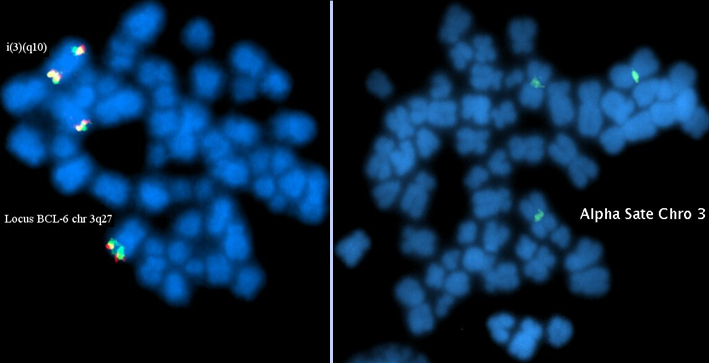
+3 (right) and partial trisomy 3 due to i(3)(q10) (left) FISH - Courtesy Hossein Mossafa.
Citation
Antonio Cuneo ; Gianluigi Castoldi
+3 or trisomy 3 in non Hodgkins lymphoma (NHL)
Atlas Genet Cytogenet Oncol Haematol. 2001-01-01
Online version: http://atlasgeneticsoncology.org/haematological/2008/+3-or-trisomy-3-in-non-hodgkins-lymphoma-(nhl)
