AMOT (angiomotin)
2010-03-01 Roshan Mandrawalia , Ranjan Tamuli AffiliationDepartment of Biotechnology, Indian Institute of Technology Guwahati, Guwahati-781 039, Assam, India
DNA/RNA
Description
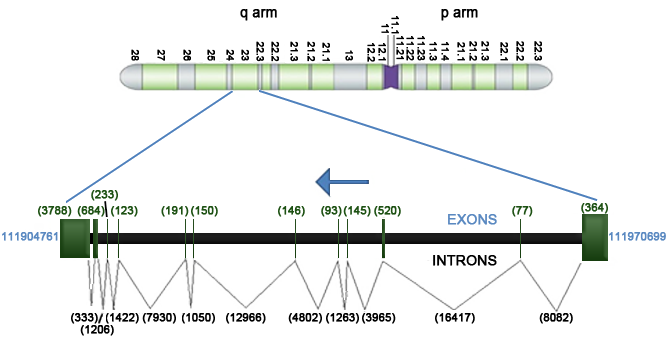
DNA size 66.31 kb, mRNA size 6888 bp, 12 exons.
Proteins
Description
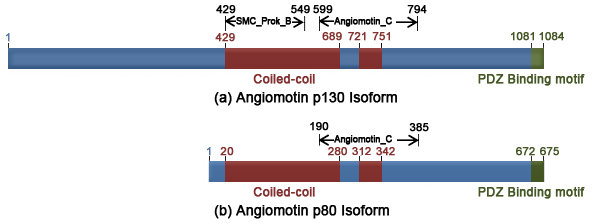
Angiomotin protein is 1084 amino acid residues in length. It contains two coiled coil domains 429-689 (261), 721-751 (31), a PDZ-binding motif 1081-1084 (4), a SMC_prok_B region 429-549 (121), and an angiomotin_C terminal 599-794 (196). Phosphorylations occur on S305, S312, S712, S714, T717, Y719, and T1061. Phosphorylated upon DNA damage, probably by ATM or ATR.
Isoforms:
- Isoform 1: p130 angiomotin
1084 amino acids, 118085 Da. This isoform has been chosen as the canonical sequence.
- Isoform 2: p80 angiomotin
675 amino acids, 72540 Da. The isoform differs from the canonical sequence with N-terminal alternative splicing region 1-409 (409) missing, which mediates the binding of angiomotin to F-actin stress fibres. The SMC_prok_B region is also missing in this isoform.
Isoforms:
- Isoform 1: p130 angiomotin
1084 amino acids, 118085 Da. This isoform has been chosen as the canonical sequence.
- Isoform 2: p80 angiomotin
675 amino acids, 72540 Da. The isoform differs from the canonical sequence with N-terminal alternative splicing region 1-409 (409) missing, which mediates the binding of angiomotin to F-actin stress fibres. The SMC_prok_B region is also missing in this isoform.
Expression
Expressed in placenta and skeletal muscle. Predominantly expressed in endothelial cells of capillaries, larger vessels of the placenta.
Localisation
Cell junction, tight junction. Localized on the cell surface. May act as a transmembrane protein.
Function
Mediates inhibitory effect of angiostatin on tube formation and the migration of endothelial cells toward growth factors during the formation of new blood vessels in the larger vessels of the placenta. Isoform-1 is found to control cell shape by association with F-actin fibres through N-terminal part of protein. The isoform 2 (p80) promotes angiogenesis, in part, by conferring a hypermigratory phenotype to endothelial cells.
Homology
The percent identity below represents identity of AMOT over an aligned region in Unigene.
Mus musculus: 88.1 (percent identity)
Oryctolagus cuniculus: 79
Sus scrofa: 72
Danio rerio: 68.9
Fugu rubripes: 65
Xenopus laevis: 61.8
Caenorhabditis elegans: 46
Saccharomyces cerevisiae: 47
Drosophila melanogaster: 36
Mus musculus: 88.1 (percent identity)
Oryctolagus cuniculus: 79
Sus scrofa: 72
Danio rerio: 68.9
Fugu rubripes: 65
Xenopus laevis: 61.8
Caenorhabditis elegans: 46
Saccharomyces cerevisiae: 47
Drosophila melanogaster: 36
Mutations
Note
Several polymorphisms have been found but none of them has shown any association with a disease. Furthermore, endothelial cells expressing mutated angiomotins have been reported failure in their function, including failure to migrate and inhibition of angiogenesis. Mutation with deletion of three amino acids from PDZ-binding motif results in inhibition of chemotaxis, embryos with this mutation may lead to death on embryonic day 9.5.
Implicated in
Entity name
Breast cancer
Note
Angiomotin is linked to angiogenesis and aggressive nature of breast tumours. Angiomotin shows high level of expression in mammary tissues during tumour stages as compared to normal expression level (33.1 ± 11 in normal versus 86.5 ± 13.7 in tumour tissues, p=0.0003). Significant high expression was found in aggressive tumours (grade 2, grade 3 and with nodal involvement) compared with less aggressive grade 1 tumour (p
Entity name
Hemangioendothelioma invasion
Disease
Angiomotin expression promotes hemangioendothelioma invasion. Expression of human angiomotin in mouse aortic endothelial (MAE) cells results in stabilization of tubes in the Matrigel assay. Cells from the established tubes invaded into the solidified matrigel, however, cells expressing a functional mutant lacking the PDZ protein interaction motif did not migrate and form tubes. Angiomotin may promote angiogenesis by both stimulating invasion as well as stabilizing established tubes.
Entity name
Endothelial cell migration and tube formation
Note
Upon expression of angiomotin in HeLa cells, angiomotin bound and internalized fluorescein-labeled angiostatin, a circulating inhibitor of angiogenesis. In endothelial cells, angiomotin protein is localized to the leading edge of migrating cells and results in increased cell migration. Angiomotin-transfected MAE cells bind and respond to angiostatin by inhibition of cell migration and tube formation, which suggest that angiomotin regulates endothelial cell migration and tube formation.
Article Bibliography
| Pubmed ID | Last Year | Title | Authors |
|---|---|---|---|
| 16043488 | 2005 | Angiomotin regulates endothelial cell-cell junctions and cell motility. | Bratt A et al |
| 12406577 | 2002 | Angiomotin belongs to a novel protein family with conserved coiled-coil and PDZ binding domains. | Bratt A et al |
| 18824598 | 2009 | The Amot/Patj/Syx signaling complex spatially controls RhoA GTPase activity in migrating endothelial cells. | Ernkvist M et al |
| 19565639 | 2009 | Human angiomotin-like 1 associates with an angiomotin protein complex through its coiled-coil domain and induces the remodeling of the actin cytoskeleton. | Gagné V et al |
| 16754857 | 2006 | A DNA vaccine targeting angiomotin inhibits angiogenesis and suppresses tumor growth. | Holmgren L et al |
| 16430777 | 2006 | Angiomotin and angiomotin like proteins, their expression and correlation with angiogenesis and clinical outcome in human breast cancer. | Jiang WG et al |
| 14730344 | 2004 | Angiomotin expression promotes hemangioendothelioma invasion. | Levchenko T et al |
| 11257124 | 2001 | Angiomotin: an angiostatin binding protein that regulates endothelial cell migration and tube formation. | Troyanovsky B et al |
| 16678097 | 2006 | A Rich1/Amot complex regulates the Cdc42 GTPase and apical-polarity proteins in epithelial cells. | Wells CD et al |
| 11257132 | 2001 | Hold that line. Angiomotin regulates endothelial cell motility. | Zetter BR et al |
Other Information
Locus ID:
NCBI: 154796
MIM: 300410
HGNC: 17810
Ensembl: ENSG00000126016
Variants:
dbSNP: 154796
ClinVar: 154796
TCGA: ENSG00000126016
COSMIC: AMOT
RNA/Proteins
Expression (GTEx)
Pathways
Protein levels (Protein atlas)
References
| Pubmed ID | Year | Title | Citations |
|---|---|---|---|
| 32656583 | 2021 | CLIC1 knockout inhibits invasion and migration of gastric cancer by upregulating AMOT-p130 expression. | 8 |
| 34284061 | 2021 | Interactions between AMOT PPxY motifs and NEDD4L WW domains function in HIV-1 release. | 5 |
| 32656583 | 2021 | CLIC1 knockout inhibits invasion and migration of gastric cancer by upregulating AMOT-p130 expression. | 8 |
| 34284061 | 2021 | Interactions between AMOT PPxY motifs and NEDD4L WW domains function in HIV-1 release. | 5 |
| 31800378 | 2020 | AMOT130 drives BMP-SMAD signaling at the apical membrane in polarized cells. | 5 |
| 32381509 | 2020 | Angiomotin regulates budding and spread of Ebola virus. | 14 |
| 33109746 | 2020 | Emerging roles for angiomotin in the nervous system. | 4 |
| 31800378 | 2020 | AMOT130 drives BMP-SMAD signaling at the apical membrane in polarized cells. | 5 |
| 32381509 | 2020 | Angiomotin regulates budding and spread of Ebola virus. | 14 |
| 33109746 | 2020 | Emerging roles for angiomotin in the nervous system. | 4 |
| 30792381 | 2019 | Angiomotin-p130 inhibits β-catenin stability by competing with Axin for binding to tankyrase in breast cancer. | 7 |
| 30996134 | 2019 | Faulty oxygen sensing disrupts angiomotin function in trophoblast cell migration and predisposes to preeclampsia. | 13 |
| 31006631 | 2019 | Angiomotin Regulates YAP Localization during Neural Differentiation of Human Pluripotent Stem Cells. | 15 |
| 30792381 | 2019 | Angiomotin-p130 inhibits β-catenin stability by competing with Axin for binding to tankyrase in breast cancer. | 7 |
| 30996134 | 2019 | Faulty oxygen sensing disrupts angiomotin function in trophoblast cell migration and predisposes to preeclampsia. | 13 |
Citation
Roshan Mandrawalia ; Ranjan Tamuli
AMOT (angiomotin)
Atlas Genet Cytogenet Oncol Haematol. 2010-03-01
Online version: http://atlasgeneticsoncology.org/gene/632/amot
