APAF1 (Apoptotic protease activating factor 1)
2004-09-01 Marco Corvaro , Francesco Cecconi AffiliationDulbecco Telethon Institute,Department of Biology, University of Rome Tor Vergata, Via della Ricerca Scientifica, 00133 Rome, Italy
DNA/RNA
Description
The APAF1 gene is comprised of 27 exons, with the coding region spanning 26 exons (the ATG is in the second exon
Transcription
Five isoforms of APAF1 cDNA have been identified in Homo sapiens
the original APAF1 (also called Apaf-1S) is 3585 bp long (it contains 12 WD40 repeats);
the APAF1-1M isoform (3618 bp) contains an insertion of 33 nt after position 295 of the first published sequence (11 aa insertion GKDSVSGITSY between aa 98 and 99; it also contains 12 WD40 repeats);
the APAF1XS isoform (3516 bp) contains the same insertion of Apaf-1M form, lacks the base pairs from 3171 to 3296 of the Apaf-1S form (the deletion is in WD40 domain) but has an insertion of 24 nt at position 1725
the APAF1L (3714 bp) contains an insertion of 129 nt at position 2466(contains 13 WD40 repeats);
the APAF1XL (3747 bp)isoform contains the same insertion of APAF1M form, plus and additional insertion of 129 bp (43 aa beetween aa 811-812; Apaf-1XL also contains 13 WD40 repeats);
Pseudogene
not known
Proteins
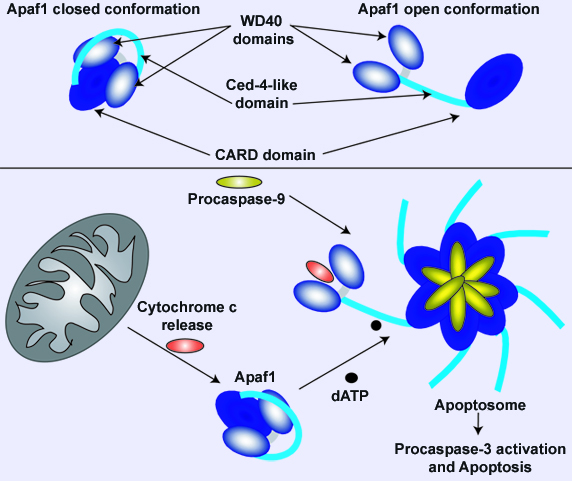
Figure 1: The conformational changes in the APAF1 molecules lead to apoptosome formation and to the activation of apoptosis. However, the assembly and the functioning of the apoptosome is regulated by mithocondrial and cytosolic factors (modif. from E. Ferraro et al. 2004)
Description
the protein can be divided into three domains: the N-terminal is a CARD domain and is necessary for APAF1 function; alternatively, it can bind the WD40 domain or cytochrome C. The ced-4-like domain is responsible for APAF1 conformational changes. The C-terminal WD40 domain is a negative regulator element composed of 12 or 13 WD40 repeats: it can bind the CARD domain but it can probably interact with other apoptotic regulator proteins as well.
Expression
APAF1 Promoter can interact with E2F1 (also E2F2-3) and p53 which can in turn regulate its expression.
Localisation
cytosolic
Function
APAF1 is the structural core of the apoptosome. When the mitochondrial pathway of apoptosis is activated, cytochrome c is released from mitochondria to cytosol, and then binds to APAF1 CARD domain changing its conformation. A further binding of ATP molecules mediates a second conformational change which leads to open APAF1 conformation. By means of the CARD domain, seven APAF1 molecules bind to each other and to seven molecules of initiator Caspase-9 forming the apoptosome and causing the activation of effector caspases. The formation of apoptosome and the activation of caspases are regulated by numerous interacting proteins.
Homology
CED-4 (C. elegans); DARK (D. melanogaster); CARD proteins.
Mutations
Germinal
not known in H. sapiens.
Somatic
not known in H. sapiens.
Implicated in
Entity name
Skin Cancers ( Melanoma, Basal Cell Carcinoma, Squamous Cell Carcinoma).
Cytogenetics
Frequent LOH in 12q22-23 locus (primary melanomas: 20-25% metastatic melanomas 35-40%).
Oncogenesis
The silencing of Apaf1 expression is often found in Melanomas. Two main mechanisms have been posited for APAF1 dimininution, either the allelic LOH in 12q22-23 locus and/or a transcriptional silencing by promoter methylation. The inactivation was not found in Nevi but it increased significantly in the later stages of carcinogenesis, when primary melanomas are fully developed (1-3mm of diameter). Very often such inactivation was associated with metastatic melanomas. Moreover, the APAF1 level is correlated with chemosensivity to different agents; different studies demonstrate that overexpressing or restoring a normal APAF1 level could sensitize chemoresistant melanoma cell lines, in vitro. Recently, APAF1 LOH determination on blood serum DNA has been proposed as a marker for selecting appropriate chemotherapy in stage IV melanoma patients.
Entity name
Brain tumors (neural tumors, glial tumors)
Cytogenetics
Frequent LOH in 12q22-23 locus in glioblastomas (40%)
Oncogenesis
APAF1 seems to be downregulated or absent in Glioblastomas at mRNA and protein level. In addition, the co-overexpression of APAF1 and Caspase-9 sensitizes glioma cell lines (U-251 and U-373 MG) to p53-dependent apoptosis. Other modulations of the apoptosome-related apoptosis have been successfully conducted in order to induce apoptosis in glioma resistant lines. By contrast, APAF1 seems to be active in Neuroblastomas while there are no studies about a putative APAF1 role in other glial tumors (such as ependimoma, astrocytoma, ganglioglioma).
Entity name
Head and neck cancers and odontogenic tumors.
Oncogenesis
There is no direct evidence of APAF1s role in the oncogenesis of these types of cancer even though Apaf1 loss has been correlated with gain of Cisplatin Chemoresistance in HSC-2CR cells (derived from HSC-2 head squamous carcinoma cells).
Entity name
Gastro-intestinal tract cancers ( oesophagus cancer, gastric cancer, gallbladder cancer, ampulla of vater cancer, peritoneum cancer, vermiform appendix cancer, colon cancer, rectal cancer, cancer of the anus).
Oncogenesis
A low frequency of mutations (10-15 % of cases) is found in ColoRectal and Gastric Cancer. these mutations are due to the genetics of microsatellite instability and appear to be heterozygous. No evidences of APAF1 involvement have been found in the pathogenesis of the other tumors mentioned
Entity name
Exocrinus pancreas cancers (various stages of the pancreas ductal adenocarcinoma - PDAC)
Cytogenetics
12q 1ocus deletions could be considered among the most frequent deletions in PDAC.
Oncogenesis
There is no direct evidence of APAF1 mutations in the progression of the PDAC (some even deny its possible role completely). There are many studies, however, which point out the 12q22-23 locus LOH or mutation in PDAC. Most of the mutated genes involved (such as K-Ras, p53, p16INK4a, p19ARF) can control the APAF1 level directly or indirectly throught the action of p53 and E2F-1 which both have active binding boxes to the APAF1 promoter.
Entity name
Liver cancer and liver metastases
Oncogenesis
Methylation is a common feature in hepatocellular carcinoma (HCC) regulation. While the analysis of promoters methylation in HCC samples showed that the APAF1 gene is not hypermethylated, the HepG2 cells exposed to a demethylating agent (DEM, diethyl maleate) showed an increased level of Apaf1 and of some caspases which lead to G2 phase arrest and apoptosis.
Entity name
Lung cancer
Oncogenesis
There is no direct evidence for abrogation of APAF1 function in lung cancer. However, the APAF1/Caspase-9 upregulation seem to be a protective mechanism in some NSCLC ( non small cell lung carcinoma) cell lines, while in other NSCLC lines (such as the NCI-H460) an indirect APAF1 loss of function is mediated by the upregulation of XIAP (an inhibitor of Apoptosome assembly). Furthermore, a driven expression of APAF1/ Caspase-9 (through the Inibition of XIAP in NCI-H460 cells or with low dose lung cancer cell lines) seems to augment sensitivity to death.
Entity name
Tumors of the female reproductive organs ( ovarian carcinoma, neoplasms of Fallopian tube, endometrium, cervix, vulva and vagina)
Oncogenesis
In ovarian carcinoma, the APAF1 gene seems to be active. However, dysfunction in the apoptosome assembly process has been correlated with chemoresistance. In contrast, loss of heterozygosity was found in the apaf1 locus in malignant ovarian germ cell tumors. There is no information about the reproductive tract.
Entity name
Tumors of the male reproductive organs ( seminoma, nonseminomatous germ cell tumors, sex cord-stromal tumors , other testis cancers, neoplasms of prostate, tumor of the penis)
Cytogenetics
Frequent deletions in Chromosome 12 long and short arm in germ line tumors; LOH in 12q22-23 is present in seminomas, non-seminomatous tumors and in mixed teratomas with various reported percentage (20-45%)
Oncogenesis
In Germ line tumors the APAF1 locus is often deleted; however it seems that APAF1 level was normal in various analyzed lines. Interestingly, Cisplatin treatment of a embryonal carcinoma cell line, TTSC-3 lead to the differentiation of the carcinoma through the up-regulation of pro-differentiation and pro-apoptotic genes (such as APAF1, Caspase-8 and TNFR1). In Prostatic Tumor there is no evidence of APAF1 involvement; however some studies have been conducted demontrating an increase of Apaf1 at transcription level as a cellular response to chemotherapeutic agents.
Entity name
Urinary tract tumors ( renal cell carcinoma, neoplasms of the renal pelvis, ureter, bladder, urethra)
Oncogenesis
The Apoptosome function seems to be active in primary samples and in a few cell lines of Renal Cell Carcinoma. There are no informations about the urinary tract.
Entity name
Hematopoietic system tumors.
Oncogenesis
Its not clear if APAF1 gene is corrupted in Leukaemias and Lymphomas. However, while the methylation of the promoter was demonstrated in different kinds of leukaemia, the protein level does not correlate with the messenger level, suggesting a multistep regulation in APAF1 expression. Furthermore, it has been demonstrated that the APAF1 overexpression, conducted by in vitro transfection or by chemoadiuvants, could overcome the resistance to chemo-radiotherapeutic agents.
Entity name
Bone and soft tissue cancers (osteoma, sarcoma, fibroma, osteosarcoma)
Oncogenesis
There is no direct evidence of APAF1 role in the oncogenesis of these types of cancer even though in Ewings sarcoma cell lines the Apaf1 low level found in two different lines (STA-ET-2.1 and STA-ET-2.2) was correlated with chemoresistance to p53-dependent death stimuli compared with lines with normal APAF1 level. APAF1 was also absent and correlated with chemoresistance in the HT-1080 fibrosacroma cell line.
Entity name
Various tumors ( eye tumor, heart and great vessels tumors, neoplasm of the endocrine glands and of the diffuse endocrine system, tumor of mesotheliums)
Oncogenesis
At present, there is no direct evidence of APAF1 involvement in the carcinogenesis of these neoplasms.
Article Bibliography
| Pubmed ID | Last Year | Title | Authors |
|---|---|---|---|
| 12473344 | 2002 | Apoptosomes: engines for caspase activation. | Adams JM et al |
| 11516099 | 2001 | Proteasome inhibitor-induced apoptosis of B-chronic lymphocytic leukaemia cells involves cytochrome c release and caspase activation, accompanied by formation of an approximately 700 kDa Apaf-1 containing apoptosome complex. | Almond JB et al |
| 15009102 | 2004 | Analysis of APAF-1 expression in human cutaneous melanoma progression. | Baldi A et al |
| 10722681 | 2000 | Expression and functional analysis of Apaf-1 isoforms. Extra Wd-40 repeat is required for cytochrome c binding and regulated activation of procaspase-9. | Benedict MA et al |
| 12670467 | 2003 | Hairy-cell leukaemia as a model for drug development. | Carson DA et al |
| 11875189 | 2002 | Transcriptional and physiological responses of HepG2 cells exposed to diethyl maleate: time course analysis. | Casey W et al |
| 10578178 | 1999 | Apaf1 and the apoptotic machinery. | Cecconi F et al |
| 11706994 | 2001 | Apaf1 in developmental apoptosis and cancer: how many ways to die? | Cecconi F et al |
| 11936259 | 2002 | Apoptosis: molecular regulation of cell death and hematologic malignancies. | Chiarugi V et al |
| 15305193 | 2004 | Reduced Apaf-1 expression in human cutaneous melanomas. | Dai DL et al |
| 12932638 | 2003 | Molecular targeting of drug delivery systems to ovarian cancer by BH3 and LHRH peptides. | Dharap SS et al |
| 11748635 | 2002 | Cancer as an epigenetic disease: DNA methylation and chromatin alterations in human tumours. | Esteller M et al |
| 15314285 | 2004 | Modulation of pro- and anti-apoptotic factors in human melanoma cells exposed to histone deacetylase inhibitors. | Facchetti F et al |
| 12767258 | 2003 | Physiological and pathological roles of Apaf1 and the apoptosome. | Ferraro E et al |
| 12545166 | 2003 | Role of DNA methylation in the suppression of Apaf-1 protein in human leukaemia. | Fu WN et al |
| 11264002 | 2001 | Apaf-1XL is an inactive isoform compared with Apaf-1L. | Fu WN et al |
| 15026369 | 2004 | Allelic imbalance of 12q22-23 associated with APAF-1 locus correlates with poor disease outcome in cutaneous melanoma. | Fujimoto A et al |
| 12149244 | 2002 | Apaf-1 is a mediator of E2F-1-induced apoptosis. | Furukawa Y et al |
| 15273730 | 2004 | 5-aza-2'-deoxycytidine upregulates caspase-9 expression cooperating with p53-induced apoptosis in human lung cancer cells. | Gomyo Y et al |
| 14566819 | 2003 | Autocrine motility factor signaling induces tumor apoptotic resistance by regulations Apaf-1 and Caspase-9 apoptosome expression. | Haga A et al |
| 11429044 | 2001 | Frameshift mutations at mononucleotide repeats in RAD50 recombinational DNA repair gene in colorectal cancers with microsatellite instability. | Ikenoue T et al |
| 14749477 | 2004 | Resveratrol modifies the expression of apoptotic regulatory proteins and sensitizes non-Hodgkin's lymphoma and multiple myeloma cell lines to paclitaxel-induced apoptosis. | Jazirehi AR et al |
| 12642862 | 2003 | Role of Smac in human leukaemic cell apoptosis and proliferation. | Jia L et al |
| 11435311 | 2001 | Apaf-1 protein deficiency confers resistance to cytochrome c-dependent apoptosis in human leukemic cells. | Jia L et al |
| 12761489 | 2003 | Response of Ewing tumor cells to forced and activated p53 expression. | Kovar H et al |
| 15101558 | 2004 | Increased expression of Apaf-1 and procaspase-3 and the functionality of intrinsic apoptosis apparatus in non-small cell lung carcinoma. | Krepela E et al |
| 12543167 | 2003 | Inhibition of caspase-9 activity and Apaf-1 expression in cisplatin-resistant head and neck squamous cell carcinoma cells. | Kuwahara D et al |
| 11830553 | 2002 | Dysfunctional apoptosome activation in ovarian cancer: implications for chemoresistance. | Liu JR et al |
| 10679386 | 2000 | Tumor suppressor genes. | Macleod K et al |
| 11295216 | 2001 | Preliminary evaluation of caspases-dependent apoptosis signaling pathways of free and HPMA copolymer-bound doxorubicin in human ovarian carcinoma cells. | Minko T et al |
| 12172980 | 2002 | Enhancing the anticancer efficacy of camptothecin using biotinylated poly(ethylene glycol) conjugates in sensitive and multidrug-resistant human ovarian carcinoma cells. | Minko T et al |
| 12569576 | 2003 | Differential expression of genes induced by resveratrol in LNCaP cells: P53-mediated molecular targets. | Narayanan BA et al |
| 12804598 | 2003 | APAF-1-ALT, a novel alternative splicing form of APAF-1, potentially causes impeded ability of undergoing DNA damage-induced apoptosis in the LNCaP human prostate cancer cell line. | Ogawa T et al |
| 9788601 | 1998 | Overexpression of Apaf-1 promotes apoptosis of untreated and paclitaxel- or etoposide-treated HL-60 cells. | Perkins C et al |
| 10749135 | 2000 | The role of Apaf-1, caspase-9, and bid proteins in etoposide- or paclitaxel-induced mitochondrial events during apoptosis. | Perkins CL et al |
| 15077155 | 2004 | Apoptosis defects and chemotherapy resistance: molecular interaction maps and networks. | Pommier Y et al |
| 12082529 | 2002 | Regulation of apoptosis by p53 in UV-irradiated human epidermis, psoriatic plaques and senescent keratinocytes. | Qin JZ et al |
| 15198948 | 2004 | Promoter hypermethylation of cancer-related genes: a strong independent prognostic factor in acute lymphoblastic leukemia. | Roman-Gomez J et al |
| 15210786 | 2004 | Fas-mediated apoptosome formation is dependent on reactive oxygen species derived from mitochondrial permeability transition in Jurkat cells. | Sato T et al |
| 11870542 | 2002 | Co-transduction of Apaf-1 and caspase-9 highly enhances p53-mediated apoptosis in gliomas. | Shinoura N et al |
| 12789290 | 2003 | Apoptosis and melanoma chemoresistance. | Soengas MS et al |
| 15031599 | 2004 | Mechanisms of paclitaxel-induced apoptosis in an ovarian cancer cell line and its paclitaxel-resistant clone. | Sugimura M et al |
| 11090079 | 2000 | Evaluation of Apaf-1 and procaspases-2, -3, -7, -8, and -9 as potential prognostic markers in acute leukemia. | Svingen PA et al |
| 11896617 | 2002 | Caspase-9 and Apaf-1 are expressed and functionally active in human neuroblastoma tumor cell lines with 1p36 LOH and amplified MYCN. | Teitz T et al |
| 15193036 | 2004 | Frequent LOH at chromosome 12q22-23 and Apaf-1 inactivation in glioblastoma. | Umetani N et al |
| 11119689 | 2000 | A comparison of the expression and properties of Apaf-1 and Apaf-1L. | Walke DW et al |
| 14655749 | 2003 | Frequent LOH at chromosome 12q22-23 and Apaf-1 inactivation in glioblastoma. | Watanabe T et al |
| 11429402 | 2001 | Defective cytochrome c-dependent caspase activation in ovarian cancer cell lines due to diminished or absent apoptotic protease activating factor-1 activity. | Wolf BB et al |
| 10819600 | 2000 | Frameshift mutations in Fas, Apaf-1, and Bcl-10 in gastro-intestinal cancer of the microsatellite mutator phenotype. | Yamamoto H et al |
| 12591734 | 2003 | Predominant suppression of apoptosome by inhibitor of apoptosis protein in non-small cell lung cancer H460 cells: therapeutic effect of a novel polyarginine-conjugated Smac peptide. | Yang L et al |
| 12433278 | 2002 | Methylation profiling of twenty promoter-CpG islands of genes which may contribute to hepatocellular carcinogenesis. | Yu J et al |
Other Information
Locus ID:
NCBI: 317
MIM: 602233
HGNC: 576
Ensembl: ENSG00000120868
Variants:
dbSNP: 317
ClinVar: 317
TCGA: ENSG00000120868
COSMIC: APAF1
RNA/Proteins
Expression (GTEx)
Pathways
Protein levels (Protein atlas)
References
| Pubmed ID | Year | Title | Citations |
|---|---|---|---|
| 38348717 | 2024 | Exosomal circ_0037104 derived from Hu-MSCs inhibits cholangiocarcinoma progression by sponging miR-620 and targeting AFAP1. | 0 |
| 38348717 | 2024 | Exosomal circ_0037104 derived from Hu-MSCs inhibits cholangiocarcinoma progression by sponging miR-620 and targeting AFAP1. | 0 |
| 37108258 | 2023 | Upregulation of APAF1 and CSF1R in Peripheral Blood Mononuclear Cells of Parkinson's Disease. | 0 |
| 37108258 | 2023 | Upregulation of APAF1 and CSF1R in Peripheral Blood Mononuclear Cells of Parkinson's Disease. | 0 |
| 34898374 | 2022 | Exosomal microRNA⁃93⁃3p secreted by bone marrow mesenchymal stem cells downregulates apoptotic peptidase activating factor 1 to promote wound healing. | 15 |
| 35030371 | 2022 | Apoptotic protease activating factor-1 gene and MicroRNA-484: A possible interplay in relapsing remitting multiple sclerosis. | 3 |
| 35975461 | 2022 | APAF1-Binding Long Noncoding RNA Promotes Tumor Growth and Multidrug Resistance in Gastric Cancer by Blocking Apoptosome Assembly. | 20 |
| 34898374 | 2022 | Exosomal microRNA⁃93⁃3p secreted by bone marrow mesenchymal stem cells downregulates apoptotic peptidase activating factor 1 to promote wound healing. | 15 |
| 35030371 | 2022 | Apoptotic protease activating factor-1 gene and MicroRNA-484: A possible interplay in relapsing remitting multiple sclerosis. | 3 |
| 35975461 | 2022 | APAF1-Binding Long Noncoding RNA Promotes Tumor Growth and Multidrug Resistance in Gastric Cancer by Blocking Apoptosome Assembly. | 20 |
| 33132160 | 2021 | Loss of WD2 subdomain of Apaf-1 forms an apoptosome structure which blocks activation of caspase-3 and caspase-9. | 8 |
| 33308446 | 2021 | Apaf-1 Pyroptosome Senses Mitochondrial Permeability Transition. | 51 |
| 33386492 | 2021 | Intracellular leucine-rich alpha-2-glycoprotein-1 competes with Apaf-1 for binding cytochrome c in protecting MCF-7 breast cancer cells from apoptosis. | 16 |
| 34298080 | 2021 | Contribution of Apaf-1 to the pathogenesis of cancer and neurodegenerative diseases. | 8 |
| 34507064 | 2021 | Apaf1 nanoLuc biosensors identified lentinan as a potent synergizer of cisplatin in targeting hepatocellular carcinoma cells. | 4 |
Citation
Marco Corvaro ; Francesco Cecconi
APAF1 (Apoptotic protease activating factor 1)
Atlas Genet Cytogenet Oncol Haematol. 2004-09-01
Online version: http://atlasgeneticsoncology.org/gene/422/apaf1
