BAG1 (BCL2-associated athanogene)
2008-11-01 Samantha L Southern , Victoria Skeen , Ann C Williams. AffiliationDepartment of Cellular, Molecular Medicine, University of Bristol, School of Medical Sciences, Bristol,BS8 1TD, UK
DNA/RNA
Description
centromere to telomerase orientation; 7 exons.
Transcription
5 alternative transcripts; 1079 nucleotides mRNA.
Proteins
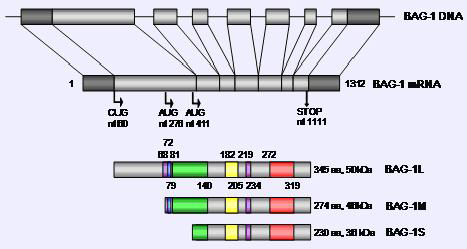
BAG-1 isoforms and their domains. The human BAG-1 gene, located on chromosome 9p12, comprises seven exons which generate an mRNA product of approximately 1.5kb. Three major BAG-1 isoforms are produced from alternative translation start sites within BAG-1 mRNA. The 50kDa BAG-1L isoform is translated from the first in-frame CUG codon by CAP-dependent translation, while BAG-1M and BAG-1S are produced from two downstream AUG codons. BAG-1M is also produced by a CAP-dependent translation mechanism, while BAG-1S is generated by IRES-dependent translation resulting in highest abundance of this short isoform. BAG-1L contains a bipartite nuclear localisation sequence (NLS, purple), the amino-terminal portion of which overlaps with a DNA binding domain (blue). BAG-1M contains a partial NLS, while the NLS is completely absent from BAG-1S. An acidic serine/threonine rich region (green) has been implicated in protein-protein interactions. The ubiquitin-like domain (yellow) and BAG domain (red) are present in all three isoforms.
Description
Three isoforms generated by alternative translation initiation; 50kDa (BAG-1L), 46kDa (BAG-1M) and 36kDa (BAG-1S)(Yang et al., 1998). Each BAG-1 isoform contains a conserved BAG domain and ubiquitin-like domain, with variation in length of their N-terminal sequences.
Expression
Expressed ubiquitously and found to be over-expressed in a number of cancers.
Localisation
The BAG-1 isoforms differ in their subcellular localisation. BAG-1L is predominantly nuclear, BAG-1M is both nuclear and cytoplasmic and BAG-1S is predominantly cytoplasmic (Packham et al., 1997; Takayama et al., 1998; Yang et al., 1998; Brimmell et al., 1999). However, subcellular localisation can be cell type and context dependent, for example in response to heat shock and hormonal stimulation (Schneikert et al., 1999; Zeiner et al., 1999).
Function
Multifunctional protein: Identified as having a role in many different cellular processes including the regulation of apoptosis, proliferation, transcription, proteasome-mediated degradation and a possible role in motility and metastasis (reviewed in Cutress et al., 2003). BAG-1 affects many cellular processes through interaction with a wide variety of cellular proteins, summarised in the table 1.
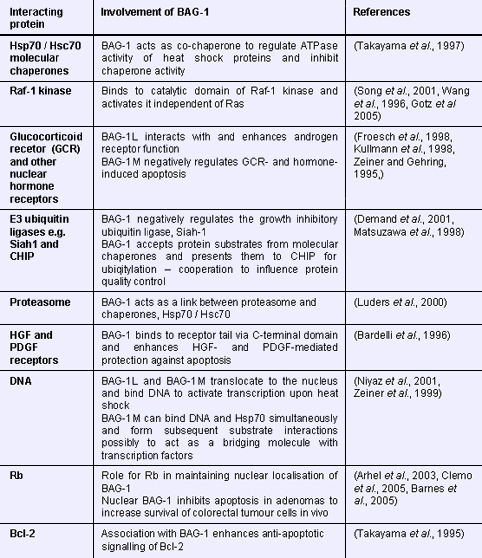
Table 1. Summary of proteins that interact with BAG-1 and some of the reported cellular functions. BAG-1 associates with a wide range of proteins and through these interactions may have multiple cellular effects, any of which might contribute to cancerous cell phenotypes.
Mutations
Note
Unknown
Implicated in
Entity name
Various cancers
Disease
BAG-1 expression is frequently altered in human cancer (Townsend et al., 2003). It has been shown to be over-expressed relative to normal cells in a number of cancers including breast cancer (Tang et al., 1999), colorectal cancer (Kikuchi et al., 2002; Clemo et al. 2008) and human squamous cell carcinoma(Shindoh et al., 2000), endometrial cancer(Moriyama et al., 2004), prostate cancer (Krajewska et al., 2006) and lung cancer (Rorke et al., 2001). Altered expression has been found in pre-malignant lesions (Clemo et al., 2008), implicating a role early in tumour development. BAG-1 has also been suggested to be involved in metastatic disease (Takaoka et al., 1997; Yawata et al., 1998; Hague et al., 2002, reviewed by Sharp et al., 2004).
Prognosis
BAG-1 expression has been shown to be a prognostic factor in a number of cancers. Kikuchi et al (2002) showed in colorectal cancer, that high nuclear BAG-1 expression resulted in a poorer prognosis and a higher risk of metastases. In oesophageal cancer, BAG-1 expression has also been linked to poor prognosis (Takeno et al., 2007). In breast cancer over-expression of BAG-1 has been suggested to be a poor prognostic factor (Krajewski et al., 1999). However, there is conflicting data, with some studies finding increased BAG-1 expression results in a good prognosis (Turner et al., 2001; Nadler et al., 2008), or establishing no link between expression and prognosis (Sjostrom et al., 2002; Tang et al., 2004).
Article Bibliography
| Pubmed ID | Last Year | Title | Authors |
|---|---|---|---|
| 12845674 | 2003 | The retinoblastoma protein interacts with Bag-1 in human colonic adenoma and carcinoma derived cell lines. | Arhel NJ et al |
| 8947043 | 1996 | HGF receptor associates with the anti-apoptotic protein BAG-1 and prevents cell death. | Bardelli A et al |
| 15843891 | 2005 | Nuclear BAG-1 expression inhibits apoptosis in colorectal adenoma-derived epithelial cells. | Barnes JD et al |
| 10576663 | 1999 | High level expression of differentially localized BAG-1 isoforms in some oestrogen receptor-positive human breast cancers. | Brimmell M et al |
| 16042572 | 2005 | The role of the retinoblastoma protein (Rb) in the nuclear localization of BAG-1: implications for colorectal tumour cell survival. | Clemo NK et al |
| 18204076 | 2008 | BAG-1 is up-regulated in colorectal tumour progression and promotes colorectal tumour cell survival through increased NF-kappaB activity. | Clemo NK et al |
| 12902980 | 2003 | The nuclear BAG-1 isoform, BAG-1L, enhances oestrogen-dependent transcription. | Cutress RI et al |
| 11676916 | 2001 | Cooperation of a ubiquitin domain protein and an E3 ubiquitin ligase during chaperone/proteasome coupling. | Demand J et al |
| 9565586 | 1998 | BAG-1L protein enhances androgen receptor function. | Froesch BA et al |
| 16116448 | 2005 | Bag1 is essential for differentiation and survival of hematopoietic and neuronal cells. | Götz R et al |
| 12081206 | 2002 | Deregulated Bag-1 protein expression in human oral squamous cell carcinomas and lymph node metastases. | Hague A et al |
| 12402153 | 2002 | Nuclear BAG-1 expression reflects malignant potential in colorectal carcinomas. | Kikuchi R et al |
| 16482527 | 2006 | Expression of BAG-1 protein correlates with aggressive behavior of prostate cancers. | Krajewska M et al |
| 10732784 | 1999 | Prognostic significance of apoptosis regulators in breast cancer. | Krajewski S et al |
| 9603979 | 1998 | RAP46 is a negative regulator of glucocorticoid receptor action and hormone-induced apoptosis. | Kullmann M et al |
| 11340068 | 2001 | BAG-1 is a novel cytoplasmic binding partner of the membrane form of heparin-binding EGF-like growth factor: a unique role for proHB-EGF in cell survival regulation. | Lin J et al |
| 10809723 | 2000 | Distinct isoforms of the cofactor BAG-1 differentially affect Hsc70 chaperone function. | Lüders J et al |
| 9582267 | 1998 | p53-inducible human homologue of Drosophila seven in absentia (Siah) inhibits cell growth: suppression by BAG-1. | Matsuzawa S et al |
| 15297164 | 2004 | BAG-1 expression in normal and neoplastic endometrium. | Moriyama T et al |
| 18430249 | 2008 | Expression patterns and prognostic value of Bag-1 and Bcl-2 in breast cancer. | Nadler Y et al |
| 11329370 | 2001 | Transcriptional activation by the human Hsp70-associating protein Hap50. | Niyaz Y et al |
| 9396724 | 1997 | Mammalian cells express two differently localized Bag-1 isoforms generated by alternative translation initiation. | Packham G et al |
| 11494232 | 2001 | Prognostic significance of BAG-1 expression in nonsmall cell lung cancer. | Rorke S et al |
| 10477749 | 1999 | A nuclear action of the eukaryotic cochaperone RAP46 in downregulation of glucocorticoid receptor activity. | Schneikert J et al |
| 15033003 | 2004 | BAG-1 in carcinogenesis. | Sharp A et al |
| 10964051 | 2000 | BAG-1 expression correlates highly with the malignant potential in early lesions (T1 and T2) of oral squamous cell carcinoma. | Shindoh M et al |
| 11895913 | 2002 | The predictive value of bcl-2, bax, bcl-xL, bag-1, fas, and fasL for chemotherapy response in advanced breast cancer. | Sjöström J et al |
| 11231577 | 2001 | Bag1-Hsp70 mediates a physiological stress signalling pathway that regulates Raf-1/ERK and cell growth. | Song J et al |
| 9205104 | 1997 | Anti-cell death activity promotes pulmonary metastasis of melanoma cells. | Takaoka A et al |
| 9679980 | 1998 | Expression and location of Hsp70/Hsc-binding anti-apoptotic protein BAG-1 and its variants in normal tissues and tumor cell lines. | Takayama S et al |
| 17260107 | 2007 | Assessment of clinical outcome in patients with esophageal squamous cell carcinoma using TNM classification score and molecular biological classification. | Takeno S et al |
| 15026618 | 2004 | BAG-1 expression correlates with Bcl-2, p53, differentiation, estrogen and progesterone receptors in invasive breast carcinoma. | Tang SC et al |
| 15474970 | 2005 | BAG-1: a multi-functional pro-survival molecule. | Townsend PA et al |
| 11181661 | 2001 | BAG-1: a novel biomarker predicting long-term survival in early-stage breast cancer. | Turner BC et al |
| 8692945 | 1996 | Bcl-2 interacting protein, BAG-1, binds to and activates the kinase Raf-1. | Wang HG et al |
| 9747877 | 1998 | Human BAG-1/RAP46 protein is generated as four isoforms by alternative translation initiation and overexpressed in cancer cells. | Yang X et al |
| 9632144 | 1998 | Prolonged cell survival enhances peritoneal dissemination of gastric cancer cells. | Yawata A et al |
| 8524784 | 1995 | A protein that interacts with members of the nuclear hormone receptor family: identification and cDNA cloning. | Zeiner M et al |
| 10468585 | 1999 | The hsp70-associating protein Hap46 binds to DNA and stimulates transcription. | Zeiner M et al |
Other Information
Locus ID:
NCBI: 573
MIM: 601497
HGNC: 937
Ensembl: ENSG00000107262
Variants:
dbSNP: 573
ClinVar: 573
TCGA: ENSG00000107262
COSMIC: BAG1
RNA/Proteins
Expression (GTEx)
Pathways
Protein levels (Protein atlas)
References
| Pubmed ID | Year | Title | Citations |
|---|---|---|---|
| 34995286 | 2022 | CRISPR/Cas9-mediated Bag-1 knockout increased mesenchymal characteristics of MCF-7 cells via Akt hyperactivation-mediated actin cytoskeleton remodeling. | 2 |
| 34995286 | 2022 | CRISPR/Cas9-mediated Bag-1 knockout increased mesenchymal characteristics of MCF-7 cells via Akt hyperactivation-mediated actin cytoskeleton remodeling. | 2 |
| 32400287 | 2021 | Genes involved in glucocorticoid receptor signalling affect susceptibility to mood disorders. | 3 |
| 32447321 | 2021 | Integrated case-control and somatic-germline interaction analyses of soft-tissue sarcoma. | 2 |
| 33152339 | 2021 | Mutation of the BAG-1 domain decreases its protective effect against hypoxia/reoxygenation by regulating HSP70 and the PI3K/AKT signalling pathway in SY-SH5Y cells. | 1 |
| 33561998 | 2021 | Co-Chaperone Bag-1 Plays a Role in the Autophagy-Dependent Cell Survival through Beclin 1 Interaction. | 7 |
| 33581726 | 2021 | Expression of BAG1 is associated with prognosis in kidney renal clear cell carcinoma based on bioinformatics. | 1 |
| 34056003 | 2021 | Bag-1L Protects against Cell Apoptosis in an In Vitro Model of Lung Ischemia-Reperfusion Injury through the C-Terminal "Bag" Domain. | 0 |
| 32400287 | 2021 | Genes involved in glucocorticoid receptor signalling affect susceptibility to mood disorders. | 3 |
| 32447321 | 2021 | Integrated case-control and somatic-germline interaction analyses of soft-tissue sarcoma. | 2 |
| 33152339 | 2021 | Mutation of the BAG-1 domain decreases its protective effect against hypoxia/reoxygenation by regulating HSP70 and the PI3K/AKT signalling pathway in SY-SH5Y cells. | 1 |
| 33561998 | 2021 | Co-Chaperone Bag-1 Plays a Role in the Autophagy-Dependent Cell Survival through Beclin 1 Interaction. | 7 |
| 33581726 | 2021 | Expression of BAG1 is associated with prognosis in kidney renal clear cell carcinoma based on bioinformatics. | 1 |
| 34056003 | 2021 | Bag-1L Protects against Cell Apoptosis in an In Vitro Model of Lung Ischemia-Reperfusion Injury through the C-Terminal "Bag" Domain. | 0 |
| 31609014 | 2020 | Inhibition of BAG-1 induced SH-SY5Y cell apoptosis without affecting Hsp70 expression. | 0 |
Citation
Samantha L Southern ; Victoria Skeen ; Ann C Williams.
BAG1 (BCL2-associated athanogene)
Atlas Genet Cytogenet Oncol Haematol. 2008-11-01
Online version: http://atlasgeneticsoncology.org/gene/742/bag1
