BARD1 (BRCA1 associated RING domain 1)
2007-02-01 Irmgard Irminger-Finger AffiliationBiology of Aging Laboratory, Dept of Geriatrics, Dept of Gynecology, Obstetrics, Geneva University, University Hospitals, 30, Bloulevard de la Cluse, CH-1211 Geneva, Switzerland
DNA/RNA
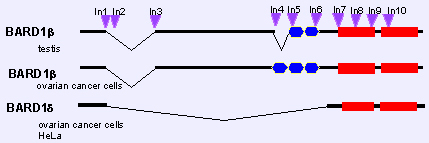
BARD1 structure is presented with RING finger (green) ankyrin repeats (ANK, blue) and BRCT domains (red). Positions of introns (in) are indicated. Structures of splice variants are shown for BARD1beta from the rat (Feki et al., 2004), BARD1delta (Feki et al., 2005; Tsuzuki et al., 2006).
Description
The gene spans 81 kb, composed of 11 exons. Alternatively spliced isoforms are identified.
Insert known isoforms:
BARD1beta (rat testis)
BARD1delta (rat ovarian cancer cells)
BARD1delta (HeLa)
BARD1delta (rat ovarian cancer cells)
Insert known isoforms:
BARD1beta (rat testis)
BARD1delta (rat ovarian cancer cells)
BARD1delta (HeLa)
BARD1delta (rat ovarian cancer cells)
Transcription
Transcription start is 100 bp upstream of first ATG of the BARD1 ORF. There a two 3ends reported and possibly two alternative polyadenylation sites. BARD1 is expressed in most proliferative tissues. Highest expression in testis and spleen. No expression the central nervous system.
Pseudogene
No pseudogenes reported.
Proteins

Mouse and human BARD1 protein sequences are shown schematically. RING finger domains (gren), Ankyrin repeats (ANK, blue), BRCT domains (red), nulear localization signals (light blue). Homology between human and mouse BARD1 is indicated in perentage of identical amino acids for structural regions.
Description
Human BARD1 777 amino acids ; Structural motifs: RING, 5 Ankyrin repeats, 2 BRCT domains
Expression
In the mouse BARD1 is expressed in most proliferative tissues. Highest expression in testis and spleen, no expression in nervous system.
During mouse development BARD1 is expressed in early embryogenesis and declines after day 9.
During mouse development BARD1 is expressed in early embryogenesis and declines after day 9.
Localisation
During S-phase BARD1 localizes to nuclear dots. Partially, BARD1 is also localized to the cytoplasm in response to stress.
Function
BARD1 functions as heterodimer with BRCA1 as ubiquitin ligase. Several targets of the BARD1-BRCA1 ubiquitin ligase have been identified and suggest its implication in DNA repair, polyadenylation, cell cycle control, and mitosis.
BARD1 acts as inducer of apoptosis, independently of BRCA1, by binding to p53, and by binding to the stress response kinase DNA-PK, facilitating p53 phosphorylation and stabilization. Thus BARD1 acts as signaling molecule from genotoxic stress towards p53-dependent apoptosis.
BARD1 acts as inducer of apoptosis, independently of BRCA1, by binding to p53, and by binding to the stress response kinase DNA-PK, facilitating p53 phosphorylation and stabilization. Thus BARD1 acts as signaling molecule from genotoxic stress towards p53-dependent apoptosis.
Homology
BARD1 is homologous to BRCA1, regarding the N-terminal RING finger and the C-terminal BRCT domains. Weak homology between BARD1 and BRCA1 can be found throughout exon 1 to exon 4. and from exon 7 through exon 11, with conserved intron-exon junctions.
Mutations
Note
Several mutations of BARD1 have been identified in breast and ovarian cancers. Three mutations have been reported associated with inherited predisposition to breast and ovarian cancer.
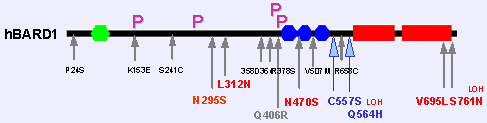
BARD1 mutations associated with cancer. Small mutations are not unambiguously identified as cancer causing mutations, long arrows red labeled mutations are accepted as cancer associated. Blue indication maps germ line mutations. Q406R, might be cancer associated.
Germinal
Germline mutations were reported for C557S and Q564H.
Somatic
Several somatic mutation were reported in addition to C557S and Q564H:
Implicated in
Entity name
Breast and/or ovarian cancer
Note
Upregulated expression of truncated BARD1 in epithelial cancers.
Prognosis
Upregulated BARD1 is correlated with poor prognosis in breast and ovarian cancer.
Cytogenetics
No determined
Hybrid gene
Not determined
Fusion protein
No fusion proteins reported
Entity name
Ovarian cancer
Prognosis
Upregulated BARD1 is correlated with poor prognosis in breast and ovarian cancer.
Hybrid gene
No
Fusion protein
No fusion proteins reported
Entity name
Lung cancer
Prognosis
Upregulated BARD1 is correlated with poor prognosis in breast and ovarian cancer.
Hybrid gene
No
Fusion protein
No fusion proteins reported
Article Bibliography
| Pubmed ID | Last Year | Title | Authors |
|---|---|---|---|
| 9798686 | 1998 | Conservation of function and primary structure in the BRCA1-associated RING domain (BARD1) protein. | Ayi TC et al |
| 11573085 | 2001 | Structure of a BRCA1-BARD1 heterodimeric RING-RING complex. | Brzovic PS et al |
| 11927591 | 2002 | Autoubiquitination of the BRCA1*BARD1 RING ubiquitin ligase. | Chen A et al |
| 9774970 | 1998 | Stable interaction between the products of the BRCA1 and BRCA2 tumor suppressor genes in mitotic and meiotic cells. | Chen J et al |
| 12154023 | 2002 | The BRCA1 and BARD1 association with the RNA polymerase II holoenzyme. | Chiba N et al |
| 15855157 | 2005 | Hyperphosphorylation of the BARD1 tumor suppressor in mitotic cells. | Choudhury AD et al |
| 10362352 | 1999 | The Bcl-3 oncoprotein acts as a bridging factor between NF-kappaB/Rel and nuclear co-regulators. | Dechend R et al |
| 11925436 | 2002 | BARD1 induces BRCA1 intranuclear foci formation by increasing RING-dependent BRCA1 nuclear import and inhibiting BRCA1 nuclear export. | Fabbro M et al |
| 15159397 | 2004 | BRCA1-BARD1 complexes are required for p53Ser-15 phosphorylation and a G1/S arrest following ionizing radiation-induced DNA damage. | Fabbro M et al |
| 15265711 | 2004 | BARD1 regulates BRCA1 apoptotic function by a mechanism involving nuclear retention. | Fabbro M et al |
| 15782130 | 2005 | BARD1 induces apoptosis by catalysing phosphorylation of p53 by DNA-damage response kinase. | Feki A et al |
| 11156388 | 2000 | Identification of an apoptotic cleavage product of BARD1 as an autoantigen: a potential factor in the antitumoral response mediated by apoptotic bodies. | Gautier F et al |
| 11807980 | 2002 | Germline mutations of the BRCA1-associated ring domain (BARD1) gene in breast and breast/ovarian families negative for BRCA1 and BRCA2 alterations. | Ghimenti C et al |
| 16007073 | 2005 | Role of nucleophosmin in embryonic development and tumorigenesis. | Grisendi S et al |
| 11278247 | 2001 | The RING heterodimer BRCA1-BARD1 is a ubiquitin ligase inactivated by a breast cancer-derived mutation. | Hashizume R et al |
| 15665273 | 2005 | Down-regulation of BRCA1-BARD1 ubiquitin ligase by CDK2. | Hayami R et al |
| 16633366 | 2006 | Is there more to BARD1 than BRCA1? | Irminger-Finger I et al |
| 14550946 | 2003 | Mutational analysis of BARD1 in familial breast cancer patients in Japan. | Ishitobi M et al |
| 15077185 | 2004 | Nuclear-cytoplasmic translocation of BARD1 is linked to its apoptotic activity. | Jefford CE et al |
| 17081976 | 2006 | The BRCA1/BARD1 heterodimer modulates ran-dependent mitotic spindle assembly. | Joukov V et al |
| 16825437 | 2006 | Nordic collaborative study of the BARD1 Cys557Ser allele in 3956 patients with cancer: enrichment in familial BRCA1/BRCA2 mutation-negative breast cancer but not in other malignancies. | Karppinen SM et al |
| 15905410 | 2005 | BRCA1/BARD1 inhibition of mRNA 3' processing involves targeted degradation of RNA polymerase II. | Kleiman FE et al |
| 17185394 | 2007 | Ubiquitination and proteasome-mediated degradation of BRCA1 and BARD1 during steroidogenesis in human ovarian granulosa cells. | Lu Y et al |
| 12485996 | 2002 | Activation of the E3 ligase function of the BRCA1/BARD1 complex by polyubiquitin chains. | Mallery DL et al |
| 12832489 | 2003 | Loss of Bard1, the heterodimeric partner of the Brca1 tumor suppressor, results in early embryonic lethality and chromosomal instability. | McCarthy EE et al |
| 11773071 | 2002 | Identification of residues required for the interaction of BARD1 with BRCA1. | Morris JR et al |
| 14976165 | 2004 | BRCA1 : BARD1 induces the formation of conjugated ubiquitin structures, dependent on K6 of ubiquitin, in cells during DNA replication and repair. | Morris JR et al |
| 11799067 | 2002 | E2F integrates cell cycle progression with DNA repair, replication, and G(2)/M checkpoints. | Ren B et al |
| 14647430 | 2004 | Nuclear-cytoplasmic shuttling of BARD1 contributes to its proapoptotic activity and is regulated by dimerization with BRCA1. | Rodriguez JA et al |
| 15184379 | 2004 | Nucleophosmin/B23 is a candidate substrate for the BRCA1-BARD1 ubiquitin ligase. | Sato K et al |
| 15632137 | 2005 | Nuclear targeting and cell cycle regulatory function of human BARD1. | Schüchner S et al |
| 9159119 | 1997 | BRCA1 is a component of the RNA polymerase II holoenzyme. | Scully R et al |
| 9267023 | 1997 | Dynamic changes of BRCA1 subnuclear location and phosphorylation state are initiated by DNA damage. | Scully R et al |
| 12183411 | 2002 | Interaction of the EWS NH2 terminus with BARD1 links the Ewing's sarcoma gene to a common tumor suppressor pathway. | Spahn L et al |
| 16768547 | 2006 | The BARD1 Cys557Ser variant and breast cancer risk in Iceland. | Stacey SN et al |
| 15886201 | 2005 | BRCA1/BARD1 ubiquitinate phosphorylated RNA polymerase II. | Starita LM et al |
| 15485900 | 2004 | Genetic steps of mammalian homologous repair with distinct mutagenic consequences. | Stark JM et al |
| 9425226 | 1998 | Mutations in the BRCA1-associated RING domain (BARD1) gene in primary breast, ovarian and uterine cancers. | Thai TH et al |
| 15878232 | 2006 | A truncated splice variant of human BARD1 that lacks the RING finger and ankyrin repeats. | Tsuzuki M et al |
| 16333312 | 2006 | BARD1 variants Cys557Ser and Val507Met in breast cancer predisposition. | Vahteristo P et al |
| 14560035 | 2003 | BARD1 participates with BRCA1 in homology-directed repair of chromosome breaks. | Westermark UK et al |
| 16152612 | 2006 | Aberrant expression of BARD1 in breast and ovarian cancers with poor prognosis. | Wu JY et al |
| 8944023 | 1996 | Identification of a RING protein that can interact in vivo with the BRCA1 gene product. | Wu LC et al |
Other Information
Locus ID:
NCBI: 580
MIM: 601593
HGNC: 952
Ensembl: ENSG00000138376
Variants:
dbSNP: 580
ClinVar: 580
TCGA: ENSG00000138376
COSMIC: BARD1
RNA/Proteins
Expression (GTEx)
Pathways
Protein levels (Protein atlas)
PharmGKB
| Entity ID | Name | Type | Evidence | Association | PK | PD | PMIDs |
|---|---|---|---|---|---|---|---|
| PA443560 | Breast Neoplasms | Disease | ClinicalAnnotation | associated | PD | 30071039 | |
| PA448803 | carboplatin | Chemical | ClinicalAnnotation | associated | PD | 30071039 | |
| PA449383 | docetaxel | Chemical | ClinicalAnnotation | associated | PD | 30071039 | |
| PA451743 | trastuzumab | Chemical | ClinicalAnnotation | associated | PD | 30071039 |
References
| Pubmed ID | Year | Title | Citations |
|---|---|---|---|
| 37418175 | 2024 | Structural dynamics of clinically-reported VUS in the BARD1 ARD-BRCT region to predict the molecular basis of alterations. | 0 |
| 37688570 | 2024 | BARD1 germline variants induce haploinsufficiency and DNA repair defects in neuroblastoma. | 4 |
| 37688579 | 2024 | Germline pathogenic variants in neuroblastoma patients are enriched in BARD1 and predict worse survival. | 2 |
| 38266639 | 2024 | BLM and BRCA1-BARD1 coordinate complementary mechanisms of joint DNA molecule resolution. | 1 |
| 37418175 | 2024 | Structural dynamics of clinically-reported VUS in the BARD1 ARD-BRCT region to predict the molecular basis of alterations. | 0 |
| 37688570 | 2024 | BARD1 germline variants induce haploinsufficiency and DNA repair defects in neuroblastoma. | 4 |
| 37688579 | 2024 | Germline pathogenic variants in neuroblastoma patients are enriched in BARD1 and predict worse survival. | 2 |
| 38266639 | 2024 | BLM and BRCA1-BARD1 coordinate complementary mechanisms of joint DNA molecule resolution. | 1 |
| 37561379 | 2023 | Association of BARD1 and BRIP1 Gene Polymorphisms with the Risk of Uveal Melanoma. | 1 |
| 37592023 | 2023 | Exome sequencing identifies breast cancer susceptibility genes and defines the contribution of coding variants to breast cancer risk. | 7 |
| 37823591 | 2023 | BRCA1-BARD1 combines multiple chromatin recognition modules to bridge nascent nucleosomes. | 2 |
| 37561379 | 2023 | Association of BARD1 and BRIP1 Gene Polymorphisms with the Risk of Uveal Melanoma. | 1 |
| 37592023 | 2023 | Exome sequencing identifies breast cancer susceptibility genes and defines the contribution of coding variants to breast cancer risk. | 7 |
| 37823591 | 2023 | BRCA1-BARD1 combines multiple chromatin recognition modules to bridge nascent nucleosomes. | 2 |
| 35203293 | 2022 | RNAi Screening Uncovers a Synthetic Sick Interaction between CtIP and the BARD1 Tumor Suppressor. | 0 |
Citation
Irmgard Irminger-Finger
BARD1 (BRCA1 associated RING domain 1)
Atlas Genet Cytogenet Oncol Haematol. 2007-02-01
Online version: http://atlasgeneticsoncology.org/gene/756/bard1
