CD82 (CD82 molecule)
2009-06-01 Yanhui H Zhang , Mekel M Richardson , Feng Zhang , Xin A Zhang AffiliationVascular Biology, Cancer Centers, Departments of Medicine, Molecular Science, University of Tennessee Health Science Center, Memphis TN 38163, USA
Identity
HGNC
LOCATION
11p11.2
IMAGE

LOCUSID
ALIAS
4F9,C33,GR15,IA4,KAI1,R2,SAR2,ST6,TSPAN27
FUSION GENES
DNA/RNA
Note
We do notice that, in literature, there is one more splicing variant with functional importance (Lee et al., 2003). In this variant, the 84bp exon that encodes the amino acids 215-242 of CD82/kAI1 protein is selectively deleted. However, the chromosome location and exon numbers of this splicing variant described in the publication are not consistent with those for the other two splicing variants herein. There is no gene accession number be assigned to this slicing variant. Thus, this variant is not presented in the following diagram.

NM_002231 encodes the longer isoform, i.e., CD82 wild type; NM_001024844 encodes a shorter isoform, which lacks exon 6.
Description
Gene type: protein coding.
Gene size: 54.2 kb.
Two splicing variants in addition to wild type (NM_002231 or CD82 wild type consists of 10 exons; NM_001024844 or the splicing variant lacking exon 6 and the splicing variant likely lacking exon 8 consist of 9 exons).
Gene size: 54.2 kb.
Two splicing variants in addition to wild type (NM_002231 or CD82 wild type consists of 10 exons; NM_001024844 or the splicing variant lacking exon 6 and the splicing variant likely lacking exon 8 consist of 9 exons).
Transcription
Transcript length: NM_002231 is 1715 bp; NM_001024844 is 1640 bp; and the splicing variant likely lacking exon 8 is 1631 bp.
Proteins
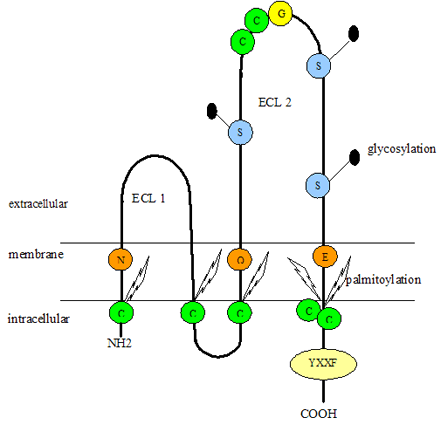
CD82 is a 4-transmembrane glycoprotein and belongs to the tetraspanin superfamily. This family of proteins is characterized by the conservation of several motifs located within the extracellular and transmembrane domains. CD82 undergoes two types of post-translational modifications: glycosylation at its large extracellular loop and palmitoylation at the cysteine residues in or near cytoplasmic domains.
Description
Size: 267 amino acids.
Because of the glycosylation, the molecular weight of CD82 proteins ranges between 30-90 kDa depending on tissue and cell types.
Because of the glycosylation, the molecular weight of CD82 proteins ranges between 30-90 kDa depending on tissue and cell types.
Expression
CD82 is ubiquitously expressed in various human tissues such as epithelium and endothelium. CD82 expression is frequently diminished or lost in invasive and metastatic solid-tumor tissues.
Localisation
CD82 is found in the plasma membrane, endosomes, lysosomes, and exosomes.
Function
In relation to cancer, CD82 function is to inhibit tumor invasion and suppresses tumor metastasis. Palmitoylation is essential for CD82 function as well as the presence of three polar residues, NQE, located within its transmembrane domains. CD82 associates with other transmembrane proteins such as tetraspanins, integrins, Ig superfamily members, and growth factor receptors and intracellular signaling proteins to regulate membrane microdomain organization, vesicular trafficking, and transmembrane signaling.
Homology
Mouse and other human tetraspanins.
Mutations
Note
Currently there is no report for the disease-related or biologically significant mutation for CD82 gene (See HGMD).
Implicated in
Entity name
Prostate cancer, breast cancer, pancreatic cancer, gastric cancer, bladder cancer, ovarian cancers, non-small-cell lung carcinoma, hepatocellular carcinoma, oral squamous cell carcinoma, and other solid tumors.
Note
Invasion and metastasis suppression.
CD82 is expressed in many normal tissues such as epithelia. In invasive or metastatic cancers, CD82 expression is typically reduced or lost. In most of the solid tumors studied so far, CD82 expression is inversely correlated with the invasive and metastatic abilities of malignant tumors.
The metastasis-suppressive effect of CD82 can be observed in the animal studies of cancer metastasis by re-introducing CD82 expression in various metastatic cancer cell lines such as prostate cancer AT6.1, prostate cancer LNCaP, fibroblastoma HT1080, melanoma MDA-MB-435, breast cancer LCC6, liver cancer MHCC97-H, and lung cancer LLC lines.
The observations of CD82-mediated suppression of cancer metastasis in animal models are supported by a variety of clinical studies on the human cancers from prostate, breast, ovary, colon, lung, stomach, liver, and other organs.
CD82 attenuates the signaling from integrins and growth factor receptors such as epidermal growth factor receptor and c-Met. CD82 also reorganizes the membrane micordomains including tetraspanin webs and lipid rafts. The interaction of CD82 and its counter-receptor DARC inhibits tumor cell proliferation and induces senescence.
CD82 is expressed in many normal tissues such as epithelia. In invasive or metastatic cancers, CD82 expression is typically reduced or lost. In most of the solid tumors studied so far, CD82 expression is inversely correlated with the invasive and metastatic abilities of malignant tumors.
The metastasis-suppressive effect of CD82 can be observed in the animal studies of cancer metastasis by re-introducing CD82 expression in various metastatic cancer cell lines such as prostate cancer AT6.1, prostate cancer LNCaP, fibroblastoma HT1080, melanoma MDA-MB-435, breast cancer LCC6, liver cancer MHCC97-H, and lung cancer LLC lines.
The observations of CD82-mediated suppression of cancer metastasis in animal models are supported by a variety of clinical studies on the human cancers from prostate, breast, ovary, colon, lung, stomach, liver, and other organs.
CD82 attenuates the signaling from integrins and growth factor receptors such as epidermal growth factor receptor and c-Met. CD82 also reorganizes the membrane micordomains including tetraspanin webs and lipid rafts. The interaction of CD82 and its counter-receptor DARC inhibits tumor cell proliferation and induces senescence.
Prognosis
The lower or no expression of CD82 in the tumors from prostate, breast, colon, stomach, bladder, lung, liver, pancreas, ovary, and other organs predicts the poor clinical outcome. Conversely, the expression of CD82 wild type proteins in solid tumors reflects the less invasiveness and low metastatic potential of the tumors.
Article Bibliography
| Pubmed ID | Last Year | Title | Authors |
|---|---|---|---|
| 8620488 | 1996 | Correlation of KAI1/CD82 gene expression with good prognosis in patients with non-small cell lung cancer. | Adachi M et al |
| 16862154 | 2006 | Interaction of KAI1 on tumor cells with DARC on vascular endothelium leads to metastasis suppression. | Bandyopadhyay S et al |
| 19116362 | 2009 | Transmembrane interactions are needed for KAI1/CD82-mediated suppression of cancer invasion and metastasis. | Bari R et al |
| 9126478 | 1997 | Genomic organization of the human KAI1 metastasis-suppressor gene. | Dong JT et al |
| 7754374 | 1995 | KAI1, a metastasis suppressor gene for prostate cancer on human chromosome 11p11.2. | Dong JT et al |
| 8813131 | 1996 | Down-regulation of the KAI1 metastasis suppressor gene during the progression of human prostatic cancer infrequently involves gene mutation or allelic loss. | Dong JT et al |
| 9828210 | 1998 | KAI1, a new metastasis suppressor gene, is reduced in metastatic hepatocellular carcinoma. | Guo XZ et al |
| 1596907 | 1992 | Localization of metastasis suppressor gene(s) for prostatic cancer to the short arm of human chromosome 11. | Ichikawa T et al |
| 15618009 | 2005 | KAI1 tetraspanin and metastasis suppressor. | Jackson P et al |
| 9254900 | 1997 | Location of KAI1 on the short arm of human chromosome 11 and frequency of allelic loss in advanced human prostate cancer. | Kawana Y et al |
| 15829968 | 2005 | Transcriptional regulation of a metastasis suppressor gene by Tip60 and beta-catenin complexes. | Kim JH et al |
| 14612520 | 2003 | Expression of a splice variant of KAI1, a tumor metastasis suppressor gene, influences tumor invasion and progression. | Lee JH et al |
| 11279141 | 2001 | Novel NEMO/IkappaB kinase and NF-kappa B target genes at the pre-B to immature B cell transition. | Li J et al |
| 10873402 | 2000 | Frequent down-regulation and lack of mutation of the KAI1 metastasis suppressor gene in epithelial ovarian carcinoma. | Liu FS et al |
| 16260083 | 2006 | KAI1/CD82, a tumor metastasis suppressor. | Liu WM et al |
| 9736732 | 1998 | The expression of the KAI1 gene, a tumor metastasis suppressor, is directly activated by p53. | Mashimo T et al |
| 18822372 | 2009 | Controlling cell surface dynamics and signaling: how CD82/KAI1 suppresses metastasis. | Miranti CK et al |
| 10327061 | 1999 | A novel molecular staging protocol for non-small cell lung cancer. | Miyake M et al |
| 10964324 | 2000 | Mutation and expression of the metastasis suppressor gene KAI1 in esophageal squamous cell carcinoma. | Miyazaki T et al |
| 10985391 | 2000 | Attenuation of EGF receptor signaling by a metastasis suppressor, the tetraspanin CD82/KAI-1. | Odintsova E et al |
| 18305955 | 2008 | Down-regulation of the metastasis suppressor protein KAI1/CD82 correlates with occurrence of metastasis, prognosis and presence of HPV DNA in human penile squamous cell carcinoma. | Protzel C et al |
| 11212267 | 2001 | Nuclear factor-kappaB-dependent expression of metastasis suppressor KAI1/CD82 gene in lung cancer cell lines expressing mutant p53. | Shinohara T et al |
| 19242414 | 2009 | Learning therapeutic lessons from metastasis suppressor proteins. | Smith SC et al |
| 16331263 | 2006 | Tetraspanin KAI1/CD82 suppresses invasion by inhibiting integrin-dependent crosstalk with c-Met receptor and Src kinases. | Sridhar SC et al |
| 10551326 | 1999 | Down-regulation of KAI1 messenger RNA expression is not associated with loss of heterozygosity of the KAI1 gene region in lung adenocarcinoma. | Tagawa K et al |
| 17215249 | 2007 | Ganglioside GM2-tetraspanin CD82 complex inhibits met and its cross-talk with integrins, providing a basis for control of cell motility through glycosynapse. | Todeschini AR et al |
| 16271511 | 2005 | CD82 metastasis suppressor gene: a potential target for new therapeutics? | Tonoli H et al |
| 18037895 | 2007 | The ubiquitin ligase gp78 promotes sarcoma metastasis by targeting KAI1 for degradation. | Tsai YC et al |
| 8909232 | 1996 | Expression of the KAI1 protein in benign prostatic hyperplasia and prostate cancer. | Ueda T et al |
| 11895916 | 2002 | High prevalence of decreased expression of KAI1 metastasis suppressor in human oral carcinogenesis. | Uzawa K et al |
| 9671393 | 1998 | Frequent downregulation of the KAI1(CD82) metastasis suppressor protein in human cancer cell lines. | White A et al |
| 19497983 | 2009 | CD82 endocytosis and cholesterol-dependent reorganization of tetraspanin webs and lipid rafts. | Xu C et al |
| 11431371 | 2001 | Overexpression of KAI1 suppresses in vitro invasiveness and in vivo metastasis in breast cancer cells. | Yang X et al |
| 9815782 | 1997 | Loss of KAI1 messenger RNA expression in both high-grade and invasive human bladder cancers. | Yu Y et al |
| 12738793 | 2003 | Requirement of the p130CAS-Crk coupling for metastasis suppressor KAI1/CD82-mediated inhibition of cell migration. | Zhang XA et al |
| 15492270 | 2004 | The palmitoylation of metastasis suppressor KAI1/CD82 is important for its motility- and invasiveness-inhibitory activity. | Zhou B et al |
Other Information
Locus ID:
NCBI: 3732
MIM: 600623
HGNC: 6210
Ensembl: ENSG00000085117
Variants:
dbSNP: 3732
ClinVar: 3732
TCGA: ENSG00000085117
COSMIC: CD82
RNA/Proteins
Expression (GTEx)
Pathways
| Pathway | Source | External ID |
|---|---|---|
| p53 signaling pathway | KEGG | ko04115 |
| p53 signaling pathway | KEGG | hsa04115 |
Protein levels (Protein atlas)
References
| Pubmed ID | Year | Title | Citations |
|---|---|---|---|
| 38473906 | 2024 | Tetraspanin CD82 Correlates with and May Regulate S100A7 Expression in Oral Cancer. | 0 |
| 38515751 | 2024 | CD81 and CD82 expressing tumor-infiltrating lymphocytes in the NSCLC tumor microenvironment play a crucial role in T-cell activation and cytokine production. | 1 |
| 38821592 | 2024 | DNA Hypermethylation Inhibits the CD82 Metastasis Suppressor Gene in Gastric Cancer. | 0 |
| 38473906 | 2024 | Tetraspanin CD82 Correlates with and May Regulate S100A7 Expression in Oral Cancer. | 0 |
| 38515751 | 2024 | CD81 and CD82 expressing tumor-infiltrating lymphocytes in the NSCLC tumor microenvironment play a crucial role in T-cell activation and cytokine production. | 1 |
| 38821592 | 2024 | DNA Hypermethylation Inhibits the CD82 Metastasis Suppressor Gene in Gastric Cancer. | 0 |
| 37434585 | 2023 | Tetraspanin CD82 Associates with Trafficking Vesicle in Muscle Cells and Binds to Dysferlin and Myoferlin. | 0 |
| 37434585 | 2023 | Tetraspanin CD82 Associates with Trafficking Vesicle in Muscle Cells and Binds to Dysferlin and Myoferlin. | 0 |
| 35728771 | 2022 | Proteomic profiling of plasma exosomes reveals CD82 involvement in the development of esophageal squamous cell carcinoma. | 2 |
| 35942551 | 2022 | Lower expression of KAI1 as a biomarker of poor survival prognosis of melanoma combined with colorectal cancer metastasis. | 1 |
| 36595821 | 2022 | Expression of KAI1 and AGR2 in lung adenocarcinoma and their clinicopathological significance. | 1 |
| 35728771 | 2022 | Proteomic profiling of plasma exosomes reveals CD82 involvement in the development of esophageal squamous cell carcinoma. | 2 |
| 35942551 | 2022 | Lower expression of KAI1 as a biomarker of poor survival prognosis of melanoma combined with colorectal cancer metastasis. | 1 |
| 36595821 | 2022 | Expression of KAI1 and AGR2 in lung adenocarcinoma and their clinicopathological significance. | 1 |
| 33605572 | 2021 | The Role of CK7, S100A1, and CD82 (KAI1) Expression in the Differential Diagnosis of Chromophobe Renal Cell Carcinoma and Renal Oncocytoma. | 1 |
Citation
Yanhui H Zhang ; Mekel M Richardson ; Feng Zhang ; Xin A Zhang
CD82 (CD82 molecule)
Atlas Genet Cytogenet Oncol Haematol. 2009-06-01
Online version: http://atlasgeneticsoncology.org/gene/41045/cd82
