CD9 (CD9 molecule)
2009-08-01 Laure Humbert , Mario Chevrette AffiliationThe Research Institute of the McGill University Health Centre, McGill University, Montreal, QC, Canada
Identity
HGNC
LOCATION
12p13.31
LOCUSID
ALIAS
BTCC-1,DRAP-27,MIC3,MRP-1,TSPAN-29,TSPAN29
FUSION GENES
DNA/RNA
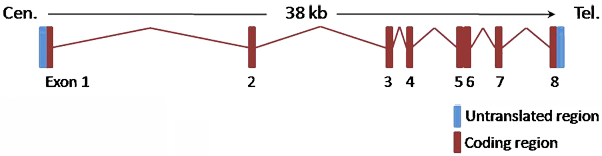
Genomic organisation of the CD9 gene on chromosome 12.
Description
The gene spans 38 kb of DNA, including a 10 kb intron separating the first two exons. CD9 encodes 8 exons, ranging from 63 to 109 base pairs. The coding sequence is highly conserved between species. The promoter contains neither TATA nor CAAT boxes, but does contain several consensus sequences for the binding of transcription factors (GATA, ETS, E2F, NF-kB, AP2) as well as three putative Sp1 binding sites.
Transcription
The CD9 transcribed RNA has 1246 bases, of which 684 bases (from 112 (Met) to 795 (Val)) encode the protein.
Pseudogene
None.
Proteins
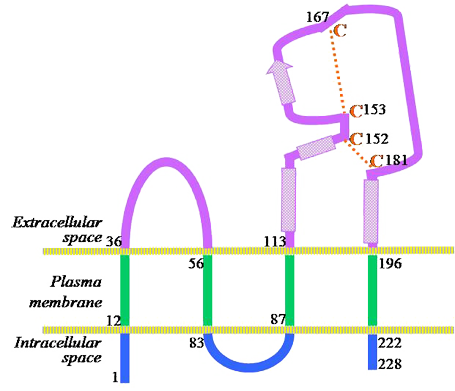
Structure of the CD9 protein.
Description
CD9 is a member of the transmembrane 4 superfamily, also called the tetraspanin family. As other tetraspanins, CD9 is a cell-surface protein containing four hydrophobic transmembrane domains (indicated in green) and two extracellular domains (illustrated in violet). CD9 consists of 228 amino acids and weighs 24-27 kDa. CD9 contains four small and highly conserved hydrophobic transmembrane domains (24-27 amino acids); a small N-terminal (11 amino acids) and a C-terminal cytoplasmic (7 amino acids) tails, and a very small intracellular domain (4 amino acids). The remaining part of the protein is composed of two extracellular domains (also called loops; a small one of 20 amino acids and a large one of 83 amino acids). Two disulfide bonds, generated by four well-conserved cysteine residues (C), stabilize the large extracellular domain. CD9 also contains a tetraspanin signature (amino acids 65-89) and a CCG motif (amino acids 152 to 154), but lacks other motifs found on other tetraspanins (DW, PxSc3, Gc4).
Expression
CD9 is expressed by a variety of hematopoietic and epithelial cells. It is transiently expressed during development of spinal motoneurons and other fetal nervous system sites, as well as in hematopoietic development. CD9 is glycosylated (the glycosylation site is in the first extracellular loop unlike most glycosylated tetraspanins where the site is located in the second extracellular loop) and acylated. CD9 is also phosphorylated on tyrosine following B-cell activation.
CD9 is up-regulated on activated B and T lymphocytes.
CD9 is up-regulated on activated B and T lymphocytes.
Localisation
In normal cells, CD9 localizes mainly in the membranes while in cancer cells the protein may also be detected throughout the cytoplasm.
Function
CD9 can interact or form complexes with many other proteins, including other tetraspanins, integrins, EWI molecules, TGF-a, diphtheria toxin receptor, receptor tyrosine kinase, pregnancy specific glycoproteins, and proteins of the immune system such as MHC class II molecules and members of the Ig superfamily. Moreover, probably because of its localization in the cell membrane, CD9 is involved in platelet activation and aggregation, as well as in cell adhesion, spreading, cell motility and tumor metastasis. CD9 also regulates paranodal junction formation, and is required for gamete fusion. Furthermore, CD9 promotes muscle cell fusion and supports myotube maintenance.
Homology
Although there are variations in the amino acid sequence in the extracellular loops, the CD9 protein sequence is very well conserved between species (90% between human, mice and rat). CD9 share also some homologies with other tetraspanins, particularly in the transmembrane domains.
Mutations
Note
Although no genomic CD9 mutation has been reported, in prostate cancer, there is mention of cDNA mutation compatible with an RNA editing mechanism. So far, CD9 has never been implicated in gene fusion that could result in a modified protein.
Implicated in
Entity name
Various cancers
Note
Decreased expression of the CD9 protein has been associated with many types of cancer.
Disease
- Expressed in 90% of non-T cell acute lymphoblastic leukemia cells and in 50% of chronic lymphocytic leukemia and acute myeloblastic leukemia.
- Expression inversely correlated with metastatic potential of melanoma.
- Expression suppresses motility and metastasis of carcinoma cells.
- Reduction of expression correlated with poor prognosis in breast, lung and colon carcinomas.
- Expression inversely correlated with metastatic potential of melanoma.
- Expression suppresses motility and metastasis of carcinoma cells.
- Reduction of expression correlated with poor prognosis in breast, lung and colon carcinomas.
Article Bibliography
| Pubmed ID | Last Year | Title | Authors |
|---|---|---|---|
| 1840589 | 1991 | Molecular cloning of the CD9 antigen. A new family of cell surface proteins. | Boucheix C et al |
| 9205061 | 1997 | Differential display cloning identifies motility-related protein (MRP1/CD9) as highly expressed in primary compared to metastatic human colon carcinoma cells. | Cajot JF et al |
| 10471321 | 1999 | The tetraspanin CD9 influences the adhesion, spreading, and pericellular fibronectin matrix assembly of Chinese hamster ovary cells on human plasma fibronectin. | Cook GA et al |
| 8521390 | 1995 | Reduced motility related protein-1 (MRP-1/CD9) gene expression as a factor of poor prognosis in non-small cell lung cancer. | Higashiyama M et al |
| 9804823 | 1998 | CD19 is linked to the integrin-associated tetraspans CD9, CD81, and CD82. | Horváth G et al |
| 8478605 | 1993 | Suppression of cell motility and metastasis by transfection with human motility-related protein (MRP-1/CD9) DNA. | Ikeyama S et al |
| 14715942 | 2004 | Tetraspanin protein CD9 is a novel paranodal component regulating paranodal junctional formation. | Ishibashi T et al |
| 15985154 | 2005 | Structural organization and interactions of transmembrane domains in tetraspanin proteins. | Kovalenko OV et al |
| 8760289 | 1996 | Transcriptional regulation of the human CD9 gene: characterization of the 5'-flanking region. | Le Naour F et al |
| 9194523 | 1997 | The tetraspanin superfamily: molecular facilitators. | Maecker HT et al |
| 10634791 | 2000 | Requirement of CD9 on the egg plasma membrane for fertilization. | Miyado K et al |
| 8640807 | 1996 | Motility-related protein-1 (MRP-1/CD9) reduction as a factor of poor prognosis in breast cancer. | Miyake M et al |
| 3039999 | 1987 | Mechanisms of the mAb ALB6(CD9) induced human platelet activation: comparison with thrombin. | Rendu F et al |
| 8486348 | 1993 | Organization of the human CD9 gene. | Rubinstein E et al |
| 3058210 | 1988 | The functional glycoprotein CD9 is variably acylated: localization of the variably acylated region to a membrane-associated peptide containing the binding site for the agonistic monoclonal antibody 50H.19. | Seehafer JG et al |
| 11483611 | 2001 | Structure of the tetraspanin main extracellular domain. A partially conserved fold with a structurally variable domain insertion. | Seigneuret M et al |
| 7592610 | 1995 | Ectopic expression of human and feline CD9 in a human B cell line confers beta 1 integrin-dependent motility on fibronectin and laminin substrates and enhanced tyrosine phosphorylation. | Shaw AR et al |
| 8478146 | 1993 | Expression of the neuroglandular antigen and analogues in melanoma. CD9 expression appears inversely related to metastatic potential of melanoma. | Si Z et al |
| 10459022 | 1999 | Role of transmembrane 4 superfamily (TM4SF) proteins CD9 and CD81 in muscle cell fusion and myotube maintenance. | Tachibana I et al |
| 8219357 | 1993 | Distribution of CD9 in the developing and mature rat nervous system. | Tole S et al |
| 17406028 | 2007 | Down-regulation of CD9 expression during prostate carcinoma progression is associated with CD9 mRNA modifications. | Wang JC et al |
Other Information
Locus ID:
NCBI: 928
MIM: 143030
HGNC: 1709
Ensembl: ENSG00000010278
Variants:
dbSNP: 928
ClinVar: 928
TCGA: ENSG00000010278
COSMIC: CD9
RNA/Proteins
Expression (GTEx)
Pathways
Protein levels (Protein atlas)
References
| Pubmed ID | Year | Title | Citations |
|---|---|---|---|
| 38001171 | 2024 | Prognostic implications of CD9 in childhood acute lymphoblastic leukemia: insights from a nationwide multicenter study in China. | 0 |
| 38472425 | 2024 | High expression of CD9 and Epidermal Growth Factor Receptor promotes the development of tongue cancer. | 0 |
| 38001171 | 2024 | Prognostic implications of CD9 in childhood acute lymphoblastic leukemia: insights from a nationwide multicenter study in China. | 0 |
| 38472425 | 2024 | High expression of CD9 and Epidermal Growth Factor Receptor promotes the development of tongue cancer. | 0 |
| 36826611 | 2023 | Small extracellular vesicles have distinct CD81 and CD9 tetraspanin expression profiles in plasma from rheumatoid arthritis patients. | 4 |
| 37047406 | 2023 | Mouse Spinal Cord Vascular Transcriptome Analysis Identifies CD9 and MYLIP as Injury-Induced Players. | 1 |
| 37198427 | 2023 | Lack of involvement of CD63 and CD9 tetraspanins in the extracellular vesicle content delivery process. | 9 |
| 37390757 | 2023 | Prognostic significance of tetraspanin CD9 and oncogenic epidermal growth factor receptor in tongue squamous cell carcinoma survival. | 1 |
| 37486132 | 2023 | CD9 co-operation with syndecan-1 is required for a major staphylococcal adhesion pathway. | 1 |
| 37525398 | 2023 | Differential proteomics argues against a general role for CD9, CD81 or CD63 in the sorting of proteins into extracellular vesicles. | 5 |
| 36826611 | 2023 | Small extracellular vesicles have distinct CD81 and CD9 tetraspanin expression profiles in plasma from rheumatoid arthritis patients. | 4 |
| 37047406 | 2023 | Mouse Spinal Cord Vascular Transcriptome Analysis Identifies CD9 and MYLIP as Injury-Induced Players. | 1 |
| 37198427 | 2023 | Lack of involvement of CD63 and CD9 tetraspanins in the extracellular vesicle content delivery process. | 9 |
| 37390757 | 2023 | Prognostic significance of tetraspanin CD9 and oncogenic epidermal growth factor receptor in tongue squamous cell carcinoma survival. | 1 |
| 37486132 | 2023 | CD9 co-operation with syndecan-1 is required for a major staphylococcal adhesion pathway. | 1 |
Citation
Laure Humbert ; Mario Chevrette
CD9 (CD9 molecule)
Atlas Genet Cytogenet Oncol Haematol. 2009-08-01
Online version: http://atlasgeneticsoncology.org/gene/995/cd9
