CLDN6 (claudin 6)
2012-12-01 Erika Patricia Rendon-Huerta , Ana C Torres-Martínez , Luis Montaño AffiliationDepartamento de Bioquimica, Facultad de Medicina, UNAM, 04510, Mexico City, Mexico
DNA/RNA
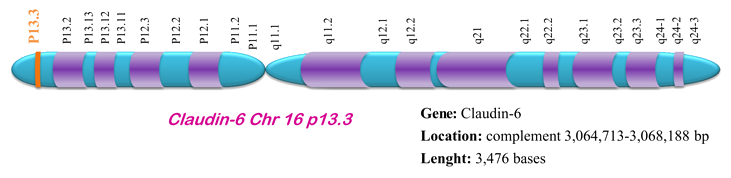
Description
5360 base-pairs DNA linear, starts at 3064713 and ends at 3070072 bp from pter with minus strand orientation. This gene contains 2 exons.
Transcription
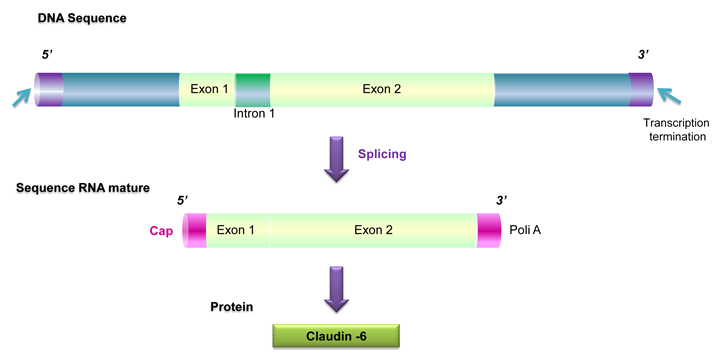
The transcription produces 2 alternatively spliced mRNA variants:
- NM_021195.4: transcript length: 2139 bp,
- ENST00000396925: transcript length: 1739 bp.
- NM_021195.4: transcript length: 2139 bp,
- ENST00000396925: transcript length: 1739 bp.
Pseudogene
Pseudogene of claudin 6 (LOC284620) is located on chromosome 1 (859 bp).
Proteins
Description
The transcription of this gene gives 1 spliced mRNA that encodes 1 protein isoform with 220 aa and 23292 Da of molecular weight.

Expression
Claudin-6 expression is mainly found in mouse embryonic stem cells (ESC), epithelial lineage cells during early development and primitive germ cell tumours such as spermatocytic seminoma, embryonal carcinoma, yolk sac tumour, choriocarcinoma, immature teratoma, mature teratoma and classic seminoma. Its expression is very weak or absent in adult mouse. In rat choroid plexus development claudin-6 is expressed postnatal between day 6 and 9. Claudin-6 expression is associated to ERα expression in human breast cancer and is inactivated by CpG island DNA hypermethylation.
Localisation
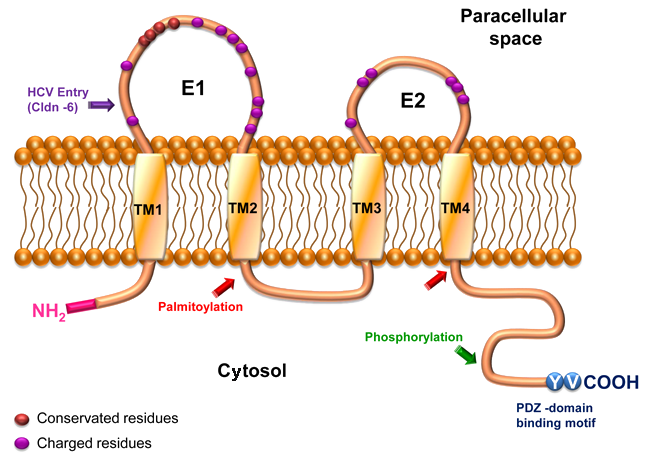
This transmembrane protein is located in the tight junction during embryogenesis and, in certain cancer pathologies. It can be found in the cell cytoplasm and in the nucleus.
Function
Claudin-6 regulates chloride and sodium permeability, and increases transepithelial electrical resistance in MDCK cells. It also has a Ca2+ independent cell adhesion activity. Is one of the entry cofactors for hepatitis C virus. Claudin-6 gene methylation may be involved in esophageal tumorogenesis.
Homology
The CLDN6 gene sequence is conserved in human, chimpanzee, monkey, wolf, cow, mouse, rat, and zebrafish.
Mutations
Somatic
A heterozygous substitution (p.T33T) in position 33 in ovarian serous carcinoma, and an homozygous substitution (p.T33T) in position 135 in stomach adenocarcinoma, have been reported.
Implicated in
Entity name
Breast cancer
Note
Up-regulation of claudin-6 expression in MCF-7 cells suppressed their malignant phenotype and restored tight junction integrity. Claudin-6 down-regulation contributes to the malignant progression of certain types of breast cancers.
Claudin-6 mRNA was low or undetectable in two rat mammary cancer cell lines, two human breast cancer cell lines, and one breast cancer sample compared to normal breast tissue (Quan and Lu, 2003). Decreased expression of claudin-6 promotes cellular invasiveness, transendothelial migration and an increase in matrix metalloproteinase activity (Osanai et al., 2007). The methylated phenotype of claudin-6 contributes to enhanced tumorigenic and invasive properties of breast carcinoma cells. Claudin-6 may function as tumor suppressor, particularly for breast cancer.
Claudin-6 mRNA was low or undetectable in two rat mammary cancer cell lines, two human breast cancer cell lines, and one breast cancer sample compared to normal breast tissue (Quan and Lu, 2003). Decreased expression of claudin-6 promotes cellular invasiveness, transendothelial migration and an increase in matrix metalloproteinase activity (Osanai et al., 2007). The methylated phenotype of claudin-6 contributes to enhanced tumorigenic and invasive properties of breast carcinoma cells. Claudin-6 may function as tumor suppressor, particularly for breast cancer.
Entity name
Gastric adenocarcinoma
Note
Abnormal claudin expression has been documented in several malignancies. Strong claudin-6 expression was associated with higher mortality rate in the diffuse- vs the intestinal-type gastric adenocarcinoma after a 2-year follow-up (Rendón-Huerta et al., 2010). Claudin-6 expression is closely related to gastric carcinogenesis, and their detection is a useful prognostic marker in gastric adenocarcinoma.
Claudin-6 overexpression in AGS cells enhanced their invasive potential (1,6-fold), cell migration and proliferation rate (13,3%); it also increased claudin-1 and zonula occludens-1 levels (Zavala-Zendejas et al., 2011). Increased expression of claudin-6 is sufficient to enhance tumorigenic properties of a gastric adenocarcinoma cell line.
Claudin-6 overexpression in AGS cells enhanced their invasive potential (1,6-fold), cell migration and proliferation rate (13,3%); it also increased claudin-1 and zonula occludens-1 levels (Zavala-Zendejas et al., 2011). Increased expression of claudin-6 is sufficient to enhance tumorigenic properties of a gastric adenocarcinoma cell line.
Entity name
Brain tumors
Note
Claudin-6 is a positive marker for atypical teratoid/rhabdoid tumors (AT/RTs) (Birks et al., 2010). AT/RTs are highly aggressive pediatric brain tumors. CLDN6 showed moderate or higher mRNA expression in eight of nine AT/RTs, with little to no expression in 114 of 115 other tumors. CLDN6 may be a useful marker to identify atypical teratoid/rhabdoid tumors AT/RTs.
Entity name
Hepatitis C virus infection
Note
Claudin-6 mediates the entry of HCV into target cells. Claudin-6 is expressed in the liver, the primary site of HCV replication. Claudin-6 expressed in CD81+ (tetraspanin) cells enables the entry of HCV pseudoparticles. Claudin-1 and -6 function equally well as entry cofactors in endothelial cells but claudin-1 is more efficient in hepatoma cells (Meertens et al., 2008). This suggests that additional cellular factors modulate the ability of claudins to function as HCV entry cofactors.
Entity name
Cornea
Note
Epigenetic regulators such as TSA, 5-aza, and DMSO significantly enhance the expression of claudin-9 in corneal cells, changing transcriptional signals by demethylating CpG islands (Nishikiori et al., 2008); additionally, the epigenetic regulators increase transendothelial electrical resistance and suppress fluxes of corneal cells, thus enhancing the corneal barrier function, in murine experimental corneal trauma.
Entity name
Adipogenesis
Note
Claudin-6 mRNA is differentially expressed in four different adipose tissues, and up regulated in each fat depot of mice fed a high-fat diet as compared to a normal-fat diet. Levels of claudin-6 transcripts were increased during differentiation of 3T3-L1 cells in vitro but small interfering RNA-mediated reduction of claudin-6 mRNA inhibited its differentiation (Hong et al., 2005). Claudin-6 is an important regulator of adipogenesis and fat deposition.
Entity name
Neonatal development
Note
Claudin-6 is a global marker of definitive endoderm and the development of the pancreas, lung and liver; CLDN6 null mice are viable and with no obvious phenotypic abnormalities (Anderson et al., 2008). Homozygous mice overexpressing claudin-6 exhibit a perturbation in the epidermal differentiation program leading to a defective epidermal permeability barrier (EPB); Inv-Cldn6 transgenic animals die within 2 days of birth, due to the lack of an intact EPB, inversely heterozygous Inv-Cldn6 mice exhibit a distinct coat phenotype and mild epidermal hyperkeratosis (Troy et al., 2005). A defective EPB has been shown in premature birth neonates (Turksen and Troy, 2002). Claudin 6 has a major role in epithelial differentiation and EPB assembly/maintenance.
Claudin-6 expression is fundamental for the formation of the trophectoderm (TE), the first epithelium generated during mammalian early development that isolates the inner cell mass from the uterine environment and provides the turgidity of the blastocyst through elevated hydrostatic pressure (Moriwaki et al., 2007). Claudin-6 was absent from TE tight junctions, and thus the barrier function of the TE was disrupted, when embryos were cultured in the presence of Clostridium perfringens enterotoxin.
Claudin-6 expression in the neonatal proximal tubule result in an increased transepithelial resistance, decreased chloride permeability, and decreased P(Na)/P(Cl) and P(HCO3)/P(Cl) (Sas et al., 2008).
Claudin-6 expression is fundamental for the formation of the trophectoderm (TE), the first epithelium generated during mammalian early development that isolates the inner cell mass from the uterine environment and provides the turgidity of the blastocyst through elevated hydrostatic pressure (Moriwaki et al., 2007). Claudin-6 was absent from TE tight junctions, and thus the barrier function of the TE was disrupted, when embryos were cultured in the presence of Clostridium perfringens enterotoxin.
Claudin-6 expression in the neonatal proximal tubule result in an increased transepithelial resistance, decreased chloride permeability, and decreased P(Na)/P(Cl) and P(HCO3)/P(Cl) (Sas et al., 2008).
Article Bibliography
| Pubmed ID | Last Year | Title | Authors |
|---|---|---|---|
| 18213590 | 2008 | Genetic targeting of the endoderm with claudin-6CreER. | Anderson WJ et al |
| 19220299 | 2010 | Claudin 6 is a positive marker for atypical teratoid/rhabdoid tumors. | Birks DK et al |
| 16306693 | 2005 | Up-regulation of the claudin-6 gene in adipogenesis. | Hong YH et al |
| 18234789 | 2008 | The tight junction proteins claudin-1, -6, and -9 are entry cofactors for hepatitis C virus. | Meertens L et al |
| 17980358 | 2007 | Tight junctions containing claudin 4 and 6 are essential for blastocyst formation in preimplantation mouse embryos. | Moriwaki K et al |
| 18661270 | 2008 | Prevention of murine experimental corneal trauma by epigenetic events regulating claudin 6 and claudin 9. | Nishikiori N et al |
| 17645772 | 2007 | Epigenetic silencing of claudin-6 promotes anchorage-independent growth of breast carcinoma cells. | Osanai M et al |
| 12896909 | 2003 | Identification of genes preferentially expressed in mammary epithelial cells of Copenhagen rat using subtractive hybridization and microarrays. | Quan C et al |
| 19960275 | 2010 | Distribution and expression pattern of claudins 6, 7, and 9 in diffuse- and intestinal-type gastric adenocarcinomas. | Rendón-Huerta E et al |
| 18784328 | 2008 | Effect of claudins 6 and 9 on paracellular permeability in MDCK II cells. | Sas D et al |
| 15908185 | 2005 | Delayed epidermal permeability barrier formation and hair follicle aberrations in Inv-Cldn6 mice. | Troy TC et al |
| 11923212 | 2002 | Permeability barrier dysfunction in transgenic mice overexpressing claudin 6. | Turksen K et al |
| 20367941 | 2010 | [Effects of stable up-regulation of tight junction protein claudin-6 upon biological phenotypes of breast cancer cell MCF-7]. | Wu Q et al |
| 20874001 | 2011 | Claudin-6, 7, or 9 overexpression in the human gastric adenocarcinoma cell line AGS increases its invasiveness, migration, and proliferation rate. | Zavala-Zendejas VE et al |
| 17804490 | 2007 | Claudin-6 and claudin-9 function as additional coreceptors for hepatitis C virus. | Zheng A et al |
Other Information
Locus ID:
NCBI: 9074
MIM: 615798
HGNC: 2048
Ensembl: ENSG00000184697
Variants:
dbSNP: 9074
ClinVar: 9074
TCGA: ENSG00000184697
COSMIC: CLDN6
RNA/Proteins
| Gene ID | Transcript ID | Uniprot |
|---|---|---|
| ENSG00000184697 | ENST00000328796 | P56747 |
| ENSG00000184697 | ENST00000396925 | P56747 |
| ENSG00000184697 | ENST00000572154 | I3L1E7 |
Expression (GTEx)
Pathways
References
| Pubmed ID | Year | Title | Citations |
|---|---|---|---|
| 36128931 | 2023 | The role of claudin-6 in chromophobe renal cell carcinoma. | 1 |
| 36471225 | 2023 | Claudin-6 enhances the malignant progression of gestational trophoblastic neoplasm by promoting proliferation and metastasis. | 0 |
| 37566248 | 2023 | CLDN6 Suppresses Migration and Invasion of MCF-7 and SKBR-3 Breast Cancer Cells by Blocking the SMAD/Snail/MMP-2/9 Axis. | 1 |
| 37762277 | 2023 | Binding of YY1/CREB to an Enhancer Region Triggers Claudin 6 Expression in H. pylori LPS-Stimulated AGS Cells. | 0 |
| 37852424 | 2023 | CLDN6 inhibits colorectal cancer proliferation dependent on restraining p53 ubiquitination via ZO-1/PTEN axis. | 1 |
| 36128931 | 2023 | The role of claudin-6 in chromophobe renal cell carcinoma. | 1 |
| 36471225 | 2023 | Claudin-6 enhances the malignant progression of gestational trophoblastic neoplasm by promoting proliferation and metastasis. | 0 |
| 37566248 | 2023 | CLDN6 Suppresses Migration and Invasion of MCF-7 and SKBR-3 Breast Cancer Cells by Blocking the SMAD/Snail/MMP-2/9 Axis. | 1 |
| 37762277 | 2023 | Binding of YY1/CREB to an Enhancer Region Triggers Claudin 6 Expression in H. pylori LPS-Stimulated AGS Cells. | 0 |
| 37852424 | 2023 | CLDN6 inhibits colorectal cancer proliferation dependent on restraining p53 ubiquitination via ZO-1/PTEN axis. | 1 |
| 35003898 | 2022 | Identification of Claudin 6-specific HLA class I- and HLA class II-restricted T cell receptors for cellular immunotherapy in ovarian cancer. | 4 |
| 35051418 | 2022 | KHDRBS3 promotes paclitaxel resistance and induces glycolysis through modulated MIR17HG/CLDN6 signaling in epithelial ovarian cancer. | 10 |
| 35100472 | 2022 | Aberrant expression of claudin-6 contributes to malignant potentials and drug resistance of cervical adenocarcinoma. | 7 |
| 35701678 | 2022 | The expression and the tumor suppressor role of CLDN6 in colon cancer. | 3 |
| 35848474 | 2022 | Claudin 6 is associated with a short survival and a short recurrent free interval in non-small cell lung carcinoma. | 2 |
Citation
Erika Patricia Rendon-Huerta ; Ana C Torres-Martínez ; Luis Montaño
CLDN6 (claudin 6)
Atlas Genet Cytogenet Oncol Haematol. 2012-12-01
Online version: http://atlasgeneticsoncology.org/gene/50974/cldn6
