CTCF (CCCTC-binding factor (zinc finger protein))
2013-05-01 Jacques Piette AffiliationInstitut de Genetique Moleculaire de Montpellier (CNRS-Universite de Montpellier I-II UMR5535), 1919 Route de Mende, 34293, Montpellier-Cedex 5, France
Identity
HGNC
LOCATION
16q22.1
IMAGE

LEGEND
Figure 1. Schematic representation of CTCF location on chromosome 16, gene structure and transcripts. Chromosome 16 is represented with the characteristic banding pattern. The region surrounding the CTCF gene is enlarged. Genes are represented by arrows pointing in the direction of transcription. Transcripts are represented with exons as vertical bars and introns as lines. Distances are in kilo bases (NCBI Map Viewer).
LOCUSID
ALIAS
CFAP108,FAP108,MRD21
FUSION GENES
DNA/RNA
Note
See figure 1.
Description
76776 bp gene (Ensembl).
Transcription
Ubiquitously highly expressed gene (GeneCards), 12 exons, 11 introns with at least 5 differentially spliced transcripts (Ensembl).
Pseudogene
No.
Proteins
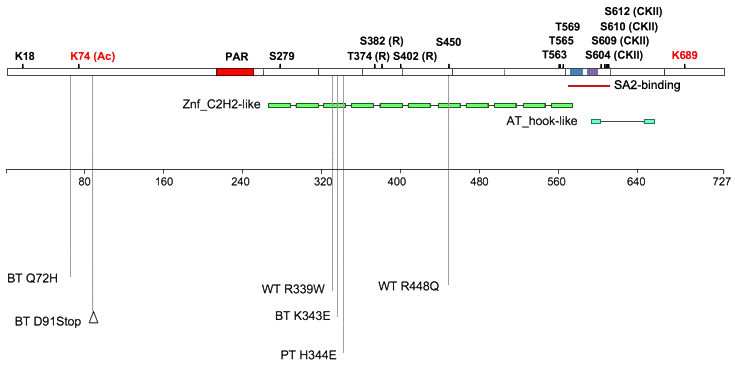
Figure 2. Schematic representation of the CTCF protein. Protein sequences encoded by exons are boxed. 11 ring fingers are indicated by green boxes as also putative AT-hooks by blue boxes (Ensembl). The interaction domain with the SA2 subunit of cohesin is underlined in red (Xiao et al., 2011). Phosphorylated residues are in black (PhosphoSitePlus), those sensitive to rapamycin are indicated by R (Chen et al., 2009) and those phosphorylated by CKII by CKII (El-Kady and Klenova, 2005; Klenova et al., 2001), sumoylated residues are in red (Kitchen and Schoenherr, 2010; MacPherson et al., 2009), acetylated residue is indicated by Ac (Choudhary et al., 2009). The domain containing poly(ADPribosyl)ation sites (PAR) is boxed in red (Farrar et al., 2010), the NTP-binding site in blue and the NLS in purple. Residues mutated in tumors are indicated (see further), BT = breast tumor, PT = prostate tumor and WT = Wilms tumor.
Description
CTCF was originally described as a c-myc activator (Klenova et al., 1993). It is a 727 aa protein with a MW of 82.8 kD, a charge of 8.5 and an iso electric point of 6.95 (Ensembl). The central domain with 11 zinc fingers of the C2H2 type is highly conserved.
Expression
CTCF is an abundant and ubiquitously expressed protein, yet absent in primary spermatocytes (Loukinov et al., 2002). It is downregulated during differentiation of human myeloid leukemia cells (Delgado et al., 1999; Torrano et al., 2005). Post-traductional modifications include acetylation (Choudhary et al., 2009), sumoylation (Kitchen and Schoenherr, 2010; MacPherson et al., 2009), which is regulated by hypoxic stress (Wang et al., 2012a), phosphorylation, in particular ser604-612 by CKII (El-Kady and Klenova, 2005; Klenova et al., 2001), and poly(ADPribo)sylation (see figure 2). The latter modification is lost or decreased in proliferating cells and in BT (Docquier et al., 2009) (for sites and role see Farrar et al., 2010; Yu et al., 2004; Guastafierro et al., 2013). CTCF is a downstream target protein of growth factor-induced pathways and is regulated by EGF and insulin through activation of ERK and AKT signaling cascades (Gao et al., 2007). It was recently shown to be regulated by NF-kB (Lu et al., 2010).
Localisation
CTCF is localized in the nucleoplasm of proliferating cells with exclusion from the nucleolus. It was detected at the centrosomes and midbody during mitosis (Zhang et al., 2004). It is associated with the nuclear matrix (Dunn et al., 2003; Yusufzai and Felsenfeld, 2004) and the Lamina (Guelen et al., 2008; Ottaviani et al., 2009). Nucleolar translocation after growth arrest is accompanied by inhibition of nucleolar transcription (Torrano et al., 2006). Cytoplasmic expression was described in sporadic breast tumors (Rakha et al., 2004).
Function
CTCF is an essential protein, since KO mice die before ED 9.5 (Heath et al., 2008) (reviewed in Filippova, 2008; Phillips and Corces, 2009). It interacts with numerous ubiquitous and cell-type specific genomic sites (Chen et al., 2008; Bao et al., 2008; Barski et al., 2007; Kim et al., 2007; Chen et al., 2012). The 11 Zn fingers would provide flexibility in DNA recognition (Filippova et al., 1996), the central 4 bind to a consensus DNA sequence (Filippova et al., 1998; Renda et al., 2007). Multiple interacting proteins were described including RNA polymerase II (Chernukhin et al., 2007), cohesin (Parelho et al., 2008; Rubio et al., 2008; Wendt et al., 2008; Xiao et al., 2011), Suz12 (Li et al., 2008), CHD8 (Ishihara et al., 2006), YY1 (Donohoe et al., 2007), nucleophosmin (Yusufzai et al., 2004), Kaiso (Defossez et al., 2005) and Sin3A (Lutz et al., 2000). XPG endonuclease promotes DNA breaks and DNA demethylation at promoters allowing the recruitment of CTCF and gene looping, which is further stabilized by XPF (Le May et al., 2012). By mediating intra and interchromosomal contacts through its interaction with cohesin, CTCF plays a central role in organization of topological domains inside the nucleus. Cell-type specific binding sites lead to specific interactomes and transcriptional programs (Hou et al., 2010; Handoko et al., 2011; Dixon et al., 2012; Botta et al., 2010; reviewed by Merkenschlager and Odom, 2013). The plasticity in binding sites occupancy is linked to DNA methylation (Wang et al., 2012b) and could depend also on CTCF interaction with other factors (see concept of modular insulators in Weth et al., 2010). One thoroughly studied factor is the thyroid receptor (Awad et al., 1999; Lutz et al., 2003). Its peculiar chromosomal environment could explain the multiple (not necessarily exclusive) functions that were described for CTCF, including chromatin barrier (Cuddapah et al., 2009; Witcher and Emerson, 2009), promoter insulation from enhancer (Bell et al., 1999) or silencer (Hou et al., 2008), transcriptional activation (Gombert and Krumm, 2009) (for instance of the tumour suppressor genes INK4A/ARF (Rodriguez et al., 2010) and p53 (Soto-Reyes and Recillas-Targa, 2010)), repression (for instance hTERT (Renaud et al., 2005)), nucleosome positioning (Fu et al., 2008b), protection from DNA methylation (Mukhopadhyay et al., 2004; Schoenherr et al., 2003; Guastafierro et al., 2008), preservation of triplet-repeat stability (Cho et al., 2005; Filippova et al., 2001; Libby et al., 2008), imprinting (Fedoriw et al., 2004; Fitzpatrick et al., 2007), X chromosome inactivation (Chao et al., 2002), chromosome "kissing" (Ling et al., 2006), transvection (Liu et al., 2008), death signaling (Docquier et al., 2005; Gomes and Espinosa, 2010; Li and Lu, 2007), replication timing (Bergstrom et al., 2007), mitotic bookmarking (Burke et al., 2005), MHC class II gene expression (Majumder et al., 2008), V(D)J recombination (Guo et al., 2011; reviewed by Chaumeil and Skok, 2012), miRNA expression (Saito and Saito, 2012), telomere end protection (Deng et al., 2012), neuronal diversity (Monahan et al., 2012), myogenesis (Delgado-Olguin et al., 2011), splicing (Shukla et al., 2011) and angiogenesis (Tang et al., 2011). Considering the central role of CTCF in transcriptional regulation, it is likely to play a role in adaptive evolution in Drosophila (Ni et al., 2012), and in the evolutionary succes of bilateria (Heger et al., 2012). Remodeling of CTCF binding sites and the accompanying interactome during evolution could be driven by retrotransposon expansion (Schmidt et al., 2012).
Homology
49 orthologues were described including D. melanogaster (Smith et al., 2009) and C. elegans proteins (Moon et al., 2005), 3 paralogues: CTCFL or BORIS, originating from a gene duplication in reptiles (Hore et al., 2008; Loukinov et al., 2002), and possibly ZFP64 (Mack et al., 1997) and the Histone H4 transcription factor HINF-P (van Wijnen et al., 1991).
Mutations
Note
SNP at AA 630 /K /E 90 /D /G 447 fR (NCBI).
Germinal
Non-coding mutations only.
Somatic
Mutations are rare and include point mutations of Zn-fingers in breast (BT) (Aulmann et al., 2003), prostate (PT) and Wilms tumor (WT) (Filippova et al., 2002; Tiffen et al., 2013), insertion in BT (Aulmann et al., 2003) (see figure 2), and indels in AML (Dolnik et al., 2012).
Implicated in
Entity name
Various cancers
Note
There is evidence for a tumor-suppressor role of CTCF (reviewed in Fiorentino and Giordano, 2012). LOH of CTCF was described in many cancers together with potential tumor suppressor genes (TSG), including E-Cad, since it is part of a larger deletion (Cancer Chromosomes; Sanger institute). In addition to WT (Yeh et al., 2002; Mummert et al., 2005), BT (Rakha et al., 2004), PT (Filippova et al., 1998), LOH was found in laryngeal squamous cell carcinoma (Grbesa et al., 2008), however, there is no evidence that CTCF is the TSG at 16q22.1 (Rakha et al., 2005), except possibly in lobular carcinoma in situ of the breast (Green et al., 2009). CTCF was also described to be overexpressed in BT (Docquier et al., 2005). An indirect role of CTCF in tumor progression is mainly suggested by mutation or aberrant methylation of its bindings sites (reviewed by Recillas-Targa et al., 2006). Interestingly, a causal link between LOH of CTCF and hypermethylation was proposed by Mummert et al. in 2005, although no real correlation was found by Yeh et al. in 2002. Methylation of CTCF sites was first described in the IGF2 imprinting control region in WT (Cui et al., 2001). Aberrant methylation of this region was also found in PT (Fu et al., 2008a; Paradowska et al., 2009), HNSCC (De Castro Valente Esteves et al., 2006; Esteves et al., 2005), colorectal cancer (Nakagawa et al., 2001), osteosarcoma (Ulaner et al., 2003), ovarian carcinoma (Dammann et al., 2010) and laryngeal squamous cell carcinoma (Grbesa et al., 2008). Hypomethylation was described in bladder cancer (Takai et al., 2001). YY1 binds with CTCF to a hypomethylated form of the macrosatellite DXZ4 on the inactive X chromosome in some male carcinomas (Moseley et al., 2012). Microdeletions were described in Beckwith-Wiedemann syndrome and WT (Prawitt et al., 2005; Sparago et al., 2007; Beygo et al., 2013). Other methylated CTCF targets were found in the genes AWT1 or WT1-AS in WT (Hancock et al., 2007), Bcl6 in B cell lymphomas (Lai et al., 2010), the miR125b locus in breast cancer (Soto-Reyes et al., 2012), p53, pRb (De La Rosa-Velazquez et al., 2007; Davalos-Salas et al., 2011), ARF (Tam et al., 2003; Rodriguez et al., 2010), INK4B, BRCA1 (Butcher et al., 2004; Butcher and Rodenhiser, 2007; Xu et al., 2010) and Rasgrf1 (Yoon et al., 2005). CTCF and its paralogue BORIS regulate pRb in lung cancer (Fiorentino et al., 2011), and CTCF could regulate the response to oestrogen in breast cancer (Zhang et al., 2010).
We describe below the rare cases of point mutations affecting the CTCF protein.
We describe below the rare cases of point mutations affecting the CTCF protein.
Entity name
Invasive ductal breast carcinoma, grade 2
Note
G2 grade tumor, no protein detected (Aulmann et al., 2003).
Cytogenetics
14 bp insertion at AA D91, see figure 2.
Entity name
Invasive ductal breast carcinoma, grade 3
Note
G3 grade tumor (Aulmann et al., 2003).
Cytogenetics
LOH and Q72H, figure 2.
Entity name
Breast cancer
Note
Zinc finger mutation (Filippova et al., 2002).
Cytogenetics
LOH and K343E, figure 2.
Entity name
Prostate cancer
Note
Zinc finger mutation (Filippova et al., 2002).
Cytogenetics
LOH and H344E, figure 2.
Entity name
Wilms tumor
Note
Zinc finger mutation (Filippova et al., 2002).
Cytogenetics
LOH and R339W or R448Q, figure 2.
Entity name
Acute myeloid leukemia (AML)
Note
(Dolnik et al., 2012).
Cytogenetics
indels.
Article Bibliography
| Pubmed ID | Last Year | Title | Authors |
|---|---|---|---|
| 14503807 | 2003 | CTCF gene mutations in invasive ductal breast cancer. | Aulmann S et al |
| 10480923 | 1999 | Negative transcriptional regulation mediated by thyroid hormone response element 144 requires binding of the multivalent factor CTCF to a novel target DNA sequence. | Awad TA et al |
| 17981843 | 2008 | CTCFBSDB: a CTCF-binding site database for characterization of vertebrate genomic insulators. | Bao L et al |
| 17512414 | 2007 | High-resolution profiling of histone methylations in the human genome. | Barski A et al |
| 10458613 | 1999 | The protein CTCF is required for the enhancer blocking activity of vertebrate insulators. | Bell AC et al |
| 17329968 | 2007 | CTCF regulates asynchronous replication of the imprinted H19/Igf2 domain. | Bergström R et al |
| 23118352 | 2013 | The molecular function and clinical phenotype of partial deletions of the IGF2/H19 imprinting control region depends on the spatial arrangement of the remaining CTCF-binding sites. | Beygo J et al |
| 21045820 | 2010 | Intra- and inter-chromosomal interactions correlate with CTCF binding genome wide. | Botta M et al |
| 16107875 | 2005 | CTCF binding and higher order chromatin structure of the H19 locus are maintained in mitotic chromatin. | Burke LJ et al |
| 17071074 | 2007 | Epigenetic inactivation of BRCA1 is associated with aberrant expression of CTCF and DNA methyltransferase (DNMT3B) in some sporadic breast tumours. | Butcher DT et al |
| 11743158 | 2002 | CTCF, a candidate trans-acting factor for X-inactivation choice. | Chao W et al |
| 22424610 | 2012 | The role of CTCF in regulating V(D)J recombination. | Chaumeil J et al |
| 22829947 | 2012 | Comprehensive identification and annotation of cell type-specific and ubiquitous CTCF-binding sites in the human genome. | Chen H et al |
| 19276368 | 2009 | CDC25B mediates rapamycin-induced oncogenic responses in cancer cells. | Chen RQ et al |
| 18555785 | 2008 | Integration of external signaling pathways with the core transcriptional network in embryonic stem cells. | Chen X et al |
| 17210645 | 2007 | CTCF interacts with and recruits the largest subunit of RNA polymerase II to CTCF target sites genome-wide. | Chernukhin I et al |
| 16285929 | 2005 | Antisense transcription and heterochromatin at the DM1 CTG repeats are constrained by CTCF. | Cho DH et al |
| 19608861 | 2009 | Lysine acetylation targets protein complexes and co-regulates major cellular functions. | Choudhary C et al |
| 19056695 | 2009 | Global analysis of the insulator binding protein CTCF in chromatin barrier regions reveals demarcation of active and repressive domains. | Cuddapah S et al |
| 11431321 | 2001 | Loss of imprinting of insulin-like growth factor-II in Wilms' tumor commonly involves altered methylation but not mutations of CTCF or its binding site. | Cui H et al |
| 19956846 | 2010 | Frequent aberrant methylation of the imprinted IGF2/H19 locus and LINE1 hypomethylation in ovarian carcinoma. | Dammann RH et al |
| 21663659 | 2011 | Gain of DNA methylation is enhanced in the absence of CTCF at the human retinoblastoma gene promoter. | Dávalos-Salas M et al |
| 16391843 | 2006 | H19-DMR allele-specific methylation analysis reveals epigenetic heterogeneity of CTCF binding site 6 but not of site 5 in head-and-neck carcinomas: a pilot case-control analysis. | De Castro Valente Esteves LI et al |
| 17363576 | 2007 | Epigenetic regulation of the human retinoblastoma tumor suppressor gene promoter by CTCF. | De La Rosa-Velázquez IA et al |
| 16230345 | 2005 | The human enhancer blocker CTC-binding factor interacts with the transcription factor Kaiso. | Defossez PA et al |
| 10037138 | 1999 | Differential expression and phosphorylation of CTCF, a c-myc transcriptional regulator, during differentiation of human myeloid cells. | Delgado MD et al |
| 21288905 | 2011 | CTCF promotes muscle differentiation by modulating the activity of myogenic regulatory factors. | Delgado-Olguín P et al |
| 23010778 | 2012 | A role for CTCF and cohesin in subtelomere chromatin organization, TERRA transcription, and telomere end protection. | Deng Z et al |
| 22495300 | 2012 | Topological domains in mammalian genomes identified by analysis of chromatin interactions. | Dixon JR et al |
| 19737964 | 2009 | Decreased poly(ADP-ribosyl)ation of CTCF, a transcription factor, is associated with breast cancer phenotype and cell proliferation. | Docquier F et al |
| 22976956 | 2012 | Commonly altered genomic regions in acute myeloid leukemia are enriched for somatic mutations involved in chromatin remodeling and splicing. | Dolnik A et al |
| 17218270 | 2007 | Identification of a Ctcf cofactor, Yy1, for the X chromosome binary switch. | Donohoe ME et al |
| 12878173 | 2003 | The insulator binding protein CTCF associates with the nuclear matrix. | Dunn KL et al |
| 15733852 | 2005 | Regulation of the transcription factor, CTCF, by phosphorylation with protein kinase CK2. | El-Kady A et al |
| 16015666 | 2005 | DNA methylation in the CTCF-binding site I and the expression pattern of the H19 gene: does positive expression predict poor prognosis in early stage head and neck carcinomas? | Esteves LI et al |
| 20038529 | 2010 | Mutational analysis of the poly(ADP-ribosyl)ation sites of the transcription factor CTCF provides an insight into the mechanism of its regulation by poly(ADP-ribosyl)ation. | Farrar D et al |
| 14716017 | 2004 | Transgenic RNAi reveals essential function for CTCF in H19 gene imprinting. | Fedoriw AM et al |
| 17950379 | 2008 | Genetics and epigenetics of the multifunctional protein CTCF. | Filippova GN et al |
| 21465478 | 2012 | The tumor suppressor role of CTCF. | Fiorentino FP et al |
| 17242189 | 2007 | Allele-specific binding of CTCF to the multipartite imprinting control region KvDMR1. | Fitzpatrick GV et al |
| 18701505 | 2008 | Aging and cancer-related loss of insulin-like growth factor 2 imprinting in the mouse and human prostate. | Fu VX et al |
| 18654629 | 2008 | The insulator binding protein CTCF positions 20 nucleosomes around its binding sites across the human genome. | Fu Y et al |
| 18021171 | 2007 | Functional role of CCCTC binding factor in insulin-stimulated cell proliferation. | Gao J et al |
| 19568426 | 2009 | Targeted deletion of multiple CTCF-binding elements in the human C-MYC gene reveals a requirement for CTCF in C-MYC expression. | Gombert WM et al |
| 20478995 | 2010 | Gene-specific repression of the p53 target gene PUMA via intragenic CTCF-Cohesin binding. | Gomes NP et al |
| 18604514 | 2008 | Loss of imprinting of IGF2 and H19, loss of heterozygosity of IGF2R and CTCF, and Helicobacter pylori infection in laryngeal squamous cell carcinoma. | Grbesa I et al |
| 18213475 | 2009 | Loss of expression of chromosome 16q genes DPEP1 and CTCF in lobular carcinoma in situ of the breast. | Green AR et al |
| 23116180 | 2013 | ADP-ribose polymer depletion leads to nuclear Ctcf re-localization and chromatin rearrangement(1). | Guastafierro T et al |
| 18463634 | 2008 | Domain organization of human chromosomes revealed by mapping of nuclear lamina interactions. | Guelen L et al |
| 21909113 | 2011 | CTCF-binding elements mediate control of V(D)J recombination. | Guo C et al |
| 17210670 | 2007 | A CTCF-binding silencer regulates the imprinted genes AWT1 and WT1-AS and exhibits sequential epigenetic defects during Wilms' tumourigenesis. | Hancock AL et al |
| 21685913 | 2011 | CTCF-mediated functional chromatin interactome in pluripotent cells. | Handoko L et al |
| 18923423 | 2008 | CTCF regulates cell cycle progression of alphabeta T cells in the thymus. | Heath H et al |
| 23045651 | 2012 | The chromatin insulator CTCF and the emergence of metazoan diversity. | Heger P et al |
| 18769711 | 2008 | The evolution of epigenetic regulators CTCF and BORIS/CTCFL in amniotes. | Hore TA et al |
| 20133600 | 2010 | Cell type specificity of chromatin organization mediated by CTCF and cohesin. | Hou C et al |
| 19074263 | 2008 | CTCF-dependent enhancer-blocking by alternative chromatin loop formation. | Hou C et al |
| 16949368 | 2006 | CTCF-dependent chromatin insulator is linked to epigenetic remodeling. | Ishihara K et al |
| 17382889 | 2007 | Analysis of the vertebrate insulator protein CTCF-binding sites in the human genome. | Kim TH et al |
| 20589758 | 2010 | Sumoylation modulates a domain in CTCF that activates transcription and decondenses chromatin. | Kitchen NS et al |
| 11238955 | 2001 | Functional phosphorylation sites in the C-terminal region of the multivalent multifunctional transcriptional factor CTCF. | Klenova EM et al |
| 20733034 | 2010 | DNA methylation prevents CTCF-mediated silencing of the oncogene BCL6 in B cell lymphomas. | Lai AY et al |
| 22771116 | 2012 | XPG and XPF endonucleases trigger chromatin looping and DNA demethylation for accurate expression of activated genes. | Le May N et al |
| 18662993 | 2008 | CTCF regulates allelic expression of Igf2 by orchestrating a promoter-polycomb repressive complex 2 intrachromosomal loop. | Li T et al |
| 17583694 | 2007 | Functional role of CCCTC binding factor (CTCF) in stress-induced apoptosis. | Li T et al |
| 19008940 | 2008 | CTCF cis-regulates trinucleotide repeat instability in an epigenetic manner: a novel basis for mutational hot spot determination. | Libby RT et al |
| 16614224 | 2006 | CTCF mediates interchromosomal colocalization between Igf2/H19 and Wsb1/Nf1. | Ling JQ et al |
| 18625744 | 2008 | Transvection mediated by the translocated cyclin D1 locus in mantle cell lymphoma. | Liu H et al |
| 12011441 | 2002 | BORIS, a novel male germ-line-specific protein associated with epigenetic reprogramming events, shares the same 11-zinc-finger domain with CTCF, the insulator protein involved in reading imprinting marks in the soma. | Loukinov DI et al |
| 20110362 | 2010 | NF-kappaB subtypes regulate CCCTC binding factor affecting corneal epithelial cell fate. | Lu L et al |
| 12660164 | 2003 | Thyroid hormone-regulated enhancer blocking: cooperation of CTCF and thyroid hormone receptor. | Lutz M et al |
| 19029252 | 2009 | The CTCF insulator protein is posttranslationally modified by SUMO. | MacPherson MJ et al |
| 9034307 | 1997 | A search for a mammalian homologue of the Drosophila photoreceptor development gene glass yields Zfp64, a zinc finger encoding gene which maps to the distal end of mouse chromosome 2. | Mack HG et al |
| 18347100 | 2008 | The insulator factor CTCF controls MHC class II gene expression and is required for the formation of long-distance chromatin interactions. | Majumder P et al |
| 23498937 | 2013 | CTCF and cohesin: linking gene regulatory elements with their targets. | Merkenschlager M et al |
| 22550178 | 2012 | Role of CCCTC binding factor (CTCF) and cohesin in the generation of single-cell diversity of protocadherin-α gene expression. | Monahan K et al |
| 15678159 | 2005 | CTCF is conserved from Drosophila to humans and confers enhancer blocking of the Fab-8 insulator. | Moon H et al |
| 22064860 | 2012 | YY1 associates with the macrosatellite DXZ4 on the inactive X chromosome and binds with CTCF to a hypomethylated form in some male carcinomas. | Moseley SC et al |
| 15256511 | 2004 | The binding sites for the chromatin insulator protein CTCF map to DNA methylation-free domains genome-wide. | Mukhopadhyay R et al |
| 15761865 | 2005 | Association of chromosome arm 16q loss with loss of imprinting of insulin-like growth factor-II in Wilms tumor. | Mummert SK et al |
| 11120891 | 2001 | Loss of imprinting of the insulin-like growth factor II gene occurs by biallelic methylation in a core region of H19-associated CTCF-binding sites in colorectal cancer. | Nakagawa H et al |
| 23139640 | 2012 | Adaptive evolution and the birth of CTCF binding sites in the Drosophila genome. | Ni X et al |
| 19644448 | 2009 | Identification of a perinuclear positioning element in human subtelomeres that requires A-type lamins and CTCF. | Ottaviani A et al |
| 19513555 | 2009 | Aberrant epigenetic modifications in the CTCF binding domain of the IGF2/H19 gene in prostate cancer compared with benign prostate hyperplasia. | Paradowska A et al |
| 18237772 | 2008 | Cohesins functionally associate with CTCF on mammalian chromosome arms. | Parelho V et al |
| 19563753 | 2009 | CTCF: master weaver of the genome. | Phillips JE et al |
| 15743916 | 2005 | Microdeletion of target sites for insulator protein CTCF in a chromosome 11p15 imprinting center in Beckwith-Wiedemann syndrome and Wilms' tumor. | Prawitt D et al |
| 15609312 | 2005 | High-resolution analysis of 16q22.1 in breast carcinoma using DNA amplifiable probes (multiplex amplifiable probe hybridization technique) and immunohistochemistry. | Rakha EA et al |
| 15354217 | 2004 | Expression of the transcription factor CTCF in invasive breast cancer: a candidate gene located at 16q22.1. | Rakha EA et al |
| 16989720 | 2006 | Epigenetic boundaries of tumour suppressor gene promoters: the CTCF connection and its role in carcinogenesis. | Recillas-Targa F et al |
| 16326864 | 2005 | CTCF binds the proximal exonic region of hTERT and inhibits its transcription. | Renaud S et al |
| 17827499 | 2007 | Critical DNA binding interactions of the insulator protein CTCF: a small number of zinc fingers mediate strong binding, and a single finger-DNA interaction controls binding at imprinted loci. | Renda M et al |
| 20051228 | 2010 | CTCF is a DNA methylation-sensitive positive regulator of the INK/ARF locus. | Rodriguez C et al |
| 18550811 | 2008 | CTCF physically links cohesin to chromatin. | Rubio ED et al |
| 23056006 | 2012 | Role of CTCF in the regulation of microRNA expression. | Saito Y et al |
| 22244452 | 2012 | Waves of retrotransposon expansion remodel genome organization and CTCF binding in multiple mammalian lineages. | Schmidt D et al |
| 12461525 | 2003 | CTCF maintains differential methylation at the Igf2/H19 locus. | Schoenherr CJ et al |
| 21964334 | 2011 | CTCF-promoted RNA polymerase II pausing links DNA methylation to splicing. | Shukla S et al |
| 19210964 | 2009 | Genome wide ChIP-chip analyses reveal important roles for CTCF in Drosophila genome organization. | Smith ST et al |
| 22277129 | 2012 | Disruption of CTCF at the miR-125b1 locus in gynecological cancers. | Soto-Reyes E et al |
| 17158821 | 2007 | Mechanisms causing imprinting defects in familial Beckwith-Wiedemann syndrome with Wilms' tumour. | Sparago A et al |
| 16951251 | 2006 | CTCF mediates long-range chromatin looping and local histone modification in the beta-globin locus. | Splinter E et al |
| 11726548 | 2001 | Large scale mapping of methylcytosines in CTCF-binding sites in the human H19 promoter and aberrant hypomethylation in human bladder cancer. | Takai D et al |
| 12538357 | 2003 | Perturbations of the Ink4a/Arf gene locus in aflatoxin B1-induced mouse lung tumors. | Tam AS et al |
| 21896759 | 2011 | Restraint of angiogenesis by zinc finger transcription factor CTCF-dependent chromatin insulation. | Tang M et al |
| 23553099 | 2013 | The cancer-testis antigen BORIS phenocopies the tumor suppressor CTCF in normal and neoplastic cells. | Tiffen JC et al |
| 15941718 | 2005 | CTCF regulates growth and erythroid differentiation of human myeloid leukemia cells. | Torrano V et al |
| 16595548 | 2006 | Targeting of CTCF to the nucleolus inhibits nucleolar transcription through a poly(ADP-ribosyl)ation-dependent mechanism. | Torrano V et al |
| 12588801 | 2003 | Loss of imprinting of IGF2 and H19 in osteosarcoma is accompanied by reciprocal methylation changes of a CTCF-binding site. | Ulaner GA et al |
| 22955980 | 2012 | Widespread plasticity in CTCF occupancy linked to DNA methylation. | Wang H et al |
| 22354964 | 2012 | De-SUMOylation of CCCTC binding factor (CTCF) in hypoxic stress-induced human corneal epithelial cells. | Wang J et al |
| 18235444 | 2008 | Cohesin mediates transcriptional insulation by CCCTC-binding factor. | Wendt KS et al |
| 20404925 | 2010 | Modular insulators: genome wide search for composite CTCF/thyroid hormone receptor binding sites. | Weth O et al |
| 19450526 | 2009 | Epigenetic silencing of the p16(INK4a) tumor suppressor is associated with loss of CTCF binding and a chromatin boundary. | Witcher M et al |
| 21444719 | 2011 | Specific sites in the C terminus of CTCF interact with the SA2 subunit of the cohesin complex and are required for cohesin-dependent insulation activity. | Xiao T et al |
| 19466541 | 2010 | CpG island methylation affects accessibility of the proximal BRCA1 promoter to transcription factors. | Xu J et al |
| 12203779 | 2002 | Chromosome arm 16q in Wilms tumors: unbalanced chromosomal translocations, loss of heterozygosity, and assessment of the CTCF gene. | Yeh A et al |
| 16314537 | 2005 | Rasgrf1 imprinting is regulated by a CTCF-dependent methylation-sensitive enhancer blocker. | Yoon B et al |
| 15361875 | 2004 | Poly(ADP-ribosyl)ation regulates CTCF-dependent chromatin insulation. | Yu W et al |
| 14759373 | 2004 | CTCF tethers an insulator to subnuclear sites, suggesting shared insulator mechanisms across species. | Yusufzai TM et al |
| 14980504 | 2004 | Dynamic association of the mammalian insulator protein CTCF with centrosomes and the midbody. | Zhang R et al |
| 20610384 | 2010 | CCCTC-binding factor acts upstream of FOXA1 and demarcates the genomic response to estrogen. | Zhang Y et al |
| 15084242 | 2004 | A screen for germline mutations in the gene encoding CCCTC-binding factor (CTCF) in familial non-BRCA1/BRCA2 breast cancer. | Zhou XL et al |
| 23193294 | 2013 | CTCFBSDB 2.0: a database for CTCF-binding sites and genome organization. | Ziebarth JD et al |
| 1655821 | 1991 | Transcriptional element H4-site II of cell cycle regulated human H4 histone genes is a multipartite protein/DNA interaction site for factors HiNF-D, HiNF-M, and HiNF-P: involvement of phosphorylation. | van Wijnen AJ et al |
Other Information
Locus ID:
NCBI: 10664
MIM: 604167
HGNC: 13723
Ensembl: ENSG00000102974
Variants:
dbSNP: 10664
ClinVar: 10664
TCGA: ENSG00000102974
COSMIC: CTCF
RNA/Proteins
Expression (GTEx)
Pathways
Protein levels (Protein atlas)
References
| Pubmed ID | Year | Title | Citations |
|---|---|---|---|
| 37326830 | 2024 | CCCTC-binding factor: the specific transcription factor of β-galactoside α-2,6-sialyltransferase 1 that upregulates the sialylation of anti-citrullinated protein antibodies in rheumatoid arthritis. | 2 |
| 37914145 | 2024 | SENP1 knockdown-mediated CTCF SUMOylation enhanced its stability and alleviated lipopolysaccharide-evoked inflammatory injury in human lung fibroblasts via regulation of FOXA2 transcription. | 1 |
| 37993084 | 2024 | Epigenetic inhibition of CTCF by HN1 promotes dedifferentiation and stemness of anaplastic thyroid cancer. | 0 |
| 38054406 | 2024 | Identification of DNA methylation episignature for the intellectual developmental disorder, autosomal dominant 21 syndrome, caused by variants in the CTCF gene. | 0 |
| 38236307 | 2024 | Differential DNA methylation and CTCF binding between the ESR1 promoter a of MCF-7 and MDA-MB-231 breast cancer cells. | 0 |
| 38408244 | 2024 | Host-encoded CTCF regulates human cytomegalovirus latency via chromatin looping. | 0 |
| 38436544 | 2024 | RPL35A drives ovarian cancer progression by promoting the binding of YY1 to CTCF promoter. | 0 |
| 38561749 | 2024 | The N-terminal dimerization domains of human and Drosophila CTCF have similar functionality. | 1 |
| 38742641 | 2024 | Single-molecule imaging reveals a direct role of CTCF's zinc fingers in SA interaction and cluster-dependent RNA recruitment. | 0 |
| 38774923 | 2024 | CCCTC-binding factor suppresses alpha-2-macroglobulin transcription to improve vascular endothelial cell functions in lower extremity arteriosclerosis obliterans. | 0 |
| 38810696 | 2024 | CTCF and BORIS-mediated autophagy regulation via alternative splicing of BNIP3L in breast cancer. | 0 |
| 38951485 | 2024 | CTCF mutation at R567 causes developmental disorders via 3D genome rearrangement and abnormal neurodevelopment. | 0 |
| 37326830 | 2024 | CCCTC-binding factor: the specific transcription factor of β-galactoside α-2,6-sialyltransferase 1 that upregulates the sialylation of anti-citrullinated protein antibodies in rheumatoid arthritis. | 2 |
| 37914145 | 2024 | SENP1 knockdown-mediated CTCF SUMOylation enhanced its stability and alleviated lipopolysaccharide-evoked inflammatory injury in human lung fibroblasts via regulation of FOXA2 transcription. | 1 |
| 37993084 | 2024 | Epigenetic inhibition of CTCF by HN1 promotes dedifferentiation and stemness of anaplastic thyroid cancer. | 0 |
Citation
Jacques Piette
CTCF (CCCTC-binding factor (zinc finger protein))
Atlas Genet Cytogenet Oncol Haematol. 2013-05-01
Online version: http://atlasgeneticsoncology.org/gene/40187/ctcf
Historical Card
2011-04-01 CTCF (CCCTC-binding factor (zinc finger protein)) by Jacques Piette Affiliation
Institut de Genetique Moleculaire de Montpellier (CNRS-Universite de Montpellier I-II UMR5535), 1919 Route de Mende, 34293, Montpellier-Cedex 5, France
