CUX1 (cut-like homeobox 1)
2011-10-01 Benjamin Kühnemuth , Patrick Michl AffiliationDepartment of Gastroenterology, Endocrinology, University of Marburg, Marburg, Germany
Identity
DNA/RNA
Description
Five alternative splice variants have been identified. Most of the splicing sites are located in the regions downstream of exon 14 and 15 (Rong Zeng et al., 2000). Two alternative sites for transcript termination have been identified. Termination at UGA in exon 24 leads to production of CUX1 mRNA comprising exon 1-24. Elongation up to exon 33 results in alternative splicing and the production of CASP mRNA comprising exon 1-15 and 25-33 (Lievens et al., 1997; Rong Zeng et al., 2000).
The first transcriptional start site is located in exon 1 but transcription can be initiated at several sites in a 200 bp region upstream of exon 1 (Rong Zeng et al., 2000). Initiation within intron 20 leads to production of an mRNA coding for the shortened p75 isoform (Goulet et al., 2002).
Several putative translation initiation codons can be found in exon 1 but ATG at position 550 has been described as the predominant initiation site (Rong Zeng et al., 2000).
Proteins
Description
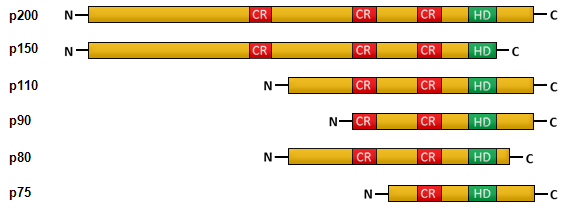
Several shortened CUX1 isoforms have been described that are named according to their molecular weight. CUX1 p75 is the product of a shortened mRNA that is generated by the use of an alternative transcription start site in exon 20 (Rong Zeng et al., 2000; Goulet et al., 2002). CUX1 p150, p110, p90 and p80 are generated by proteolytic processing of the full length protein by a nuclear isoform of Cathepsin L and other not yet identified proteases such as caspases (Goulet et al., 2004; Goulet et al., 2006; Maitra et al., 2006; Truscott et al., 2007).
The presence of DNA binding domains in the CUX1 isoforms determines their interaction with DNA and their transcriptional activity. The full length protein p200 shows unstable DNA binding, carries the CCAAT-displacement activity and functions predominantly as a transcriptional repressor. In contrast, the p110, p90, p80 and p75 isoforms show stable DNA binding and function both as transcriptional repressors or activators (Truscott et al., 2004; Goulet et al., 2002; Goulet et al., 2006; Moon et al., 2001). According to Maitra et al., the p150 isoform is incapable of DNA binding (Maitra et al., 2006).
Several posttranslational modifications are known to modulate the DNA binding activities of the CUX1 proteins. Protein kinase C and Casein kinase II are able to phosphorylate serine or threonine residues within the cut repeats (Coqueret et al., 1998b; Li et al., 2007). Protein kinase A and cyclin A/Cdk1 phosphorylate specific serine residues in a region between the Cut repeat 3 and the homeodomain (Michl et al., 2006; Santaguida et al., 2001). PCAF acetyl-transferase is able to acetylate CUX1 on a lysine residue in the homeodomain (Li et al., 2000). Both, phosphorylation and acetylation have been shown to inhibit CUX1 DNA binding (Sansregret et al., 2010; Li et al., 2000). Consistent with this, dephosphorylation by Cdc 25A phosphatase is able to increase DNA binding of CUX1 (Coqueret et al, 1998a).
Expression
Increased CUX1 expression was found in various tumour types including multiple myelomas, acute lymphoblastic leukaemia, breast carcinoma and pancreatic cancer (De Vos et al., 2002; Tsutsumi et al., 2003; Michl et al., 2005; Ripka et al., 2007).
It has been shown that the cellular expression of CUX1 mRNA and protein is elevated following TGF-beta stimulation in many cell types including fibroblasts, pancreatic cancer cells, breast cancer cells and malignant plasma cells (Fragiadaki et al., 2011; Michl et al., 2005; De Vos et al., 2002). This regulation of CUX1 expression by TGF-beta is probably mediated by p38MAPK and Smad4 signalling (Michl et al., 2005).
Localisation
Function
CUX1 is involved in at least three cellular processes important for cancer progression: cell proliferation, cell motility/invasiveness and apoptosis.
Proliferation
Studies indicate that the pro-proliferative effects of CUX1 are mainly mediated by the p110 isoform. This isoform is produced by proteolytic cleavage of the full length protein occuring during G1/S-transition in the cell cycle (Goulet et al., 2004; Moon et al., 2001). Cells stably transfected with p110 CUX1 showed increased proliferation due to a shortened G1-phase whereas embryonic fibroblasts obtained from CUX1 knockout mice showed elongated G1-phase and less proliferation compared to cells isolated from wild-type mice (Sansregret et al., 2006).
A genome-wide location array for p110 CUX1 binding sites in transformed and non-transformed cell lines identified numerous CUX1 target genes that are related to proliferation and cell cycle progression (Harada et al., 2008). Most of these genes are activated by p110 CUX1 including DNA polymerase-alpha, cyclin A2 and cyclin E2. In contrast, other genes are repressed such as the CDK-inhibitor p21 (Truscott et al., 2003; Nishio and Walsh, 2004; Harada et al., 2008).
Cell motility
First evidence that CUX1 plays a role in cell motility originates from knockdown studies in fibroblasts and a panel of human cancer cell lines that revealed that depletion of CUX1 leads to decreased cell migration and invasion (Michl et al., 2005). In agreement with this, cells stably expressing p110 and p75 CUX1 show increased cell migration and invasion (Kedinger et al., 2009; Cadieux et al., 2009). Additionally, tail vein injection of cells stably expressing shRNA against CUX1 resulted in reduced formation of lung metastases, whereas injection of cells stably overexpressing CUX1 led to increased lung metastases (Michl et al., 2005; Cadieux et al., 2009).
The molecular basis for these effects on cell motility was in part elucidated in a genome-wide location analysis in several cell lines (Kedinger et al., 2009). In this study, CUX1 was found to inhibit the expression of genes that repress cell migration (e.g. E-cadherin, occludin) and to turn on the expression of genes that promote cell migration (e.g. FAK, N-cadherin, vimentin) (Kedinger et al., 2009). The regulation of these genes seems to be mediated both directly by binding of CUX1 to the gene promoters but also indirectly by modulation of transcription factors and signaling proteins involved in EMT (e.g. SNAI1, SNAI2, Src, Wnt5a) (Kedinger et al., 2009; Aleksic et al., 2007; Ripka et al., 2007). Additionally, several of the CUX1 target genes are known GTPases important for actin-cytoskeleton polymerization (Kedinger et al., 2009).
Apoptosis
Studies in pancreatic cancer cell lines showed that depletion of CUX1 by siRNA increases TNFalpha- and TRAIL-induced apoptosis whereas overexpression of CUX1 rescues from apoptosis. Additionally, treatment of xenograft tumours with siRNA for CUX1 lead to retarded tumour growth and increased apoptosis. These effects are at least in part explained by a positive regulation of the antiapoptotic protein BCL2 by CUX1 (Ripka et al., 2010a). Subsequently, the glutamate receptor GRIA3 was identified as another downstream target of CUX1 able to mediate its antiapoptotic effects (Ripka et al., 2010b).
Homology
Mutations
Note
Implicated in
The expression of CUX1 is accompanied by the overexpression of its downstream targets WNT5a and GRIA3 that, at least in part, mediate the proinvasive and proproliferative effects of CUX1 (Ripka et al., 2006; Ripka et al., 2010b).
Antiapoptotic effects of CUX1 in pancreatic cancer, that have been shown in in vitro studies and in xenograft models, are associated with a positive regulation of BCL2 and downregulation of tumour necrosis factor alpha and are, at least in part, mediated by the glutamate receptor GRIA3 (Ripka et al., 2010a; Ripka et al., 2010b).
Article Bibliography
| Pubmed ID | Last Year | Title | Authors |
|---|---|---|---|
| 10196318 | 1999 | CCAAT displacement protein binds to and negatively regulates human papillomavirus type 6 E6, E7, and E1 promoters. | Ai W et al |
| 17369846 | 2007 | CUTL1 promotes tumor cell migration by decreasing proteasome-mediated Src degradation. | Aleksic T et al |
| 1363085 | 1992 | Clox, a mammalian homeobox gene related to Drosophila cut, encodes DNA-binding regulatory proteins differentially expressed during development. | Andres V et al |
| 9218488 | 1997 | Interaction of the nuclear matrix-associated region (MAR)-binding proteins, SATB1 and CDP/Cux, with a MAR element (L2a) in an upstream regulatory region of the mouse CD8a gene. | Banan M et al |
| 19738070 | 2009 | Mouse mammary tumor virus p75 and p110 CUX1 transgenic mice develop mammary tumors of various histologic types. | Cadieux C et al |
| 10556202 | 1999 | Overexpression of CCAAT displacement protein represses the promiscuously active proximal gp91(phox) promoter. | Catt D et al |
| 10643964 | 1999 | DNA-binding properties of CCAAT displacement protein cut repeats. | Catt D et al |
| 9446557 | 1998 | DNA binding by cut homeodomain proteins is down-modulated by casein kinase II. | Coqueret O et al |
| 12360412 | 2002 | Comparison of gene expression profiling between malignant and normal plasma cells with oligonucleotide arrays. | De Vos J et al |
| 11544187 | 2001 | The transcriptional repressor CDP (Cutl1) is essential for epithelial cell differentiation of the lung and the hair follicle. | Ellis T et al |
| 21471005 | 2011 | High doses of TGF-β potently suppress type I collagen via the transcription factor CUX1. | Fragiadaki M et al |
| 12193717 | 2002 | High frequency of matrix attachment regions and cut-like protein x/CCAAT-displacement protein and B cell regulator of IgH transcription binding sites flanking Ig V region genes. | Goebel P et al |
| 15099520 | 2004 | A cathepsin L isoform that is devoid of a signal peptide localizes to the nucleus in S phase and processes the CDP/Cux transcription factor. | Goulet B et al |
| 16972798 | 2006 | A novel proteolytically processed CDP/Cux isoform of 90 kDa is generated by cathepsin L. | Goulet B et al |
| 12438259 | 2002 | Characterization of a tissue-specific CDP/Cux isoform, p75, activated in breast tumor cells. | Goulet B et al |
| 7904999 | 1994 | Conserved cut repeats in the human cut homeodomain protein function as DNA binding domains. | Harada R et al |
| 18003658 | 2008 | Genome-wide location analysis and expression studies reveal a role for p110 CUX1 in the activation of DNA replication genes. | Harada R et al |
| 11353453 | 2001 | CUX2, a potential regulator of NCAM expression: genomic characterization and analysis as a positional candidate susceptibility gene for bipolar disorder. | Jacobsen NJ et al |
| 15371550 | 2004 | SMAR1 and Cux/CDP modulate chromatin and act as negative regulators of the TCRbeta enhancer (Ebeta). | Kaul-Ghanekar R et al |
| 19635798 | 2009 | p110 CUX1 homeodomain protein stimulates cell migration and invasion in part through a regulatory cascade culminating in the repression of E-cadherin and occludin. | Kedinger V et al |
| 11438745 | 2001 | C/EBP epsilon mediates myeloid differentiation and is regulated by the CCAAT displacement protein (CDP/cut). | Khanna-Gupta A et al |
| 9419421 | 1997 | Positive and negative regulation of the human thymidine kinase promoter mediated by CCAAT binding transcription factors NF-Y/CBF, dbpA, and CDP/cut. | Kim EC et al |
| 17682059 | 2007 | Protein kinase C-mediated modulation of FIH-1 expression by the homeodomain protein CDP/Cut/Cux. | Li J et al |
| 10852958 | 2000 | Regulation of the homeodomain CCAAT displacement/cut protein function by histone acetyltransferases p300/CREB-binding protein (CBP)-associated factor and CBP. | Li S et al |
| 10075672 | 1999 | Transcriptional repression of the cystic fibrosis transmembrane conductance regulator gene, mediated by CCAAT displacement protein/cut homolog, is associated with histone deacetylation. | Li S et al |
| 9332351 | 1997 | CASP, a novel, highly conserved alternative-splicing product of the CDP/cut/cux gene, lacks cut-repeat and homeo DNA-binding domains, and interacts with full-length CDP in vitro. | Lievens PM et al |
| 17015474 | 2006 | Differentiation-induced cleavage of Cutl1/CDP generates a novel dominant-negative isoform that regulates mammary gene expression. | Maitra U et al |
| 16357536 | 2006 | CUTL1: a key mediator of TGFbeta-induced tumor invasion. | Michl P et al |
| 15950902 | 2005 | CUTL1 is a target of TGF(beta) signaling that enhances cancer cell motility and invasiveness. | Michl P et al |
| 11509674 | 2001 | S phase-specific proteolytic cleavage is required to activate stable DNA binding by the CDP/Cut homeodomain protein. | Moon NS et al |
| 1301999 | 1992 | Human CCAAT displacement protein is homologous to the Drosophila homeoprotein, cut. | Neufeld EJ et al |
| 15269344 | 2004 | CCAAT displacement protein/cut homolog recruits G9a histone lysine methyltransferase to repress transcription. | Nishio H et al |
| 10590129 | 2000 | The differentiation-specific factor CDP/Cut represses transcription and replication of human papillomaviruses through a conserved silencing element. | O'Connor MJ et al |
| 9032333 | 1997 | CCAAT displacement protein, a regulator of differentiation-specific gene expression, binds a negative regulatory element within the 5' end of the human papillomavirus type 6 long control region. | Pattison S et al |
| 17227781 | 2007 | WNT5A--target of CUTL1 and potent modulator of tumor cell migration and invasion in pancreatic cancer. | Ripka S et al |
| 20442202 | 2010 | CUX1: target of Akt signalling and mediator of resistance to apoptosis in pancreatic cancer. | Ripka S et al |
| 20689760 | 2010 | Glutamate receptor GRIA3--target of CUX1 and mediator of tumor progression in pancreatic cancer. | Ripka S et al |
| 10607901 | 2000 | Exon/intron structure and alternative transcripts of the CUTL1 gene. | Rong Zeng W et al |
| 20729212 | 2010 | Hyperphosphorylation by cyclin B/CDK1 in mitosis resets CUX1 DNA binding clock at each cell cycle. | Sansregret L et al |
| 11584018 | 2001 | Phosphorylation of the CCAAT displacement protein (CDP)/Cux transcription factor by cyclin A-Cdk1 modulates its DNA binding activity in G(2). | Santaguida M et al |
| 8468066 | 1993 | Regional localization of the CCAAT displacement protein gene (CUTL1) to 7q22 by analysis of somatic cell hybrids. | Scherer SW et al |
| 10684263 | 2000 | Nuclear matrix attachment regions of human papillomavirus type 16 repress or activate the E6 promoter, depending on the physical state of the viral DNA. | Stünkel W et al |
| 21674579 | 2011 | Novel CUX1 missense mutation in association with 7q- at leukemic transformation of MPN. | Thoennissen NH et al |
| 17681953 | 2007 | Carboxyl-terminal proteolytic processing of CUX1 by a caspase enables transcriptional activation in proliferating cells. | Truscott M et al |
| 12941810 | 2003 | Two distinct gene expression signatures in pediatric acute lymphoblastic leukemia with MLL rearrangements. | Tsutsumi S et al |
| 17496784 | 2007 | CCAAT displacement protein regulates nuclear factor-kappa beta-mediated chemokine transcription in melanoma cells. | Ueda Y et al |
| 7910552 | 1993 | The mouse homeodomain protein Phox2 regulates Ncam promoter activity in concert with Cux/CDP and is a putative determinant of neurotransmitter phenotype. | Valarché I et al |
| 8840273 | 1996 | Expression of a cut-related homeobox gene in developing and polycystic mouse kidney. | Vanden Heuvel GB et al |
| 10606245 | 1999 | The CCAAT displacement protein/cut homeodomain protein represses osteocalcin gene transcription and forms complexes with the retinoblastoma protein-related protein p107 and cyclin A. | van Gurp MF et al |
Other Information
Locus ID:
NCBI: 1523
MIM: 116896
HGNC: 2557
Ensembl: ENSG00000257923
Variants:
dbSNP: 1523
ClinVar: 1523
TCGA: ENSG00000257923
COSMIC: CUX1
RNA/Proteins
Expression (GTEx)
Pathways
Protein levels (Protein atlas)
References
| Pubmed ID | Year | Title | Citations |
|---|---|---|---|
| 38315716 | 2024 | Abnormal expression of CUX1 influences autophagy activation in paroxysmal nocturnal hemoglobinuria. | 0 |
| 38849771 | 2024 | CUX1 attenuates the apoptosis of renal tubular epithelial cells induced by contrast media through activating the PI3K/AKT signaling pathway. | 0 |
| 38315716 | 2024 | Abnormal expression of CUX1 influences autophagy activation in paroxysmal nocturnal hemoglobinuria. | 0 |
| 38849771 | 2024 | CUX1 attenuates the apoptosis of renal tubular epithelial cells induced by contrast media through activating the PI3K/AKT signaling pathway. | 0 |
| 34661647 | 2022 | Clinically Significant CUX1 Mutations Are Frequently Subclonal and Common in Myeloid Disorders With a High Number of Co-mutated Genes and Dysplastic Features. | 0 |
| 34997000 | 2022 | Genomic studies controvert the existence of the CUX1 p75 isoform. | 2 |
| 37117763 | 2022 | Post-GWAS functional analysis identifies CUX1 as a regulator of p16(INK4a) and cellular senescence. | 4 |
| 34661647 | 2022 | Clinically Significant CUX1 Mutations Are Frequently Subclonal and Common in Myeloid Disorders With a High Number of Co-mutated Genes and Dysplastic Features. | 0 |
| 34997000 | 2022 | Genomic studies controvert the existence of the CUX1 p75 isoform. | 2 |
| 37117763 | 2022 | Post-GWAS functional analysis identifies CUX1 as a regulator of p16(INK4a) and cellular senescence. | 4 |
| 33542188 | 2021 | Overexpressed P75CUX1 promotes EMT in glioma infiltration by activating β-catenin. | 11 |
| 33741902 | 2021 | N6-methyladenosine modification of circCUX1 confers radioresistance of hypopharyngeal squamous cell carcinoma through caspase1 pathway. | 64 |
| 33931647 | 2021 | Cut-like homeobox 1 (CUX1) tumor suppressor gene haploinsufficiency induces apoptosis evasion to sustain myeloid leukemia. | 8 |
| 34579723 | 2021 | p113 isoform encoded by CUX1 circular RNA drives tumor progression via facilitating ZRF1/BRD4 transactivation. | 24 |
| 33542188 | 2021 | Overexpressed P75CUX1 promotes EMT in glioma infiltration by activating β-catenin. | 11 |
Citation
Benjamin Kühnemuth ; Patrick Michl
CUX1 (cut-like homeobox 1)
Atlas Genet Cytogenet Oncol Haematol. 2011-10-01
Online version: http://atlasgeneticsoncology.org/gene/403/cux1
