CYP4B1 (cytochrome P450, family 4, subfamily B, polypeptide 1)
2012-02-01 Edward J Kelly , Vladimir Yarov-Yarovoy , Allan E Rettie AffiliationIdentity
HGNC
LOCATION
1p33
LOCUSID
ALIAS
CYPIVB1,P-450HP
FUSION GENES
DNA/RNA
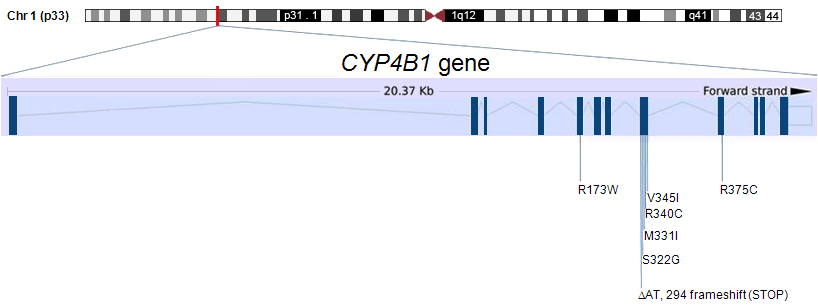
Figure 1. Localization of the CYP4B1 locus to chromosome 1p33 and sites (exons 5, 8 and 9) of polymorphic variants that describe the 7 allelic variants of CYP4B1 (see table 1 for details).
Description
The CYP4B1 gene has 12 exons resulting in an open reading frame of 1533 bp (isoform 1). The CYP4B1 locus is depicted in figure 1 (NCBI).
Transcription
Two major transcripts are known to derive from alternative splicing (NM_000779.3, NM_001099772.1). Isoform 1 encodes a 511 amino acid protein, while isoform 2 encodes a 512 amino acid protein with a Ser206 insertion. It should be noted that this is a complicated locus with many other possibilities for alternative splicing.
Pseudogene
No pseudogene is known for CYP4B1.
Proteins
Note
CYP4B1 belongs to the mammalian CYP4 enzyme family that also includes CYP4A, 4F and the recently discovered CYP 4V, 4X and 4Z sub-families (Rettie and Kelly, 2008). P450 enzymes usually function as monooxygenases in that they incorporate one atom of molecular oxygen into their substrates and reduce the other to water. CYP4 enzymes typically catalyze fatty acid ω-hydroxylase reactions.
Description
Structurally, P450 enzymes all share a similar fold featuring a β-sheet rich N-terminus and an α-helix rich C-terminus. The hydrophobic N-terminus of eukaryotic P450s functions as membrane anchor, whereas the C-terminal region houses the cysteinyl heme (iron protoporphyrin IX) cofactor that binds and activates molecular oxygen. Many CYP4 enzymes, including CYP4B1, possess a unique post-translational modification at the heme active center, wherein a conserved glutamate residue in the core I-helix forms a covalent, ester linkage at the C-5 methyl group of the heme (Henne et al., 2001). The function of the unusual modification has not been established, although it may serve to rigidify the enzymes active site and modulate the substrate selectivity of CYP4B1. The CYP4B1 enzyme is highly conserved across species - see figure 2 below that also highlights the position of the cysteinyl ligand and the I-helix glutamate.
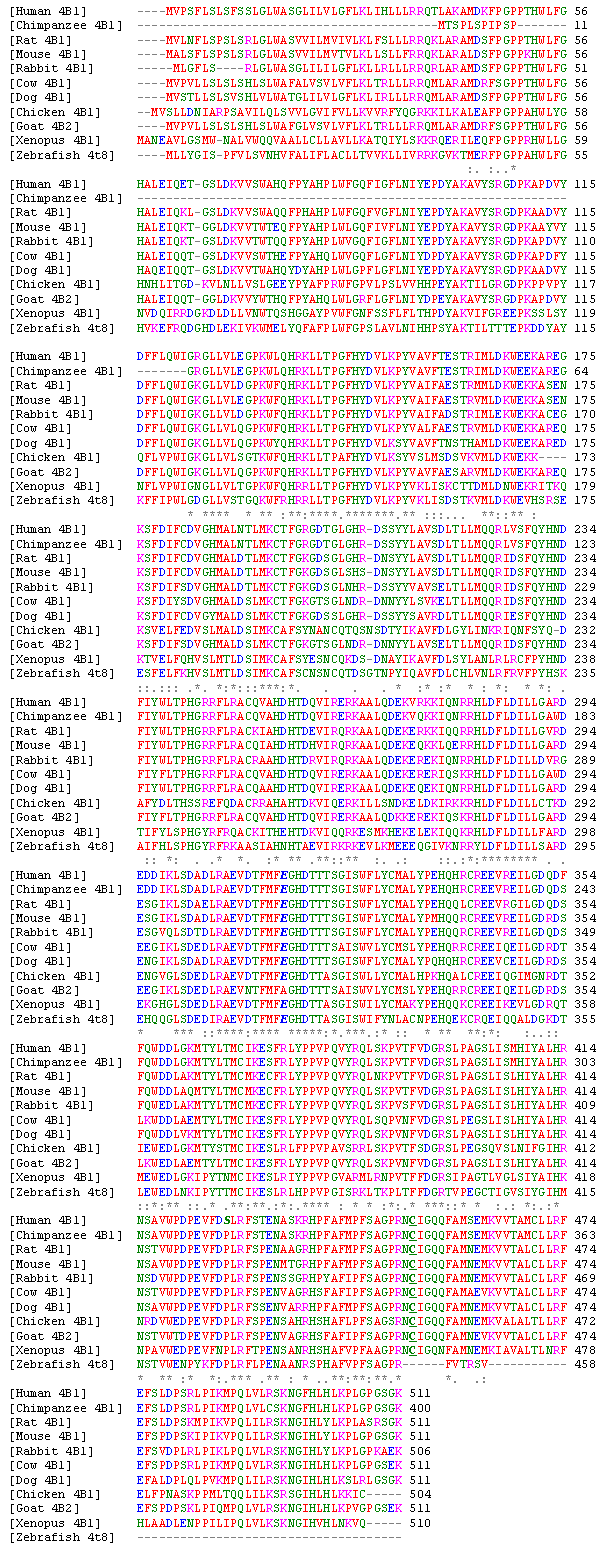
Figure 2. Multiple sequence alignment of vertebrate CYP4B proteins. The covalently heme-linked glutamate residue is indicated in bold italics and the heme-coordinating cysteinyl ligand depicted in bold underline. The Pro>Ser substitution at position 427 in human CYP4B1 is depicted in italics. Alignments determined using the ClustalW2 multiple sequence alignment program available online at EMBL-EBI.
Expression
CYP4B1 mRNA and/or protein are found typically at the highest levels in lung and airway tissue. Liver levels of the enzyme are usually much lower, but inducible by phenobarbital. Expression of the enzyme in mouse kidney is regulated by androgens. CYP4B1 is highly expressed in several cancer types, including colon, adrenal gland, lung and gastric cancers.
Localisation
CYP4B1 is located in the ER membrane, although one report suggests that the rat enzyme may be a secreted protein in respiratory mucosa (Genter et al., 2006).
Function
CYP4B1 is functionally related to the larger mammalian CYP4 family through maintenance of ω-hydroxylase activity towards fatty acids and alkyl hydrocarbons, which may be reflective of its endogenous role. Indeed, a strong link has been made between CYP4B1 levels, 12-HETrE production, and angiogenic activity in the rabbit cornea (Seta et al., 2007). Additionally, CYP4B1 has the capacity to metabolize a diverse array of xenobiotic pro-toxins, including valproic acid, 3-methylindole, 4-ipomeanol, and numerous aromatic amines. While these xenobiotics have little in common structurally or chemically, their metabolism by CYP4B1 leads to reactive metabolites that may cause tissue-specific toxicities in several experimental animals. The bioactivation capabilities of rabbit CYP4B1 have attracted attention in the cancer community and formed the basis of an experimental therapeutic strategy involving prodrug-activation by the CYP4B1 transgene (Rainov et al., 1998). The metabolic capabilities of human CYP4B1 are much less clear due to difficulties in heterologous expression of active enzyme and/or the existence of alternatively spliced products. Note that human CYP4B1 also uniquely possesses a Ser instead of a Pro residue at amino acid position 427 (see figure 3) - a sequence variation that has been suggested to result in a functionally defective enzyme (Zheng et al., 1998).
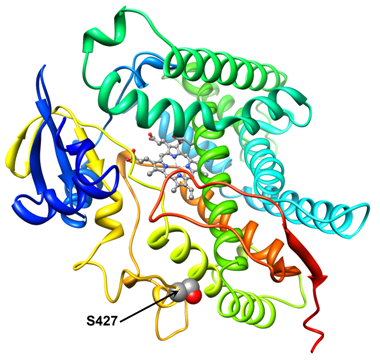
Figure 3. Homology model of CYP4B1 based on human P450 1A2 structure (Sansen et al., 2007), highlighting the location of the Pro>Ser substitution unique to the human isozyme. Structure shown in ribbon representation and colored by a rainbow scheme from N-terminus (blue) to C-terminus (red). S427 is shown in spacefilling representation and labeled. Heme shown in ball and stick representation.
Homology
- CYP4B1 (Pan troglodytes)
- Cyp4b1 (Mus musculus)
- Cyp4b1 (Rattus norvegicus)
- CYP4B1 (Oryctolagus cuniculus)
- CYP4B1 (Bos Taurus)
- CYP4B1 (Canis lupus)
- CYP4B1 (Gallus gallus)
- CYP4B1 (Xenopus laevis)
- Cyp4b1 (Mus musculus)
- Cyp4b1 (Rattus norvegicus)
- CYP4B1 (Oryctolagus cuniculus)
- CYP4B1 (Bos Taurus)
- CYP4B1 (Canis lupus)
- CYP4B1 (Gallus gallus)
- CYP4B1 (Xenopus laevis)
Denoted as similar to CYP4B1:
- CYP4B2 (Capra hircus)
- cyp4t8 (Danio rerio)
Mutations
Note
Seven alleles (CYP4B1*1-*7) are listed at http://www.cypalleles.ki.se/cyp4b1.htm and summarized in table 1 below. The CYP4B1*1 allele is described by a composition of the major alleles shown in table 1. CYP4B1*2 contains the haplotype of the 294 frameshift along with M331I, R340C and R375C. CYP4B1*7 is the same haplotype minus the R375C variant. CYP4B1*3/4/5 are described by the R173W, S322G and M331I polymorphisms, respectively. CYP4B1*6 is R173W in combination with V345I.
Table 1. CYP4B1 polymorphic variants including nucleotide changes and effect on protein coding sequences. 1 The values for heterozygosity of the minor alleles are taken from NCBI. ND: not determined.
| Nucleotide Change, cDNA position | Protein Coding Sequence Change | Heterozygosity1 |
| 517C>T | R173W | 0.28 |
| 881_882ΔAT | 294 frameshift (STOP) | 0.34 |
| 964A>G | S322G | 0.02 |
| 993G>A | M331I | 0.40 |
| 1018C>T | R340C | 0.22 |
| 1033G>A | V345I | ND |
| 1123C>T | R375C | 0.26 |
Recent exome sequencing has revealed considerable additional polymorphism (>75 total SNPs) in the human CYP4B1 gene (search at Exome Variant Server).
Implicated in
Entity name
Various cancers
Note
CYP4B1 mRNA and/or protein are highly expressed in some cancer types. In particular Imaoka et al. demonstrated increased CYP4B1 in bladder tumor tissue at both the mRNA and protein level (Imaoka et al., 2000). This finding is also consistent with rodent studies demonstrating localization of CYP4B1 in mouse and rat bladder tissue (Imaoka et al., 1997; Imaoka et al., 2001). However, Czerwinski et al. observed down regulation of CYP4B1 mRNA in lung tumors relative to normal lung (Czerwinski et al., 1994). With breast cancer, there does not appear to be any difference in expression of CYP4B1 when comparing tumor tissue with surrounding healthy tissue, but these studies did not use disease-free subjects as a comparator (Iscan et al., 2001). Relatively high expression of constitutive CYP4B1 mRNA has been found in human urothelial cells (Roos et al., 2006). Peripheral blood mononuclear cell CYP4B1 mRNA expression correlated with human liver expression and therefore has been suggested as a surrogate marker for hepatic bioactivation of environmental pro-toxins (Furukawa et al., 2004). An increased risk of bladder cancer (OR of 1.03-2.95) has been reported in Japanese patients carrying the CYP4B1*2 allele (Sasaki et al., 2008). One potential explanation could be that CYP4B1 is known to play a role in aromatic amine bioactivation (Windmill et al., 1997) and these compounds are known bladder carcinogens and present in cooked meats (Jägerstad and Skog, 2005) and cigarette smoke (Smith et al., 1997), among other sources. However, no association was found between lung cancer risk and CYP4B1*1-*7 polymorphisms in Japanese (Tamaki et al., 2011).
Entity name
Angiogenesis
Note
Studies conducted in a rabbit model of corneal wound healing have implicated that CYP4B1 may play a role in production of inflammatory eicosanoids and corneal neovascularization (Mastyugin et al., 2001). These observations are corroborated by findings in mice, whereby heme oxygenase-I induction attenuates corneal inflammation and is associated with a lack of CYP4B1 induction (and eicosanoid production) (Patil et al., 2008). Conversely, retinoic acid (RA) has been shown to increase CYP4B1 gene expression in ocular organ cultures, resulting in increased metabolism of arachidonic acid to 12-HETE and 12-HETrE (Ashkar et al., 2004). These effects were shown to be mediated, at least in part, by transcriptional regulation of the rabbit CYP4B1 promoter, which contains several RAR/RXR binding motifs (Ashkar et al., 2004). While RA is typically associated with corneal wound healing, the induction of CYP4B1 by RA suggests it may also have a pro-inflammatory role in wound healing. This is supported by the observation that systemic treatment with 13-cis-retinoic acid (Accutane™) for cystic acne is associated with conjunctivitis, eyelid inflammation and keratitis, along with other ocular effects (Lebowitz and Berson, 1988). Further evidence that CYP4B1 is important in ocular inflammation, eicosanoid production and neovascularization is shown in a study by Seta et al., using in vivo siRNA targeting of CYP4B1 in a rabbit model of corneal wound healing. It was found that down-regulation of CYP4B1 inhibited production of 12- HETrE and VEGF in addition to decreasing neovascularization (Seta et al., 2007).
Entity name
Colitis
Note
Several recent studies have implicated a potential role for CYP4B1 in inflammatory bowel disease (IBD). In a mouse model of dextran sodium sulfate (DSS)-induced colitis, Ye et al. found that caffeic acid treatment decreased disease severity and this was associated with increased expression of Cyp4b1 in affected tissues (Ye et al., 2009). In a subsequent study looking at the role of caffeic acid bioavailability in this model, they found that mice treated with DSS alone had lower colonic Cyp4b1 expression when compared to DSS plus caffeic acid treated mice (Ye et al., 2011). In a different mouse model of IBD, Liu et al. also found evidence that Cyp4b1 gene expression is altered in this disease state (Liu et al., 2009). It was found that IBD induced by infection with Helicobacter bilis resulted in changes in mucosal gene expression patterns. Using microarray analysis, it was found that H. bilis infection resulted in decreased expression of Cyp4b1. These authors also examined mice with IBD induced by DSS and, akin to Liu et al., found decreased expression of Cyp4b1 in diseased tissue. These findings suggest an anti-inflammatory role for CYP4B1 in IBD, but these preclinical studies must be weighed against what is known about gastrointestinal expression of CYP4B1 and human IBD. While rodents and rabbits and other species are known to expression CYP4B1 in the gut, there are species-specific differences, with humans expressing little CYP4B1 in this tissue (McKinnon et al., 1994). Whether the CYP4B1 gene plays any role in IBD is unclear, particularly in light of the functionality of the Pro427Ser human protein (Zheng et al., 1998). Finally, in considering risk of developing IBD, a genome wide association study by The Wellcome Trust examining 2000 cases of Crohns with 3000 controls, found no significant association between CYP4B1 genetic variants and disease incidence (Wellcome Trust Case Control Consortium, 2007).
Article Bibliography
| Pubmed ID | Last Year | Title | Authors |
|---|---|---|---|
| 15006160 | 2004 | Retinoic acid induces corneal epithelial CYP4B1 gene expression and stimulates the synthesis of inflammatory 12-hydroxyeicosanoids. | Ashkar S et al |
| 8313365 | 1994 | Quantification of CYP2B7, CYP4B1, and CYPOR messenger RNAs in normal human lung and lung tumors. | Czerwinski M et al |
| 15182434 | 2004 | Cytochrome p450 gene expression levels in peripheral blood mononuclear cells in comparison with the liver. | Furukawa M et al |
| 16788951 | 2006 | Localization of CYP4B1 in the rat nasal cavity and analysis of CYPs as secreted proteins. | Genter MB et al |
| 11669629 | 2001 | Covalent linkage of prosthetic heme to CYP4 family P450 enzymes. | Henne KR et al |
| 11311483 | 2001 | Androgen regulation of CYP4B1 responsible for mutagenic activation of bladder carcinogens in the rat bladder: detection of CYP4B1 mRNA by competitive reverse transcription-polymerase chain reaction. | Imaoka S et al |
| 11767004 | 2001 | The expression of cytochrome P450 enzymes in human breast tumours and normal breast tissue. | Iscan M et al |
| 15914214 | 2005 | Genotoxicity of heat-processed foods. | Jägerstad M et al |
| 3045165 | 1988 | Ocular effects of oral retinoids. | Lebowitz MA et al |
| 19397886 | 2009 | Mucosal gene expression profiles following the colonization of immunocompetent defined-flora C3H mice with Helicobacter bilis: a prelude to typhlocolitis. | Liu Z et al |
| 11821980 | 2001 | Corneal epithelial VEGF and cytochrome P450 4B1 expression in a rabbit model of closed eye contact lens wear. | Mastyugin V et al |
| 7894498 | 1994 | Species-specific expression of CYP4B1 in rabbit and human gastrointestinal tissues. | McKinnon RA et al |
| 18441305 | 2008 | Heme oxygenase-1 induction attenuates corneal inflammation and accelerates wound healing after epithelial injury. | Patil K et al |
| 9650611 | 1998 | New prodrug activation gene therapy for cancer using cytochrome P450 4B1 and 2-aminoanthracene/4-ipomeanol. | Rainov NG et al |
| 16341845 | 2006 | Expression of cytochrome P450 enzymes CYP1A1, CYP1B1, CYP2E1 and CYP4B1 in cultured transitional cells from specimens of the human urinary tract and from urinary sediments. | Roos PH et al |
| 17311915 | 2007 | Adaptations for the oxidation of polycyclic aromatic hydrocarbons exhibited by the structure of human P450 1A2. | Sansen S et al |
| 18713828 | 2008 | Possible relationship between the risk of Japanese bladder cancer cases and the CYP4B1 genotype. | Sasaki T et al |
| 17991614 | 2007 | Inhibition of VEGF expression and corneal neovascularization by siRNA targeting cytochrome P450 4B1. | Seta F et al |
| 9463546 | 1997 | An international literature survey of "IARC Group I carcinogens" reported in mainstream cigarette smoke. | Smith CJ et al |
| 21791872 | 2011 | Association between cancer risk and drug-metabolizing enzyme gene (CYP2A6, CYP2A13, CYP4B1, SULT1A1, GSTM1, and GSTT1) polymorphisms in cases of lung cancer in Japan. | Tamaki Y et al |
| 17554300 | 2007 | Genome-wide association study of 14,000 cases of seven common diseases and 3,000 shared controls. | |
| 9202751 | 1997 | The role of xenobiotic metabolizing enzymes in arylamine toxicity and carcinogenesis: functional and localization studies. | Windmill KF et al |
| 21918060 | 2011 | Plasma caffeic acid is associated with statistical clustering of the anticolitic efficacy of caffeic acid in dextran sulfate sodium-treated mice. | Ye Z et al |
| 19307459 | 2009 | Increased CYP4B1 mRNA is associated with the inhibition of dextran sulfate sodium-induced colitis by caffeic acid in mice. | Ye Z et al |
| 9737862 | 1998 | Identification of a meander region proline residue critical for heme binding to cytochrome P450: implications for the catalytic function of human CYP4B1. | Zheng YM et al |
Other Information
Locus ID:
NCBI: 1580
MIM: 124075
HGNC: 2644
Ensembl: ENSG00000142973
Variants:
dbSNP: 1580
ClinVar: 1580
TCGA: ENSG00000142973
COSMIC: CYP4B1
RNA/Proteins
Expression (GTEx)
Pathways
Protein levels (Protein atlas)
PharmGKB
| Entity ID | Name | Type | Evidence | Association | PK | PD | PMIDs |
|---|---|---|---|---|---|---|---|
| PA445425 | Prostatic Neoplasms | Disease | ClinicalAnnotation | associated | PD | 20038957 | |
| PA449383 | docetaxel | Chemical | ClinicalAnnotation | associated | PD | 20038957 | |
| PA451644 | thalidomide | Chemical | ClinicalAnnotation | associated | PD | 20038957 |
References
| Pubmed ID | Year | Title | Citations |
|---|---|---|---|
| 36768362 | 2023 | Spotlight on CYP4B1. | 1 |
| 37950293 | 2023 | Missense variants in CYP4B1 associated with increased risk of lung cancer among Chinese Han population. | 1 |
| 38041008 | 2023 | CYP4B1 polymorphisms and the risk of breast cancer in Chinese women: a case-control study. | 0 |
| 36768362 | 2023 | Spotlight on CYP4B1. | 1 |
| 37950293 | 2023 | Missense variants in CYP4B1 associated with increased risk of lung cancer among Chinese Han population. | 1 |
| 38041008 | 2023 | CYP4B1 polymorphisms and the risk of breast cancer in Chinese women: a case-control study. | 0 |
| 36307788 | 2022 | Case-control study on CYP4B1 gene polymorphism and susceptibility to gastric cancer in the chinese Han population. | 3 |
| 36307788 | 2022 | Case-control study on CYP4B1 gene polymorphism and susceptibility to gastric cancer in the chinese Han population. | 3 |
| 33592039 | 2021 | CYP4B1 is a prognostic biomarker and potential therapeutic target in lung adenocarcinoma. | 18 |
| 33592039 | 2021 | CYP4B1 is a prognostic biomarker and potential therapeutic target in lung adenocarcinoma. | 18 |
| 31801692 | 2020 | Novel insights into oxidation of fatty acids and fatty alcohols by cytochrome P450 monooxygenase CYP4B1. | 6 |
| 32054340 | 2020 | Cytochrome P450 4B1 (CYP4B1) as a target in cancer treatment. | 15 |
| 31801692 | 2020 | Novel insights into oxidation of fatty acids and fatty alcohols by cytochrome P450 monooxygenase CYP4B1. | 6 |
| 32054340 | 2020 | Cytochrome P450 4B1 (CYP4B1) as a target in cancer treatment. | 15 |
| 30803053 | 2019 | Downregulation of the cytochrome P450 4B1 protein confers a poor prognostic factor in patients with urothelial carcinomas of upper urinary tracts and urinary bladder. | 9 |
Citation
Edward J Kelly ; Vladimir Yarov-Yarovoy ; Allan E Rettie
CYP4B1 (cytochrome P450, family 4, subfamily B, polypeptide 1)
Atlas Genet Cytogenet Oncol Haematol. 2012-02-01
Online version: http://atlasgeneticsoncology.org/gene/40253/cyp4b1
