DLG1 (discs, large homolog 1 (Drosophila))
2015-01-01 Paola Massimi , Lawrence Banks AffiliationInternational Centre for Genetic Engeneering, Biotechnology (ICGEB), Trieste, Italy
Identity
Abstract
The human homologue of Drosophila disc large tumor suppressor protein (hDlg) also known as synapse-associated protein 97, is a scaffold protein, a member of the membrane-associated guanylate kinase family. It is one of the proteins known to act cooperatively in regulating cell polarity and proliferation, suggesting an important connection between epithelial organization and cellular growth control. An abnormal expression of hDlg has been reported in several cancer types.This protein may have a role in cell junction formation, signal transduction, cell proliferation, synaptogenesis and lymphocyte activation.
DNA/RNA
Description
Transcription
DLG1 contains also a 59 aa SH3 (Src homolgy 3) domain, which mainly mediates binding to other proteins. The N terminal half of the molecule contains three copies of the 80-90 aa motif called DHR/GLGF/PDZ (PSD-95, Dlg, ZO-1), which mediate the binding of the protein to the plasma membrane and confers binding to proteins that possess a class I PDZ binding motif (Morais Cabral et al., 1996).
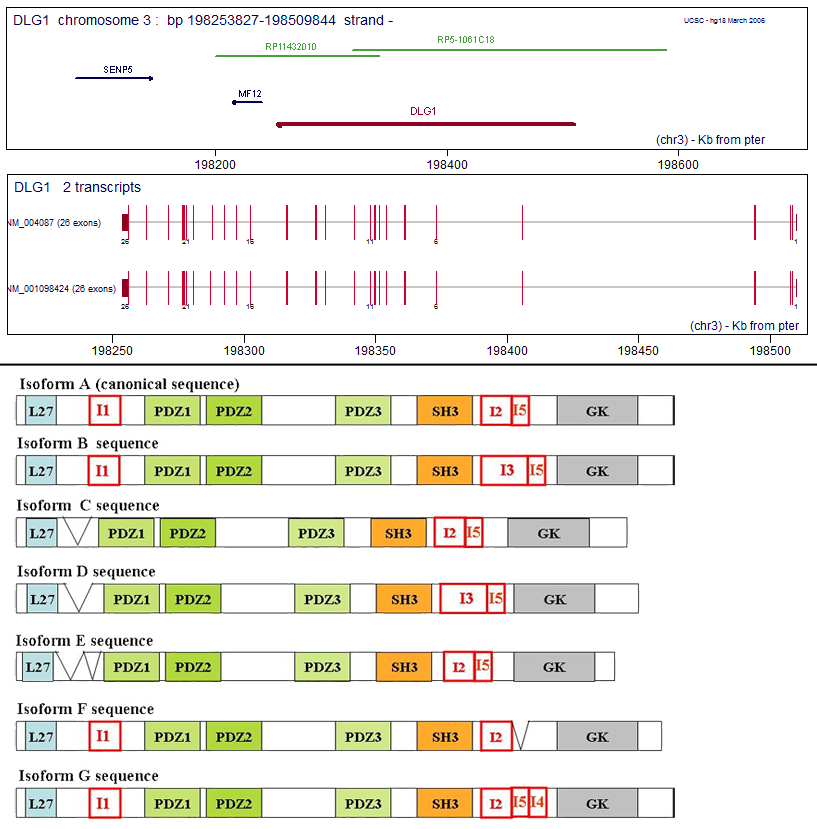
There are two major transcripts of DLG1 gene. One is Discs large homolog 1 isoform 1, which contains an additional exon (99 nucleotides) in the 5 part of the Dlg homology repeats (DHR) domain and lacks an exon in the 3 coding region, resulting in a shorter protein (isoform 1), compared to isoform 2. The second is Discs large homolog 1 isoform 2, which represents the longer transcript and encodes the longer isoform. This second transcript is alternatively spliced with an insertion of 34 nucleotides in the region between the SH3 and GUK (isoform 2). Another alternative splice has an insertion of 100 nucleotides and the resulting transcript is called Discs large homolog 1 isoform 3.
In conclusion, the protein is regulated by a several different alternative splicing events (Mori et al., 1998) resulting in a number of different combination of spliced variants (which give raise to at least 7 isoforms such as I1I2, I1I3, etc.) (see table), some of which are transcribed in a tissue-specific manner (Lue et al., 1996; McLaughlin et al., 2002).
Pseudogene
Proteins
Description
Specific binding partners are known for each domain of DLG1, and different modes of intramolecular interactions have been proposed that particularly involve the SH3 and GUK domains and the so-called HOOK region located between these two domains.
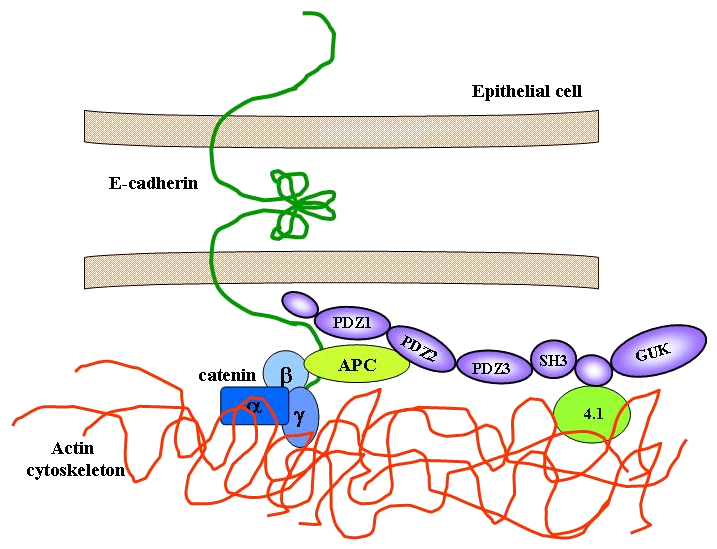
DLG1 binds to the membrane cytoskeletal 4.1 protein through its C-terminal region (Hanada et al., 2003), via a motif encoded by the alternatively spliced exon located between the SH3 and the C-terminal guanylate kinase-like domains (Isoform I3). The PDZ1-2 modules and the I3 domain associate with the 30-kD NH2-terminal domain of protein 4.1 that is conserved in ezrin/radixin/moesin (ERM) proteins module (Lue et al., 1996; Bonilha and Rodriguez-Boulan, 2001). Indeed SAP97 also interacts with ezrin, an actin-binding protein crucial for morphogenesis of apical microvilli and basolateral infoldings in retinal pigment epithelial (RPE) cells.
Through the PDZ2 domain the protein also interacts with the carboxyl-terminal S/TXV motif of the APC (Adenomatous polyposis coli) tumour suppressor protein and plays an important role in transducing the APC cell cycle blocking signal (Makino et al., 1997; Ishidate et al., 2000; Mimori-Kiyosue et al., 2007). Recent studies report that APC can bind to all the three PDZ domains from hDlg, whereas PTEN mainly binds to PDZ-2/hDlg. This indicates the existence of overlapping, but distinct PDZ-domain recognition patterns by APC and PTEN. Furthermore, a ternary complex formed by APC, PTEN, and hDlg has been detected, suggesting that hDlg may serve as a platform to bring in proximity APC and PTEN tumor suppressor activities, which may be relevant in oncogenesis (Sotelo et al. 2012). In addition, APC appears to mediate the interaction between DLG1, beta-catenin and the actin cytoskeleton. Beta-catenin is complexed with gamma-catenin and alpha-catenin, through which DLG1 binds to E-cadherin (Reuver et al., 1998). .
Moreover, the Src homology domain 2 of the p85/PI3K and hDlg are associated with E-cadherin in a common macromolecular complex in differentiating intestinal cells, and in this way hDlg may be a determinant in E-cadherin-mediated adhesion and signaling in mammalian epithelial cells (Laprise et al., 2004).
DLG1 was demonstrated also to bind with voltage-gated or Kv K(+) channels through its PDZ domains (Hanada et al., 1997; Tiffany et al., 2000; Eldstrom et al., 2003). The complex formation involves the association of Cav-3 with a segment of SAP97 localized between its PDZ2 and PDZ3 domains. This scaffolding complex can recruit Kv1.5 to form a tripartite complex in which each of the three components interacts with the other two. These interactions between Kv1.5, Cav3 and SAP97 may constitute the nucleation site for the assembly of macromolecular containing potassium channels and thereby regulates cellular potential currents (Folco et al., 2004).
Hanada showed by immunoblot analysis that immunoprecipitates of DLG1 in T lymphocytes contain the Src family tyrosine kinase p56 (lck). Binding analysis demonstrated that LCK interacts with the proline-rich N-terminal domain of DLG1, suggesting that DLG1 may function as a coupler of tyrosine kinase and a voltage-gated potassium channel in T lymphocytes.
The HOOK region of DLG1 is also a specific site for calmodulin binding and interaction of SAP97 to immobilized calmodulin is strictly calcium-dependent (Paarmann et al., 2002). The calmodulin seems to regulate the intramolecular interaction between the SH3, HOOK, and GK domains of the protein.
DLG1 also forms multiprotein complexes with CASK, LIN7A, LIN7B, LIN7C, APBA1, and KCNJ12 (Nix et al., 2000; Lee et al., 2002; Leonoudakis et al., 2004) and exists as a tripartite complex composed of DLG1, MPP7 and LIN7 (LIN7A or LIN7C) (Bohl et al., 2007; Stucke et al., 2007). MPP7 dimerized with the LIN7 proteins through its L27C domain. The LIN7/MPP7 dimer then linked to DLG1 though the L27N domain of MPP7. This complex localizes to epithelial adherens junctions in transfected Madin-Darby Canine Kidney cells (MDCK). MPP7 constructs lacking either the PDZ or SH3 domain redistributed MPP7, DLG1, and LIN7 into the soluble cytoplasmic fraction. MPP7 and DLG1 colocalized at the lateral surface of epithelial cells, and they overlapped with markers of adherens junctions and tight junctions. Loss of either DLG1 or MPP7 from epithelial cells resulted in a significant defect in assembly and maintenance of functional tight junctions. The formation of the DLG1-MPP7 complex promotes also epithelial cell polarity.
SAP97 binds two other mLIN-7 binding MAGUK proteins. One of these MAGUK proteins, DLG3, coimmunoprecipitates with SAP97 in lysates from rat brain and transfected MDCK cells. This interaction requires the MRE (MAGUK recruitment) domain of SAP97 and surprisingly, both the L27N and L27 carboxyl-terminal (L27C) domains of DLG3. SAP97 can interact with the MAGUK protein, DLG2, but not the highly related protein, PALS2. The ability of SAP97 to interact with multiple MAGUK proteins is likely to be important for the targeting of specific protein complexes in polarized cells (Karnak et al., 2002).
The kinesin-3 motor protein, GAKIN, is regulated by the direct binding of its protein cargo hDlg. Direct binding of the SH3-I3-GUK module of hDlg to the MAGUK Binding Stalk domain of GAKIN activates the microtubule-stimulated ATPase activity of GAKIN (Hanada et al., 2000; Yamada et al., 2007; Unno et al., 2008).
Using the yeast two-hybrid screening a novel protein from a human cDNA library was isolated as a binding partner of DLG1. This protein is a component of TJs rather than AJs (where DLG1 is normally found), even if it is incorporated into TJs after TJ strands are formed, and therefore it is named Pilt (protein incorporated later into TJs) (Kawabe et al., 2001).
DLG1 is known to interact also with several human virus oncoproteins : HPV E6 (Lee et al., 1997; Kiyono et al.,1997, Gardiol et al., 1999) through its C-terminus and DLG1 PDZ2 domain and as result is subjected to proteasome mediated degradation; HTLV-1 TAX (Suzuki et al., 1999), via the C-terminus of Tax and the PDZ domain of hDLG. Tax prevents the binding of hDLG to APC tumor suppressor gene product, suggesting the mechanism for inhibition of hDLG function; Adenovirus type 9 E4-ORF1 specifically requires endogenous DLG1 to provoke oncogenic activation of phosphatidylinositol 3-kinase (PI3K) in cells. E4-ORF1 binding to Dlg1 on ts PDZ domain triggers the resulting complex to translocate to the plasma membrane and, at this site, to promote Ras-mediated PI3K activation, suggesting a surprising oncogenic function for DLG1 in virus-mediated cellular transformation (Frese et al., 2006; Chung et al., 2007). Moreover, phosphatidylinositol 3-kinases are one class of signaling molecules reported to regulate adherens junction and to be activated by adherens junction assembly . While the exact molecular mechanisms involved are not clear, data indicate that one of the earliest events likely involves c-Src which is rapidly activated by E-cadherin-mediated cellular aggregation and may facilitate the recruitment and activation of PI3K to E-cadherin-containing complexes. Beta-catenin, gamma-catenin and hDlg which are present at cell-cell adhesions can act as docking proteins for PI3K (Rivard N. 2009).
hDlg also binds the tumor endothelial marker 5 (TEM5), a seven-pass transmembrane protein that is homologous to the B family of G-protein-coupled receptors (GPCRs). The PDZ domains of hDlg bound the C-terminal PDZ-binding motif of TEM5. DLG1 is furthermore able to interact with a novel seven-pass transmembrane protein, which was homologous to TEM5, and was named here a TEM5-like protein (TEM5-like) (Yamamoto et al., 2004).
SAP97/hDlg as a scaffold protein is also targeted to the cytoskeleton by its association with the protein guanylate kinase-associated protein (GKAP), which is part of the postsynaptic scaffold in neuronal cells (Sabio et al., 2005). Moreover, hDlg is believed to associate with AMPA receptors (AMPARs) containing the GluR1 subunit, but the functional significance of these interactions is partially unclear, even if this interaction seems to be occur early in the secretory pathway, while the receptors are in the endoplasmic reticulum or cis-Golgi (Sans et al., 2001). In light membrane fractions prepared from rat brain, myosin VI and SAP97 form a trimeric complex with the alpha-amino-3-hydroxy-5-methylisoxazole-4-propionic acid (AMPA) receptor subunit, GluR1. It is possible that SAP97 may serve as a molecular link between GluR1 and the actin-dependent motor protein myosin VI during the dynamic translocation of AMPA receptors to and from the postsynaptic plasma membrane (Wu et al., 2002).
DLG1 is also able to translocate to the immune synapse and lipid rafts in response to T cell receptor (TCR)/CD28 engagement and LckSH3-mediated interactions with DLG1 control its membrane targeting. TCR/CD28 engagement induces the formation of endogenous Lck-DLG1-Zap70-Wiskott-Aldrich syndrome protein (WASp) complexes in which DLG1 acts to facilitate interactions of Lck with Zap70 and WASp (Round et al., 2005).
Delta 1 acts as a membrane-bound ligand that interacts with the Notch receptor and plays a critical role in cell fate specification. DLG1 binds the Delta 1 C-terminal region, in a PDZ dependent manner. Delta 4 also interacts with DLG1, whereas Jagged1, another Notch ligand, does not (Six et al., 2004).
MARCH 2, which is part of the MARCH family ubiquitin ligases and is implicated in the endosomal trafficking interacts with full-length DLG1 in a PDZ domain dependent manner. Furthermore, MARCH2 co-localized with DLG1 at sites of cell-cell contact (Cao et al., 2008).
SAP97 is a binding partner of the cytoplasmic domain of TACE, which is the Tumour necrosis factor alpha converting enzyme and is the metalloprotease-disintegrin responsible for the ectodomain shedding of several proteins, including tumour necrosis factor alpha. The interaction involved the PDZ3 domain of SAP97 and the extreme C-terminal amino-acid sequence of TACE (Peiretti et al., 2003).
DLG1 is able to interact also with Net 1 which is a nuclear RhoA-specific guanine nucleotide exchange factor. The binding is through the PDZ-binding motif. The ability of oncogenic Net1 to transform cells may be in part related to its ability to sequester tumour suppressor proteins like DLG1 in the cytosol, thereby interfering with their normal cellular function (Garcia-Mata et al., 2007).
DLG1 interacts with the tSNARE syntaxin 4 which is involved in vesicle transport, and this binding may contribute to the correct colocaliation of the other proteins of the Scrib complex: hScribble and Hugl-1 (Massimi et al., 2008).
Osmotic stress triggers hDlg degradation through a mechanism different from the one mediated by proteasomes, and hDlg is also a caspase substrate during the apoptotic process, although its proteolysis may not be implicated in the progression of early apoptosis (Inesta-Vaquera FA et al. 2009).
In response to hyperosmotic stress, p38? also regulates formation of complexes between hDlg and the nuclear protein polypyrimidine tract-binding protein-associated-splicing factor (PSF). Following osmotic shock, p38? in the cell nucleus increases its association with nuclear hDlg, thereby causing dissociation of hDlg-PSF complexes. Moreover, hDlg and PSF bind different RNAs; in response to osmotic shock, p38? causes hDlg-PSF and hDlg-RNA dissociation independently of its kinase activity, affecting mRNA processing and/or gene transcription (Sabio et al. 2010). Moreover, the exposure of cells to osmotic shock induces the hyperphosphorylation of Dlg and its concomitant accumulation within the cell membrane at sites of cell contact, a process that requires an intact actin filament network. In addition, hyperphosphorylation of Dlg also renders it more susceptible to degradation induced by the HPV-18 E6 oncoprotein (Massimi et al.2006).
Also the ERK5 pathway is reported to mediate hDlg cell cycle dependent phosphorylation. This is likely to have important implications in the correct timely mitotic entry and mitosis progression ( Inesta- Vaquera et al. 2010).
Using the yeast two-hybrid system to screen a human aorta cDNA library, mitogen-activated protein/extracellular signal-responsive kinase (ERK) kinase (MEK)2, a member of the ERK cascade it was identified as an hDlg binding partner. Site-directed mutagenesis showed a major involvement of the PSD-95, disc-large, ZO-1 domain-2 of hDlg and the C-terminal sequence RTAV of MEK2 in this interaction. hDlg acts as a MEK2-specific scaffold protein for the ERK signaling pathway differentially tuning MEK1/MEK2 signaling and cell responses ( Maiga et al. 2011). Both proteins localize also to a sub-structure of the midbody, the midbody ring (Massimi et al. 2003; Gaudet et al. 2011).
Using a proteomic approach it has been shown that a strong interacting partner of hDlg is the RhoG-specific guanine nucleotide exchange factor SGEF. The interaction between hDlg1 and SGEF involves both PDZ and SH3 domain recognition, and directly contributes to the regulation of SGEFs cellular localization and activity. Consistent with this, hDlg is a strong enhancer of RhoG activity, which occurs in an SGEF-dependent manner and directly contributes to the invasive capacity of HPV-16 and HPV-18 transformed tumour cells displaying a distinct oncogenic function in the context of HPV induced malignancy (Krishna Subbaiah et al. 2012).
Loss of gap junctional communication correlatedswith relocalization of Cx43 to the cytoplasm late in tumorigenesis. A similar pattern of altered expression for the hDlg was found in cervical tumour cells, with partial co-localization of Cx43 and hDlg in an endosomal/lysosomal compartment. Relocalization of these proteins is not due to a general disruption of cell membrane integrity or Cx targeting. Cx43 (via its C-terminus) and hDlg interact directly in vitro and can form a complex in cells. This novel interaction requires the N- and C-termini of hDlg (Macdonald et al. 2012).
The components of the Scrib/Dlg tumour suppressor complex have complementary roles in Drosophila and loss of both proteins is a common event in many different human tumours. In human keratinocytes the removal of hScrib greatly reduces cell-cell contact and cell-matrix interactions, and promotes an invasive phenotype. Conversely, in cells lacking hDlg1 cell-cell contacts are maintained and there are decreases in both cell growth and invasion (Massimi et al. 2012).
Expression
Localisation
Again, the different isoforms of the protein seem to have diverse localisation in the cell. I2 and I3 variants have distinct distributions in epidermal and cervical epithelia. In skin and cervix, I3 variants are found in the cytoplasm. Cytoplasmic localization of I3 variants decreases as cervical keratinocytes differentiate, concomitant with relocalization to the cell periphery. I2 variants are found at the cell periphery of differentiated epidermal and cervical keratinocytes. Nuclear localization of I2 variants is evident in both tissues, with a concentration of nuclear I2 variants in basal and parabasal cervical keratinocytes (Roberts et al., 2007), underlining that different hDlg isoforms play distinct roles at various stages of epithelial differentiation. Moreover, upon transient transfection into subconfluent (MDCK) epithelial cells, hDlg-I3 accumulated predominantly at the plasma membrane of cell-cell contact sites, whereas hDlg-I2 distributed in the cytoplasm. The hDlg-I3 but not the hDlg-I2 isoform binds to the FERM (Four.1-Ezrin-Radixin-Moesin) domain of protein 4.1, playing a critical role in recruiting DLG1 to the lateral membrane in epithelial cells (Bonhila et al., 2001; Hanada et al., 2003; Massimi et al., 2003; Wu et al., 2002).
Several different domains of DLG1 contribute to its localisation. Mutation of the SH3 or GUK domain, but not the PDZ domain, results in a re-localization of hDLG to the nucleus and, moreover, DLG1 possess a potential nuclear localization signal in the HOOK domain (Kohu et al., 2002).
It has been reported that the localisation of DLG1 is also dependent on the post-translational modification of the protein, by phosphorylation occurring post-osmotic shock (Massimi et al., 2006; Remy et al. 2010) and also during the cell cycle following CDK phosphorylation (Narayan et al., 2009). Nuclear forms of Dlg phosphorylated on its CDK phospho-acceptor sites (S158 and S442) has enhanced susceptibility to E6-induced degradation (Narayan et al. 2009; Nagasaka et al. 2013). Moreover, DLG1 localises dependently from the other proteins involved in the complex at the adherens junctions: hScribble and Hugl-1 (Massimi et al., 2008).
In addition, CaMKII (calcium/calmodulin-dependent protein kinase II) activation led to increased targeting of SAP97 into dendritic spines, whereas CaMKII inhibition was responsible for SAP97 colocalization in the cell soma with the endoplasmic reticulum protein disulfide-isomerase (Mauceri et al., 2004).
Regarding the localisation of the different isoforms, the two main cardiac SAP97 isoforms contains both I3 and I1B inserts and differs by the I1A insert. Both isoforms co-precipitate with hKv1.5 channels, and have different effects on the hKv1.5 current, depending on their capacity to form clusters (Godreau et al., 2003).
In the case of endothelial cells of embryonic liver the expression of TEM5 colocalises with DLG1. This suggest that hDlg localizes at the plasma membrane through TEM5 and TEM5-like proteins and furthermore scaffolds these GPCRs in endothelial cells during tumour angiogenesis and neoangiogenesis (Yamamoto et al., 2004).
Function
It is able to recruits channels (Hanada et al., 1997; Tiffany et al., 2000; Abi-Char et al., 2008), receptors and signaling molecules (Sans et al., 2001; Wuh et al., 2002; Six et al., 2004) to discrete plasma membrane domains in polarized cells. Its main role is played in adherens junctions assembly (Laprise et al., 2004; Bohl et al., 2007; Stucke et al., 2007; Massimi et al., 2008). However DLG1 with the establishment of a multiprotein complexes at cell-cell contacts is also involved in signal transduction (Massimi et al., 2006), cell proliferation (Suzuki et al., 1999; Ishidate et al., 2000; Massimi et al., 2003; Thomas et al., 2005; Frese et al., 2006; Garcia-Mata et al., 2007; Unno et al., 2008), synaptogenesis (Mori et al., 1998; Sans et al., 2001; Mauceri et al., 2004), lymphocyte activation (Hanada et al., 1997; Hanada et al., 2000; Round et al., 2005), cell differentiation (Laprise et al., 2004; Roberts et al., 2007), cell migration (Six et al., 2004) and cellular apical-basal polarity control (Bonilha et al., 2001).
Homology
Mutations
Note
Implicated in
Article Bibliography
| Pubmed ID | Last Year | Title | Authors |
|---|---|---|---|
| 18245566 | 2008 | The anchoring protein SAP97 retains Kv1.5 channels in the plasma membrane of cardiac myocytes. | Abi-Char J et al |
| 9321488 | 1997 | Fine scale mapping places DLG1, the gene encoding hDlg, telomeric to the OPA1 candidate region. | Alexander C et al |
| 8825652 | 1995 | DLG1: chromosome location of the closest human homologue of the Drosophila discs large tumor suppressor gene. | Azim AC et al |
| 17237226 | 2007 | The stardust family protein MPP7 forms a tripartite complex with LIN7 and DLG1 that regulates the stability and localization of DLG1 to cell junctions. | Bohl J et al |
| 11726633 | 2001 | Polarity and developmental regulation of two PDZ proteins in the retinal pigment epithelium. | Bonilha VL et al |
| 8922396 | 1996 | Cloning and characterization of postsynaptic density 93, a nitric oxide synthase interacting protein. | Brenman JE et al |
| 17980554 | 2008 | DLG1 is an anchor for the E3 ligase MARCH2 at sites of cell-cell contact. | Cao Z et al |
| 18725271 | 2008 | Cloning and functional analysis of the promoter region of the human Disc large gene. | Cavatorta AL et al |
| 1419001 | 1992 | The rat brain postsynaptic density fraction contains a homolog of the Drosophila discs-large tumor suppressor protein. | Cho KO et al |
| 17314165 | 2007 | A new crucial protein interaction element that targets the adenovirus E4-ORF1 oncoprotein to membrane vesicles. | Chung SH et al |
| 12860415 | 2003 | SAP97 increases Kv1.5 currents through an indirect N-terminal mechanism. | Eldstrom J et al |
| 15277200 | 2004 | Caveolin-3 and SAP97 form a scaffolding protein complex that regulates the voltage-gated potassium channel Kv1.5. | Folco EJ et al |
| 16511562 | 2006 | Oncogenic function for the Dlg1 mammalian homolog of the Drosophila discs-large tumor suppressor. | Frese KK et al |
| 14871824 | 2004 | Somatic mutations and altered expression of the candidate tumor suppressors CSNK1 epsilon, DLG1, and EDD/hHYD in mammary ductal carcinoma. | Fuja TJ et al |
| 17938206 | 2007 | The nuclear RhoA exchange factor Net1 interacts with proteins of the Dlg family, affects their localization, and influences their tumor suppressor activity. | García-Mata R et al |
| 10523825 | 1999 | Oncogenic human papillomavirus E6 proteins target the discs large tumour suppressor for proteasome-mediated degradation. | Gardiol D et al |
| 16619250 | 2006 | Human discs large and scrib are localized at the same regions in colon mucosa and changes in their expression patterns are correlated with loss of tissue architecture during malignant progression. | Gardiol D et al |
| 22185284 | 2011 | The MEK2-binding tumor suppressor hDlg is recruited by E-cadherin to the midbody ring. | Gaudet S et al |
| 12970345 | 2003 | Different isoforms of synapse-associated protein, SAP97, are expressed in the heart and have distinct effects on the voltage-gated K+ channel Kv1.5. | Godreau D et al |
| 10859302 | 2000 | GAKIN, a novel kinesin-like protein associates with the human homologue of the Drosophila discs large tumor suppressor in T lymphocytes. | Hanada T et al |
| 12807908 | 2003 | Protein 4.1-mediated membrane targeting of human discs large in epithelial cells. | Hanada T et al |
| 12766944 | 2003 | Dlg, Scribble and Lgl in cell polarity, cell proliferation and cancer. | Humbert P et al |
| 20643107 | 2010 | ERK5 pathway regulates the phosphorylation of tumour suppressor hDlg during mitosis. | Iñesta-Vaquera FA et al |
| 10656683 | 2000 | The APC-hDLG complex negatively regulates cell cycle progression from the G0/G1 to S phase. | Ishidate T et al |
| 12351654 | 2002 | Identification of multiple binding partners for the amino-terminal domain of synapse-associated protein 97. | Karnak D et al |
| 11602598 | 2001 | Pilt, a novel peripheral membrane protein at tight junctions in epithelial cells. | Kawabe H et al |
| 9326658 | 1997 | Binding of high-risk human papillomavirus E6 oncoproteins to the human homologue of the Drosophila discs large tumor suppressor protein. | Kiyono T et al |
| 12081647 | 2002 | The SH3, HOOK and guanylate kinase-like domains of hDLG are important for its cytoplasmic localization. | Kohu K et al |
| 22383878 | 2012 | The invasive capacity of HPV transformed cells requires the hDlg-dependent enhancement of SGEF/RhoG activity. | Krishna Subbaiah V et al |
| 14699157 | 2004 | Human homolog of disc-large is required for adherens junction assembly and differentiation of human intestinal epithelial cells. | Laprise P et al |
| 11865057 | 2002 | A novel and conserved protein-protein interaction domain of mammalian Lin-2/CASK binds and recruits SAP97 to the lateral surface of epithelia. | Lee S et al |
| 9192623 | 1997 | Binding of human virus oncoproteins to hDlg/SAP97, a mammalian homolog of the Drosophila discs large tumor suppressor protein. | Lee SS et al |
| 14960569 | 2004 | A multiprotein trafficking complex composed of SAP97, CASK, Veli, and Mint1 is associated with inward rectifier Kir2 potassium channels. | Leonoudakis D et al |
| 8922391 | 1996 | Two independent domains of hDlg are sufficient for subcellular targeting: the PDZ1-2 conformational unit and an alternatively spliced domain. | Lue RA et al |
| 7937897 | 1994 | Cloning and characterization of hdlg: the human homologue of the Drosophila discs large tumor suppressor binds to protein 4.1. | Lue RA et al |
| 21615688 | 2011 | Identification of mitogen-activated protein/extracellular signal-responsive kinase kinase 2 as a novel partner of the scaffolding protein human homolog of disc-large. | Maïga O et al |
| 9188857 | 1997 | Cloning and characterization of NE-dlg: a novel human homolog of the Drosophila discs large (dlg) tumor suppressor protein interacts with the APC protein. | Makino K et al |
| 10788497 | 2000 | Human homologue of the Drosophila discs large tumor suppressor protein forms an oligomer in solution. Identification of the self-association site. | Marfatia SM et al |
| 14567986 | 2003 | Redistribution of the discs large tumor suppressor protein during mitosis. | Massimi P et al |
| 18793635 | 2008 | Regulation of the hDlg/hScrib/Hugl-1 tumour suppressor complex. | Massimi P et al |
| 22792261 | 2012 | Differential regulation of cell-cell contact, invasion and anoikis by hScrib and hDlg in keratinocytes. | Massimi P et al |
| 15044483 | 2004 | Calcium/calmodulin-dependent protein kinase II phosphorylation drives synapse-associated protein 97 into spines. | Mauceri D et al |
| 11723125 | 2002 | The distribution and function of alternatively spliced insertions in hDlg. | McLaughlin M et al |
| 17295841 | 2007 | Adenomatous polyposis coli (APC) protein regulates epithelial cell migration and morphogenesis via PDZ domain-based interactions with plasma membranes. | Mimori-Kiyosue Y et al |
| 8757139 | 1996 | Crystal structure of a PDZ domain. | Morais Cabral JH et al |
| 9621517 | 1998 | Identification of brain-specific splicing variants of the hDLG1 gene and altered splicing in neuroblastoma cell lines. | Mori K et al |
| 24093094 | 2013 | PDZ domains and viral infection: versatile potentials of HPV-PDZ interactions in relation to malignancy. | Nagasaka K et al |
| 19066288 | 2009 | CDK phosphorylation of the discs large tumour suppressor controls its localisation and stability. | Narayan N et al |
| 19307009 | 2009 | The high-risk HPV E6 oncoprotein preferentially targets phosphorylated nuclear forms of hDlg. | Narayan N et al |
| 20127000 | 2010 | The expression of hDlg as a biomarker of the outcome in malignant fibrous histiocytomas. | Niimi R et al |
| 10993877 | 2000 | hCASK and hDlg associate in epithelia, and their src homology 3 and guanylate kinase domains participate in both intramolecular and intermolecular interactions. | Nix SL et al |
| 12189141 | 2002 | Formation of complexes between Ca2+.calmodulin and the synapse-associated protein SAP97 requires the SH3 domain-guanylate kinase domain-connecting HOOK region. | Paarmann I et al |
| 12668732 | 2003 | Identification of SAP97 as an intracellular binding partner of TACE. | Peiretti F et al |
| 20004242 | 2010 | Differential activation of p38MAPK isoforms by MKK6 and MKK3. | Remy G et al |
| 9512503 | 1998 | E-cadherin mediated cell adhesion recruits SAP97 into the cortical cytoskeleton. | Reuver SM et al |
| 19273082 | 2009 | Phosphatidylinositol 3-kinase: a key regulator in adherens junction formation and function. | Rivard N et al |
| 17574238 | 2007 | Changes in localization of human discs large (hDlg) during keratinocyte differentiation are [corrected] associated with expression of alternatively spliced hDlg variants. | Roberts S et al |
| 15699074 | 2005 | Dlgh1 coordinates actin polymerization, synaptic T cell receptor and lipid raft aggregation, and effector function in T cells. | Round JL et al |
| 15729360 | 2005 | p38gamma regulates the localisation of SAP97 in the cytoskeleton by modulating its interaction with GKAP. | Sabio G et al |
| 20605917 | 2010 | p38gamma regulates interaction of nuclear PSF and RNA with the tumour-suppressor hDlg in response to osmotic shock. | Sabio G et al |
| 11567040 | 2001 | Synapse-associated protein 97 selectively associates with a subset of AMPA receptors early in their biosynthetic pathway. | Sans N et al |
| 18665322 | 2008 | An association analysis of synapse-associated protein 97 (SAP97) gene in schizophrenia. | Sato J et al |
| 15485825 | 2004 | The notch ligand Delta1 recruits Dlg1 at cell-cell contacts and regulates cell migration. | Six EM et al |
| 22434720 | 2012 | A functional network of the tumor suppressors APC, hDlg, and PTEN, that relies on recognition of specific PDZ-domains. | Sotelo NS et al |
| 17332497 | 2007 | The MAGUK protein MPP7 binds to the polarity protein hDlg1 and facilitates epithelial tight junction formation. | Stucke VM et al |
| 10557085 | 1999 | Tax oncoprotein of HTLV-1 binds to the human homologue of Drosophila discs large tumor suppressor protein, hDLG, and perturbs its function in cell growth control. | Suzuki T et al |
| 16103886 | 2005 | The hScrib/Dlg apico-basal control complex is differentially targeted by HPV-16 and HPV-18 E6 proteins. | Thomas M et al |
| 10629225 | 2000 | PSD-95 and SAP97 exhibit distinct mechanisms for regulating K(+) channel surface expression and clustering. | Tiffany AM et al |
| 12421351 | 2002 | Selective reduction of a PDZ protein, SAP-97, in the prefrontal cortex of patients with chronic schizophrenia. | Toyooka K et al |
| 18760273 | 2008 | Functional involvement of human discs large tumor suppressor in cytokinesis. | Unno K et al |
| 21664656 | 2011 | Abnormal distribution of hDlg and PTEN in premalignant lesions and invasive cervical cancer. | Vázquez-Ulloa E et al |
| 12419826 | 2002 | Changes in expression of the human homologue of the Drosophila discs large tumour suppressor protein in high-grade premalignant cervical neoplasias. | Watson RA et al |
| 15918153 | 2005 | 3q29 microdeletion syndrome: clinical and molecular characterization of a new syndrome. | Willatt L et al |
| 12050163 | 2002 | Interaction of SAP97 with minus-end-directed actin motor myosin VI. Implications for AMPA receptor trafficking. | Wu H et al |
| 9683631 | 1998 | Subcellular targeting and cytoskeletal attachment of SAP97 to the epithelial lateral membrane. | Wu H et al |
| 17696365 | 2007 | The effector domain of human Dlg tumor suppressor acts as a switch that relieves autoinhibition of kinesin-3 motor GAKIN/KIF13B. | Yamada KH et al |
| 15021905 | 2004 | Direct binding of the human homologue of the Drosophila disc large tumor suppressor gene to seven-pass transmembrane proteins, tumor endothelial marker 5 (TEM5), and a novel TEM5-like protein. | Yamamoto Y et al |
Other Information
Locus ID:
NCBI: 1739
MIM: 601014
HGNC: 2900
Ensembl: ENSG00000075711
Variants:
dbSNP: 1739
ClinVar: 1739
TCGA: ENSG00000075711
COSMIC: DLG1
RNA/Proteins
Expression (GTEx)
Pathways
Protein levels (Protein atlas)
References
| Pubmed ID | Year | Title | Citations |
|---|---|---|---|
| 38341127 | 2024 | NONO promotes gallbladder cancer cell proliferation by enhancing oncogenic RNA splicing of DLG1 through interaction with IGF2BP3/RBM14. | 1 |
| 38341127 | 2024 | NONO promotes gallbladder cancer cell proliferation by enhancing oncogenic RNA splicing of DLG1 through interaction with IGF2BP3/RBM14. | 1 |
| 36830709 | 2023 | Spatio-Temporal Expression Pattern of CAKUT Candidate Genes DLG1 and KIF12 during Human Kidney Development. | 3 |
| 37288673 | 2023 | The human discs large protein 1 interacts with and maintains connexin 43 at the plasma membrane in keratinocytes. | 0 |
| 37644438 | 2023 | Genetic contribution of synapse-associated protein 97 to cerebellar functional connectivity changes in first-episode schizophrenia. | 0 |
| 36830709 | 2023 | Spatio-Temporal Expression Pattern of CAKUT Candidate Genes DLG1 and KIF12 during Human Kidney Development. | 3 |
| 37288673 | 2023 | The human discs large protein 1 interacts with and maintains connexin 43 at the plasma membrane in keratinocytes. | 0 |
| 37644438 | 2023 | Genetic contribution of synapse-associated protein 97 to cerebellar functional connectivity changes in first-episode schizophrenia. | 0 |
| 35039052 | 2022 | The SF3B1(R625H) mutation promotes prolactinoma tumor progression through aberrant splicing of DLG1. | 9 |
| 35163460 | 2022 | Analysis of mRNA and Protein Levels of CAP2, DLG1 and ADAM10 Genes in Post-Mortem Brain of Schizophrenia, Parkinson's and Alzheimer's Disease Patients. | 7 |
| 35380688 | 2022 | PDZ Proteins SCRIB and DLG1 Regulate Myeloma Cell Surface CD86 Expression, Growth, and Survival. | 4 |
| 35039052 | 2022 | The SF3B1(R625H) mutation promotes prolactinoma tumor progression through aberrant splicing of DLG1. | 9 |
| 35163460 | 2022 | Analysis of mRNA and Protein Levels of CAP2, DLG1 and ADAM10 Genes in Post-Mortem Brain of Schizophrenia, Parkinson's and Alzheimer's Disease Patients. | 7 |
| 35380688 | 2022 | PDZ Proteins SCRIB and DLG1 Regulate Myeloma Cell Surface CD86 Expression, Growth, and Survival. | 4 |
| 33486056 | 2021 | An internal class III PDZ binding motif in HPV16 E6* protein is required for Dlg degradation activity. | 0 |
Citation
Paola Massimi ; Lawrence Banks
DLG1 (discs, large homolog 1 (Drosophila))
Atlas Genet Cytogenet Oncol Haematol. 2015-01-01
Online version: http://atlasgeneticsoncology.org/gene/40333/dlg1
Historical Card
2009-05-01 DLG1 (discs, large homolog 1 (Drosophila)) by Paola Massimi,Lawrence Banks Affiliation
