EEF1A2 (eukaryotic translation elongation factor 1 alpha 2)
2008-04-01 Sanna Noubir , Jonathan M Lee AffiliationDepartment of Biochemistry, Microbiology, Immunology, University of Ottawa, 451 Smyth Road, Ottawa, Ontario, Canada K1H 8M5.
Identity
HGNC
LOCATION
20q13.33
LOCUSID
ALIAS
DEE33,EEF1AL,EF-1-alpha-2,EF1A,EIEE33,HS1,MRD38,STN,STNL
FUSION GENES
DNA/RNA
Description
8 exons and 7 introns.
Transcription
5 alternatives for transcript splicing.
Proteins
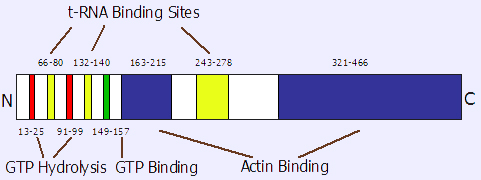
Description
50kDa; 463 amino acids contains tRNA binding sites, GTP binding and hydrolysis sites and putative actin binding sites (see figure above).
Expression
In mice and humans, eEF1A2 is expressed only in normal tissues of the brain, heart and skeletal muscle. Expression is found in tumours of the breast, lung and ovary.
Localisation
Diffusely cytoplasmic and nuclear.
Function
This protein is an isoform of the alpha subunit of the elongation factor-1 complex. There are two known isoforms of protein elongation factor eEF1A (eEF1A1 and eEF1A2). eEF1A proteins are GTP-binding proteins that interact with amino-acylated tRNA and recruit them to the ribosome during the elongation phase of protein translation. In addition, eEF1A2 binds to and stimulates the lipid kinase activity of phosphatidylinositol 4-kinase beta, the enzyme that catalyzes the generation of phosphatidylinositol 4-phosphate from phosphatidylinositol. eEF1A2 also activates the Akt serine/threonine kinase and can stimulate actin remodeling and increase the rate of cell invasion and migration in vitro.
Homology
EEF1A2 is highly homologous to the EEF1A1. EEF1A2 and EEF1A1 share greater than 90% DNA sequence and amino acid identity. The GTP binding and hydrolysis domains also have homology to the Ras GTPase.
Mutations
Note
Inactivation of mouse EEF1A2 leads to immunodeficiency, neuromuscular abnormalities and death by 30 days of age.
Implicated in
Entity name
Tumorigenesis
Disease
Breast, lung and ovarian cancer. EEF1A2 overexpression is found in approximatively 60% of breast, 30% of ovary and 40% of lung tumours.
Prognosis
High eEF1A2 protein expression is associated with good prognosis in both breast and ovarian cancer. High eEF1A2 protein expression predicts poor prognosis in lung cancer.
Cytogenetics
Fluorescence in situ hybridization (FISH), showed high copy numbers of EEF1A2 in 25% ovarian tumors.
Oncogenesis
The eEF1A2 gene is transforming and increases the in-vitro growth rate of mouse and human cells grown in-vitro and also enhances their tumorigenicity in mouse xenograft models.
Article Bibliography
| Pubmed ID | Last Year | Title | Authors |
|---|---|---|---|
| 17130842 | 2007 | eEF1A2 activates Akt and stimulates Akt-dependent actin remodeling, invasion and migration. | Amiri A et al |
| 12053177 | 2002 | Protein elongation factor EEF1A2 is a putative oncogene in ovarian cancer. | Anand N et al |
| 17088255 | 2007 | Binding of elongation factor eEF1A2 to phosphatidylinositol 4-kinase beta stimulates lipid kinase activity and phosphatidylinositol 4-phosphate generation. | Jeganathan S et al |
| 16897428 | 2007 | Expression of protein elongation factor eEF1A2 predicts favorable outcome in breast cancer. | Kulkarni G et al |
| 18164751 | 2008 | The prognostic significance of elongation factor eEF1A2 in ovarian cancer. | Pinke DE et al |
| 17437010 | 2007 | Expression of eEF1A2 is associated with clear cell histology in ovarian carcinomas: overexpression of the gene is not dependent on modifications at the EEF1A2 locus. | Tomlinson VA et al |
Other Information
Locus ID:
NCBI: 1917
MIM: 602959
HGNC: 3192
Ensembl: ENSG00000101210
Variants:
dbSNP: 1917
ClinVar: 1917
TCGA: ENSG00000101210
COSMIC: EEF1A2
RNA/Proteins
Expression (GTEx)
Pathways
Protein levels (Protein atlas)
References
| Pubmed ID | Year | Title | Citations |
|---|---|---|---|
| 38220433 | 2024 | Understanding functions of eEF1 translation elongation factors beyond translation. A proteomic approach. | 0 |
| 38220433 | 2024 | Understanding functions of eEF1 translation elongation factors beyond translation. A proteomic approach. | 0 |
| 36637958 | 2023 | Analysis of eEF1A2 gene expression and copy number in cervical carcinoma. | 1 |
| 37051183 | 2023 | eEF1A2 siRNA Suppresses MPP(+)-Induced Activation of Akt and mTOR and Potentiates Caspase-3 Activation in a Parkinson's Disease Model. | 0 |
| 37437931 | 2023 | Eukaryotic Elongation Factor 1Alpha-2 (EEF1A2) Participates in the Progression of Gastric Cancer via Interaction with Heat Shock Protein B8 (HSPB8). | 2 |
| 37695913 | 2023 | Autism- and epilepsy-associated EEF1A2 mutations lead to translational dysfunction and altered actin bundling. | 3 |
| 37852428 | 2023 | Hypoxia-induced circ-CDYL-EEF1A2 transcriptional complex drives lung metastasis of cancer stem cells from hepatocellular carcinoma. | 4 |
| 36637958 | 2023 | Analysis of eEF1A2 gene expression and copy number in cervical carcinoma. | 1 |
| 37051183 | 2023 | eEF1A2 siRNA Suppresses MPP(+)-Induced Activation of Akt and mTOR and Potentiates Caspase-3 Activation in a Parkinson's Disease Model. | 0 |
| 37437931 | 2023 | Eukaryotic Elongation Factor 1Alpha-2 (EEF1A2) Participates in the Progression of Gastric Cancer via Interaction with Heat Shock Protein B8 (HSPB8). | 2 |
| 37695913 | 2023 | Autism- and epilepsy-associated EEF1A2 mutations lead to translational dysfunction and altered actin bundling. | 3 |
| 37852428 | 2023 | Hypoxia-induced circ-CDYL-EEF1A2 transcriptional complex drives lung metastasis of cancer stem cells from hepatocellular carcinoma. | 4 |
| 35594436 | 2022 | eEF1A2 knockdown impairs neuronal proliferation and inhibits neurite outgrowth of differentiating neurons. | 3 |
| 35741005 | 2022 | Analysis of the Expression and Subcellular Distribution of eEF1A1 and eEF1A2 mRNAs during Neurodevelopment. | 5 |
| 35594436 | 2022 | eEF1A2 knockdown impairs neuronal proliferation and inhibits neurite outgrowth of differentiating neurons. | 3 |
Citation
Sanna Noubir ; Jonathan M Lee
EEF1A2 (eukaryotic translation elongation factor 1 alpha 2)
Atlas Genet Cytogenet Oncol Haematol. 2008-04-01
Online version: http://atlasgeneticsoncology.org/gene/40408/eef1a2
