EIF3C (eukaryotic translation initiation factor 3, subunit C)
2008-02-01 Daniel R Scoles AffiliationDivision of Neurology, CSMC Burns, Allen Research Institute, Cedars-Sinai Medical Center, 8700 Beverly Boulevard, Los Angeles, CA 9, USA
DNA/RNA
Description
The EIF3C gene is composed of 21 exons. No alternative splicing has been reported for eIF3c.
The EIF3C gene is located on chromosome 16p11.2 within an unstable region prone to duplication, and intact duplication of the entire EIF3C gene has been demonstrated in multiple tissue types. One mechanism of eIF3c overexpression, observed in various tumor types, may be gene duplication.
The EIF3C gene is located on chromosome 16p11.2 within an unstable region prone to duplication, and intact duplication of the entire EIF3C gene has been demonstrated in multiple tissue types. One mechanism of eIF3c overexpression, observed in various tumor types, may be gene duplication.
Proteins
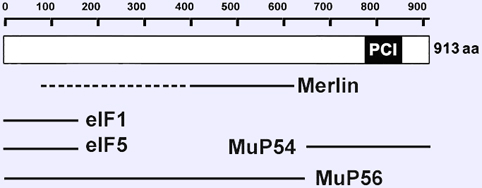
Schematic of the 913 amino acid eIF3c protein with amino acid positions shown and locations of the PCI domain. Also indicated are the known minimal regions in eIF3c required for binding by interacting proteins. These include eIF complexes eIF1 and eIF5, the NF2 tumor suppressor merlin, and murine viral stress mediated inhibitors of protein translation MuP56 and MuP54. For merlin, the broken line indicates a region promoting stronger merlin binding when included. Note that eIF3c also binds the COP9 signalosome protein CSN7 in Arabidopsis, which may mediate inhibition of protein translation.
Description
The eIF3c protein is 913 amino acids in length. The eIF3c protein possesses the PCI (proteasome component region) domain within its C-terminal half (also referred to as PINT domain). Domain searching reveals that EIF3c also possesses a winged helix repressor DNA-binding domain overlapping with the PCI domain.
Expression
Ubiquitous.
Localisation
eIF3c is cytoplasmic. There is some evidence of eIF3c occurring in the nucleus consistent with reports of intranuclear protein translation as well as regulation of protein translation by interaction with the COP9 signalosome.
Function
The initiation of protein translation is a complex sequence of events mediated by the interaction of eIF3 with phosphorylated mTOR . Multiple interactions by eIF3 subsequently take place during the progression of protein translation initiation including the proper positioning of the preinitiation complex on the 40S ribosome mediated by eIF3. EIF3c has a significant role in binding to two AUG recognition factors, eIF1 and eIF5, and these interactions are required for proper AUG scanning by the preinitiation complex.
EIF3c is overexpressed in some tumors including seminomas and meningiomas. EIF3c can also interact with the neurofibromatosis 2 (NF2) tumor suppressor merlin (schwannomin) and merlin can inhibit eIF3c mediated cell proliferation. In meningiomas eIF3c expression was inversely related to merlin expression and was overexpressed in meningiomas that had lost merlin expression. EIF3c overexpression can also transform NIH/3T3 fibroblasts, indicated by decreased doubling times, increased clonogenicity, increased viability, facilitated S-phase entry, attenuated apoptosis, formation of transformed foci, and anchorage-independent growth.
Murine EIF3c is also a target of inhibitory proteins induced by viral stress. Viral induced MuP56 and MuP54 bind eIF3c in different locations resulting in protein translation inhibition.
In Arabidopsis, eIF3c also interacts with the COP9 signalosome subunit CSN7 in the nucleus. COP9 binding is thought to be associated with downregulated protein translation. eIF3c possesses the PCI domain common among proteasome member proteins and also found in other eIF subunit proteins.
EIF3c is overexpressed in some tumors including seminomas and meningiomas. EIF3c can also interact with the neurofibromatosis 2 (NF2) tumor suppressor merlin (schwannomin) and merlin can inhibit eIF3c mediated cell proliferation. In meningiomas eIF3c expression was inversely related to merlin expression and was overexpressed in meningiomas that had lost merlin expression. EIF3c overexpression can also transform NIH/3T3 fibroblasts, indicated by decreased doubling times, increased clonogenicity, increased viability, facilitated S-phase entry, attenuated apoptosis, formation of transformed foci, and anchorage-independent growth.
Murine EIF3c is also a target of inhibitory proteins induced by viral stress. Viral induced MuP56 and MuP54 bind eIF3c in different locations resulting in protein translation inhibition.
In Arabidopsis, eIF3c also interacts with the COP9 signalosome subunit CSN7 in the nucleus. COP9 binding is thought to be associated with downregulated protein translation. eIF3c possesses the PCI domain common among proteasome member proteins and also found in other eIF subunit proteins.
Homology
eIF3c is the homolog to yeast NIP1 (37% identity).
Mutations
Note
No eIF3c mutations have been reported.
Implicated in
Entity name
Various Cancer
Oncogenesis
eIF3c has been noted overexpressed in a subset of testicular tumors (seminomas). EIF3c has also been shown overexpressed in meningiomas that have lost expression of the neurofibromatosis 2 tumor suppressor merlin (approximately 50% of sporadic meningiomas).
Article Bibliography
| Pubmed ID | Last Year | Title | Authors |
|---|---|---|---|
| 8995409 | 1997 | Conservation and diversity of eukaryotic translation initiation factor eIF3. | Asano K et al |
| 12030760 | 2002 | A method for the rapid construction of cRNA standard curves in quantitative real-time reverse transcription polymerase chain reaction. | Fronhoffs S et al |
| 12861028 | 2003 | The yeast eukaryotic initiation factor 4G (eIF4G) HEAT domain interacts with eIF1 and eIF5 and is involved in stringent AUG selection. | He H et al |
| 16920360 | 2006 | eIF3: a versatile scaffold for translation initiation complexes. | Hinnebusch AG et al |
| 10493829 | 1999 | Genome duplications and other features in 12 Mb of DNA sequence from human chromosome 16p and 16q. | Loftus BJ et al |
| 11073819 | 2000 | Eukaryotic initiation factor 3 p110 mRNA is overexpressed in testicular seminomas. | Rothe M et al |
| 17980164 | 2008 | The merlin interacting proteins reveal multiple targets for NF2 therapy. | Scoles DR et al |
| 16497727 | 2006 | Schwannomin inhibits tumorigenesis through direct interaction with the eukaryotic initiation factor subunit c (eIF3c). | Scoles DR et al |
| 16023166 | 2005 | Induction and mode of action of the viral stress-inducible murine proteins, P56 and P54. | Terenzi F et al |
| 11029466 | 2001 | Arabidopsis eIF3e (INT-6) associates with both eIF3c and the COP9 signalosome subunit CSN7. | Yahalom A et al |
| 17170115 | 2007 | Individual overexpression of five subunits of human translation initiation factor eIF3 promotes malignant transformation of immortal fibroblast cells. | Zhang L et al |
Other Information
Locus ID:
NCBI: 8663
MIM: 603916
HGNC: 3279
Ensembl: ENSG00000184110
Variants:
dbSNP: 8663
ClinVar: 8663
TCGA: ENSG00000184110
COSMIC: EIF3C
RNA/Proteins
Expression (GTEx)
Pathways
Protein levels (Protein atlas)
References
| Pubmed ID | Year | Title | Citations |
|---|---|---|---|
| 37996918 | 2023 | Complement factor H attenuates TNF-α-induced inflammation by upregulating EIF3C in rheumatoid arthritis. | 0 |
| 37996918 | 2023 | Complement factor H attenuates TNF-α-induced inflammation by upregulating EIF3C in rheumatoid arthritis. | 0 |
| 35650605 | 2022 | circPDE5A regulates prostate cancer metastasis via controlling WTAP-dependent N6-methyladenisine methylation of EIF3C mRNA. | 23 |
| 35650605 | 2022 | circPDE5A regulates prostate cancer metastasis via controlling WTAP-dependent N6-methyladenisine methylation of EIF3C mRNA. | 23 |
| 33414445 | 2021 | ZNF280A promotes lung adenocarcinoma development by regulating the expression of EIF3C. | 11 |
| 34260931 | 2021 | Human oncoprotein 5MP suppresses general and repeat-associated non-AUG translation via eIF3 by a common mechanism. | 12 |
| 33414445 | 2021 | ZNF280A promotes lung adenocarcinoma development by regulating the expression of EIF3C. | 11 |
| 34260931 | 2021 | Human oncoprotein 5MP suppresses general and repeat-associated non-AUG translation via eIF3 by a common mechanism. | 12 |
| 31863585 | 2020 | Adapted formaldehyde gradient cross-linking protocol implicates human eIF3d and eIF3c, k and l subunits in the 43S and 48S pre-initiation complex assembly, respectively. | 17 |
| 31863585 | 2020 | Adapted formaldehyde gradient cross-linking protocol implicates human eIF3d and eIF3c, k and l subunits in the 43S and 48S pre-initiation complex assembly, respectively. | 17 |
| 30362562 | 2019 | Overexpressed circ_0067934 acts as an oncogene to facilitate cervical cancer progression via the miR-545/EIF3C axis. | 60 |
| 31181967 | 2019 | The Prognostic Significance of EIF3C Gene during the Tumorigenesis of Prostate Cancer. | 7 |
| 31316002 | 2019 | Eukaryotic initiation factor 3, subunit C silencing inhibits cell proliferation and promotes apoptosis in human ovarian cancer cells. | 4 |
| 31638200 | 2019 | Upregulated expression of eIF3C is associated with malignant behavior in renal cell carcinoma. | 7 |
| 30362562 | 2019 | Overexpressed circ_0067934 acts as an oncogene to facilitate cervical cancer progression via the miR-545/EIF3C axis. | 60 |
Citation
Daniel R Scoles
EIF3C (eukaryotic translation initiation factor 3, subunit C)
Atlas Genet Cytogenet Oncol Haematol. 2008-02-01
Online version: http://atlasgeneticsoncology.org/gene/44187/eif3c
