ENPP2 (ectonucleotide pyrophosphatase/phosphodiesterase 2)
2007-02-01 Mary L. Stracke , Timothy Clair AffiliationLaboratory of Pathology, National Cancer Institute, National Institutes of Health, Bldg 10, Rm 2A33, MSC 1500, 9000 Rockville Pike, Bethesda, MD 20892
Identity
HGNC
LOCATION
8q24.12
LOCUSID
ALIAS
ATX,ATX-X,AUTOTAXIN,LysoPLD,NPP2,PD-IALPHA,PDNP2
FUSION GENES
DNA/RNA
Note
mRNA length 3276 or 3120 bp, depending upon alternate splicing.

ENPP2 Gene: Intron-exon organization of ENPP2.
Description
The ENPP2 gene is 81,754 bp in length and is composed of 26 exons. Part of exon 1 and 26 are untranslated (UTR); translation extends from the remainder of exon 1 through the proximal portion of exon 26; however, there is a 152 bp exon (exon 12) that is alternatively spliced and is included primarily in neurally derived tissues.
Transcription
The mRNA for ENPP2 is 3276 bp with exon 12 and 3120 bp without it. The ENPP2 promoter is reported to have four SP1 sites as well as binding sites for NFAT and NF-kappaB but no TATA or CAAT boxes. The only transcription factor that has been proven to increase ENPP2 protein expression is NFATC2/NFAT1, after release of alpha6beta4 from hemidesmosomes in a breast cancer cell line. A number of growth factors have been found to stimulate ENPP2 protein expression, while several inflammatory cytokines have been reported to inhibit expression.
Pseudogene
CYCSP23
Proteins
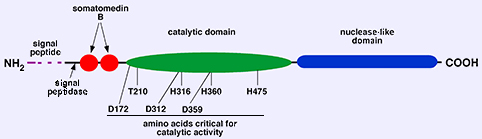
ENPP2 Protein (NPP2/ATX): Organization of domains and other critical elements within ENPP2.
Description
The ENPP2 protein, NPP2 or ATX, is an N-glycolsylated member of the ecto-nucleotide pyrophosphatase and phosphodiesterase (NPP) family of proteins. The NPP2 precursor contains 915 amino acids, 105.2 KDa; and an alternately spliced variant is 863 amino acids, 99.0 KDa. The amino terminal signal peptide sequence is cleaved at a signal peptidase site between G27 and F28 to yield a secreted protein that contains 888/836 amino acids, 102.3/96.9 KDa. NPP2 contains up to 3 ASN-linked glycosylation sites that appear to be required for secretion as well as for stabilization of its active conformation.
Expression
NPP2 is expressed in many tissues during development, but it is critical for blood vessel maturation and neurogenesis. Certain inflammatory cytokines and the tumor suppressor CST6 downregulate ENPP2 expression, and some of the NPP2 products exert a negative feedback on its expression. Conversely, a number of growth factors as well as EBV infection (in Hodgkins lymphoma) upregulate ENPP2 expression. Disruption of hemidesmosomes in breast cancer cells releases alpha6beta4, which initiates a signaling cascade that culminates in the activation of the transcription factor NFAT1, which binds to the ENPP2 promoter to upregulate protein expression. Upregulation of ENPP2 has been reported in a number of aggressive tumors, including glioblastoma, undifferentiated anaplastic thyroid carcinoma, invasive breast carcinoma, and metastatic hepatocellular carcinoma.
In adults, NPP2 is the major source of serum and plasma lysophospholipase D activity. It is also highly expressed in brain, kidney, liver, ovary, small intestine, and placenta, and is present in many other tissues.
In adults, NPP2 is the major source of serum and plasma lysophospholipase D activity. It is also highly expressed in brain, kidney, liver, ovary, small intestine, and placenta, and is present in many other tissues.
Function
NPP2 is a Type 2 nucleotide pyrophosphatase and phosphodiesterase that also has ATPase activity. In addition, NPP2 is the major source of serum and plasma lysophospholipase D activity, hydrolyzing lysophosphatidylcholine into lysophosphatidic acid as well as cyclic phosphatidic acid. NPP2 also hydrolyzes sphingosylphosphorylcholine into sphingosine-1-phosphate; however, NPP2 is not a major source of sphingosine-1-phosphate in plasma. The production of lysophosphatidic acid is thought to account for many of the physiological and pathological roles of ENPP2.
Both enzymatic activities of NPP2 share a common catalytic domain. Like other members of the NPP family, NPP2 is a metallo-enzyme with binding sites for 2 metal atoms coordinated by three critical histidines (H316, H360, and H475) and associated aspartates (D172, D312, and D359). T210 is nucleotidylated during the nucleotide pyrophosphatase/phosphodiesterase reaction and is essential for hydrolysis of substrate during the lysophospholipase D reaction as well.
Both enzymatic activities of NPP2 share a common catalytic domain. Like other members of the NPP family, NPP2 is a metallo-enzyme with binding sites for 2 metal atoms coordinated by three critical histidines (H316, H360, and H475) and associated aspartates (D172, D312, and D359). T210 is nucleotidylated during the nucleotide pyrophosphatase/phosphodiesterase reaction and is essential for hydrolysis of substrate during the lysophospholipase D reaction as well.
Homology
NPP2 is a member of the nucleotide pyrophosphatase and phosphodiesterase family, which includes ENPP1 (PC1) and ENPP3 (B10). Although the catalytic domain is highly conserved within this family of proteins, only NPP2 possesses lysophospholipase D activity.
Mutations
Note
There are a number of single nucleotide polymorphisms (SNPs) that have been reported within the ENPP2 gene but none are yet reported to be associated with altered phenotype. However, knockout of ENPP2 is lethal in mice (approximately E12), therefore mutations associated with loss of function might be lethal.
Implicated in
Entity name
Various cancers
Disease
Overexpression of the ENPP2 protein has been associated with tumor cell motility and invasion, tumor growth and metastasis, and blood vessel formation.
Prognosis
ENPP2 is over-expressed in poorly differentiated non-small cell lung carcinomas and invasive and metastatic hepatocellular carcinoma. In thyroid carcinomas, ENPP2 expression was found to be higher in undifferentiated anaplastic thyroid carcinoma cell lines and tissues than in follicular thyroid carcinomas or goiters. When glioblastoma multiforme cells were collected from tumor cores vs. areas of white matter invasion, ENPP2 was found to be overexpressed predominantly at the invasive front.
Oncogenesis
Upregulation of NPP2 expression appears to be associated with cancer progression rather than with oncogenesis. Transfection of ENPP2 cDNA into mouse fibroblast cell lines (NIH3T3 clone7) did not result in tumorigenic cell lines, but transfection into Ras-transformed fibroblasts resulted in rapidly growing, hematogenous, highly metastatic tumors. NPP2 expression was found in Hodgkins lymphoma cells as well as in CD30+ anaplastic large-cell lymphomas. In the Hodgkins lymphomas , EBV infection was correlated to induction of ENPP2 expression (P = 0.006).
Transfection of the tumor suppressor CST6 into MDA-MB-435 cells resulted in down-regulation of ENPP2. In contrast, down regulation of ENPP2 by specific siRNAs resulted in down-regulation of the tumor suppressors, thrombospondin-1 and thrombospondin-2 (THBS1 and THBS2, respectively).
Transfection of the tumor suppressor CST6 into MDA-MB-435 cells resulted in down-regulation of ENPP2. In contrast, down regulation of ENPP2 by specific siRNAs resulted in down-regulation of the tumor suppressors, thrombospondin-1 and thrombospondin-2 (THBS1 and THBS2, respectively).
Entity name
Diabetes
Disease
NPP2 expression is highly upregulated during adipocyte differentiation and its product, lysophosphatidic acid, stimulates proliferation in preadipocytes. In genetically obese, diabetic mice, NPP2 expression was increased in adipose tissue compared to their lean siblings. This is a possible model for type 2 diabetes, which has a strong genetic component.
Article Bibliography
| Pubmed ID | Last Year | Title | Authors |
|---|---|---|---|
| 10473125 | 1999 | Developmental expression analysis of murine autotaxin (ATX). | Bächner D et al |
| 15933052 | 2005 | Induction of autotaxin by the Epstein-Barr virus promotes the growth and survival of Hodgkin lymphoma cells. | Baumforth KR et al |
| 14691447 | 2004 | Microarray analysis identifies Autotaxin, a tumour cell motility and angiogenic factor with lysophospholipase D activity, as a specific target of cell transformation by v-Jun. | Black EJ et al |
| 15700135 | 2005 | Potential involvement of adipocyte insulin resistance in obesity-associated up-regulation of adipocyte lysophospholipase D/autotaxin expression. | Boucher J et al |
| 15258914 | 2004 | Lipid phosphate phosphatases and related proteins: signaling functions in development, cell division, and cancer. | Brindley DN et al |
| 15897878 | 2005 | Integrin alpha6beta4 promotes expression of autotaxin/ENPP2 autocrine motility factor in breast carcinoma cells. | Chen M et al |
| 14500380 | 2003 | Autotaxin hydrolyzes sphingosylphosphorylcholine to produce the regulator of migration, sphingosine-1-phosphate. | Clair T et al |
| 8995394 | 1997 | Autotaxin is an exoenzyme possessing 5'-nucleotide phosphodiesterase/ATP pyrophosphatase and ATPase activities. | Clair T et al |
| 15930494 | 2005 | Footer: a quantitative comparative genomics method for efficient recognition of cis-regulatory elements. | Corcoran DL et al |
| 12642576 | 2003 | Autotaxin is released from adipocytes, catalyzes lysophosphatidic acid synthesis, and activates preadipocyte proliferation. Up-regulated expression with adipocyte differentiation and obesity. | Ferry G et al |
| 12837632 | 2003 | Phosphodiesterase-Ialpha/autotaxin: a counteradhesive protein expressed by oligodendrocytes during onset of myelination. | Fox MA et al |
| 12633853 | 2003 | The hydrolysis of lysophospholipids and nucleotides by autotaxin (NPP2) involves a single catalytic site. | Gijsbers R et al |
| 14744855 | 2004 | Lysophosphatidic acid and autotaxin stimulate cell motility of neoplastic and non-neoplastic cells through LPA1. | Hama K et al |
| 9192834 | 1997 | Expression and transcriptional regulation of the PD-Ialpha/autotaxin gene in neuroblastoma. | Kawagoe H et al |
| 15027116 | 2004 | Expression, regulation and function of autotaxin in thyroid carcinomas. | Kehlen A et al |
| 12727817 | 2003 | Site-directed mutations in the tumor-associated cytokine, autotaxin, eliminate nucleotide phosphodiesterase, lysophospholipase D, and motogenic activities. | Koh E et al |
| 16436050 | 2006 | The N-terminal hydrophobic sequence of autotaxin (ENPP2) functions as a signal peptide. | Koike S et al |
| 11943209 | 2002 | Autotaxin promotes motility via G protein-coupled phosphoinositide 3-kinase gamma in human melanoma cells. | Lee HY et al |
| 8798697 | 1996 | Stimulation of tumor cell motility linked to phosphodiesterase catalytic site of autotaxin. | Lee HY et al |
| 8579579 | 1996 | Cloning, chromosomal localization, and tissue expression of autotaxin from human teratocarcinoma cells. | Lee HY et al |
| 17013094 | 2006 | Autotaxin stimulates urokinase-type plasminogen activator expression through phosphoinositide 3-kinase-Akt-nuclear [corrected] factor kappa B signaling cascade in human melanoma cells. | Lee J et al |
| 7982964 | 1994 | cDNA cloning of the human tumor motility-stimulating protein, autotaxin, reveals a homology with phosphodiesterases. | Murata J et al |
| 11559573 | 2001 | Autotaxin (NPP-2), a metastasis-enhancing motogen, is an angiogenic factor. | Nam SW et al |
| 16601922 | 2006 | Identification of large-scale molecular changes of Autotaxin(ENPP2) knock-down by small interfering RNA in breast cancer cells. | Noh JH et al |
| 17208043 | 2007 | Secretion and lysophospholipase D activity of autotaxin by adipocytes are controlled by N-glycosylation and signal peptidase. | Pradère JP et al |
| 17192809 | 2007 | Autotaxin (NPP-2) in the brain: cell type-specific expression and regulation during development and after neurotrauma. | Savaskan NE et al |
| 16356477 | 2006 | The candidate tumor suppressor CST6 alters the gene expression profile of human breast carcinoma cells: down-regulation of the potent mitogenic, motogenic, and angiogenic factor autotaxin. | Song J et al |
| 1733949 | 1992 | Identification, purification, and partial sequence analysis of autotaxin, a novel motility-stimulating protein. | Stracke ML et al |
| 16829511 | 2006 | Autotaxin stabilizes blood vessels and is required for embryonic vasculature by producing lysophosphatidic acid. | Tanaka M et al |
| 12176993 | 2002 | Identification of human plasma lysophospholipase D, a lysophosphatidic acid-producing enzyme, as autotaxin, a multifunctional phosphodiesterase. | Tokumura A et al |
| 16837466 | 2006 | Cyclic phosphatidic acid is produced by autotaxin in blood. | Tsuda S et al |
| 12119361 | 2002 | Autotaxin has lysophospholipase D activity leading to tumor cell growth and motility by lysophosphatidic acid production. | Umezu-Goto M et al |
| 12498389 | 2002 | Expression of autotaxin (NPP-2) is closely linked to invasiveness of breast cancer cells. | Yang SY et al |
| 10423404 | 1999 | Autotaxin expression in non-small-cell lung cancer. | Yang Y et al |
| 11593532 | 1999 | Expression of autotaxin mRNA in human hepatocellular carcinoma. | Zhang G et al |
| 16782887 | 2006 | Autotaxin, a secreted lysophospholipase D, is essential for blood vessel formation during development. | van Meeteren LA et al |
Other Information
Locus ID:
NCBI: 5168
MIM: 601060
HGNC: 3357
Ensembl: ENSG00000136960
Variants:
dbSNP: 5168
ClinVar: 5168
TCGA: ENSG00000136960
COSMIC: ENPP2
RNA/Proteins
Expression (GTEx)
Pathways
Protein levels (Protein atlas)
References
| Pubmed ID | Year | Title | Citations |
|---|---|---|---|
| 37392838 | 2024 | Dysregulation of the LPC-ATX-LPA axis in autoimmune hepatitis is associated with monocyte activation. | 1 |
| 37392838 | 2024 | Dysregulation of the LPC-ATX-LPA axis in autoimmune hepatitis is associated with monocyte activation. | 1 |
| 36374860 | 2023 | Genotype-Phenotype Correlations for ATX-TBP (SCA17): MDSGene Systematic Review. | 2 |
| 37108194 | 2023 | Hypoxia Increases ATX Expression by Histone Crotonylation in a HIF-2α-Dependent Manner. | 2 |
| 37176032 | 2023 | The Role of Autotaxin and LPA Signaling in Embryonic Development, Pathophysiology and Cancer. | 1 |
| 37358838 | 2023 | E2F7 drives autotaxin/Enpp2 transcription via chromosome looping: Repression by p53 in murine but not in human carcinomas. | 1 |
| 37770812 | 2023 | Dual role of autotaxin as novel biomarker and therapeutic target in pancreatic neuroendocrine neoplasms. | 1 |
| 38095984 | 2023 | Diagnostic value of serum autotaxin level in colorectal cancer. | 0 |
| 36374860 | 2023 | Genotype-Phenotype Correlations for ATX-TBP (SCA17): MDSGene Systematic Review. | 2 |
| 37108194 | 2023 | Hypoxia Increases ATX Expression by Histone Crotonylation in a HIF-2α-Dependent Manner. | 2 |
| 37176032 | 2023 | The Role of Autotaxin and LPA Signaling in Embryonic Development, Pathophysiology and Cancer. | 1 |
| 37358838 | 2023 | E2F7 drives autotaxin/Enpp2 transcription via chromosome looping: Repression by p53 in murine but not in human carcinomas. | 1 |
| 37770812 | 2023 | Dual role of autotaxin as novel biomarker and therapeutic target in pancreatic neuroendocrine neoplasms. | 1 |
| 38095984 | 2023 | Diagnostic value of serum autotaxin level in colorectal cancer. | 0 |
| 35409077 | 2022 | ENPP2 Promoter Methylation Correlates with Decreased Gene Expression in Breast Cancer: Implementation as a Liquid Biopsy Biomarker. | 11 |
Citation
Mary L. Stracke ; Timothy Clair
ENPP2 (ectonucleotide pyrophosphatase/phosphodiesterase 2)
Atlas Genet Cytogenet Oncol Haematol. 2007-02-01
Online version: http://atlasgeneticsoncology.org/gene/40455/enpp2
