ESRRA (estrogen-related receptor alpha)
2009-07-01 Rebecca Stein Kunder , Donald P McDonnell AffiliationDepartment of Pharmacology, Cancer Biology, Duke University Medical Center, Box 3813, Durham, NC 27710, USA
Identity
HGNC
LOCATION
11q13.1
LOCUSID
ALIAS
ERR1,ERRa,ERRalpha,ESRL1,NR3B1
FUSION GENES
DNA/RNA
Description
-Sequence length 11,172 bases;
-CDS: 2221;
-Exons: 7.
-CDS: 2221;
-Exons: 7.
Transcription
Alternative splicing results in transcript variants, but these have not yet been well-characterized.
Pseudogene
A pseudogene has been reported, ESRRAP, located at 13q12.1. However, it is possible that this pseudogene is not transcribed (Sladek et al., 1997).
Proteins
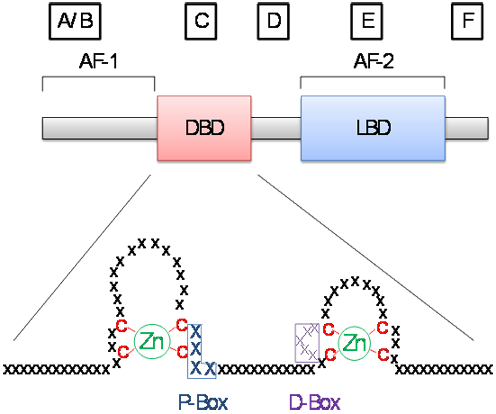
Schematic of nuclear receptor structure and function.
ERRa is a member of the nuclear receptor (NR) superfamily of transcription factors and is most closely related to estrogen receptor alpha (ERa). The modular structure of NRs consists of seven (A-F) domains. The A/B region, which harbors activation function 1 (AF-1), is not well-conserved across NRs, but regions C and E are highly conserved and harbor, respectively, the DNA-binding domain (DBD) and ligand-binding domain (LBD). ERRa shares with ERa 68% sequence identity within the DBD and 33% within the LBD. The functional regions of the DBD have been finely mapped. In addition to two zinc finger motifs, this domain contains a Proximal-box (P-box) which determines DNA sequence specificity, and a Dimerization-box (D-box), which part of the dimerization interface.
Description
ERRa is a 45.5 kDa, 423 amino acid orphan nuclear receptor. Although closely related to the estrogen receptors, its transcriptional activity is regulated to any significant degree by estrogens. ERRa binds to specific DNA sequences within target gene promoters as a monomer or homodimer and recruits coactivating proteins, the best known of which is PGC-1a.
Expression
ERRa is ubiquitously expressed throughout development with the highest levels of expression in tissues that oxidize fatty acids such as kidney, heart, cerebellum, intestine and skeletal muscle (nursa).
Localisation
ERRa is thought to be predominately nuclear, although recently it has been reported to be perinuclear and cytoplasmic in breast cancer tissue (Jarzabek et al., 2009).
Function
The function of ERRa as a metabolic regulator is supported by the observation that erra-null mice demonstrate impaired fat metabolism and absorption (Luo et al., 2003). It has recently been demonstrated that erra-null mice also have a reduced capacity for adaptation to hemodynamic stressors. Due to this functional deficit, these mice often develop cardiac contractile dysfunction. The cardiac remodeling under stress in ERR-null mice is due to defects in ATP synthesis and reduced phosphocreatine stores, which are both characteristic of pathologic cardiac hypertrophy (Huss et al., 2007). That the expression of ERRa is elevated in exercising muscle and in fasting liver specifically implicates this receptor in beta-oxidation of fatty acids, a metabolic pathway that is highly active under these conditions. On a mechanistic level, several studies have revealed that ERRa is involved in the transcriptional regulation of genes required for mitochondrial biogenesis, oxidative phosphorylation and fatty acid oxidation (Huss et al., 2004; Mootha et al., 2004; Dufour et al., 2007).
Thus far, metabolic studies of ERRa function have mainly focused on its role as the downstream effector of PGC-1a. PGC-1a is a promiscuous nuclear receptor coactivator expressed at low basal levels but induced by fasting and other metabolic stresses (Puigserver and Spiegelman, 2003). PGC-1beta, a related cofactor, may have similar functions, although its expression level is not as acutely regulated by variations in energy demand (Yoon et al., 2001). Rather than being regulated by ligand, the magnitude of ERRa activity is thought to be largely dependent on the presence of transcriptional coactivators such as PGC-1a and beta. Interest in the ERR-PGC-1 regulatory axis was heightened by the observation that there is a decrease in both PGC-1a and PGC-1beta in the skeletal muscle of patients with diabetes and obesity (Mootha et al., 2003).
Thus far, metabolic studies of ERRa function have mainly focused on its role as the downstream effector of PGC-1a. PGC-1a is a promiscuous nuclear receptor coactivator expressed at low basal levels but induced by fasting and other metabolic stresses (Puigserver and Spiegelman, 2003). PGC-1beta, a related cofactor, may have similar functions, although its expression level is not as acutely regulated by variations in energy demand (Yoon et al., 2001). Rather than being regulated by ligand, the magnitude of ERRa activity is thought to be largely dependent on the presence of transcriptional coactivators such as PGC-1a and beta. Interest in the ERR-PGC-1 regulatory axis was heightened by the observation that there is a decrease in both PGC-1a and PGC-1beta in the skeletal muscle of patients with diabetes and obesity (Mootha et al., 2003).
Homology
Sequence analysis reveals that the ERRs and the classical estrogen receptors share a high degree of homology within their DNA and ligand binding domains. In particular, ERRa shares with ERa approximately 68% sequence identity within the DNA binding domain and 33% within the ligand binding domains. This relationship provides a structural basis both for the conserved nature of DNA binding and the divergence in hormone binding between these two receptors.
Mutations
Note
Although over 80 SNPs have been reported, only one variant has been shown to carry clinical associations.
Laflamme et al. reported a polymoprohic hormone response element within the ESRRA promoter (Laflamme et al., 2005). The variant sequence, present in 11% of the population tested (white, premenopausal women), included an ERRa responsive element within the additional 23-nucelotides. This longer variant was associated with higher bone mineral density measured in the lumbar spine.
Kamei et al. reported that the longer variant is associated with a significantly higher body mass index in their study population of 729 Japanese men and women (Kamie et al., 2005).
Laflamme et al. reported a polymoprohic hormone response element within the ESRRA promoter (Laflamme et al., 2005). The variant sequence, present in 11% of the population tested (white, premenopausal women), included an ERRa responsive element within the additional 23-nucelotides. This longer variant was associated with higher bone mineral density measured in the lumbar spine.
Kamei et al. reported that the longer variant is associated with a significantly higher body mass index in their study population of 729 Japanese men and women (Kamie et al., 2005).
Implicated in
Entity name
Breast cancer
Prognosis
Two independent clinical studies have implicated ERRa in breast cancer progression (Ariazi et al., 2002; Suzuki et al., 2004). In the first study to link ERRa to clinical and pathological characteristics of breast cancer, Ariazi et al. found that ERRa expression is significantly associated with ERa-negative and progesterone receptor-negative tumor status as well as Her2 status. Further exploring the relationship between ERRa and Her2, Barry et al. demonstrated that ERRa transcriptional activity can be enhanced by phosphorylation events downstream of Her2 (Barry and Giguere, 2005). Building on the association between ERRa and negative prognostic biomarkers, Suzuki et al. demonstrated a direct correlation between ERRa expression and unfavorable breast cancer patient outcomes including increased tumor recurrence and decreased survival (Suzuki et al., 2004). Importantly, the predictive value of ERRa expression was shown to be independent of ERa status, confirming that targeting the ERRa pathway may be of therapeutic benefit in patients with either ERa-positive or ERa-negative breast cancer.
Recently, the function of ERRa has been evaluated in xenograft models of breast cancer. Stein et al. demonstrated that ERRa is critical for the growth of ERa-negative breast cancer through use of RNAi (Stein et al. 2008). Furthermore, Chisamore and coworkers found that an ERRa antagonist inhibited the growth of ERa-positive and ERa-negative breast cancer cell lines in a xenograft model (Chisamore et al., 2009).
Recently, the function of ERRa has been evaluated in xenograft models of breast cancer. Stein et al. demonstrated that ERRa is critical for the growth of ERa-negative breast cancer through use of RNAi (Stein et al. 2008). Furthermore, Chisamore and coworkers found that an ERRa antagonist inhibited the growth of ERa-positive and ERa-negative breast cancer cell lines in a xenograft model (Chisamore et al., 2009).
Entity name
Ovarian cancer
Prognosis
Sun et al. demonstrated that the ovarian tumors had significantly higher ERRa mRNA levels than normal ovaries and that high ERRa expression correlated with clinically advanced and histologically aggressive disease. Furthermore, ERRa expression was shown to be an independent prognostic factor for poor overall patient survival (Sun et al., 2005).
Entity name
Colorectal cancer
Prognosis
Analysis of 80 colorectal tumor samples demonstrated that higher levels of ERRa mRNA are expressed in tumor tissue versus in the surrounding normal mucosa. Furthermore, tumor tissue ERRa mRNA levels are positively correlated with increased tumor stage and histological grade (Cavallini et al., 2005).
Entity name
Prostate cancer
Prognosis
Cheung et al. investigated the expression patterns of the three ERR family members in normal and malignant human prostate epithelial cells and cell lines (Cheung et al., 2005). The authors also characterized ERR protein expression and localization in normal, dysplastic, and malignant prostate tissue (Cheung et al., 2005). They concluded that ERRbeta and ERRgamma protein expression is reduced in neoplastic prostatic cells versus their non-malignant counterparts and suggested that each is down-regulated in the progression of prostate cancer. The authors went on to measure the effect of overexpressing the ERRs on proliferation of an immortalized prostate cell line and a prostate cancer cell line in vitro and on prostate cancer xenograft growth in vivo (Yu et al., 2007; Yu et al., 2008). They found that ERRbeta and ERRgamma can inhibit proliferation in cells derived from normal and malignant prostate epithelium by inducing a G1-S cell cycle arrest. Furthermore, activation of either ERRbeta or ERRgamma using the agonist DY131 resulted in a decreased rate of prostate tumor growth in a xenograft model.
Entity name
Endometrial cancer
Prognosis
Gao et al. explored the extent to which the ERRs are involved in ERa-positive endometrial adenocarcinoma (Gao et al., 2006). They measured the expression of each ERR family member in malignant versus normal endometrium and compared the expression levels to clinical and pathologic features. They concluded that the expression of ERRa mRNA was lower in ERa-positive endometrial adenocarcinoma versus normal endometrium. However, they also found that ERRa mRNA expression was positively correlated with tumor stage and myometrial invasion. Additionally Gao et al. found that the expression of ERRgamma mRNA was increased in endometrial adenocarcinoma compared to normal endometrium.
Breakpoints
Note
None.
Article Bibliography
| Pubmed ID | Last Year | Title | Authors |
|---|---|---|---|
| 18509053 | 2008 | Involvement of estrogen-related receptors in transcriptional response to hypoxia and growth of solid tumors. | Ao A et al |
| 18288196 | 2008 | HIF-independent regulation of VEGF and angiogenesis by the transcriptional coactivator PGC-1alpha. | Arany Z et al |
| 12438245 | 2002 | Estrogen-related receptor alpha and estrogen-related receptor gamma associate with unfavorable and favorable biomarkers, respectively, in human breast cancer. | Ariazi EA et al |
| 16515477 | 2006 | Estrogen-related receptors as emerging targets in cancer and metabolic disorders. | Ariazi EA et al |
| 17259347 | 2007 | Estrogen-related receptor alpha1 transcriptional activities are regulated in part via the ErbB2/HER2 signaling pathway. | Ariazi EA et al |
| 16024613 | 2005 | Epidermal growth factor-induced signaling in breast cancer cells results in selective target gene activation by orphan nuclear receptor estrogen-related receptor alpha. | Barry JB et al |
| 15509154 | 2004 | Identification of a selective inverse agonist for the orphan nuclear receptor estrogen-related receptor alpha. | Busch BB et al |
| 15949936 | 2005 | Oestrogen receptor-related receptor alpha (ERRalpha) and oestrogen receptors (ERalpha and ERbeta) exhibit different gene expression in human colorectal tumour progression. | Cavallini A et al |
| 15598686 | 2005 | Expression and functional study of estrogen receptor-related receptors in human prostatic cells and tissues. | Cheung CP et al |
| 19276159 | 2009 | Estrogen-related receptor-alpha antagonist inhibits both estrogen receptor-positive and estrogen receptor-negative breast tumor growth in mouse xenografts. | Chisamore MJ et al |
| 17488637 | 2007 | Genome-wide orchestration of cardiac functions by the orphan nuclear receptors ERRalpha and gamma. | Dufour CR et al |
| 17509876 | 2007 | Clinical implication of estrogen-related receptor (ERR) expression in ovarian cancers. | Fujimoto J et al |
| 17294452 | 2007 | Increased expression of estrogen-related receptor alpha (ERRalpha) is a negative prognostic predictor in human prostate cancer. | Fujimura T et al |
| 17053040 | 2007 | Definition of the molecular basis for estrogen receptor-related receptor-alpha-cofactor interactions. | Gaillard S et al |
| 16681769 | 2006 | Expression of estrogen receptor-related receptor isoforms and clinical significance in endometrial adenocarcinoma. | Gao M et al |
| 3267207 | 1988 | Identification of a new class of steroid hormone receptors. | Giguère V et al |
| 12185669 | 2002 | To ERR in the estrogen pathway. | Giguère V et al |
| 14664699 | 2003 | Estrogen receptor-related receptors: orphan receptors desperately seeking a ligand. | Horard B et al |
| 18174157 | 2008 | Estrogen induces estrogen-related receptor alpha gene expression and chromatin structural changes in estrogen receptor (ER)-positive and ER-negative breast cancer cells. | Hu P et al |
| 17618854 | 2007 | The nuclear receptor ERRalpha is required for the bioenergetic and functional adaptation to cardiac pressure overload. | Huss JM et al |
| 15375023 | 2004 | Nuclear receptor signaling and cardiac energetics. | Huss JM et al |
| 15456881 | 2004 | Estrogen-related receptor alpha directs peroxisome proliferator-activated receptor alpha signaling in the transcriptional control of energy metabolism in cardiac and skeletal muscle. | Huss JM et al |
| 18052088 | 2007 | On the intractability of estrogen-related receptor alpha as a target for activation by small molecules. | Hyatt SM et al |
| 19138740 | 2009 | The significance of the expression of ERRalpha as a potential biomarker in breast cancer. | Jarzabek K et al |
| 9058380 | 1997 | Estrogen-related receptor alpha 1 functionally binds as a monomer to extended half-site sequences including ones contained within estrogen-response elements. | Johnston SD et al |
| 16286534 | 2005 | The 2.3 genotype of ESRRA23 of the ERR alpha gene is associated with a higher BMI than the 2.2 genotype. | Kamei Y et al |
| 14530391 | 2003 | PPARgamma coactivator 1beta/ERR ligand 1 is an ERR protein ligand, whose expression induces a high-energy expenditure and antagonizes obesity. | Kamei Y et al |
| 15883633 | 2005 | A frequent regulatory variant of the estrogen-related receptor alpha gene associated with BMD in French-Canadian premenopausal women. | Laflamme N et al |
| 14978033 | 2004 | A polymorphic autoregulatory hormone response element in the human estrogen-related receptor alpha (ERRalpha) promoter dictates peroxisome proliferator-activated receptor gamma coactivator-1alpha control of ERRalpha expression. | Laganière J et al |
| 17631492 | 2007 | Potentiation of ICI182,780 (Fulvestrant)-induced estrogen receptor-alpha degradation by the estrogen receptor-related receptor-alpha inverse agonist XCT790. | Lanvin O et al |
| 12960079 | 2003 | Estrogen stimulates estrogen-related receptor alpha gene expression through conserved hormone response elements. | Liu D et al |
| 11559547 | 2001 | Transcriptional regulation of the estrogen-inducible pS2 breast cancer marker gene by the ERR family of orphan nuclear receptors. | Lu D et al |
| 14585956 | 2003 | Reduced fat mass in mice lacking orphan nuclear receptor estrogen-related receptor alpha. | Luo J et al |
| 15100410 | 2004 | Erralpha and Gabpa/b specify PGC-1alpha-dependent oxidative phosphorylation gene expression that is altered in diabetic muscle. | Mootha VK et al |
| 12808457 | 2003 | PGC-1alpha-responsive genes involved in oxidative phosphorylation are coordinately downregulated in human diabetes. | Mootha VK et al |
| 15087503 | 2004 | The estrogen-related receptor alpha (ERRalpha) functions in PPARgamma coactivator 1alpha (PGC-1alpha)-induced mitochondrial biogenesis. | Schreiber SN et al |
| 9286700 | 1997 | Human estrogen receptor-like 1 (ESRL1) gene: genomic organization, chromosomal localization, and promoter characterization. | Shi H et al |
| 9344655 | 1997 | Chromosomal mapping of the human and murine orphan receptors ERRalpha (ESRRA) and ERRbeta (ESRRB) and identification of a novel human ERRalpha-related pseudogene. | Sladek R et al |
| 17671090 | 2007 | Nuclear receptor ERR alpha and coactivator PGC-1 beta are effectors of IFN-gamma-induced host defense. | Sonoda J et al |
| 18974123 | 2008 | Estrogen-related receptor alpha is critical for the growth of estrogen receptor-negative breast cancer. | Stein RA et al |
| 17259555 | 2006 | Estrogen-related receptor alpha as a therapeutic target in cancer. | Stein RA et al |
| 15770498 | 2005 | Expression of estrogen receptor-related receptors, a subfamily of orphan nuclear receptors, as new tumor biomarkers in ovarian cancer cells. | Sun P et al |
| 17010074 | 2006 | An estrogen receptor alpha-dependent regulation of estrogen receptor-related receptor alpha in the proliferation of endometrial carcinoma cells. | Sun PM et al |
| 15231680 | 2004 | Estrogen-related receptor alpha in human breast carcinoma as a potent prognostic factor. | Suzuki T et al |
| 18063693 | 2008 | Phosphorylation-dependent sumoylation regulates estrogen-related receptor-alpha and -gamma transcriptional activity through a synergy control motif. | Tremblay AM et al |
| 10319326 | 1999 | Transcriptional activities of the orphan nuclear receptor ERR alpha (estrogen receptor-related receptor-alpha). | Vanacker JM et al |
| 9395511 | 1997 | A role for estrogen-related receptor alpha in the control of mitochondrial fatty acid beta-oxidation during brown adipocyte differentiation. | Vega RB et al |
| 18778951 | 2008 | ERRalpha: a metabolic function for the oldest orphan. | Villena JA et al |
| 17676930 | 2007 | Phosphorylation-dependent sumoylation of estrogen-related receptor alpha1. | Vu EH et al |
| 19171140 | 2009 | Kaempferol is an estrogen-related receptor alpha and gamma inverse agonist. | Wang J et al |
| 16464951 | 2006 | Function of estrogen-related receptor alpha in human endometrial cancer. | Watanabe A et al |
| 10598588 | 1999 | Constitutive activation of transcription and binding of coactivator by estrogen-related receptors 1 and 2. | Xie W et al |
| 10493499 | 1999 | Two organochlorine pesticides, toxaphene and chlordane, are antagonists for estrogen-related receptor alpha-1 orphan receptor. | Yang C et al |
| 9865725 | 1998 | Modulation of aromatase expression in the breast tissue by ERR alpha-1 orphan receptor. | Yang C et al |
| 11557972 | 2001 | Control of hepatic gluconeogenesis through the transcriptional coactivator PGC-1. | Yoon JC et al |
| 18071305 | 2008 | Orphan nuclear receptor estrogen-related receptor-beta suppresses in vitro and in vivo growth of prostate cancer cells via p21(WAF1/CIP1) induction and as a potential therapeutic target in prostate cancer. | Yu S et al |
| 17157980 | 2007 | Interplay between estrogen-related receptor alpha (ERRalpha) and gamma (ERRgamma) on the regulation of ERRalpha gene expression. | Zhang Z et al |
| 18234909 | 2008 | Estrogen receptor-related receptor alpha (ERRalpha) regulates osteopontin expression through a non-canonical ERRalpha response element in a cell context-dependent manner. | Zirngibl RA et al |
Other Information
Locus ID:
NCBI: 2101
MIM: 601998
HGNC: 3471
Ensembl: ENSG00000173153
Variants:
dbSNP: 2101
ClinVar: 2101
TCGA: ENSG00000173153
COSMIC: ESRRA
RNA/Proteins
Expression (GTEx)
Pathways
References
| Pubmed ID | Year | Title | Citations |
|---|---|---|---|
| 38129506 | 2024 | ERRα: unraveling its role as a key player in cell migration. | 0 |
| 38393411 | 2024 | Estrogen-related receptor alpha (ERRα) promotes the migration, invasion and angiogenesis of breast cancer stem cell-like cells. | 0 |
| 38447458 | 2024 | Estrogen related receptor alpha: Potential modulator of age-related macular degeneration. | 0 |
| 38129506 | 2024 | ERRα: unraveling its role as a key player in cell migration. | 0 |
| 38393411 | 2024 | Estrogen-related receptor alpha (ERRα) promotes the migration, invasion and angiogenesis of breast cancer stem cell-like cells. | 0 |
| 38447458 | 2024 | Estrogen related receptor alpha: Potential modulator of age-related macular degeneration. | 0 |
| 36237175 | 2023 | New insights into cholesterol-mediated ERRα activation in breast cancer progression and pro-tumoral microenvironment orchestration. | 4 |
| 36534970 | 2023 | ERRα Attenuates Vascular Inflammation via Enhanced NFκB Degradation Pathway. | 1 |
| 36835419 | 2023 | ERRα Up-Regulates Invadopodia Formation by Targeting HMGCS1 to Promote Endometrial Cancer Invasion and Metastasis. | 0 |
| 36901694 | 2023 | Multifaceted Transcriptional Network of Estrogen-Related Receptor Alpha in Health and Disease. | 4 |
| 37175690 | 2023 | The Role of the Estrogen-Related Receptor Alpha (ERRa) in Hypoxia and Its Implications for Cancer Metabolism. | 4 |
| 37347142 | 2023 | Exome Sequencing Implicates DGKZ , ESRRA , and GXYLT1 for Modulating Granuloma Formation in Crohn Disease. | 1 |
| 37584854 | 2023 | Estrogen-Related Receptor Alpha (ERRα) Promotes Cancer Stem Cell-Like Characteristics in Breast Cancer. | 3 |
| 36237175 | 2023 | New insights into cholesterol-mediated ERRα activation in breast cancer progression and pro-tumoral microenvironment orchestration. | 4 |
| 36534970 | 2023 | ERRα Attenuates Vascular Inflammation via Enhanced NFκB Degradation Pathway. | 1 |
Citation
Rebecca Stein Kunder ; Donald P McDonnell
ESRRA (estrogen-related receptor alpha)
Atlas Genet Cytogenet Oncol Haematol. 2009-07-01
Online version: http://atlasgeneticsoncology.org/gene/44408/esrra
