ETV1 (ets variant 1)
2013-02-01 Yu Chen , Ping Chi AffiliationHuman Oncology, Pathogenesis Program, Memorial Sloan-Kettering Cancer Center, 1275 York, Avenue, New York, NY 10065, USA
DNA/RNA
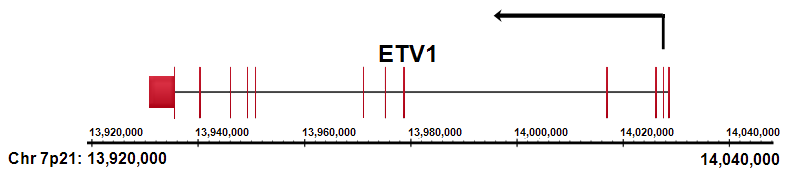
The ETV1 gene locus is on the p arm of chromosome 7 (7p21.3), spanning from 13930854 to 14031050 (Feb. 2009 GRCh37/hg19).
Description
The ETV1 (ETS-translocation variant 1) gene belongs to the PEA3-subfamily of erythroblast transformation-specific (ETS)-family of transcription factors. It is located on chromosome 7p21.3, consisting of 13 exons and spanning approximately 100 kb DNA in length (Coutte et al., 1999).
Transcription
ETV1 has 7 Refseq transcripts that are generated by alternative splicing and alternative transcriptional initiation.
Pseudogene
No pseudogene reported.
Proteins
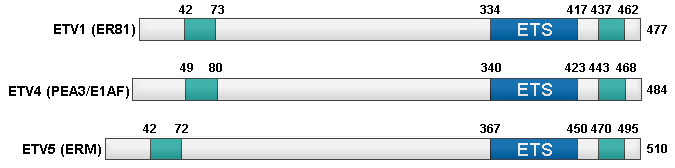
Schematics of ETV1 and PEA3-subfamily homolog, ETV4 and ETV5. Transcriptional activation acidic domains are in grey and ETS DNA binding domains are in black (adapted from Oh et al., 2012).
Description
ETV1 belongs to the PEA3-subfamily of erythroblast transformation-specific (ETS)-family of transcription factors. There are 7 protein isoforms of ETV1, ranging from 374 amino acids to 477 amino acids (~55 kD).
Expression
The ETV1 protein is physiologically expressed in the central nervous system including the developing propioceptive neurons, the motor neurons and the dopaminergic neurons (Arber et al., 2000; Flames and Hobert, 2009). ETV1 is also expressed in the inner core cells of the Pacinian corpuscle (Sedy et al., 2006) and in the interstitial cells of Cajal (Chen et al., 2007; Chi et al., 2010). Pathologically, the ETV1 protein is aberrantly expressed in a subset of melanoma and prostate cancer through genomic rearrangements (Jané-Valbuena et al., 2010; Tomlins et al., 2005), or abnormally highly expressed in gastrointestinal stromal tumor (GIST) through high endogenous expression and protein stabilization by active MAP kinase signaling (Chi et al., 2010), or partially highly expressed as part of an oncogenic fusion protein-EWSR1-ETV1-in Ewing sarcoma (Jeon et al., 1995).
Localisation
Nucleus.
Function
ETV1 belongs to the ETS (E-twenty-six) family of transcription factors and the PEA3 subfamily transcription factors (ETV1, ETV4 and ETV5). It specifically recognizes the GGAA core consensus DNA motif in the genome and mediates transcriptional activation and repression of target genes in cell type and cell lineage-specific contexts. ETV1 is critical in the normal development of a functional sensory-motor circuitry in the spinal cord (Arber et al., 2000), the specification of a group of specialized dopaminergic neurons in the central nervous system (Flames and Hobert, 2009), the normal development of the Pacinian corpuscle (Sedy et al., 2006), and the normal development and specification of the subclasses of interstitial cells of Cajal localized in the circular muscle and in the myenteric plexus (Chi et al., 2010). ETV1 contributes to the pathogenesis of a number of cancer types through 1) aberrantly overexpression in melanoma and prostate cancer via genomic rearrangement (Jané-Valbuena et al., 2010; Tomlins et al., 2007; Tomlins et al., 2005), 2) abnormal protein stabilization in GIST (Chi et al., 2010), 3) formation of the oncogenic fusion protein EWSR1-ETV1 in Ewing sarcoma (Jeon et al., 1995).
Homology
A member of the ETS-family transcription factor and the PEA3 subfamily transcription factors , with most sequence homology to ETV5 and ETV4.
Mutations
Note
No validated known mutations.
Implicated in
Entity name
Ewing sarcoma
Prognosis
The prognostic relevance remains to be determined.
Cytogenetics
Ewing sarcoma translocation, t(7;22)(p22;q12) that fused EWSR1 to the ETV1 gene (Jeon et al., 1995).
Hybrid gene
EWSR1-ETV1 fusion gene accounts for ~1% of all Ewing sarcomas. The majority of Ewing sarcoma fusion genes are EWSR1-FLI1 (~85%) and EWSR1-ERG (~10%).
Fusion protein
EWSR1-ETV1 fusion protein that fuses the first 7 exons of EWSR1 to the last 3-4 exons of ETV1 (exons 10 or 11-exon 13).
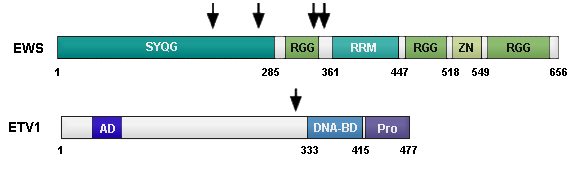
Common breakpoints of the EWS-ETV1 fusion. DNA-BD: DNA binding domain; Pro: proline-rich activation domain; PTD: pointed domain; RGG: arginine-glycine-glycine-rich region; RRM: RNA recognition motif; SYQG: serine-tyrosine-glutamine-glycine-rich region that has a high transactivation potential; ZN: zinc finger. Adapted from Janknecht, 2005.
Oncogenesis
The EWSR1-ETS (EWSR1-FLI1, EWSR1-ETV1, EWSR1-ERG, etc) fusion proteins are thought to be the "oncogenic drivers" in Ewing sarcoma. EWSR1-FLI1 and EWSR1-ERG have been modeled in cell lines demonstrating the requirement of the oncogenic fusion proteins for Ewing sarcoma cell line growth and survival. The EWSR1-ETV1 fusion protein has not been modeled.
Entity name
Prostate cancer
Prognosis
ETV1 fusion seems to confer a poorer prognosis in several studies.

Typical breakpoint in prostate cancer fusions.
Oncogenesis
ETV1 is aberrantly overexpressed in prostate cancer through genomic rearrangements that result in overexpression of a truncated ETV1 or full-length ETV1. ETV1 is required for the growth of ETV1-positive prostate cancer cells and ETV1 overexpression confers invasiveness prostate cancer cells (Tomlins et al., 2007; Tomlins et al., 2005).
Entity name
Melanoma
Prognosis
The prognostic relevance remains to be determined.
Oncogenesis
ETV1 is amplified in 13% of primary and 18% of metastatic melanomas, which results in aberrant overexpression. ETV1 is required for growth and proliferation of melanoma cells with ETV1 amplification and it cooperates with oncogenic NRAS (G12D) for tumorigenesis in mice (Jané-Valbuena et al., 2010).
Entity name
Gastrointestinal stromal tumor (GIST)
Prognosis
The prognostic relevance remains to be determined.
Oncogenesis
ETV1 is naturally highly expressed and is required for the development of the interstitial cells of Cajal (ICCs) in the gastrointestinal tract that are the precursor cells of GIST. It is also highly expressed and required for the growth, survival and tumorigenesis of GISTs. It drives a core transcriptional program that is conserved in ICC and GIST. ETV1 protein level is stabilized by active KIT and downstream MAP kinase signaling pathways and cooperates with mutant KIT in GIST pathogenesis (Chi et al., 2010).
Breakpoints
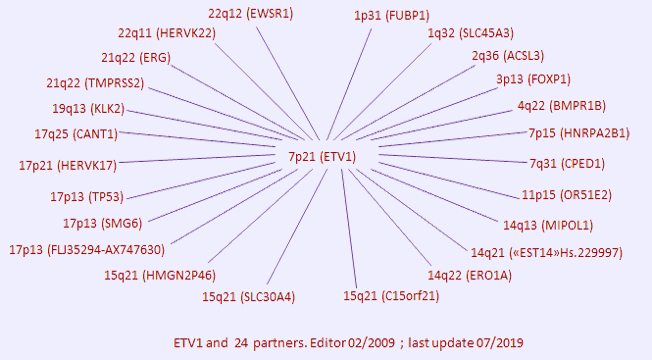
ETV1 and partners.
Article Bibliography
| Pubmed ID | Last Year | Title | Authors |
|---|---|---|---|
| 10850491 | 2000 | ETS gene Er81 controls the formation of functional connections between group Ia sensory afferents and motor neurons. | Arber S et al |
| 17895395 | 2007 | Differential gene expression in functional classes of interstitial cells of Cajal in murine small intestine. | Chen H et al |
| 20927104 | 2010 | ETV1 is a lineage survival factor that cooperates with KIT in gastrointestinal stromal tumours. | Chi P et al |
| 10597226 | 1999 | Characterization of the human and mouse ETV1/ER81 transcription factor genes: role of the two alternatively spliced isoforms in the human. | Coutte L et al |
| 19287374 | 2009 | Gene regulatory logic of dopamine neuron differentiation. | Flames N et al |
| 20160028 | 2010 | An oncogenic role for ETV1 in melanoma. | Jané-Valbuena J et al |
| 16202544 | 2005 | EWS-ETS oncoproteins: the linchpins of Ewing tumors. | Janknecht R et al |
| 7700648 | 1995 | A variant Ewing's sarcoma translocation (7;22) fuses the EWS gene to the ETS gene ETV1. | Jeon IS et al |
| 22425584 | 2012 | ETV1, 4 and 5: an oncogenic subfamily of ETS transcription factors. | Oh S et al |
| 16493690 | 2006 | ETS transcription factor ER81 is required for the Pacinian corpuscle development. | Sedý J et al |
| 17671502 | 2007 | Distinct classes of chromosomal rearrangements create oncogenic ETS gene fusions in prostate cancer. | Tomlins SA et al |
Other Information
Locus ID:
NCBI: 2115
MIM: 600541
HGNC: 3490
Ensembl: ENSG00000006468
Variants:
dbSNP: 2115
ClinVar: 2115
TCGA: ENSG00000006468
COSMIC: ETV1
RNA/Proteins
Expression (GTEx)
Pathways
| Pathway | Source | External ID |
|---|---|---|
| Transcriptional misregulation in cancer | KEGG | ko05202 |
| Transcriptional misregulation in cancer | KEGG | hsa05202 |
References
| Pubmed ID | Year | Title | Citations |
|---|---|---|---|
| 38200696 | 2024 | Reduction of ETV1 is Identified as a Prominent Feature of Age-Related Cataract. | 0 |
| 38200696 | 2024 | Reduction of ETV1 is Identified as a Prominent Feature of Age-Related Cataract. | 0 |
| 37428861 | 2023 | Transcription factor ETV1-induced lncRNA MAFG-AS1 promotes migration, invasion, and epithelial-mesenchymal transition of pancreatic cancer cells by recruiting IGF2BP2 to stabilize ETV1 expression. | 3 |
| 37428861 | 2023 | Transcription factor ETV1-induced lncRNA MAFG-AS1 promotes migration, invasion, and epithelial-mesenchymal transition of pancreatic cancer cells by recruiting IGF2BP2 to stabilize ETV1 expression. | 3 |
| 35860243 | 2022 | ETV1 Positively Correlated With Immune Infiltration and Poor Clinical Prognosis in Colorectal Cancer. | 2 |
| 36109787 | 2022 | HGF-mediated elevation of ETV1 facilitates hepatocellular carcinoma metastasis through upregulating PTK2 and c-MET. | 8 |
| 35860243 | 2022 | ETV1 Positively Correlated With Immune Infiltration and Poor Clinical Prognosis in Colorectal Cancer. | 2 |
| 36109787 | 2022 | HGF-mediated elevation of ETV1 facilitates hepatocellular carcinoma metastasis through upregulating PTK2 and c-MET. | 8 |
| 32797637 | 2021 | Identification of regulatory mRNA and microRNA for differentiation into cementoblasts and periodontal ligament cells. | 7 |
| 32797637 | 2021 | Identification of regulatory mRNA and microRNA for differentiation into cementoblasts and periodontal ligament cells. | 7 |
| 31381204 | 2020 | A novel PTPRZ1-ETV1 fusion in gliomas. | 10 |
| 31584209 | 2020 | Clonal evaluation of early onset prostate cancer by expression profiling of ERG, SPINK1, ETV1, and ETV4 on whole-mount radical prostatectomy tissue. | 10 |
| 32580154 | 2020 | Frequent copy number gains of SLC2A3 and ETV1 in testicular embryonal carcinomas. | 4 |
| 32901065 | 2020 | Low ETV1 mRNA expression is associated with recurrence in gastrointestinal stromal tumors. | 1 |
| 33174020 | 2020 | Cooperation between ETS transcription factor ETV1 and histone demethylase JMJD1A in colorectal cancer. | 9 |
Citation
Yu Chen ; Ping Chi
ETV1 (ets variant 1)
Atlas Genet Cytogenet Oncol Haematol. 2013-02-01
Online version: http://atlasgeneticsoncology.org/gene/73/etv1
