FAIM (Fas apoptotic inhibitory molecule)
2009-12-01 Miguel F Segura , Carme Sole , Rana S Moubarak , Victor J Yuste , Joan X Comella AffiliationDNA/RNA
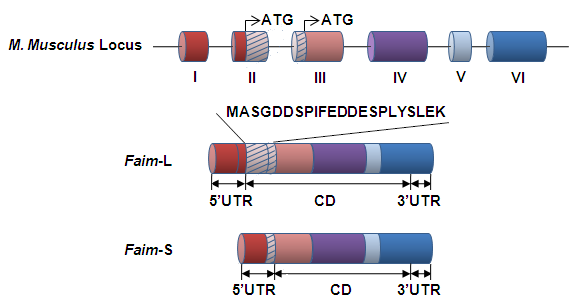
Genomic organization and splice variants of FAIM gene. Schematic representation of the structure of FAIM gene, that contains 4 different transcripts and 6 alternative splice variants but only two resulting proteins have been characterized so far: FAIM-S and FAIM-L (adapted from Zhong et al., 2001).
Description
The genomic structure of the FAIM locus gives two alternative splicing results, FAIM-S and FAIM-L, that share part of the 5_UTR (exon I). Part of the coding sequence in FAIM-L (diagonal bar of exon III) serves as part of the UTR of FAIM-S. The additional 22 amino acid sequence is indicated above the correlating exons (Zhong et al., 2001).
Transcription
FAIM-S: mRNA size: 1104 nucleotides (nt); coding sequence: 539 nt;
FAIM-L: mRNA size: 1164 nt; coding sequence: 605 nt.
FAIM-L: mRNA size: 1164 nt; coding sequence: 605 nt.
Proteins
Note
Signaling pathways controlling cell death and survival are crucial for the normal development and tissue homeostasis. In contrast to most cell types, differentiated cells such as neurons require a highly controlled mechanism that allows survival for the entire life of the organism and protecting it from multitude of stimuli that can affect cellular integrity. Among those stimuli, cell death induction and more precisely, apoptosis induced by the extrinsic pathway mediated by Death Receptors (DRs), has been widely reported in the pathological loss of neurons. Therefore, those proteins that are able to block the apoptotic pathway will play a key role in the protection from neuronal death. Among all the described anti-apoptotic proteins, FAIM, with no homology with a previously known protein, may constitute a new family of proteins that regulate the DR signaling pathway.
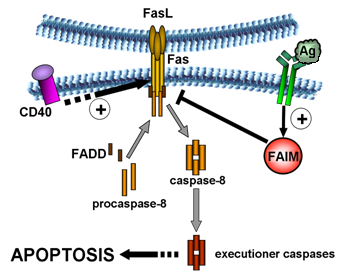
Proposed mechanism of FAIM action in B-cells.
Description
Fas apoptosis inhibitory molecule (FAIM) is a Fas antagonist that was initially characterized by differential display as a gene that is up-regulated in B cells resistant to Fas-mediated cell death and functions as an inhibitor of Fas-induced cell death (Schneider et al., 1999). Shortly after, a new alternative splice variant was described and named FAIM-L. FAIM-S is composed of 179 aminoacids (aa), with stable structure and rich in beta-sheets, and FAIM-L contains 22 additional aa in the N-terminus part of the protein. This extra sequence does not have any particular defined structure.
Expression
FAIM-S mRNA has been detected in all tissues analyzed so far, whereas FAIM-L has a more restricted pattern of expression, being predominantly expressed in the nervous system and testis. Protein immunostaining confirmed restricted expression in different areas of the brain.
Localisation
Both isoforms, FAIM-S and FAIM-L are cytosolic.
Function
Fas apoptosis inhibitory molecule (FAIM) was first identified as a Fas antagonist in B-cells. The overexpression of FAIM-S, but not FAIM-L, enhances NGF-induced neurite outgrowth in different neuronal populations through activation of the NF-kB pathway. No anti-apoptotic function of FAIM-S has been described in the nervous system (Sole et al., 2004). However, FAIM-L is specifically expressed in neurons and its expression is regulated during development. FAIM-L does not affect neurite outgrowth, nor does it modulate NF-kB activation. However, cells overexpressing FAIM-L are resistant to apoptotic cell death induced by DRs such as Fas or TNFR1. Reduction of endogenous expression shows that endogenous FAIM-L protects primary neurons against DR-induced cell death. FAIM-L normally binds the Fas receptor and prevents its activation. Fas-L binding to Fas induces the release of FAIM-L from Fas, allows the binding of FADD and caspase-8 , and leads to apoptosis activation (Segura et al., 2007).
Homology
FAIM is highly conserved in evolution from Caenorhabditis elegans to humans (Rothstein et al., 2000). However, FAIM-L is only conserved in superior vertebrates (Zhong et al., 2001; Segura et al., 2007). There is no homology with previously characterized families of proteins.
Implicated in
Article Bibliography
| Pubmed ID | Last Year | Title | Authors |
|---|---|---|---|
| 19168072 | 2009 | Fas apoptosis inhibitory molecule contains a novel beta-sandwich in contact with a partially ordered domain. | Hemond M et al |
| 19300454 | 2009 | Genetic deletion of faim reveals its role in modulating c-FLIP expression during CD95-mediated apoptosis of lymphocytes and hepatocytes. | Huo J et al |
| 19843941 | 2009 | Fas apoptosis inhibitory molecule expression in B cells is regulated through IRF4 in a feed-forward mechanism. | Kaku H et al |
| 11191348 | 2000 | Inducible resistance to Fas-mediated apoptosis in B cells. | Rothstein TL et al |
| 10075978 | 1999 | A novel gene coding for a Fas apoptosis inhibitory molecule (FAIM) isolated from inducibly Fas-resistant B lymphocytes. | Schneider TJ et al |
| 17942717 | 2007 | The long form of Fas apoptotic inhibitory molecule is expressed specifically in neurons and protects them against death receptor-triggered apoptosis. | Segura MF et al |
| 15520226 | 2004 | The death receptor antagonist FAIM promotes neurite outgrowth by a mechanism that depends on ERK and NF-kapp B signaling. | Sole C et al |
| 18650325 | 2008 | Death receptors and caspases but not mitochondria are activated in the GDNF- or BDNF-deprived dopaminergic neurons. | Yu LY et al |
| 11483211 | 2001 | An alternatively spliced long form of Fas apoptosis inhibitory molecule (FAIM) with tissue-specific expression in the brain. | Zhong X et al |
Other Information
Locus ID:
NCBI: 55179
MIM: 617535
HGNC: 18703
Ensembl: ENSG00000158234
Variants:
dbSNP: 55179
ClinVar: 55179
TCGA: ENSG00000158234
COSMIC: FAIM
RNA/Proteins
Expression (GTEx)
Protein levels (Protein atlas)
References
| Pubmed ID | Year | Title | Citations |
|---|---|---|---|
| 34720024 | 2022 | FAIM regulates autophagy through glutaminolysis in lung adenocarcinoma. | 5 |
| 36233145 | 2022 | Small Heat Shock Proteins Collaborate with FAIM to Prevent Accumulation of Misfolded Protein Aggregates. | 3 |
| 34720024 | 2022 | FAIM regulates autophagy through glutaminolysis in lung adenocarcinoma. | 5 |
| 36233145 | 2022 | Small Heat Shock Proteins Collaborate with FAIM to Prevent Accumulation of Misfolded Protein Aggregates. | 3 |
| 33249986 | 2020 | FAIM-S functions as a negative regulator of NF-κB pathway and blocks cell cycle progression in NSCLC cells. | 2 |
| 33249986 | 2020 | FAIM-S functions as a negative regulator of NF-κB pathway and blocks cell cycle progression in NSCLC cells. | 2 |
| 31270932 | 2019 | PACAP ameliorates hepatic metabolism and inflammation through up-regulating FAIM in obesity. | 6 |
| 31270932 | 2019 | PACAP ameliorates hepatic metabolism and inflammation through up-regulating FAIM in obesity. | 6 |
| 28383554 | 2017 | SRT1720 promotes survival of aged human mesenchymal stem cells via FAIM: a pharmacological strategy to improve stem cell-based therapy for rat myocardial infarction. | 24 |
| 28981531 | 2017 | Identification and characterization of new isoforms of human fas apoptotic inhibitory molecule (FAIM). | 6 |
| 28383554 | 2017 | SRT1720 promotes survival of aged human mesenchymal stem cells via FAIM: a pharmacological strategy to improve stem cell-based therapy for rat myocardial infarction. | 24 |
| 28981531 | 2017 | Identification and characterization of new isoforms of human fas apoptotic inhibitory molecule (FAIM). | 6 |
| 26866272 | 2016 | Loss of Fas apoptosis inhibitory molecule leads to spontaneous obesity and hepatosteatosis. | 13 |
| 26866272 | 2016 | Loss of Fas apoptosis inhibitory molecule leads to spontaneous obesity and hepatosteatosis. | 13 |
| 23138182 | 2013 | Fas apoptosis inhibitory molecule is upregulated by IGF-1 signaling and modulates Akt activation and IRF4 expression in multiple myeloma. | 11 |
Citation
Miguel F Segura ; Carme Sole ; Rana S Moubarak ; Victor J Yuste ; Joan X Comella
FAIM (Fas apoptotic inhibitory molecule)
Atlas Genet Cytogenet Oncol Haematol. 2009-12-01
Online version: http://atlasgeneticsoncology.org/gene/43251/faim
