FOXP1 (Forkhead box P1)
2007-08-01 Iwona Wlodarska AffiliationDepartment of Human Genetics, Catholic University Leuven, Leuven, Belgium
Identity
HGNC
LOCATION
3p13
IMAGE

LEGEND
FOXP1 (3p14.1): RP11-154H23 (Spectrum0range) and RP11-79P21 (SpectrumGreen) covering the 5 and the 3end of FOXP1, respectively.
LOCUSID
ALIAS
12CC4,HSPC215,MFH,QRF1,hFKH1B
FUSION GENES
DNA/RNA
Description
21 exons; the first 5 exons, the 5 part of exon 6 and the 3 part of exon 21 are non-coding.
Transcription
628405 bps mRNA; transcribed in a centromeric to telomeric orientation. Alternative splicing; 4 named isoforms (Q9H334-1,-2,-3,-4) recognized.
Proteins
Note
Forkhead box P1
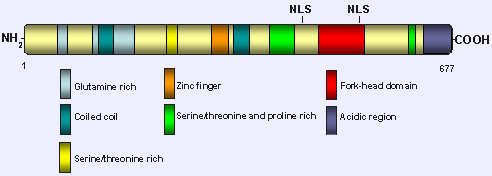
Schematic diagram of the Foxp1 protein indicating the localization of predicted domains and motifs. Modified from Banham AH et al., Cancer Res 61, 8820-8820, 2001.
Description
The FOXP1 protein is 677-amino acid long and its molecular weight is 75317 Da. It contains two potential nucleic acid-binding motifs, including a forkhead (winged-helix) domain and C2H2 zinc finger domain. Other regions that may regulate transcription and mediate protein-protein interaction include coiled-coil, glutamine rich, S/T-rich, S/T/P-rich and acidic rich domains. Two potential nuclear localization signals (NLS) were identified at amino acid434-440 and amino acid543-546. Two potential PEST motifs are predicted in the acidic region near its COOH terminus. The FOXP1 protein contains a number potential of cyclin-cdk phosphorylation sites and a recognition site for the p70S6-kinase which is itself regulated by the PI(3)K. The FOXP1 protein forms homodimers and heterodimers with FOXP2 and FOXP4. Dimerization is required for DNA-binding.
Expression
Ubiquitous expression in normal adult and fetal human tissues; highest expression in lymphoid and gastrointestinal tissues. Within the B lineage, FOXP1 is expressed modestly in progenitors, with highest levels in activated B cells and mantle zone B cells.
Localisation
Predominantly nuclear
Function
FOXP1 can act as a transcriptional repressor. The gene has a broad range of functions and plays an important role in cardiac and lung development, B-cell development and macrophage differentiation. FOXP1 is implicated in malignancy.
Homology
Member of the broadly expressed FOXP subfamily which itself is a part of the FOX gene family of transcription factors, characterized by sharing a common DNA binding domain termed forkhead or a winged-helix domain. FOXP proteins (FOXP1, -2, -3, -4) play important roles in immune responses, organ development and cancer pathogenesis.
Implicated in
Disease
B-progenitor ALL (single case)
Cytogenetics
Unknown
Fusion protein
Contains the NH2 terminus of PAX5 with the DNA-binding paired, octapeptide and homeodomain-like domains and the COOH-terminus of FOXP1 containing its DNA-binding (Zn and FH) and transcriptional regulatory domains.
Oncogenesis
The fusion protein is predicted to retain the ability to bind to PAX5 and FOXP1 transcriptional targets, but no longer provide normal transcriptional regulatory functions of both genes.
Entity name
Disease
t(3;14)(p14;q32) resulting in upregulated expression of FOXP1, is a rare aberration in B-NHL. The translocation occurs recurrently in MALT-type of marginal zone B-cell lymphomas (MZBCL) and diffuse large B cell lymphoma (DLBCL). Single cases with variant FOXP1 translocations involving unknown non-IG loci have been reported.
Of note, a significant number of DLBCL (with a predominantly ABC-like phenotype) and extranodal MZBCL displayed a strong expression of FOXP1 which is independent of genomic rearrangements of the FOXP1 locus. FOXP1-positivity was also found in numerous cases of cutaneous B-cell lymphomas and follicular lymphomas.
Of note, a significant number of DLBCL (with a predominantly ABC-like phenotype) and extranodal MZBCL displayed a strong expression of FOXP1 which is independent of genomic rearrangements of the FOXP1 locus. FOXP1-positivity was also found in numerous cases of cutaneous B-cell lymphomas and follicular lymphomas.
Prognosis
High expression of FOXP1 in DLBCL is associated with poor prognosis. Deregulation of FOXP1 in MALT lymphomas possibly leads to transformation to a more aggressive DLBCL.
Cytogenetics
Hybrid gene
No hybrid gene; 5 FOXP1 juxtaposed with 3 IGH enhancer. Molecular characteristics of FOXP1 variant translocations are unknown.
Oncogenesis
The occurrence of activated FOXP1 translocations in lymphoma indicates that FOXP1 functions as an oncogene. So far, mechanisms and molecular consequences of aberrant expression of FOXP1 in lymphomas not harboring 3p14/FOXP1 rearrangements are unknown. The preliminary data suggest that not the full-length protein, but smaller FOXP1 isoforms are atypically highly expressed in ABC-DLBCL cell lines. Their role in the disease process is currently investigated.
Entity name
Solid tumors
Disease
FOXP1 abnormalities (overexpression, mislocalization or loss of FOXP1) are observed in a wide variety of cancers, particularly of epithelial origin.
FOXP1 located in the 3p region frequently deleted in multiple types of cancers is one of a few potential tumor suppressor genes. Genomic loss of FOXP1 correlates with a decrease in FOXP1 mRNA and/or a decrease in FOXP1 protein levels in a significant number of analyzed lung cancers and head and neck cancers. In addition, an aberrant cytoplasmic localization of FOXP1 has been observed in a number of epithelial malignancies. Whether that aberrant localization may be a mechanism for inactivation of FOXP1 remains to be determined. So far, the direct evidence that FOXP1 functions as a tumor suppressor gene is limited.
In contrast, increased nuclear expression of FOXP1 has been detected in renal cell carcinoma, some prostate cancers, endometrial cancers and breast cancers. The mechanisms leading to altered expression of FOXP1 in cancer are elusive.
FOXP1 located in the 3p region frequently deleted in multiple types of cancers is one of a few potential tumor suppressor genes. Genomic loss of FOXP1 correlates with a decrease in FOXP1 mRNA and/or a decrease in FOXP1 protein levels in a significant number of analyzed lung cancers and head and neck cancers. In addition, an aberrant cytoplasmic localization of FOXP1 has been observed in a number of epithelial malignancies. Whether that aberrant localization may be a mechanism for inactivation of FOXP1 remains to be determined. So far, the direct evidence that FOXP1 functions as a tumor suppressor gene is limited.
In contrast, increased nuclear expression of FOXP1 has been detected in renal cell carcinoma, some prostate cancers, endometrial cancers and breast cancers. The mechanisms leading to altered expression of FOXP1 in cancer are elusive.
Breakpoints
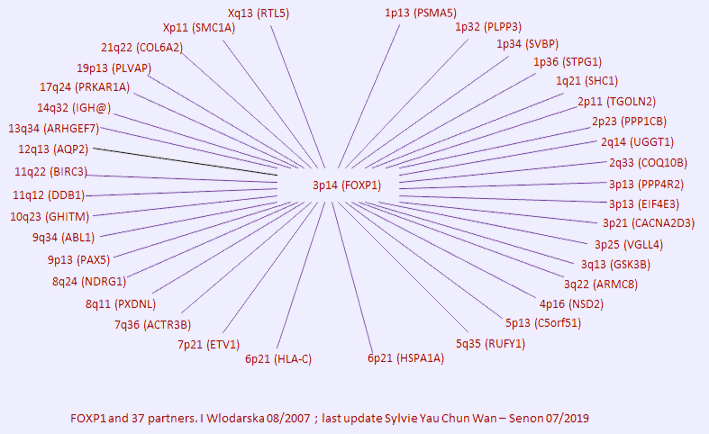
Recurrent (14q32/IGH) and non-recurrent chromosomal breakpoints/partners involved in the FOXP1 rearrangements in hematological malignancies.
Article Bibliography
| Pubmed ID | Last Year | Title | Authors |
|---|---|---|---|
| 17477366 | 2007 | Expression of the forkhead transcription factor FOXP1 is associated both with hypoxia inducible factors (HIFs) and the androgen receptor in prostate cancer but is not directly regulated by androgens or hypoxia. | Banham AH et al |
| 15709173 | 2005 | Expression of the FOXP1 transcription factor is strongly associated with inferior survival in patients with diffuse large B-cell lymphoma. | Banham AH et al |
| 15238418 | 2004 | Strong expression of FOXP1 identifies a distinct subset of diffuse large B-cell lymphoma (DLBCL) patients with poor outcome. | Barrans SL et al |
| 16200457 | 2005 | The FOXP1 transcription factor is expressed in the majority of follicular lymphomas but is rarely expressed in classical and lymphocyte predominant Hodgkin's lymphoma. | Brown P et al |
| 12297093 | 2002 | Forkhead transcription factors: key players in development and metabolism. | Carlsson P et al |
| 16252263 | 2006 | t(3;14)(p14;q32) results in aberrant expression of FOXP1 in a case of diffuse large B-cell lymphoma. | Fenton JA et al |
| 15161711 | 2004 | Expression of the forkhead transcription factor FOXP1 is associated with estrogen receptor alpha and improved survival in primary human breast carcinomas. | Fox SB et al |
| 16258506 | 2006 | Loss of expression and nuclear/cytoplasmic localization of the FOXP1 forkhead transcription factor are common events in early endometrial cancer: relationship with estrogen receptors and HIF-1alpha expression. | Giatromanolaki A et al |
| 16673020 | 2006 | Genetic rearrangement of FOXP1 is predominantly detected in a subset of diffuse large B-cell lymphomas with extranodal presentation. | Haralambieva E et al |
| 16819554 | 2006 | Foxp1 is an essential transcriptional regulator of B cell development. | Hu H et al |
| 15492844 | 2004 | Human FOX gene family (Review). | Katoh M et al |
| 17614763 | 2007 | FOXP1: a potential therapeutic target in cancer. | Koon HB et al |
| 8265594 | 1993 | DNA-binding properties and secondary structural model of the hepatocyte nuclear factor 3/fork head domain. | Li C et al |
| 17344859 | 2007 | Genome-wide analysis of genetic alterations in acute lymphoblastic leukaemia. | Mullighan CG et al |
| 16636337 | 2006 | Forkhead box protein P1 expression in mucosa-associated lymphoid tissue lymphomas predicts poor prognosis and transformation to diffuse large B-cell lymphoma. | Sagaert X et al |
| 15286807 | 2004 | Integrin engagement regulates monocyte differentiation through the forkhead transcription factor Foxp1. | Shi C et al |
| 16023287 | 2006 | Reduced expressions of Foxp1 and Rassf1a genes in lung adenocarcinomas induced by N-nitrosobis(2-hydroxypropyl)amine in rats. | Shimizu K et al |
| 15703784 | 2005 | T(3;14)(p14.1;q32) involving IGH and FOXP1 is a novel recurrent chromosomal aberration in MALT lymphoma. | Streubel B et al |
| 12692134 | 2003 | Multiple domains define the expression and regulatory properties of Foxp1 forkhead transcriptional repressors. | Wang B et al |
| 15342473 | 2004 | Foxp1 regulates cardiac outflow tract, endocardial cushion morphogenesis and myocyte proliferation and maturation. | Wang B et al |
| 15944719 | 2005 | FOXP1, a gene highly expressed in a subset of diffuse large B-cell lymphoma, is recurrently targeted by genomic aberrations. | Wlodarska I et al |
Other Information
Locus ID:
NCBI: 27086
MIM: 605515
HGNC: 3823
Ensembl: ENSG00000114861
Variants:
dbSNP: 27086
ClinVar: 27086
TCGA: ENSG00000114861
COSMIC: FOXP1
RNA/Proteins
Expression (GTEx)
Pathways
Protein levels (Protein atlas)
PharmGKB
| Entity ID | Name | Type | Evidence | Association | PK | PD | PMIDs |
|---|---|---|---|---|---|---|---|
| PA447199 | Bipolar Disorder | Disease | Literature, MultilinkAnnotation | associated | 24718920 |
References
| Pubmed ID | Year | Title | Citations |
|---|---|---|---|
| 38594460 | 2024 | Spatiotemporal transcriptomic changes of human ovarian aging and the regulatory role of FOXP1. | 0 |
| 38608123 | 2024 | The role of transcription factor FOXA1/C2/M1/O3/P1/Q1 in breast cancer. | 0 |
| 38594460 | 2024 | Spatiotemporal transcriptomic changes of human ovarian aging and the regulatory role of FOXP1. | 0 |
| 38608123 | 2024 | The role of transcription factor FOXA1/C2/M1/O3/P1/Q1 in breast cancer. | 0 |
| 36952469 | 2023 | FOXP1 inhibits pancreatic cancer growth by transcriptionally regulating IRF1 expression. | 2 |
| 37052757 | 2023 | miR-526b-5p/c-Myc/Foxp1 participates in recurrent spontaneous abortion by regulating the proliferation, migration, and invasion of trophoblasts. | 3 |
| 37084237 | 2023 | Single-nucleus transcriptomics reveals a gatekeeper role for FOXP1 in primate cardiac aging. | 9 |
| 37507770 | 2023 | Deacetylation of FOXP1 by HDAC7 potentiates self-renewal of mesenchymal stem cells. | 0 |
| 37540706 | 2023 | FOXP1 orchestrates neurogenesis in human cortical basal radial glial cells. | 2 |
| 37818745 | 2023 | NAT10/ac4C/FOXP1 Promotes Malignant Progression and Facilitates Immunosuppression by Reprogramming Glycolytic Metabolism in Cervical Cancer. | 6 |
| 36952469 | 2023 | FOXP1 inhibits pancreatic cancer growth by transcriptionally regulating IRF1 expression. | 2 |
| 37052757 | 2023 | miR-526b-5p/c-Myc/Foxp1 participates in recurrent spontaneous abortion by regulating the proliferation, migration, and invasion of trophoblasts. | 3 |
| 37084237 | 2023 | Single-nucleus transcriptomics reveals a gatekeeper role for FOXP1 in primate cardiac aging. | 9 |
| 37507770 | 2023 | Deacetylation of FOXP1 by HDAC7 potentiates self-renewal of mesenchymal stem cells. | 0 |
| 37540706 | 2023 | FOXP1 orchestrates neurogenesis in human cortical basal radial glial cells. | 2 |
Citation
Iwona Wlodarska
FOXP1 (Forkhead box P1)
Atlas Genet Cytogenet Oncol Haematol. 2007-08-01
Online version: http://atlasgeneticsoncology.org/gene/40632/foxp1
