FOXP3 (forkhead box P3)
2008-06-01 Yang Liu , Lizhong Wang AffiliationDivision of Immunotherapy, Department of Surgery Co-leader of Cancer Immunology Program, UMCCC Program of Molecular Mechanism of Diseases University of Michigan BSRB 2059, 109 Zina Pitcher Place, Ann Arbor, MI 48109, USA
Identity
HGNC
LOCATION
Xp11.23
IMAGE

LEGEND
The location and orientation of FOXP3 gene on X chromosome. The X-linked gene FOXP3 is a member of the forkhead-box/winged-helix transcription factor family. It was identified during position cloning of Scurfin, a gene responsible for X-linked autoimmune diseases in mice and humans (Chatila et al., 2000; Brunkow et al., 2001; Bennett et al., 2001; Wildin et al., 2001).
LOCUSID
ALIAS
AIID,DIETER,IPEX,JM2,MGC141961,MGC141963,PIDX,SCURFIN,XPID
FUSION GENES
DNA/RNA
Note
Some Gene Database only showed 11 coding exons and the first exon is not contained.
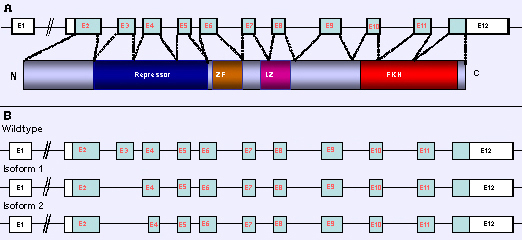
Figure a: Schematic diagram of the FOXP3 gene and protein. ZF: zinc finger domain, LZ: leucine zipper domain, and FKH fork-head domain.
Figure b: Alternatively spliced transcript variants encoding different isoforms have been identified. The two isoforms 1 and 2 is shown in the deletion of exon 3 and exon 3 with 5 part of exon 4, respectively. Other splice variant lacking both exons 3 and 8 was also reported (Smith et al., 2006).
Description
12 exons; the first exon, 5 part of exon 2 and 3 part of exon 12 are non-coding.
Transcription
1869 bps mRNA; transcribed in a centromeric to telomeric orientation. Alternative splicing: we have identified two isoforms in both normal breast and prostate cell lines and tissues, but thirteen isoforms were found in breast, prostate, and pancreas cell lines.
Pseudogene
None
Proteins
Note
None
Description
The FOXP3 protein is 431-amino acid long and its molecular weight is 47.25 kilo Daltons. It contains four potential functional domains including the repressor, ZF, LZ and fork-head (FKH) domains. The repressor domain is localized to the N-terminal region of FOXP3 and is required to repress NFAT-mediated transcriptional activity (Bettelli et al., 2005; Lopes et al., 2006; Wu et al., 2006). The mutant LZ domain impairs both dimerization and suppressive function of FoxP3 in T cells (Chae et al., 2006). The FKH domain is critical for both DNA binding and nuclear localization (Ziegler 2006). The FKH domain is the most frequent target in immunodysregulation polyendocrinopathy enteropathy X-linked syndrome (IPEX) patients.
Expression
FOXP3 locus is transcribed in the regulatory T cell. We used the Rag2 (-/-) and the Rag2 (-/-) mice with the Scurfy (sf) mutation (FoxP3 (sf/Y) or FoxP3 (sf/sf)) to evaluate FoxP3 expression outside of the lymphoid system. Immunohistochemistry and real-time PCR revealed FoxP3 expression in breast epithelial cells, lung respiratory epithelial cells, and prostate epithelial cells, although not in liver, heart, and intestine (Chen et al., 2008). Using mice with a green fluorescence protein open reading frame knocked into the 3 untranslated region of the FoxP3 locus, we showed that the locus is transcribed broadly in epithelial cells of multiple organs (Chen et al., 2008). In human, FOXP3 is expressed in normal human breast epithelial cells but is silenced in most human breast cancers (Zuo et al., 2007b).
Localisation
Predominately nuclear
Function
Foxp3 is a member of the forkhead/winged-helix family of transcriptional regulators and functions as the master regulator in the development and function of regulatory T (Treg) cells (Fontenot et al., 2003; Hori et al., 2003; Khattri et al., 2003). Nevertheless, there is still a controversy as to whether defect Treg alone explains the lethal autoimmune diseases observed in the mutant mouse and man (Chang et al., 2005; Godfrey et al., 1991). Moreover, FOXP3 as the first X-linked tumor suppressor directly targets two critical oncogenes HER2/ErbB2 and SKP2 and represses their transcription activity to inhibit cell growth in breast cancer (Zuo et al., 2007a; Zuo et al., 2007b).
Homology
FOXP1, FOXP2, and FOXP3 all have the FKH domain and may interact with cytokine gene transactivators NFkappaB and NFAT to regulate several cytokine gene transcription in T cells (Bettelli et al., 2005; Tone et al., 2008; Wu et al., 2006). However, their functional roles are alterative in different T cells.
Mutations
Note
The somatic mutations but not germline mutations in breast cancer patients.
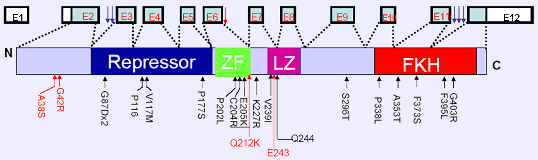
Somatic mutation of the FOXP3 gene in breast cancer samples: summary of sequencing data from 65 cases, including 50 formalin-fixed samples and 15 frozen samples. Genomic DNA was isolated from matched normal and cancerous tissues from the same patients and amplified with primers for individual exons and intron-exon boundary regions. Somatic mutations were identified by comparing sequences from normal and cancerous samples from the same patients. The data are from either bulk sequencing of PCR products or from the sequencing of 5-10 clones from PCR products. Only those mutations that were observed in multiple clones were scored. Mutations identified from 50 cases of formalin-fixed samples are marked in black, while those identified from 15 cases of frozen tissue samples are marked in red.
Germinal
In mice, a Foxp3 frameshift mutation in the forkhead domain results in lethality in hemizygous males 16 to 25 days after birth (Brunkow et al., 2001). The mutation in some human IPEX patients is analogous as they cause frameshift and early termination of translation (Chatila, 2000; Brunkow, 2001; Bennett, 2001; Wildin, 2001).
Somatic
In breast cancer patients, a total of 27 somatic mutations in all 11 coding exons and intron-exon boundary regions have been identified in 36% of 65 patients by PCR (Zuo et al., 2007b). In these mutations, there are 18 nonsynonymous mutations, 3 synonymous mutations and 6 mutations in the intron-exon junction 12 (Zuo et al. 2007b). Interestingly, the mutations are not randomly distributed in FOXP3 gene and the overwhelming majority of the mutations were either in the functional domains or within intron 11 which can affect the forkhead domain sequence (Zuo et al. 2007b).
Implicated in
Entity name
Breast cancer
Note
None
Disease
In majority of the mammary cancers, Foxp3 allele was inactivated and HER-2/ErbB2 and SKP2 are overexpressed and repressed the HER-2/ErbB2 and SKP2 promoters. Deletion, functionally significant somatic mutations, and down-regulation of the FOXP3 gene are commonly found in human breast cancer samples and correlated significantly with HER-2/ErbB2 over-expression, regardless of the status of HER-2 amplification. FOXP3 is an X-linked breast cancer suppressor gene and an important regulator of the HER-2/ErbB2 and SKP2 oncogenes in breast cancer development.
Prognosis
None
Cytogenetics
In fluorescence in situ hybridization (FISH) analysis, the FOXP3 gene is frequently deleted in the breast cancer samples. Out of 223 informative samples, we observed 28 cases (12.6%) with FXOP3 deletion. FOXP3 is likely within the minimal region of deletion in the Xp11 region studied. Although all deletions were heterozygous, the FOXP3 protein was undetectable in 26 out of 28 cases. Thus, it appears that for the majority of the breast cancer samples, LOH alone was sufficient to inactivate the locus, perhaps due to X-chromosomal inactivation. The two cases with both deletion and FOXP3 expression had X polysomy with three and four X chromosomes, respectively.
Hybrid gene
None
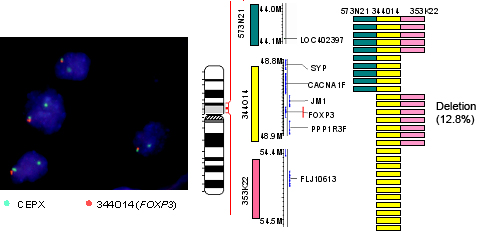
X-chromosomal deletion pattern in breast cancer. TMA samples were probed with 3 markers for X-chromosome as marked. The deletion of each probe was scored independently and summarized in the colour bars, each bar representing one case. Note that the FOXP3 locus encompasses the minimal deletion in the 10MB area of the X-chromosome. A typical FISH for the CEPX (green) and FOXP3 (orange) probes is shown.
Fusion protein
None
Oncogenesis
Mice with the Foxp3 heterozygous mutation spontaneously developed mammary cancer at a high rate (Zuo et al., 2007b). Foxp3 mutation have a comparably higher incidence of human mammary cancer and is likely responsible for the increased rate of breast cancer. Our analysis of human breast cancer samples provides strong support for an important role for the FOXP3 gene in the development of breast cancer (Zuo et al., 2007a; Zuo et al., 2007b). First, FOXP3 is likely the minimal region of deletion in breast cancer. Second, a high proportion of somatic mutations in the FOXP3 gene are identified in breast cancer and most of the mutations resulted in the non-conservative replacement of amino acids, and the deletions and mutations of the FOXP3 locus corresponded to increased HER-2 and SKP2 levels. Third, approximate 80% breast cancers have a down-regulation of FOXP3 in tumor tissues compared to normal breast tissues. These data indicated that FOXP3 is an X-Linked mammary tumor suppressor gene.
Breakpoints
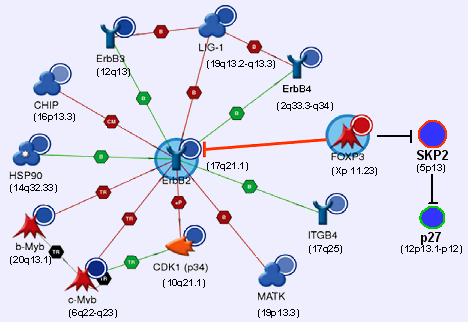
Ingenuity Pathway analysis indicated that FoxP3-regulated genes belong to multiple cellular pathways related to the process of cancer development. Most of which are not directly related to FOXP3-mediated repression of ErbB2 (Zuo et al., 2007b). Interestingly, when we used the GeneGo MetaCore knowledgebase to analyze genes that related to ErbB2 signaling pathway, we found that FOXP3 down-regulated 10 genes in this pathway. With the notable exception of b-Myb and c-Myb, the down-regulation is not likely related to FoxP3-mediated ErbB2 repression, as they are not known transcriptional targets of ErbB2. Thus, FOXP3 can suppress ErbB2 signaling and tumor growth by mechanisms other than ErbB2 expression. These data provide a plausible explanation for the tumor suppressor activity of FOXP3 in breast cancer cell lines that do not substantially overexpress HER-2. We also demonstrated that downregulation of SKP2 was critical for FOXP3-mediated growth inhibition in breast cancer cells that do not overexpress ERBB2/HER2 (Zuo et al., 2007a). Our data provide genetic, biochemical, and functional evidence that FOXP3 is a novel transcriptional repressor for the oncogenes HER2/ErbB2 and SKP2 (Zuo et al., 2007b; Zuo et al., 2007a).
Note
None
Article Bibliography
| Pubmed ID | Last Year | Title | Authors |
|---|---|---|---|
| 11137993 | 2001 | The immune dysregulation, polyendocrinopathy, enteropathy, X-linked syndrome (IPEX) is caused by mutations of FOXP3. | Bennett CL et al |
| 15790681 | 2005 | Foxp3 interacts with nuclear factor of activated T cells and NF-kappa B to repress cytokine gene expression and effector functions of T helper cells. | Bettelli E et al |
| 11138001 | 2001 | Disruption of a new forkhead/winged-helix protein, scurfin, results in the fatal lymphoproliferative disorder of the scurfy mouse. | Brunkow ME et al |
| 16769892 | 2006 | The mutant leucine-zipper domain impairs both dimerization and suppressive function of Foxp3 in T cells. | Chae WJ et al |
| 16230479 | 2005 | The Scurfy mutation of FoxP3 in the thymus stroma leads to defective thymopoiesis. | Chang X et al |
| 11120765 | 2000 | JM2, encoding a fork head-related protein, is mutated in X-linked autoimmunity-allergic disregulation syndrome. | Chatila TA et al |
| 18390696 | 2008 | Cutting edge: Broad expression of the FoxP3 locus in epithelial cells: a caution against early interpretation of fatal inflammatory diseases following in vivo depletion of FoxP3-expressing cells. | Chen GY et al |
| 12612578 | 2003 | Foxp3 programs the development and function of CD4+CD25+ regulatory T cells. | Fontenot JD et al |
| 2062835 | 1991 | Fatal lymphoreticular disease in the scurfy (sf) mouse requires T cells that mature in a sf thymic environment: potential model for thymic education. | Godfrey VL et al |
| 12522256 | 2003 | Control of regulatory T cell development by the transcription factor Foxp3. | Hori S et al |
| 18008005 | 2007 | FOXP3 is a novel transcriptional repressor for the breast cancer oncogene SKP2. | Zuo T et al |
| 12612581 | 2003 | An essential role for Scurfin in CD4+CD25+ T regulatory cells. | Khattri R et al |
| 16920951 | 2006 | Analysis of FOXP3 reveals multiple domains required for its function as a transcriptional repressor. | Lopes JE et al |
| 17005002 | 2006 | Splice variants of human FOXP3 are functional inhibitors of human CD4+ T-cell activation. | Smith EL et al |
| 18157133 | 2008 | Smad3 and NFAT cooperate to induce Foxp3 expression through its enhancer. | Tone Y et al |
| 11137992 | 2001 | X-linked neonatal diabetes mellitus, enteropathy and endocrinopathy syndrome is the human equivalent of mouse scurfy. | Wildin RS et al |
| 16873067 | 2006 | FOXP3 controls regulatory T cell function through cooperation with NFAT. | Wu Y et al |
| 16551248 | 2006 | FOXP3: of mice and men. | Ziegler SF et al |
| 17570480 | 2007 | FOXP3 is an X-linked breast cancer suppressor gene and an important repressor of the HER-2/ErbB2 oncogene. | Zuo T et al |
Other Information
Locus ID:
NCBI: 50943
MIM: 300292
HGNC: 6106
Ensembl: ENSG00000049768
Variants:
dbSNP: 50943
ClinVar: 50943
TCGA: ENSG00000049768
COSMIC: FOXP3
RNA/Proteins
Expression (GTEx)
Pathways
| Pathway | Source | External ID |
|---|---|---|
| Inflammatory bowel disease (IBD) | KEGG | hsa05321 |
| Inflammatory bowel disease (IBD) | KEGG | ko05321 |
| Th17 cell differentiation | KEGG | ko04659 |
| Th17 cell differentiation | KEGG | hsa04659 |
Protein levels (Protein atlas)
PharmGKB
| Entity ID | Name | Type | Evidence | Association | PK | PD | PMIDs |
|---|---|---|---|---|---|---|---|
| PA165817016 | Kidney Transplantation | Disease | ClinicalAnnotation | associated | PD | 27747372 | |
| PA445451 | Psoriasis | Disease | ClinicalAnnotation | associated | PD | 28444425 | |
| PA450428 | methotrexate | Chemical | ClinicalAnnotation | associated | PD | 28444425 | |
| PA451578 | tacrolimus | Chemical | ClinicalAnnotation | associated | PD | 27747372 |
References
| Pubmed ID | Year | Title | Citations |
|---|---|---|---|
| 37936281 | 2024 | Circulating levels of FoxP3, M2 (sCD163) and IGF-1 as potential biomarkers associated with Laryngeal Squamous Cell Carcinoma in Tunisian patients. | 0 |
| 37994657 | 2024 | FOXP3 deficiency, from the mechanisms of the disease to curative strategies. | 0 |
| 38147957 | 2024 | Peptidase inhibitor 16 promotes inflammatory arthritis by suppressing Foxp3 expression via regulating K48-linked ubiquitin degradation Bmi-1 in regulatory T cells. | 1 |
| 38244519 | 2024 | Downregulation of circular RNA ETS1 promotes SLE activity and inhibits Treg cell differentiation through miR-1205/FoxP3 molecular axis. | 0 |
| 38308298 | 2024 | The relationship between high ratios of CD4/FOXP3 and CD8/CD163 and the improved survivability of metastatic triple-negative breast cancer patients: a multicenter cohort study. | 0 |
| 38311556 | 2024 | [Clinical features and genetic analysis of three patients with Immune dysregulation, polyendocrinopathy, enteropathy, X-linked syndrome due to variants of FOXP3 gene]. | 0 |
| 38402536 | 2024 | Insight into the significance of Foxp3 + tumor-infiltrating lymphocytes in squamous cell lung cancer. | 0 |
| 38415552 | 2024 | Evaluating CD4 and Foxp3 mRNA Expression in Tissue Specimens of Celiac Disease and Colorectal Cancer Patients. | 0 |
| 38433312 | 2024 | Meta-analysis of FOXP3 polymorphisms and recurrent spontaneous abortion susceptibility. | 0 |
| 38536932 | 2024 | CRIF1 deficiency induces FOXP3(LOW) inflammatory non-suppressive regulatory T cells, thereby promoting antitumor immunity. | 0 |
| 38660296 | 2024 | FOXP3 full length splice variant is associated with kidney allograft tolerance. | 0 |
| 38676826 | 2024 | Expression of full-length FOXP3 exceeds other isoforms in thymus and stimulated CD4 + T cells. | 0 |
| 38754303 | 2024 | FOXP3 gene is associated with susceptibility to ischemic stroke in the Chinese population. | 0 |
| 38805281 | 2024 | Long noncoding RNA LIRIL2R modulates FOXP3 levels and suppressive function of human CD4(+) regulatory T cells by regulating IL2RA. | 1 |
| 38811598 | 2024 | Inferring upstream regulatory genes of FOXP3 in human regulatory T cells from time-series transcriptomic data. | 0 |
Citation
Yang Liu ; Lizhong Wang
FOXP3 (forkhead box P3)
Atlas Genet Cytogenet Oncol Haematol. 2008-06-01
Online version: http://atlasgeneticsoncology.org/gene/44129/foxp3
