HFE (hemochromatosis)
2008-03-01 M Tevfik Dorak AffiliationGenomic Immunoepidemiology Laboratory, HUMIGEN LLC, The Institute for Genetic Immunology, Hamilton, NJ 08690-3303, USA
DNA/RNA
Note
History and Nomenclature: The HFE gene was discovered in 1996 by Feder et al after a long search in the vicinity of the HLA-A locus. It is around 5 Mb telomeric to HLA-A in physical distance but genetic distance is less than 1 cM. Unfortunately, it was originally named HLA-H as the HLA class I-like hemochromatosis gene but there was already a gene called HLA-H. Thus, the hemochromatosis gene should not be called HLA-H. According to nomenclature conventions, the gene is called HFE and the protein product is HFE. There is no pseudogene derived from HFE.
Description
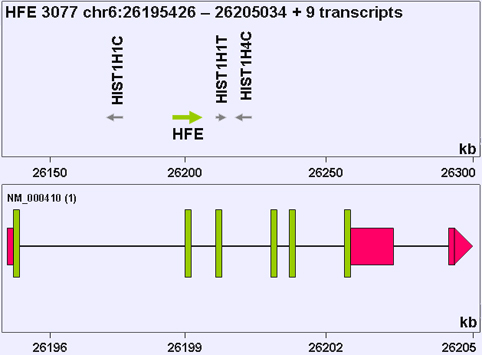
HFE encompasses 9,609 bp of DNA on chromosome 6 (6p22.1) between 26,195,426 - 26,205,034 bp from pter within the extended HLA class I region. Histone genes populate either side of the HFE gene. It is an HLA class-I-like molecule but is not involved in antigen presentation or immune response.
Transcription
HFE has at least nine alternatively spliced forms. The full-length transcript contains six exons, however, the number of exons can be as few as three (see Figure).
Proteins
Description
HFE is a beta2-microglobulin-associated membrane protein similar to HLA class I molecules. It consists of an a-chain encoded by HFE and beta2-microglobulin as the b-chain.
Expression
Expressed in a wide range of cell types and tissues including lymphocytes and placenta.
Localisation
HFE is a cell surface membrane protein.
Function
HFE is primarily involved in iron homeostasis. Initially it was thought that it directly regulated intestinal iron absorption. It is now believed that functional HFE is required for normal regulation of hepcidin synthesis, which is the main regulator of iron metabolism. Mutations of HFE result in iron overload.
Mutations
Note
Two missense mutations C282Y (rs1800562) and H63D (rs1799945) are relatively common. C282Y is most common in Northern European populations and H63D has a global distribution. Whereas the prevalence of these mutations is high, the clinical penetrance of the disease they cause is low.
There is no nonsense mutation described in HFE.
Missense mutations are involved in pathogenesis of iron overload.
HFE is not involved in any known translocations.
Hfe knockout mice are viable and develop iron overload.
Implicated in
Entity name
Iron Overload
Disease
Mutations in HFE increase body iron levels and homozygosity or compound heterozygosity may cause iron overload. The penetrance is low. Dietary iron intake, alcohol consumption and blood loss are environmental modifiers. The importance of iron overload is that it increases the risk for cancer development presumably due to its potential to cause oxidative DNA damage.
Entity name
Hereditary Hemochromatosis
Disease
Hereditary hemochromatosis (HH; OMIM 235200) is a recessive iron storage disorder resulting from defects in HFE. HH (type 1) is the most common autosomal recessive disease in Caucasians adults. Most patients (about 90%) are homozygous for the C282Y mutation and another 4% are compound heterozygotes (C282Y, H63D). Different forms of non-HFE hemochromatosis are caused by other iron-related genes: type 2 (mutations in HFE2), type 3 (mutations in TFR2) and type 4 (mutations in SLC40A1 ferroportin). HH is characterized by abnormal intestinal iron absorption and elevated total body iron levels. Iron overload results in clinical complications including cirrhosis, cardiopathy, endocrine dysfunctions including diabetes, arthropathy and susceptibility to liver cancer. The penetrance is higher in males due to regular blood loss in premenopausal women. Disease complications can be prevented by regular phlebotomy. The effect of HFE on disease phenotype can be modified by other iron-related genes including hepcidin (HAMP), transferrin (TF), transferrin receptor (TFRC), haptoglobin (HP) and ceruloplasmin (CP).
Entity name
Porphyria variegata
Disease
Defects in HFE also cause porphyria variegata (OMIM 176200). Porphyrias are inherited defects in the biosynthesis of heme, resulting in the accumulation and increased excretion of porphyrins or porphyrin precursors. Porphyria variegata is the prevalent form in South Africa. It is characterized by skin hyperpigmentation and hypertrichosis, abdominal pain, tachycardia, hypertension and neuromuscular disturbances. Iron overload is the hallmark of the disease.
Entity name
Leukemias
Disease
HFE mutations do not cause cancer and HFE mutations are not detected preferentially in cancer cells as somatic mutations. Both C282Y and H63D mutations, however, have been implicated in susceptibility to leukemias and other cancers. In South Wales (U.K.), C282Y mutation is associated with increased risk to childhood acute lymphoblastic leukemia in boys only. This association has not been noted in other studies in Finland, Spain and Mexico. In Italy, adult leukemia shows an association with H63D mutation.
Entity name
Breast Cancer
Disease
Studies in USA, Russia and Turkey have found risk associations with HFE mutations C282Y and/or H63D with breast cancer. A Swedish study found a risk association only in women homozygous for the TFRC variant S142G.
Entity name
Other cancers
Disease
In Sweden, combination of HFE mutation C282Y and/or H63D and homozygosity for the TFRC variant S142G increase susceptibility to multiple myeloma, hepatocellular carcinoma and colon cancer (besides breast cancer). An interaction of HFE mutations with dietary intake of excessive iron also increases the risk for colorectal cancer. Various studies have reported increased frequency of HFE mutations in hepatocellular carcinoma secondary to hepatic iron overload but not in HCV-induced hepatocellular carcinoma. There appears to be an interaction between HFE and alcohol in the induction of iron overload, cirrhosis and subsequent hepatocellular carcinoma. For each genetic association report between HFE and any cancer, there is also one or more negative association report. It appears that only large and comprehensive studies taking into account gene x gene and gene x environment interactions may conclude this issue.
Article Bibliography
| Pubmed ID | Last Year | Title | Authors |
|---|
Other Information
Locus ID:
NCBI: 3077
MIM: 613609
HGNC: 4886
Ensembl: ENSG00000010704
Variants:
dbSNP: 3077
ClinVar: 3077
TCGA: ENSG00000010704
COSMIC: HFE
RNA/Proteins
Expression (GTEx)
Protein levels (Protein atlas)
PharmGKB
| Entity ID | Name | Type | Evidence | Association | PK | PD | PMIDs |
|---|---|---|---|---|---|---|---|
| PA10004 | adalimumab | Chemical | ClinicalAnnotation | associated | PD | 27115882 | |
| PA443815 | Crohn Disease | Disease | ClinicalAnnotation | associated | PD | 27115882 |
References
| Pubmed ID | Year | Title | Citations |
|---|---|---|---|
| 37133674 | 2024 | Hereditary hemochromatosis with homozygous C282Y HFE mutation: possible clinical model to assess effects of elevated reactive oxygen species on the development of cardiovascular disease. | 0 |
| 37930135 | 2024 | Height of non-Hispanic white adults with homeostatic iron regulator HFE genotypes p.C282Y/p.C282Y and wt/wt. | 1 |
| 38263707 | 2024 | Penetrance, cancer incidence and survival in HFE haemochromatosis-A population-based cohort study. | 1 |
| 38329447 | 2024 | Serum ferritin level is associated with liver fibrosis and incident liver-related outcomes independent of HFE genotype in the general population. | 0 |
| 38479735 | 2024 | HFE genotypes, haemochromatosis diagnosis and clinical outcomes at age 80 years: a prospective cohort study in the UK Biobank. | 0 |
| 37133674 | 2024 | Hereditary hemochromatosis with homozygous C282Y HFE mutation: possible clinical model to assess effects of elevated reactive oxygen species on the development of cardiovascular disease. | 0 |
| 37930135 | 2024 | Height of non-Hispanic white adults with homeostatic iron regulator HFE genotypes p.C282Y/p.C282Y and wt/wt. | 1 |
| 38263707 | 2024 | Penetrance, cancer incidence and survival in HFE haemochromatosis-A population-based cohort study. | 1 |
| 38329447 | 2024 | Serum ferritin level is associated with liver fibrosis and incident liver-related outcomes independent of HFE genotype in the general population. | 0 |
| 38479735 | 2024 | HFE genotypes, haemochromatosis diagnosis and clinical outcomes at age 80 years: a prospective cohort study in the UK Biobank. | 0 |
| 35790703 | 2023 | Risk of Hepatocellular Carcinoma in Patients with Various HFE Genotypes. | 4 |
| 36572138 | 2023 | A haemochromatosis-causing HFE mutation is associated with SARS-CoV-2 susceptibility in the Czech population. | 3 |
| 37176017 | 2023 | Risk Effects of rs1799945 Polymorphism of the HFE Gene and Intergenic Interactions of GWAS-Significant Loci for Arterial Hypertension in the Caucasian Population of Central Russia. | 6 |
| 35790703 | 2023 | Risk of Hepatocellular Carcinoma in Patients with Various HFE Genotypes. | 4 |
| 36572138 | 2023 | A haemochromatosis-causing HFE mutation is associated with SARS-CoV-2 susceptibility in the Czech population. | 3 |
Citation
M Tevfik Dorak
HFE (hemochromatosis)
Atlas Genet Cytogenet Oncol Haematol. 2008-03-01
Online version: http://atlasgeneticsoncology.org/gene/44099/hfe
