KAT5 (HIV-1 Tat interacting protein, 60kDa)
2007-10-01 Lise Mattera AffiliationDr Trouche Team, LBCMCP, UMR 5088 CNRS, 118 route de Narbonne, 31062 Toulouse cedex 9, France
Identity
HGNC
LOCATION
11q13.1
LOCUSID
ALIAS
ESA1,HTATIP,HTATIP1,NEDFASB,PLIP,TIP,TIP60,ZC2HC5,cPLA2
FUSION GENES
DNA/RNA
Description
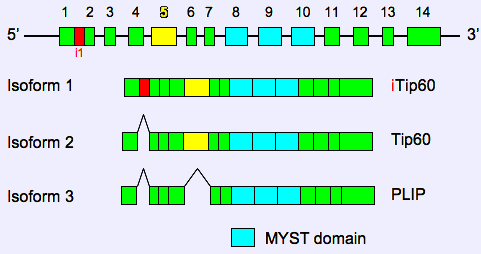
The HTATIP gene consists of 14 exons. 7,586 bases.
Transcription
The predominant mRNA transcribed from this gene is 2,229 bp long. This is actually the isoform 2 of HTATIP.
Two others isoforms generated by alternative splicing have been described:
Isoform 1 retains the alternatively spliced intron 1.
Isoform 3 lacks exon 5.
Two others isoforms generated by alternative splicing have been described:
Pseudogene
No pseudogene is currently known.
Proteins
Description
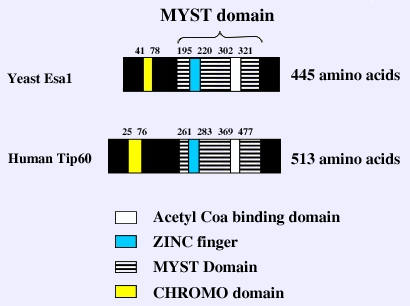
The Tip60 protein (isoform 2) is 513 amino acids long and its molecular weight is about 60 kDa. It was cloned and characterized in 1996 thanks to its interaction with the HIV-1 transactivator Tat protein.
Isoform 1 produces a 546 amino acids long protein.
Isoform 3 produces a 461 amino acids long protein.
A novel isoform, Tip55, encodes a novel splicing variant corresponding to 103 amino acids of the C-terminus.
The domain architectures of human TIP60 is similar to yeast Esa1 protein and consist of a chromodomain and a MYST domain harboring a zinc finger and an Acetyl-CoA binding site.
Isoform 1 produces a 546 amino acids long protein.
Isoform 3 produces a 461 amino acids long protein.
A novel isoform, Tip55, encodes a novel splicing variant corresponding to 103 amino acids of the C-terminus.
The domain architectures of human TIP60 is similar to yeast Esa1 protein and consist of a chromodomain and a MYST domain harboring a zinc finger and an Acetyl-CoA binding site.
Expression
Tip60 is ubiquitously expressed.
In mouse adult tissues Tip60 is expressed in the following decreasing order of intensity: testis, heart, brain, kidney, liver, lung, with little to no expression in spleen and skeletal muscle .
In human, Tip60 (Isoform 2) and PLIP (Isoform 3) are expressed in human heart, kidney and brain tissue.
With a half-life of approximately 30 minutes, Tip60 is very unstable. In normal conditions, the proteasome pathway permits to maintain low protein levels. Tip60 is ubiquitinated and targeted to proteasome-mediated degradation by Mdm2 but also by p300-associated E4 ubiquitin ligase. Tip60 is stabilized after DNA damage, and accumulates in cells. Moreover, Tip60 is the target of several post-translational modifications such as phosphorylation on serine 86 and 90 by cdc2 but also acetylation by p300/CBP acetyltransferases. Acetylation by p300/CBP occurs in the zinc finger of Tip60 but consequences of this modification are currently not known. Finally, a recent report shows that Tip60 is sumoylated at lysines 430 and 451 via Ubc9.
No data are available about regulation of the Tip60 promoter.
In mouse adult tissues Tip60 is expressed in the following decreasing order of intensity: testis, heart, brain, kidney, liver, lung, with little to no expression in spleen and skeletal muscle .
In human, Tip60 (Isoform 2) and PLIP (Isoform 3) are expressed in human heart, kidney and brain tissue.
With a half-life of approximately 30 minutes, Tip60 is very unstable. In normal conditions, the proteasome pathway permits to maintain low protein levels. Tip60 is ubiquitinated and targeted to proteasome-mediated degradation by Mdm2 but also by p300-associated E4 ubiquitin ligase. Tip60 is stabilized after DNA damage, and accumulates in cells. Moreover, Tip60 is the target of several post-translational modifications such as phosphorylation on serine 86 and 90 by cdc2 but also acetylation by p300/CBP acetyltransferases. Acetylation by p300/CBP occurs in the zinc finger of Tip60 but consequences of this modification are currently not known. Finally, a recent report shows that Tip60 is sumoylated at lysines 430 and 451 via Ubc9.
No data are available about regulation of the Tip60 promoter.
Localisation
Tip60 (Isoform 2) is nuclear. PLIP (Isoform 3) is nuclear but also cytoplasmic.
Function
Tip60 is a Histone Acetyltransferase (HAT), which belongs to the MYST family. It participates in a multimolecular complex: The Tip60 complex, which contains proteins such as p400, Tip49a and Tip49b . Within this complex, Tip60 exerts its HAT activity on nucleosomal histone H4. Tip60 is involved in various cellular mechanisms:
In transcription: Tip60 acts as a coactivator. Indeed, Tip60 is able to interact with transcription factors, such as E2F-1 or c-Myc. Tip60 can be recruited to Myc and E2F-1 target promoters and enhances Myc transactivation. It also acetylates histone H4 on several E2F responsive genes. Moreover Tip60 was found to be involved in nuclear receptor (NR) signaling and to be a NR-coregulator.
In apoptosis and cell cycle arrest: Tip60 can interact with and acetylate the tumor suppressor p53. It enhances p53 binding to pro-apoptotic target genes like PUMA, Bax or Fas. Moreover, Tip60 is also required for cell growth arrest via the p21-dependent pathway.
In DNA repair: Tip60 is involved in double strand breaks (DSB) repair. Interacting and acetylating ATM, Tip60 participates in DNA damage signaling. But, Tip60 is also involved directly in DSB repair since it is recruited, with TRRAP, to the DSB site. Tip60 interacts with the chromatin surrounding sites of DSBs and this recruitment is responsible for hyperacetylation of histone H4.
Homology
Tip60 CHROMO domain has been identified by sequence homology with the Heterochromatin-associated protein 1 (HP1) chromodomain, which recognizes methylated lysines. It also harbors the MYST domain, which is highly conserved from yeast to human.
Homologs in other species:
S. Cerevisae: Esa1
D. Melanogaster: DmeI/Tip60
M. musculus: Htatip
R. norvegicus: Htatip
Predicted:
P.troglodytes: HTATIP
M.mulatta: HTATIP
Homologs in other species:
Predicted:
Mutations
Note
No mutation in Tip60 protein has been currently described.
Implicated in
Entity name
Acquired Immunodeficiency Syndrome (AIDS)
Disease
Tip60 interacts with the HIV-1 transactivator Tat and this interaction inhibits Tip60 HAT activity. Moreover, in Jurkat cells, Tat enhances Tip60 turnover since it uses the p300/CBP-associated E4-type ubiquitin-ligase activity to induce polyubiquitynation and degradation of Tip60. This targeting by Tat induces an impairment of Tip60-dependent apoptosis after DNA damage.
Entity name
Neurodegenerative diseases
Entity name
Alzheimer disease
Disease
In the nucleus of human H4 neuroglioma cells, TIP60 can interact with a free carboxyl-terminal intracellular fragment, APP-CT, which is generated by the cleavage of the Amyloid precursor protein APP by a gamma-secretase. This fragment induces apoptosis of neuroglioma and this cell death is enhanced when a wild type form of Tip60 is transfected. Thus Tip60 might play a role in Alzheimers disease neurodegeneration.
Entity name
Spinocerebellar ataxia type-1
Disease
TIP60 participates in a complex with ATXN1 and ROR-alpha in a conditional transgenic mouse model of Spinocerebellar ataxia type-1 (SCA1), one of the nine inherited polyglutamine neurodegenerative diseases.
Entity name
Cancers
Entity name
Prostate cancer
Disease
Immunohistochemistry experiments have shown that Tip60 accumulates in the nucleus of hormone-refractory prostate cancer compared to prostate hyperplasia and primary prostate cancer.
Entity name
Lung cancer and colon cancer
Disease
Real time RT-PCR experiments have shown that Tip60 mRNA is under expressed in colon and lung carcinomas.
Entity name
Skin cancer
Disease
The expression levels of TIP60 protein, analyzed by western blot, were found to be greater in skin tumors as compared to adjacent non-tumor-bearing skin in a skin cancer mouse model (K6/ODC mouse). Additionally, the interaction between Tip60 and E2F1 is enhanced in these tumors.
Entity name
HTLV-1 induced leukemogenesis
Disease
Enhancement of c-Myc transforming activity by HTLV-1 p30II oncoprotein in HeLa cells requires TIP60 HAT activity.
Article Bibliography
| Pubmed ID | Last Year | Title | Authors |
|---|---|---|---|
| 15988028 | 2005 | A human T-cell lymphotropic virus type 1 enhancer of Myc transforming potential stabilizes Myc-TIP60 transcriptional interactions. | Awasthi S et al |
| 15042092 | 2004 | A large-scale RNAi screen in human cells identifies new components of the p53 pathway. | Berns K et al |
| 10364196 | 1999 | Tip60 is a nuclear hormone receptor coactivator. | Brady ME et al |
| 17704809 | 2008 | Functional characterization of TIP60 sumoylation in UV-irradiated DNA damage response. | Cheng Z et al |
| 16001085 | 2005 | HIV-1 Tat targets Tip60 to impair the apoptotic cell response to genotoxic stresses. | Col E et al |
| 10393559 | 1999 | Control of the histone-acetyltransferase activity of Tip60 by the HIV-1 transactivator protein, Tat. | Creaven M et al |
| 12776177 | 2003 | MYC recruits the TIP60 histone acetyltransferase complex to chromatin. | Frank SR et al |
| 11591700 | 2001 | Tip60 is a co-activator specific for class I nuclear hormone receptors. | Gaughan L et al |
| 11994312 | 2002 | Tip60 and histone deacetylase 1 regulate androgen receptor activity through changes to the acetylation status of the receptor. | Gaughan L et al |
| 12717424 | 2003 | Expression of Tip60, an androgen receptor coactivator, and its role in prostate cancer development. | Halkidou K et al |
| 16912189 | 2006 | Tip60 protein isoforms and altered function in skin and tumors that overexpress ornithine decarboxylase. | Hobbs CA et al |
| 10966108 | 2000 | Involvement of the TIP60 histone acetylase complex in DNA repair and apoptosis. | Ikura T et al |
| 8607265 | 1996 | Identification of a cellular protein that specifically interacts with the essential cysteine region of the HIV-1 Tat transactivator. | Kamine J et al |
| 16597624 | 2006 | Co-activation of atrial natriuretic factor promoter by Tip60 and serum response factor. | Kim MS et al |
| 12032152 | 2002 | The gamma secretase-generated carboxyl-terminal domain of the amyloid precursor protein induces apoptosis via Tip60 in H4 cells. | Kinoshita A et al |
| 16865262 | 2006 | New p53 related genes in human tumors: significant downregulation in colon and lung carcinomas. | LLeonart ME et al |
| 15310756 | 2004 | Role of the histone acetyl transferase Tip60 in the p53 pathway. | Legube G et al |
| 12801643 | 2003 | Identification of a larger form of the histone acetyl transferase Tip60. | Legube G et al |
| 12468530 | 2003 | Tip60 acetyltransferase activity is controlled by phosphorylation. | Lemercier C et al |
| 12036595 | 2002 | Characterization and expression of the mouse tat interactive protein 60 kD (TIP60) gene. | McAllister D et al |
| 16341205 | 2006 | Histone acetylation by Trrap-Tip60 modulates loading of repair proteins and repair of DNA double-strand breaks. | Murr R et al |
| 11111051 | 2000 | Identification of an alternatively spliced form of the Tat interactive protein (Tip60), Tip60(beta). | Ran Q et al |
| 17110330 | 2006 | RORalpha-mediated Purkinje cell development determines disease severity in adult SCA1 mice. | Serra HG et al |
| 11416127 | 2001 | PLIP, a novel splice variant of Tip60, interacts with group IV cytosolic phospholipase A(2), induces apoptosis, and potentiates prostaglandin production. | Sheridan AM et al |
| 16141325 | 2005 | A role for the Tip60 histone acetyltransferase in the acetylation and activation of ATM. | Sun Y et al |
| 17189187 | 2006 | Acetylation of the p53 DNA-binding domain regulates apoptosis induction. | Sykes SM et al |
| 17189186 | 2006 | Tip60-dependent acetylation of p53 modulates the decision between cell-cycle arrest and apoptosis. | Tang Y et al |
| 15121871 | 2004 | E2F-dependent histone acetylation and recruitment of the Tip60 acetyltransferase complex to chromatin in late G1. | Taubert S et al |
| 16601686 | 2006 | Tip60 and p400 are both required for UV-induced apoptosis but play antagonistic roles in cell cycle progression. | Tyteca S et al |
Other Information
Locus ID:
NCBI: 10524
MIM: 601409
HGNC: 5275
Ensembl: ENSG00000172977
Variants:
dbSNP: 10524
ClinVar: 10524
TCGA: ENSG00000172977
COSMIC: KAT5
RNA/Proteins
Expression (GTEx)
Pathways
Protein levels (Protein atlas)
References
| Pubmed ID | Year | Title | Citations |
|---|---|---|---|
| 38141874 | 2024 | The Tudor-knot Domain of KAT5 Regulates Nucleosomal Substrate Acetylation. | 0 |
| 38141874 | 2024 | The Tudor-knot Domain of KAT5 Regulates Nucleosomal Substrate Acetylation. | 0 |
| 36463002 | 2023 | Investigation of mRNA Expression Levels of Tip60 and Related DNA Repair Genes in Molecular Subtypes of Breast Cancer. | 1 |
| 36916958 | 2023 | TIP60 is required for tumorigenesis in non-small cell lung cancer. | 2 |
| 36463002 | 2023 | Investigation of mRNA Expression Levels of Tip60 and Related DNA Repair Genes in Molecular Subtypes of Breast Cancer. | 1 |
| 36916958 | 2023 | TIP60 is required for tumorigenesis in non-small cell lung cancer. | 2 |
| 35383533 | 2022 | Vacuolar protein sorting-associated protein 72 homolog (VPS72) binding to lysine acetyltransferase 5 (KAT5) promotes the proliferation, invasion and migration of hepatocellular carcinoma through regulating phosphatidylinositol 3-kinase (PI3K)/protein kinase B (AKT) signaling pathway. | 6 |
| 35525269 | 2022 | TIP60 acts as a regulator of genes involved in filopodia formation and cell migration during wound healing. | 2 |
| 35853868 | 2022 | Loss of TIP60 (KAT5) abolishes H2AZ lysine 7 acetylation and causes p53, INK4A, and ARF-independent cell cycle arrest. | 5 |
| 35951156 | 2022 | Regulation of UHRF1 acetylation by TIP60 is important for colon cancer cell proliferation. | 4 |
| 36066422 | 2022 | A balancing act: interactions within NuA4/TIP60 regulate picNuA4 function in Saccharomyces cerevisiae and humans. | 0 |
| 36190325 | 2022 | Acetylation of Nup62 by TIP60 ensures accurate chromosome segregation in mitosis. | 3 |
| 35383533 | 2022 | Vacuolar protein sorting-associated protein 72 homolog (VPS72) binding to lysine acetyltransferase 5 (KAT5) promotes the proliferation, invasion and migration of hepatocellular carcinoma through regulating phosphatidylinositol 3-kinase (PI3K)/protein kinase B (AKT) signaling pathway. | 6 |
| 35525269 | 2022 | TIP60 acts as a regulator of genes involved in filopodia formation and cell migration during wound healing. | 2 |
| 35853868 | 2022 | Loss of TIP60 (KAT5) abolishes H2AZ lysine 7 acetylation and causes p53, INK4A, and ARF-independent cell cycle arrest. | 5 |
Citation
Lise Mattera
KAT5 (HIV-1 Tat interacting protein, 60kDa)
Atlas Genet Cytogenet Oncol Haematol. 2007-10-01
Online version: http://atlasgeneticsoncology.org/gene/40893/kat5
