MAL (mal, T-cell differentiation protein)
2010-07-01 Levent B Beder , Noboru Yamanaka AffiliationDepartment of Otolaryngology Head, Neck Surgery, Wakayama Medical University, 811-1, Kimiidera, Wakayama, 641-8509, Japan
DNA/RNA
Description
The promoter lacks a consensus TATA box in the vicinity of transcription start side and there is no consensus polyadenylation signal, although ATAAAA sequence exists.
There are two separated promoter CpG islands at a totally 1500 bp length of region extending into the first intron and contains up to 116 CpG dinucleotides. CpG island is divided into two regions and usually methylation status of these regions are evaluated separately by specifically designed primer sets.
MAL promoter at 110 bp upstream of the transcriptional start site contains also several SP1 binding sites, which may be regulated by transcriptional activator SP1 (Tugores et al., 1997).
Transcription
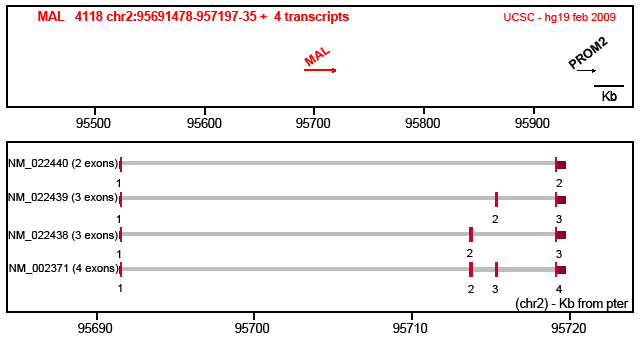
The mRNA is 1051 bp and open reading frame is 460 bp in length. Translation begins from a start codon in exon 1, ends at a stop codon in exon 4, and results in a 153 amino acid protein product. mRNA orientation is forward and transcription occurs on plus strand. The first exon encodes the 5 untranslated region and the first 31 amino acids. The second and the third exons encode 56 and 42 amino acids, respectively. Fourth exon encodes the 24 amino acids at COOH-terminal and the 3 untranslated region. The intron boundaries follow the AG/GT rule of acceptor/donor splice signal sequences and splicing between exons occurs between the last nucleotide of a codon and the first one of the next codon (Rancano et al., 1994b).
Pseudogene
Proteins
Description
Molecular mass of the MAL protein is 16700 Da and assigned into proteolipid group based on the solubility feature in lipophilic solvents. MAL is a non-glycosylated integral membrane protein including four transmembrane domains as hydrophobic segments. Each of four exons encodes a hydrophobic membrane-associated segment and its adjacent hydrophilic sequence in the protein structure (Rancano et al., 1994a). A model is proposed about orientation of MAL protein in the membrane (Alonso et al., 1987).
Another feature of MAL is its transmembrane helices constituting the MARVEL (MAL and related proteins for vesicle trafficking and membrane link) domain. This domain is also found approximately in 20 open reading frames of human genome (Sanchez-Pulido et al., 2002). Furthermore, the domain is also found in the tight-junction-associated proteins including occluding, tricellulin, marvelD3 and in the synaptic-membrane-localized synaptophysin and synaptogyrin. Thus, a common characteristic of proteins containing the MARVEL domain is localization to specialized domains within surface membranes (Magal et al., 2009).
Expression
Although four transcripts identified, MAL-a variant containing the all four exons is found to be the most abundantly expressed in several tissues including peripheral blood lymphocytes and HNSCC tissues (Rancano et al., 1994b; Beder et al., 2009).
Maruzela et al. defined a detailed expression status for MAL protein by immunostaining in a wide range of human tissues and expression is found to be mainly localized in epithelial cells, myelinating cells and T-lymphocytes (Marazuela et al., 2003). Detailed results according to this study:
A- MAL negative cells and tissues:
- Fibroblasts, endothelial cells, B lymphocytes, skeletal and smooth muscle, skin (keratinized squamous epithelium and subcutaneous fibro-adipose tissue).
B- MAL positive cells and tissues:
- Gastrointestinal tract: Epithelium in esophagus, stomach, ileum, colon, liver, and pancreas.
- Genitourinary tract: Multiple sites of tract including transitional epithelium of the urothelium.
- Respiratory tract: Ciliated columnar epithelium of bronchi and bronchioles, and type 2 pneumocytes of alveolae.
- Hematopoietic system: Expression is restricted to regions rich in T-cells including cortex of thymus and paracortical lymphocytes of lymph node and tonsil.
- Endocrine system: Thyroid follicular cells, medulla of adrenal gland.
- Nervous system: Axons of peripheral nerves and myelinating Schwann cells in peripheral nervous system, oligodendrocytes of white and gray matter in central nervous system.
- Exocrine glands: breast epithelium (Horne et al., 2009).
Localisation
The protein has been mainly identified as an internal component of glycolipid-enriched membrane (GEM) domains in T-lymphocytes (Millan et al., 1997), in polarized epithelial MDCK cells (Zacchetti et al., 1995) and in myelin-forming cells (Kim et al., 1995). As intracellular placement, the protein is localized to endoplasmic reticulum of T-lymphocytes (Rancano et al., 1994b).
Function
MAL is an integral membrane component of raft domains and recycles between the Golgi complex and the apical membrane in MDCK cells (Puertollano et al., 1999a). Although, exact mechanism of MAL function in raft-dependent apical sorting is unknown, MAL family proteolipids are implicated to be potent regulator of apical transport by involving in the assembly and targeting of apical transport platforms and in the formation and stabilization of raft domains. Consensus sorting motifs in the C-terminus function in regulation of raft transport (Puertollano et al., 1997).
In apical sorting, PM proteins are clustered into either glycolipid raft domains or non-raft carriers. MAL and MAL2 together with FAPP2 take part in constitutive apical transport of Influenza hemagglutinin (HA) (Puertollano et al., 1999b) and GPI-anchored proteins (decay-accelerating F factor, folate receptor, GFP-GPI, 5-nucleotidase, CEA) by lipid-raft-associated mechanism (Weisz et al., 2009). Based on apical sorting of many proteins, MAL is implied to function in establishment of cell polarity, however, MAL knockout mice did not display a clear defect in neuronal and epithelial cell polarity (Harada, 2010).
Related with the location of MAL in membrane microdomains another role is also suggested in cell signaling (Alonso et al., 2001), although there is yet no clear evidence concerning this function.
Homology
Mutations
Note
Currently, there is no further data in HGMD database.
Implicated in
Tumor-metastasis suppressive vs oncogenic role: Current functions attributed to MAL gene does not reveal a clear mechanism for MAL in oncogenesis. The gene is suggested to have tumor suppressive role in some malignancies, while oncogenic role in others according with expression level in tumors and normal tissues.
In cervical carcinoma cell lines, MAL overexpression by transfection reduces proliferation rate and suppressed migration and anchorage-dependent growth. Furthermore, Fas-induced apoptosis is found to be related with reduced migration and tumorigenicity by ectopic expression of MAL in esophageal carcinoma (Mimori et al., 2003).
Article Bibliography
| Pubmed ID | Last Year | Title | Authors |
|---|---|---|---|
| 11739628 | 2001 | The role of lipid rafts in signalling and membrane trafficking in T lymphocytes. | Alonso MA et al |
| 3494249 | 1987 | cDNA cloning and sequence of MAL, a hydrophobic protein associated with human T-cell differentiation. | Alonso MA et al |
| 19445022 | 2009 | T-lymphocyte maturation-associated protein gene as a candidate metastasis suppressor for head and neck squamous cell carcinomas. | Beder LB et al |
| 15897565 | 2005 | Patterns of gene expression that characterize long-term survival in advanced stage serous ovarian cancers. | Berchuck A et al |
| 19002170 | 2008 | MAL promoter hypermethylation as a novel prognostic marker in gastric cancer. | Buffart TE et al |
| 16092115 | 2005 | Genetic expression profiles and biologic pathway alterations in head and neck squamous cell carcinoma. | Choi P et al |
| 20356823 | 2010 | Molecular mechanism of polarized transport. | Harada A et al |
| 14718022 | 2004 | Down-regulation of members of glycolipid-enriched membrane raft gene family, MAL and BENE, in cervical squamous cell cancers. | Hatta M et al |
| 19208741 | 2009 | Inactivation of the MAL gene in breast cancer is a common event that predicts benefit from adjuvant chemotherapy. | Horne HN et al |
| 16707382 | 2006 | MAL is expressed in a subset of Hodgkin lymphoma and identifies a population of patients with poor prognosis. | Hsi ED et al |
| 8583510 | 1995 | Cloning and characterization of MVP17: a developmentally regulated myelin protein in oligodendrocytes. | Kim T et al |
| 9084136 | 1997 | Expression of mal is associated with urothelial differentiation in vitro: identification by differential display reverse-transcriptase polymerase chain reaction. | Liebert M et al |
| 18346269 | 2008 | Hypermethylated MAL gene - a silent marker of early colon tumorigenesis. | Lind GE et al |
| 19553470 | 2009 | Clustering and lateral concentration of raft lipids by the MAL protein. | Magal LG et al |
| 9168137 | 1997 | Myelin and lymphocyte protein (MAL/MVP17/VIP17) and plasmolipin are members of an extended gene family. | Magyar JP et al |
| 12704214 | 2003 | Expression of MAL, an integral protein component of the machinery for raft-mediated pical transport, in human epithelia. | Marazuela M et al |
| 9003426 | 1997 | The MAL proteolipid is a component of the detergent-insoluble membrane subdomains of human T-lymphocytes. | Millán J et al |
| 17151798 | 2007 | Loss of MAL expression in precancerous lesions of the esophagus. | Mimori K et al |
| 12776198 | 2003 | MAL gene expression in esophageal cancer suppresses motility, invasion and tumorigenicity and enhances apoptosis through the Fas pathway. | Mimori K et al |
| 16952549 | 2006 | A genome-wide search identifies epigenetic silencing of somatostatin, tachykinin-1, and 5 other genes in colon cancer. | Mori Y et al |
| 19662663 | 2009 | Repression of MAL tumour suppressor activity by promoter methylation during cervical carcinogenesis. | Overmeer RM et al |
| 10189374 | 1999 | The MAL proteolipid is necessary for normal apical transport and accurate sorting of the influenza virus hemagglutinin in Madin-Darby canine kidney cells. | Puertollano R et al |
| 8132541 | 1994 | Genomic structure and subcellular localization of MAL, a human T-cell-specific proteolipid protein. | Rancaño C et al |
| 12468223 | 2002 | MARVEL: a conserved domain involved in membrane apposition events. | Sánchez-Pulido L et al |
| 12414529 | 2002 | Identification of genes involved in resistance to interferon-alpha in cutaneous T-cell lymphoma. | Tracey L et al |
| 9115633 | 1997 | A tandem array of Sp-1 sites and a reverse initiator element are both required for synergistic transcriptional activation of the T-cell-specific MAL gene. | Tugores A et al |
| 9404004 | 1997 | MAL mRNA is induced during the differentiation of human embryonal carcinoma cells into neurons and is also localised within specific regions of the human brain. | Wakeman JA et al |
| 19923269 | 2009 | Apical trafficking in epithelial cells: signals, clusters and motors. | Weisz OA et al |
| 18618715 | 2008 | Integrated genomic and transcriptional profiling identifies chromosomal loci with altered gene expression in cervical cancer. | Wilting SM et al |
| 8549777 | 1995 | VIP17/MAL, a proteolipid in apical transport vesicles. | Zacchetti D et al |
Other Information
Locus ID:
NCBI: 4118
MIM: 188860
HGNC: 6817
Ensembl: ENSG00000172005
Variants:
dbSNP: 4118
ClinVar: 4118
TCGA: ENSG00000172005
COSMIC: MAL
RNA/Proteins
Expression (GTEx)
References
| Pubmed ID | Year | Title | Citations |
|---|---|---|---|
| 38461243 | 2024 | MAL expression downregulation through suppressive H3K27me3 marks at the promoter in HPV16-related cervical cancers is prognostically relevant and manifested by the interplay of novel MAL antisense long noncoding RNA AC103563.8, E7 oncoprotein and EZH2. | 0 |
| 38678596 | 2024 | MAL, a potential immunotherapy target, is associated with poor prognosis in cancer patients. | 0 |
| 38461243 | 2024 | MAL expression downregulation through suppressive H3K27me3 marks at the promoter in HPV16-related cervical cancers is prognostically relevant and manifested by the interplay of novel MAL antisense long noncoding RNA AC103563.8, E7 oncoprotein and EZH2. | 0 |
| 38678596 | 2024 | MAL, a potential immunotherapy target, is associated with poor prognosis in cancer patients. | 0 |
| 35093120 | 2022 | MAL protein suppresses the metastasis and invasion of GC cells by interfering with the phosphorylation of STAT3. | 3 |
| 35093120 | 2022 | MAL protein suppresses the metastasis and invasion of GC cells by interfering with the phosphorylation of STAT3. | 3 |
| 33345332 | 2021 | Differentiation and activation of human CD4 T cells is associated with a gradual loss of myelin and lymphocyte protein. | 6 |
| 33345332 | 2021 | Differentiation and activation of human CD4 T cells is associated with a gradual loss of myelin and lymphocyte protein. | 6 |
| 32463157 | 2020 | Clostridium perfringens epsilon toxin binds to erythrocyte MAL receptors and triggers phosphatidylserine exposure. | 8 |
| 32463157 | 2020 | Clostridium perfringens epsilon toxin binds to erythrocyte MAL receptors and triggers phosphatidylserine exposure. | 8 |
| 29987189 | 2018 | The Cytotoxicity of Epsilon Toxin from Clostridium perfringens on Lymphocytes Is Mediated by MAL Protein Expression. | 21 |
| 29987189 | 2018 | The Cytotoxicity of Epsilon Toxin from Clostridium perfringens on Lymphocytes Is Mediated by MAL Protein Expression. | 21 |
| 27329150 | 2017 | MAL and TMEM220 are novel DNA methylation markers in human gastric cancer. | 15 |
| 28545541 | 2017 | MAL gene overexpression as a marker of high-grade serous ovarian carcinoma stem-like cells that predicts chemoresistance and poor prognosis. | 14 |
| 27329150 | 2017 | MAL and TMEM220 are novel DNA methylation markers in human gastric cancer. | 15 |
Citation
Levent B Beder ; Noboru Yamanaka
MAL (mal, T-cell differentiation protein)
Atlas Genet Cytogenet Oncol Haematol. 2010-07-01
Online version: http://atlasgeneticsoncology.org/gene/46222/mal
