MAP2K4 (mitogen-activated protein kinase kinase 4)
2012-06-01 Kentaro Nakayama , Naomi Nakayama , Kohji Miyazaki AffiliationDepartment of Obstetrics, Gynecology, Shimane University School of Medicine, Shimane, Japan
Identity
HGNC
LOCATION
17p12
LOCUSID
ALIAS
JNKK,JNKK1,MAPKK4,MEK4,MKK4,PRKMK4,SAPKK-1,SAPKK1,SEK1,SERK1,SKK1
FUSION GENES
DNA/RNA
Note
Mitogen-activated protein kinase kinase 4 (MKK4) was first identified in a cDNA library from Xenopus laevis embryos using a PCR-based screen and was initially referred to as XMEK2 (Yashar et al., 1993). Drosophila, mouse, rat, and human homologues were subsequently cloned. MKK4 is also known as stress-activated protein kinase/extracellular signal-related protein kinase kinase 1 (SEK1) and c-Jun N-terminal kinase kinase 1 (JNKK1) (Dérijard et al., 1995).

Description
MKK4 gene is encoded by 11 exons located on chromosome 17p12. The genomic size is 122917 bp.
Transcription
mRNA size: 3752 bp; coding sequence from 1 bp-3743 bp.
Pseudogene
Pseudogene is located on Xq13.2.
Proteins
Note
The MKK4 cDNA has 1197 bp open reading frame encoding a predicted polypeptide of 399 amino acids with a predicted molecular mass of 67 kDa.
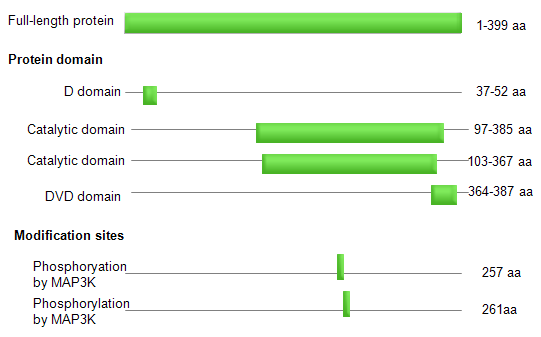
MKK4 interacts with the substrates JNK1, JNK2, JNK3, MAPK11, and MAPK14 via the D domain. MKK4 also interacts with the MAP3K activators MEKK1 and MLK3 via the domain for versatile docking (DVD domain). The DVD domain contains a conserved docking site that binds to upstream MAP3Ks and is essential for activation. The D domain contains a conserved docking site that binds to MAPK substrates. MKK4 is activated by the phosphorylation of Ser-257 and Thr-261 by MAP kinase kinase kinases.
Description
The MKK4 gene encodes a dual specificity protein kinase that belongs to the Ser/Thr protein kinase family. This kinase is a direct activator of MAP kinases in response to environmental stress or mitogenic stimuli. MKK4 has been shown to activate MAPK8/JNK1, MAPK9/JNK2, and MAPK14/p38, but not MAPK1/ERK2 or MAPK3/ERK3. This kinase is phosphorylated and activated by MAP3K1/MEKK.
Expression
MKK4 is widely expressed in normal tissues, including the thyroid, heart, lymph nodes, trachea, adrenal glands, and ovaries. The expression of MKK4 is lower in neoplastic tissues.
Localisation
MKK4 is primarily located in the cytoplasm of the cell.
Function
Three mitogen-activated protein kinase (MAPK) cascades occur in mammals. Each of the MAPK cascades consists of a three-kinase module that includes a MAPK, a MAPK kinase (MAPKK), and a MAPKK kinase (MAPKKK). Various cellular stresses, including ultraviolet (UV) and gamma irradiation, heat shock, hyperosmolarity, hydrogen peroxide, and inflammatory cytokines, activate the stress-activated protein kinase/c-Jun N-terminal kinase (SAP/JNK) signalling pathway. c-Jun N-terminal kinases (JNKs) are MAPKs that stimulate the transcriptional activity of Jun in response to cellular stress. MAP2K4 is a MAPKK that directly activates the JNKs and the related MAPK p38 (Lin et al., 1995).
MKK4 is a dual specificity kinase that activates the Jun kinases MAPK8 (JNK1) and MAPK9 (JNK2) and MAPK14 (p38), but does not activate MAPK1 (ERK2) or MAPK3 (ERK1).
MKK4 is a dual specificity kinase that activates the Jun kinases MAPK8 (JNK1) and MAPK9 (JNK2) and MAPK14 (p38), but does not activate MAPK1 (ERK2) or MAPK3 (ERK1).
Homology
The MAP2K4 gene is conserved in chimpanzee, dog, cow, mouse, rat, chicken, zebrafish, fruit fly, mosquito, C. elegans, S. pombe, S. cerevisiae, K. lactis, E. gossypii, M. grisea, and N. crassa.
Mutations
Germinal
There are no reports regarding the germline.
Somatic
Genomic studies identified a total of 11 tumours from human cancer samples (3% of the 356 tumours evaluated) with somatic mutations in the MAP2K4 (MKK4) gene. These mutations are primarily located in the kinase domain of MAP2K4. The mutations include frameshift, nonsense, and missense mutations and have been reported to occur in colorectal, non-small-cell lung, melanoma, and ovarian cancer specimens (Ahn et al., 2011).
Implicated in
Entity name
Various cancers
Note
Genomic studies have identified somatic mutations in the MAP2K4 gene in a total of 11 human cancer tumours (3% of the 356 tumours evaluated). These mutations are located primarily in the kinase domain. The mutations include frameshift, nonsense, and missense mutations and occur in colorectal, non-small-cell lung, melanoma, and ovarian cancer specimens (Ahn et al., 2011).
The frequency of MKK4 homozygous deletions in high-grade ovarian serous carcinomas was reported to be 4,2%, which is similar to the rates observed in pancreatic (2%) and breast (4,5%) carcinomas (Nakayama et al., 2006). Loss of heterozygosity on chromosome 17p occurred in 24 (86%) of 28 high-grade serous carcinomas, including two cases with a homozygous MKK4 deletion. Downregulation of MKK4 expression was reported in 96 (75%) of 128 ovarian serous carcinomas compared to benign ovarian tissues. These findings suggest that homozygous deletions or reduced expression of MKK4 may contribute to the development of ovarian serous carcinomas (Nakayama et al., 2006).
MKK4 expression related to tumour invasion results from an epithelial to mesenchymal transition (EMT)-like morphological change. Yeasmin et al. reported that the downregulation of MKK4 increased the phosphorylation of NF-κB and promoted the overexpression of Twist, resulting in the downregulation of E-cadherin, which induced an EMT in ovarian cancer.
In most reports, MKK4 is defined as a tumour suppressor gene. However, Finegan and Tournier evaluated the role of MKK4 in skin tumourigenesis and reported that skin-specific MKK4-deficient mice are resistant to carcinogen-induced tumourigenesis. MKK4 is essential for mediating the oncogenic effects of Ras in vivo (Finegan and Tournier, 2010).
The frequency of MKK4 homozygous deletions in high-grade ovarian serous carcinomas was reported to be 4,2%, which is similar to the rates observed in pancreatic (2%) and breast (4,5%) carcinomas (Nakayama et al., 2006). Loss of heterozygosity on chromosome 17p occurred in 24 (86%) of 28 high-grade serous carcinomas, including two cases with a homozygous MKK4 deletion. Downregulation of MKK4 expression was reported in 96 (75%) of 128 ovarian serous carcinomas compared to benign ovarian tissues. These findings suggest that homozygous deletions or reduced expression of MKK4 may contribute to the development of ovarian serous carcinomas (Nakayama et al., 2006).
MKK4 expression related to tumour invasion results from an epithelial to mesenchymal transition (EMT)-like morphological change. Yeasmin et al. reported that the downregulation of MKK4 increased the phosphorylation of NF-κB and promoted the overexpression of Twist, resulting in the downregulation of E-cadherin, which induced an EMT in ovarian cancer.
In most reports, MKK4 is defined as a tumour suppressor gene. However, Finegan and Tournier evaluated the role of MKK4 in skin tumourigenesis and reported that skin-specific MKK4-deficient mice are resistant to carcinogen-induced tumourigenesis. MKK4 is essential for mediating the oncogenic effects of Ras in vivo (Finegan and Tournier, 2010).
Prognosis
A decreased expression of MKK4 based on immunointensity scores was observed in 63,2% (55/87) of endometrioid adenocarcinomas analysed. Patients with decreased MKK4 expression in endometrial cancer tissues tended to have a shorter overall rate of survival (p = 0,197) (Ishikawa et al., 2010).
Entity name
Embryogenesis
Note
MKK4 has diverse physiological functions during embryogenesis. JNK activation by MKK4 and MKK7 is utilised in parallel morphogenetic events in widely divergent species. In vertebrates and invertebrates, MKK4/MKK7-JNK signalling regulates the expression of secreted signalling molecules that are capable of promoting the movements of neighbouring cells that are required for dorsal closure and gastrulation (Asaoka and Nishina, 2010).
Article Bibliography
| Pubmed ID | Last Year | Title | Authors |
|---|---|---|---|
| 21896780 | 2011 | Map2k4 functions as a tumor suppressor in lung adenocarcinoma and inhibits tumor cell invasion by decreasing peroxisome proliferator-activated receptor γ2 expression. | Ahn YH et al |
| 20801953 | 2010 | Diverse physiological functions of MKK4 and MKK7 during early embryogenesis. | Asaoka Y et al |
| 7839144 | 1995 | Independent human MAP-kinase signal transduction pathways defined by MEK and MKK isoforms. | Dérijard B et al |
| 20610622 | 2010 | The mitogen-activated protein kinase kinase 4 has a pro-oncogenic role in skin cancer. | Finegan KG et al |
| 21372598 | 2010 | Functional and clinicopathological analysis of loss of MKK4 expression in endometrial cancer. | Ishikawa M et al |
| 7716521 | 1995 | Identification of a dual specificity kinase that activates the Jun kinases and p38-Mpk2. | Lin A et al |
| 16627982 | 2006 | Homozygous deletion of MKK4 in ovarian serous carcinoma. | Nakayama K et al |
| 8395011 | 1993 | Novel members of the mitogen-activated protein kinase activator family in Xenopus laevis. | Yashar BM et al |
| 20309881 | 2011 | Loss of MKK4 expression in ovarian cancer: a potential role for the epithelial to mesenchymal transition. | Yeasmin S et al |
Other Information
Locus ID:
NCBI: 6416
MIM: 601335
HGNC: 6844
Ensembl: ENSG00000065559
Variants:
dbSNP: 6416
ClinVar: 6416
TCGA: ENSG00000065559
COSMIC: MAP2K4
RNA/Proteins
Expression (GTEx)
Pathways
Protein levels (Protein atlas)
PharmGKB
| Entity ID | Name | Type | Evidence | Association | PK | PD | PMIDs |
|---|---|---|---|---|---|---|---|
| PA283 | MAPK8 | Gene | Pathway | associated | 20124951, 23922006 | ||
| PA30592 | MAP3K1 | Gene | Pathway | associated | 23922006 | ||
| PA30616 | MAPK1 | Gene | Pathway | associated | 20124951 | ||
| PA30617 | MAPK10 | Gene | Pathway | associated | 20124951 | ||
| PA30618 | MAPK11 | Gene | Pathway | associated | 20124951 | ||
| PA30619 | MAPK12 | Gene | Pathway | associated | 20124951 | ||
| PA30620 | MAPK13 | Gene | Pathway | associated | 20124951 | ||
| PA30621 | MAPK14 | Gene | Pathway | associated | 20124951 | ||
| PA30622 | MAPK3 | Gene | Pathway | associated | 20124951 | ||
| PA30623 | MAPK4 | Gene | Pathway | associated | 20124951 | ||
| PA30624 | MAPK6 | Gene | Pathway | associated | 20124951 | ||
| PA30625 | MAPK7 | Gene | Pathway | associated | 20124951 | ||
| PA30630 | MAPK9 | Gene | Pathway | associated | 20124951 | ||
| PA34183 | RAF1 | Gene | Pathway | associated | 20124951 | ||
| PA443309 | Alcoholism | Disease | ClinicalAnnotation | associated | PD | ||
| PA447197 | Attention Deficit Disorder with Hyperactivity | Disease | ClinicalAnnotation | associated | PD | ||
| PA448073 | ethanol | Chemical | ClinicalAnnotation | associated | PD |
References
| Pubmed ID | Year | Title | Citations |
|---|---|---|---|
| 36181561 | 2023 | Hsa_circ_0081069 facilitates tongue squamous cell carcinoma progression by modulating MAP2K4 expression via miR-634. | 0 |
| 36181561 | 2023 | Hsa_circ_0081069 facilitates tongue squamous cell carcinoma progression by modulating MAP2K4 expression via miR-634. | 0 |
| 35615401 | 2022 | PCAT19 Regulates the Proliferation and Apoptosis of Lung Cancer Cells by Inhibiting miR-25-3p via Targeting the MAP2K4 Signal Axis. | 4 |
| 35615401 | 2022 | PCAT19 Regulates the Proliferation and Apoptosis of Lung Cancer Cells by Inhibiting miR-25-3p via Targeting the MAP2K4 Signal Axis. | 4 |
| 32779194 | 2021 | Long noncoding RNA HNF1A-AS1 regulates proliferation and apoptosis of glioma through activation of the JNK signaling pathway via miR-363-3p/MAP2K4. | 7 |
| 33341545 | 2021 | A new prognosis prediction model combining TNM stage with MAP2K4 and JNK in postoperative pancreatic cancer patients. | 4 |
| 32779194 | 2021 | Long noncoding RNA HNF1A-AS1 regulates proliferation and apoptosis of glioma through activation of the JNK signaling pathway via miR-363-3p/MAP2K4. | 7 |
| 33341545 | 2021 | A new prognosis prediction model combining TNM stage with MAP2K4 and JNK in postoperative pancreatic cancer patients. | 4 |
| 31635803 | 2020 | Ensemble structural analyses depict the regulatory mechanism of non-phosphorylated human MAP2K4. | 2 |
| 32495394 | 2020 | microRNA-124-3p inhibits tumourigenesis by targeting mitogen-activated protein kinase 4 in papillary thyroid carcinoma. | 5 |
| 32552144 | 2020 | Is there any correlation among MKK4 (mitogen-activated protein kinase kinase 4) expression, clinicopathological features, and KRAS/NRAS mutation in colorectal cancer. | 2 |
| 31635803 | 2020 | Ensemble structural analyses depict the regulatory mechanism of non-phosphorylated human MAP2K4. | 2 |
| 32495394 | 2020 | microRNA-124-3p inhibits tumourigenesis by targeting mitogen-activated protein kinase 4 in papillary thyroid carcinoma. | 5 |
| 32552144 | 2020 | Is there any correlation among MKK4 (mitogen-activated protein kinase kinase 4) expression, clinicopathological features, and KRAS/NRAS mutation in colorectal cancer. | 2 |
| 30537492 | 2019 | Clinicopathological and prognostic significance of MKK4 and MKK7 in resectable pancreatic ductal adenocarcinoma. | 5 |
Citation
Kentaro Nakayama ; Naomi Nakayama ; Kohji Miyazaki
MAP2K4 (mitogen-activated protein kinase kinase 4)
Atlas Genet Cytogenet Oncol Haematol. 2012-06-01
Online version: http://atlasgeneticsoncology.org/gene/244/map2k4
