MMP14 (matrix metallopeptidase 14 (membrane-inserted))
2010-10-01 Cem Kuscu , Nikki Evensen , Jian Cao AffiliationDivision of Cancer Prevention, Stony Brook University, Stony Brook, New York 11794, USA
Identity
DNA/RNA
Description
Transcription
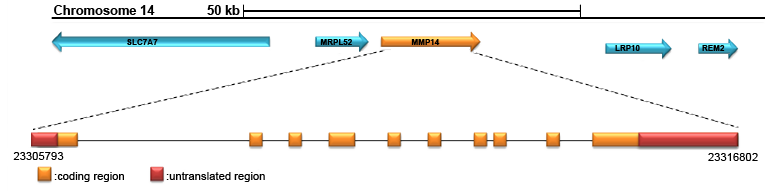
Two functional SNPs in the MMP-14 promoter have been found in focal-segmental glomerulosclerosis (FSGS) disease. -378 T/C and -364 G/T alterations cause a reduction in the expression of MMP-14 and correlate with significant risk reduction of FSGS. Epigenetic regulation is also involved in the regulation of MMP-14 expression. Hypermethylation of the CpG100 island, which spans a region from the proximal promoter to the 1st intron of MMP-14, and trimethylation of Histone H3 lysine-27 (known as a repressive marker) are determined as epigenetic controls causing the transcriptional silencing of MMP-14.
Pseudogene
Proteins

Description
Expression
Localisation
Function
I-) Activation of proMMPs and degradation of ECM
Pro-MMP2 was the first identified substrate of MMP-14 and the trimolecular complex consisting of MMP-14 and proMMP2-TIMP2 has been investigated very well for many years. TIMP2 (tissue inhibitor of metalloproteinases-2) is actually the inhibitor of the MMPs. However, low concentrations of TIMP-2 aids in the activation of proMMP-2 by MMP-14 within this complex by binding to the catalytic domain of MMP-14 and the C-terminal domain of pro-MMP2. Following the formation of the triplex, a second MMP-14, which is free of TIMP-2, forms a dimer with the pre-existing MMP-14 on the cell membrane and cleaves the latent pro-MMP2 to produce active MMP2. Active MMP-2 can then participate in other events such as the degradation of collagen type-IV, a major protein component of the basement membrane, which is not cleaved by MMP-14 itself. Another substrate of MMP-14 within the MMP family is the pro-MMP-13, which also functions as a collagenase in the surrounding tissue after its activation.
Besides activation of MMPs, especially pro-MMP-2, MMP-14 cleaves many proteins in the ECM and changes the composition of the matrix. Type I-Type II-Type III collagen, gelatin, fibronectin, laminin-1 and -5, fibrin and proteoglycans are the major direct targets of MMP-14 in the extracellular environment. Out of these substrates, collagen makes up a significant portion of the ECM and acts as a barrier for migratory cells. Within the collagenases, which includes MMP-1, MMP-2, MMP-8, MMP-13, only MMP-14 can stimulate invasion into collagen by epithelial cells, fibroblasts, and cancer cells. MMP-14 concentrates in the protrusions of the cells, called lamellipodia in normal cells and invadopodia in cancer cells, to induce a significant increase in cell migration and invasion by degrading components of the ECM and making a path in through the surrounding tissue. In this aspect, MMP-14 should be bound to the plasma membrane in vivo, as membrane-bound MMP-14 has been demonstrated to be more proteolytically active than the soluble recombinant MMP-14.
II-) Shedding of cell surface molecules
Studies underlying the mechanism of the constitutive shedding of CD44 from the human melanoma cell surface implicated the necessity of MMP-14 with the presence of ADAM-10 for this process. Especially in the hyaluronan based matrix, cleavage of CD44 at the stem region by MMP-14 sheds these molecules from the cell surface and concurrently promotes the migration of the cells from the leading edge. Another cell adhesion molecule, E-cadherin, is also cleaved by MMP-14 to disrupt contact between cells. In the ischemia-induced ARF (acute renal failure), MMP-14 expression is required for the disruption of the cadherin/catenin complex. Syndecan-1 is another cell surface molecule which is cleaved by MMP-14.
III-) Cleavage of cytokines and growth factors
MMP-14 indirectly plays a major role in cleavage of the cytokines and growth factors by activating pro-MMP-2 and pro-MMP13. It also makes direct contact with several chemokines and growth factors including; the neutrophil chemokine IL-8, secretory leukocyte protease inhibitor, pro-tumor necrosis factor, death receptor-6, and connective tissue growth factor.
IV-) Activation of ERK cascade by the cytoplasmic tail of MMP-14
In several studies, overexpression of MMP-14 has been reported to activate the ERK cascade. It is not yet clear how MMP-14 activates ERK signalling, but overexpression of the cytoplasmic-deleted form of MMP-14 has been shown to eradicate ERK activation. Within the cytoplasmic tail, the 573YCQR576 motif has been suggested to be involved in ERK activation. In addition to ERK activation, the role of MMP-14 in the p38 and JNK pathway has also been investigated.
V-) Inhibition of MMP-14 function
Function of MMP-14 can be abolished either by TIMPs (Tissue Inhibitor of MetalloProteinases) or proteolytic degradation. TIMP-2, -3 and -4 but not TIMP-1 specifically inactivates the functions of MMP-14. Besides TIMPs, RECK and N-Tes can also block the activity of MMP-14 in a similar manner. For the proteolytic cleavage of MMP-14, membrane bound MMP-14 should be internalized by the clathrin-dependent and caveolae-dependent pathways. There is an AP-2 binding site in the cytoplasmic domain of MMP-14, 571LLY573 which is required for the incorporation of MMP-14 into clathrin-coated vesicles. The palmitoylation of the C574 right after the AP-2 binding site has also been demonstrated to be an essential modification for the internalization of MMP-14.
Homology
Implicated in
Article Bibliography
| Pubmed ID | Last Year | Title | Authors |
|---|---|---|---|
| 9490275 | 1998 | MT1-MMP and MMP-2 mRNA expression in human ovarian tumors: possible implications for the role of desmoplastic fibroblasts. | Afzal S et al |
| 18971959 | 2009 | ADAM10 is the constitutive functional sheddase of CD44 in human melanoma cells. | Anderegg U et al |
| 18174174 | 2008 | Membrane type 1 matrix metalloproteinase induces epithelial-to-mesenchymal transition in prostate cancer. | Cao J et al |
| 14729674 | 2004 | Distinct roles for the catalytic and hemopexin domains of membrane type 1-matrix metalloproteinase in substrate degradation and cell migration. | Cao J et al |
| 15637056 | 2005 | Furin directly cleaves proMMP-2 in the trans-Golgi network resulting in a nonfunctioning proteinase. | Cao J et al |
| 19286653 | 2009 | Epigenetic control of the invasion-promoting MT1-MMP/MMP-2/TIMP-2 axis in cancer cells. | Chernov AV et al |
| 16077081 | 2006 | Ischemia-induced cleavage of cadherins in NRK cells requires MT1-MMP (MMP-14). | Covington MD et al |
| 11726397 | 2001 | Ventilator-induced lung injury upregulates and activates gelatinases and EMMPRIN: attenuation by the synthetic matrix metalloproteinase inhibitor, Prinomastat (AG3340). | Foda HD et al |
| 11686300 | 2001 | Contribution of MT1-MMP and of human laminin-5 gamma2 chain degradation to mammary epithelial cell migration. | Gilles C et al |
| 11684104 | 2001 | Activation of the extracellular signal-regulated protein kinase (ERK) cascade by membrane-type-1 matrix metalloproteinase (MT1-MMP). | Gingras D et al |
| 10428849 | 1999 | Egr-1 mediates extracellular matrix-driven transcription of membrane type 1 matrix metalloproteinase in endothelium. | Haas TL et al |
| 10878552 | 2000 | Macrophage-derived MT1-MMP and increased MMP-2 activity are associated with glomerular damage in crescentic glomerulonephritis. | Hayashi K et al |
| 10520996 | 1999 | MT1-MMP-deficient mice develop dwarfism, osteopenia, arthritis, and connective tissue disease due to inadequate collagen turnover. | Holmbeck K et al |
| 10567400 | 1999 | Membrane type 4 matrix metalloproteinase (MT4-MMP, MMP-17) is a glycosylphosphatidylinositol-anchored proteinase. | Itoh Y et al |
| 11698655 | 2001 | Regulation of membrane-type matrix metalloproteinase 1 activity by dynamin-mediated endocytosis. | Jiang A et al |
| 8663255 | 1996 | Cellular mechanisms for human procollagenase-3 (MMP-13) activation. Evidence that MT1-MMP (MMP-14) and gelatinase a (MMP-2) are able to generate active enzyme. | Knäuper V et al |
| 11034316 | 2000 | Membrane-type 6 matrix metalloproteinase (MT6-MMP, MMP-25) is the second glycosyl-phosphatidyl inositol (GPI)-anchored MMP. | Kojima S et al |
| 19815335 | 2010 | The activity of a designer tissue inhibitor of metalloproteinases (TIMP)-1 against native membrane type 1 matrix metalloproteinase (MT1-MMP) in a cell-based environment. | Lee MH et al |
| 18927121 | 2009 | Characterization of the transcriptional regulation of the human MT1-MMP gene and association of risk reduction for focal-segmental glomerulosclerosis with two functional promoter SNPs. | Munkert A et al |
| 16680573 | 2006 | Degradomics: systems biology of the protease web. Pleiotropic roles of MMPs in cancer. | Overall CM et al |
| 10857781 | 2000 | Differential expression pattern of membrane-type matrix metalloproteinases in rheumatoid arthritis. | Pap T et al |
| 10085137 | 1999 | Identification and characterization of the fifth membrane-type matrix metalloproteinase MT5-MMP. | Pei D et al |
| 15592504 | 2005 | Identification of membrane type-1 matrix metalloproteinase as a target of hypoxia-inducible factor-2 alpha in von Hippel-Lindau renal cell carcinoma. | Petrella BL et al |
| 19692588 | 2009 | Matrix invasion by tumour cells: a focus on MT1-MMP trafficking to invadopodia. | Poincloux R et al |
| 10207013 | 1999 | Inflammatory cytokines and oxidized low density lipoproteins increase endothelial cell expression of membrane type 1-matrix metalloproteinase. | Rajavashisth TB et al |
| 11007969 | 2000 | Elevated expression of membrane type 1 metalloproteinase (MT1-MMP) in reactive astrocytes following neurodegeneration in mouse central nervous system. | Rathke-Hartlieb S et al |
| 19434087 | 2009 | Shedding light on proteolytic cleavage of CD44: the responsible sheddase and functional significance of shedding. | Stamenkovic I et al |
| 7583637 | 1995 | Structural features of a superfamily of zinc-endopeptidases: the metzincins. | Stöcker W et al |
| 7890645 | 1995 | Mechanism of cell surface activation of 72-kDa type IV collagenase. Isolation of the activated form of the membrane metalloprotease. | Strongin AY et al |
| 15118097 | 2004 | Membrane protease proteomics: Isotope-coded affinity tag MS identification of undescribed MT1-matrix metalloproteinase substrates. | Tam EM et al |
| 10840163 | 2000 | Granulocyte-macrophage colony-stimulating factor upregulates matrix metalloproteinase-2 (MMP-2) and membrane type-1 MMP (MT1-MMP) in human head and neck cancer cells. | Tomita T et al |
| 10706098 | 2000 | Human MT6-matrix metalloproteinase: identification, progelatinase A activation, and expression in brain tumors. | Velasco G et al |
| 7649159 | 1995 | cDNA sequence and mRNA tissue distribution of a novel human matrix metalloproteinase with a potential transmembrane segment. | Will H et al |
| 12093818 | 2002 | Transcription factor Sp1 phosphorylation induced by shear stress inhibits membrane type 1-matrix metalloproteinase expression in endothelium. | Yun S et al |
| 10737763 | 2000 | Impaired endochondral ossification and angiogenesis in mice deficient in membrane-type matrix metalloproteinase I. | Zhou Z et al |
| 9495249 | 1998 | Vascular endothelial growth factor induces tissue factor and matrix metalloproteinase production in endothelial cells: conversion of prothrombin to thrombin results in progelatinase A activation and cell proliferation. | Zucker S et al |
Other Information
Locus ID:
NCBI: 4323
MIM: 600754
HGNC: 7160
Ensembl: ENSG00000157227
Variants:
dbSNP: 4323
ClinVar: 4323
TCGA: ENSG00000157227
COSMIC: MMP14
RNA/Proteins
| Gene ID | Transcript ID | Uniprot |
|---|---|---|
| ENSG00000157227 | ENST00000311852 | P50281 |
| ENSG00000157227 | ENST00000547279 | F8VP90 |
| ENSG00000157227 | ENST00000548761 | F8W1B7 |
Expression (GTEx)
Pathways
Protein levels (Protein atlas)
References
| Pubmed ID | Year | Title | Citations |
|---|---|---|---|
| 38661040 | 2024 | MCT4 and CD147 colocalize with MMP14 in invadopodia and support matrix degradation and invasion by breast cancer cells. | 0 |
| 38670210 | 2024 | Exosomal lncRNA-MIAT promotes neovascularization via the miR-133a-3p/MMP-X1 axis in diabetic retinopathy. | 0 |
| 38766853 | 2024 | Calreticulin regulates the expression of MMP14 and ADAR1 through EIF2AK2 signaling to promote the proliferation and progression of malignant melanoma cells. | 0 |
| 38661040 | 2024 | MCT4 and CD147 colocalize with MMP14 in invadopodia and support matrix degradation and invasion by breast cancer cells. | 0 |
| 38670210 | 2024 | Exosomal lncRNA-MIAT promotes neovascularization via the miR-133a-3p/MMP-X1 axis in diabetic retinopathy. | 0 |
| 38766853 | 2024 | Calreticulin regulates the expression of MMP14 and ADAR1 through EIF2AK2 signaling to promote the proliferation and progression of malignant melanoma cells. | 0 |
| 35944080 | 2023 | MT1-MMP and ADAM10/17 exhibit a remarkable overlap of shedding properties. | 5 |
| 36765296 | 2023 | MMP14 expression levels accurately predict the presence of extranodal extensions in oral squamous cell carcinoma: a retrospective cohort study. | 2 |
| 36883877 | 2023 | Tumour Suppressor Neuron Navigator 3 and Matrix Metalloproteinase 14 are Co-expressed in Most Melanomas but Downregulated in Thick Tumours. | 0 |
| 37086494 | 2023 | ALIX promotes cell migration and invasion of head and neck squamous cell carcinoma by regulating the expression of MMP9, MMP14, VEGF-C. | 4 |
| 37105082 | 2023 | Characterizing the function-related specific assembly pattern of matrix metalloproteinase-14 by dSTORM imaging. | 1 |
| 37162337 | 2023 | Gallbladder cancer-associated genetic variants rs1003349 and rs1004030 regulate MMP14 expression by altering SOX10- and MYB-binding sites. | 1 |
| 37169079 | 2023 | Degradomic Identification of Membrane Type 1-Matrix Metalloproteinase as an ADAMTS9 and ADAMTS20 Substrate. | 1 |
| 37696580 | 2023 | KIF16B drives MT1-MMP recycling in macrophages and promotes co-invasion of cancer cells. | 1 |
| 37904429 | 2023 | Expression of MMP-14 and its role in bone destruction in middle ear cholesteatoma: A prospective observational study. | 0 |
Citation
Cem Kuscu ; Nikki Evensen ; Jian Cao
MMP14 (matrix metallopeptidase 14 (membrane-inserted))
Atlas Genet Cytogenet Oncol Haematol. 2010-10-01
Online version: http://atlasgeneticsoncology.org/gene/41391/mmp14
