MSH2 (human mutS homolog 2)
2005-07-01 Enric Domingo , Sim Schwartz Jr AffiliationOncologia Molecular i Envelliment, Centre dInvestigacions en Bioqumica i Biologia Molecular (CIBBIM) Hospital Universitari Vall dHebron Passeig Vall dHebron 119-129 Barcelona 08035, Catalonia, Spain
Identity
HGNC
LOCATION
2p21
LOCUSID
ALIAS
COCA1,FCC1,HNPCC,HNPCC1,LCFS2,MMRCS2,hMSH2
FUSION GENES
DNA/RNA
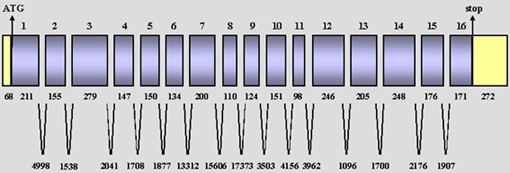
Diagram of the MSH2 gene. Exons are represented by boxes (in scale) transcribed and untranscribed sequences in blue and yellow, with exon numbers on top and number of base pairs at the bottom. Introns are represented by black bars (not in scale) and the number of base pairs indicated. The arrows show the ATG and the stop codons respectively.
Description
The MSH2 gene is composed of 16 exons spanning in a region of 80098 bp.
Transcription
The transcribed mRNA has 3145 bp.
Proteins

Diagram of the MSH2 protein in scale. Numbers inside the blue boxes indicate the exon from which is translated each part of the protein. The boxes inside represent the DNA binding domain (red), the hMSH3/hMSH6 interaction domain (yellow) and the MutL homologs interaction domain (green); C: Carboxyl-terminal; N: Amino-terminal.
Description
Aminoacids: 934. Molecular Weight: 104.7 kDa. MSH2 is a protein involved in the mismatch repair process after DNA replication. It contains a DNA binding domain and two interaction domains, one for MSH3 or MSH6 and the other for MutL homologs (MLH1 and PMS2), located in two different regions of the gene.
Localisation
Nuclear
Function
MSH2 can bind to MSH6 or to MSH3 to form the MutS alpha or the MutS beta complexes respectively. While MutS alpha complex binds to base-base and insertion-deletion mismatches, MutS beta only binds to insertion-deletion mismatches. Upon binding to the mismatch, the MutS complex associates with the MutL complex (composed of MLH1 and PMS2), and recruits the proteins needed for DNA excision and repair. (See also: Repair of DNA double-strand breaks
Homology
MSH2 is homologue to the bacterial MutS gene and MSH2 homologues are also present in eukaryotes.
Mutations
Germinal
There are over 300 MSH2 germline mutations described along the gene that cause hereditary non-polyposis colorectal cancer (HNPCC, see below). Mutations do not occur in any particular hotspot or region of the gene and include either nucleotide substitutions (missense, nonsense and splicing errors) and insertions/deletions (gross or small). In most of these mutations the resulting protein is truncated. Although rare there are described some founding mutations which account for a high proportion of the HNPCC tumours in some specific populations. Some germline genetic changes have also been described in exons and introns as non pathogenic.
Somatic
Some sporadic mismatch repair deficient cases (sporadic MSI) with somatic MSH2 mutations are described.
Implicated in
Entity name
HNPCC (Hereditary Non Polyposis Colorectal Cancer)
Disease
Predisposition to develop cancer, preferentially colorectal, but also in endometrium, ovary, urinary tract, stomach, small bowel, biliary tract and brain.
Oncogenesis
MSH2 mutations in HNPCC account for about 25% of the total cases approximately. These mutations are inherited in one allele and later the other allele is lost by LOH. This leads to mismatch repair deficiency in this patients, which is the cause of the accumulation of mutations along the genome, causing microsatellite instability (MSI) and promoting tumorigenesis. It has also been described that low levels of MSI characterize MLH1 and MSH2 HNPCC carriers before tumour diagnosis.
Entity name
MSI (MicroSatellite Instability)
Note
Tumours in which the molecular feature that leads to cancer is the lost of the mismatch repair (MMR) system.
Disease
This phenotype is present in 15% of colorectal, gastric and endometrial cancer, and has a lower incidence in some other tissues.
Prognosis
MSI tumours have better prognosis than the MicroSatellite Stable (MSS).
Oncogenesis
Few sporadic cases and about 25% of the HNPCC are due to different mutations in MSH2. These mutations are germline in HNPCC.
Entity name
Muir-Torre syndrome
Disease
Coincidence of at least one sebaceous adenoma, epithelioma or carcinoma and one internal malignancy.
Oncogenesis
Muir-Torre syndrome is mainly due to inherited MSH2 mutations.
Article Bibliography
| Pubmed ID | Last Year | Title | Authors |
|---|---|---|---|
| 15563510 | 2005 | Low levels of microsatellite instability characterize MLH1 and MSH2 HNPCC carriers before tumor diagnosis. | Alazzouzi H et al |
| 7696368 | 1995 | Microsatellite instability in inherited and sporadic neoplasms. | Eshleman JR et al |
| 8252616 | 1993 | The human mutator gene homolog MSH2 and its association with hereditary nonpolyposis colon cancer. | Fishel R et al |
| 11900875 | 2002 | DNA mismatch repair defects: role in colorectal carcinogenesis. | Jacob S et al |
| 14871915 | 2004 | A founder mutation of the MSH2 gene and hereditary nonpolyposis colorectal cancer in the United States. | Lynch HT et al |
| 15235030 | 2004 | A genotype-phenotype correlation in HNPCC: strong predominance of msh2 mutations in 41 patients with Muir-Torre syndrome. | Mangold E et al |
| 11920679 | 2002 | DNA mismatch repair and mutation avoidance pathways. | Marti TM et al |
| 12419761 | 2002 | Mismatch repair genes hMLH1 and hMSH2 and colorectal cancer: a HuGE review. | Mitchell RJ et al |
Other Information
Locus ID:
NCBI: 4436
MIM: 609309
HGNC: 7325
Ensembl: ENSG00000095002
Variants:
dbSNP: 4436
ClinVar: 4436
TCGA: ENSG00000095002
COSMIC: MSH2
RNA/Proteins
Expression (GTEx)
Pathways
Protein levels (Protein atlas)
PharmGKB
| Entity ID | Name | Type | Evidence | Association | PK | PD | PMIDs |
|---|---|---|---|---|---|---|---|
| PA443761 | Colorectal Neoplasms, Hereditary Nonpolyposis | Disease | Literature, MultilinkAnnotation | associated | 23788249 |
References
| Pubmed ID | Year | Title | Citations |
|---|---|---|---|
| 37914149 | 2024 | Novel MSH2 and TSC2 variants in a Chinese family with Lynch syndrome and their synergistic impact in urothelial carcinoma. | 0 |
| 37919876 | 2024 | Rare single-nucleotide variants of MLH1 and MSH2 genes in patients with Lynch syndrome. | 1 |
| 37914149 | 2024 | Novel MSH2 and TSC2 variants in a Chinese family with Lynch syndrome and their synergistic impact in urothelial carcinoma. | 0 |
| 37919876 | 2024 | Rare single-nucleotide variants of MLH1 and MSH2 genes in patients with Lynch syndrome. | 1 |
| 36113988 | 2023 | Comprehensive RNA and protein functional assessments contribute to the clinical interpretation of MSH2 variants causing in-frame splicing alterations. | 1 |
| 36208091 | 2023 | High MutS homolog 2 expression predicts poor prognosis and is related to immune infiltration in endometrial carcinoma. | 0 |
| 36894311 | 2023 | MSH2 is the very young onset ovarian cancer predisposition gene, not BRCA1. | 2 |
| 36994850 | 2023 | hMSH2 coordinated with the expression of E2F1 promotes platinum response in epithelial ovarian cancer. | 0 |
| 37140056 | 2023 | MSH2-MSH3 promotes DNA end resection during homologous recombination and blocks polymerase theta-mediated end-joining through interaction with SMARCAD1 and EXO1. | 5 |
| 37314251 | 2023 | Whole exome sequencing identifies MAP3K1, MSH2, and MLH1 as potential cancer-predisposing genes in familial early-onset colorectal cancer. | 1 |
| 37392283 | 2023 | MiR-590-5p promotes cisplatin resistance via targeting hMSH2 in ovarian cancer. | 1 |
| 37657688 | 2023 | Role of MLH1 and MSH2 deficiency in the development of tumorigenesis and chemo-tolerance of cervical Carcinoma: Clinical implications. | 0 |
| 36113988 | 2023 | Comprehensive RNA and protein functional assessments contribute to the clinical interpretation of MSH2 variants causing in-frame splicing alterations. | 1 |
| 36208091 | 2023 | High MutS homolog 2 expression predicts poor prognosis and is related to immune infiltration in endometrial carcinoma. | 0 |
| 36894311 | 2023 | MSH2 is the very young onset ovarian cancer predisposition gene, not BRCA1. | 2 |
Citation
Enric Domingo ; Sim Schwartz Jr
MSH2 (human mutS homolog 2)
Atlas Genet Cytogenet Oncol Haematol. 2005-07-01
Online version: http://atlasgeneticsoncology.org/gene/340/msh2
