MYLK (myosin light chain kinase)
2012-06-01 Kui Shen , Ting Wang , Joe GN Garcia AffiliationInstitute of Personalized Respiratory Medicine, Department of Medicine, University of Illinois, Chicago, IL 60612, USA
Identity
HGNC
LOCATION
3q21.1
LOCUSID
ALIAS
AAT7,KRP,MLCK,MLCK1,MLCK108,MLCK210,MMIHS,MMIHS1,MSTP083,MYLK1,smMLCK
FUSION GENES
DNA/RNA
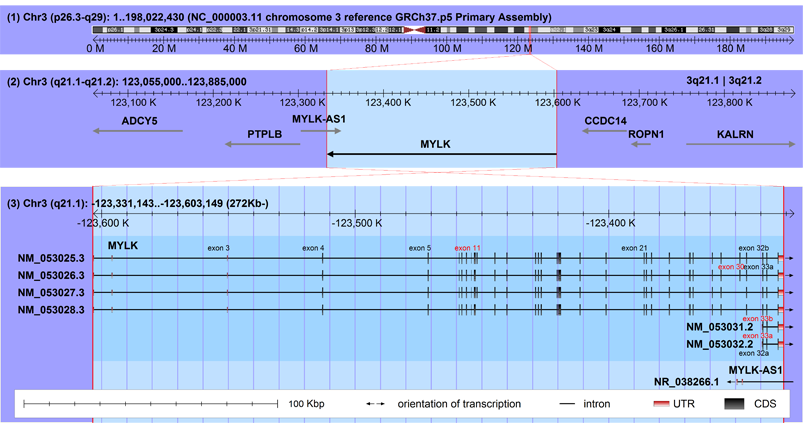
The MYLK gene viewed at three different levels of detail (highlighted between two red vertical boundary lines). (1) Overview within chromosome 3. (2) Partial regional view within chromosome 3q21.1-3q21.2. (3) Detailed view within chromosome 3q21.1 showing six of the transcription variants of MLCK, which include nmMLCK1 (NM_053025), 2 (NM_053026), 3A (NM_053027), 3B (NM_053028), and two telokins (NM_053031 and NM_053032). The transcripts are not drawn in exact proportion so that their introns and exons, including CDSs and UTRs, can all be seen at a limited resolution. Abbreviations: Chr, chromosome; CDS, coding sequence; UTR, untranslated region.
Description
The gene is composed of 34 exons, 31 out of which are coding exons.
Transcription
Multiple MLCK isoforms are produced from the same MYLK gene by alternative splicing or alternative initiation (Lazar and Garcia, 1999; Verin et al., 1998b; Watterson et al., 1999). Six transcript variants have been identified that produce four kinase domain-encoding isoforms and two isoforms of telokin. Additional variants exist but lack full length transcripts. The longest transcript (nmMLCK1), which encodes the full length nonmuscle isoform (NM_053025), is a 7852 bp mRNA with a 5745 bp open reading frame from base pair 283 to 6027.
Pseudogene
PGOHUM00000250243, PGOHUM00000238157, and PGOHUM00000238160 (Human Pseudogenes, Build 61). Note: Partially duplicated from the original MYLK gene, the MYLKP1 pseudogene (PGOHUM00000250243) is proposed to negatively regulate MYLK gene expression (Han et al., 2011).
Proteins
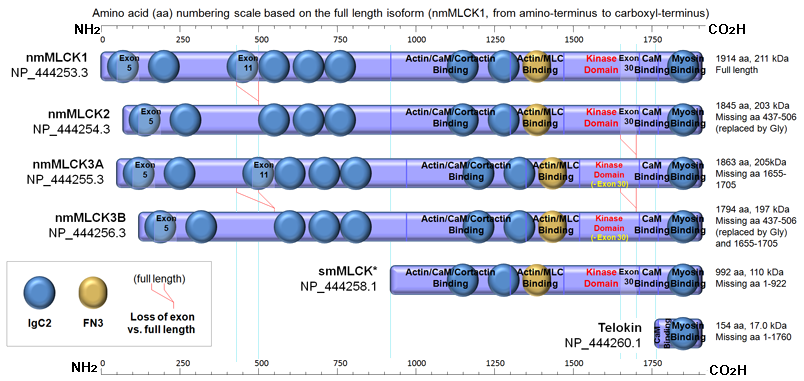
Representative MLCK protein isoforms shown with select structural/functional information, as compared with the full length isoform (nmMLCK1). The nonmuscle MLCK isoform variants (nmMLCK 1, 2, 3A, 3B) differ in the presence or absence of exons 11 and 30. All nmMLCK variants possess unique amino termini that are absent in the smooth muscle isoform, smMLCK, and two isoforms of telokin. The longer isoform of telokin, differing by one amino acid from its shorter version (with the aa 1790 deletion), is identical to the C-termini of nmMLCK and smMLCK isoforms shown (Watterson et al., 1999). Abbreviations: aa, amino acid; CaM, calmodulin; IgC2, immunoglobulin C-2 type domain; FN3, fibronectin type 3 domain. *Note: NCBI RefSeq NM_053030.2 (NP_444258.1) was permanently suppressed because there was insufficient support for the transcript and the CDS was partial.
Description
The full length isoform nmMLCK1 is a 1914-aa protein with a molecular weight of 210715 Da. All isoforms including telokin bind calmodulin (Davis et al., 1996; Gallagher and Herring, 1991; Geguchadze et al., 2004; Katoh et al., 2001). Various MLCK protein isoforms that result from the same MYLK gene (Lazar and Garcia, 1999) by alternative splicing or alternative initiation may be differentially regulated to achieve a tissue-specific spatiotemporal control of the binding (Davis et al., 1996; Dudek et al., 2002; Dudek et al., 2004; Hatch et al., 2001; Kishi et al., 1998) and catalytic activity of MLCK. The full length isoform nmMLCK1 is activated by post-translational modifications (PTMs) such as phosphorylation on Tyr-464 and Tyr-471 (coded by exon 11) (Birukov et al., 2001; Dudek et al., 2010). These PTMs are catalyzed by c-Abl (Dudek et al., 2010), p60Src (Birukov et al., 2001; Garcia et al., 1999), cAMP-dependent protein kinase (PKA) (Garcia et al., 1997a; Verin et al., 1998a) and p21-activated kinases (Goeckeler et al., 2000; Sanders et al., 1999). Additional regulatory mechanisms involve acetylation (Shin et al., 2009), carboxyl-terminal deglutamylation (Rogowski et al., 2010), and kinase activation after thrombin, tumor necrosis factor (TNF), sphingosine 1-phosphate, G proteins, and during cell cycle (Garcia et al., 1995; Petrache et al., 2003; Poperechnaya et al., 2000; Somlyo and Somlyo, 2003; Ye et al., 2006; Ye and Ma, 2008).
Expression
The nmMLCK or smMLCK isoforms and telokin are ubiquitously expressed in various adult and fetal tissues and in cultured endothelium with qualitative expression appearing to be neither tissue- nor development-specific (Garcia et al., 1997a; Lazar and Garcia, 1999; Potier et al., 1995; Verin et al., 1998b; Watterson et al., 1999). The nmMLCK 1 and 2 isoforms are dominant isoforms in nonmuscle (endothelial) cells (Brown et al., 2010; Garcia et al., 1997a; Lazar and Garcia, 1999; Verin et al., 1998b).
Localisation
Lamellipodium; cytoplasm; cytoskeleton; stress fiber; cytosol; cleavage furrow.
Function
Belongs to protein kinase superfamily, non-receptor Ser/Thr protein kinase, EC 2.7.11.18, calcium/calmodulin-dependent protein kinase (CAMK) group, MLCK family. Regulates smooth muscle and nonmuscle cell contractile processes (De Lanerolle et al., 1991; Garcia et al., 1995; Katoh et al., 2001; Somlyo and Somlyo, 2003), via phosphorylation of myosin light chains (MLC), or through a non-kinase activity (Dudek et al., 2004; Herring et al., 2006; Kudryashov et al., 2002; Nakamura et al., 2008; Shirinsky et al., 1993). Regulates cytogenesis (Dulyaninova et al., 2004; Fishkind et al., 1991; Matsumura et al., 2011; Poperechnaya et al., 2000). Regulates other related cellular processes including cell adhesion, migration, morphology, and inflammatory responses (Garcia et al., 1998; Savkovic et al., 2001), e.g., apoptosis (Mills et al., 1998; Petrache et al., 2003; Wright et al., 1993), and vascular permeability (Dudek et al., 2004; Garcia et al., 1995; Garcia et al., 1998; Shen et al., 2010; Vandenbroucke et al., 2008; Yuan et al., 2002), all via the regulation of cytoskeletal rearrangements. Genetic variants in MYLK are implicated in inflammatory disorders such as asthma and acute lung injury (Flores et al., 2007; Gao et al., 2006; Gao et al., 2007). Implicated in tumor formation and metastasis (see below).
Homology
The human MYLK gene is conserved in Euteleostomi, with a high percentage of identity in the pairwise alignment of protein/DNA vs. chimpanzee (99,1% / 99,4%), monkey (97,3% / 97,0%), dog (89,1% / 89,0%), mouse (85,9% / 85,6%), rat (85,4% / 86,0%), chicken (71,4% / 68,8%), and zebrafish (63,0% / 65,5%) (Homologene). The paralogs of human MYLK gene include MYLK2-4, DAPK1-3, STK17A and STK17B, and SPEG (Ensembl) (Manning et al., 2002).
Mutations
Note
Some protein-coding somatic mutations in MYLK are associated with cancers (Catalogue of Somatic Mutations in Cancer–COSMIC) (Greenman et al., 2007). Several variants of MYLK are associated with familial aortic dissections (Wang et al., 2010). A few race-specific single nucleotide polymorphism (SNP) variants of MYLK, both in coding and noncoding regions, are associated with the susceptibility to acute lung injury, sepsis and severe asthma (Flores et al., 2007; Gao et al., 2006; Gao et al., 2007).
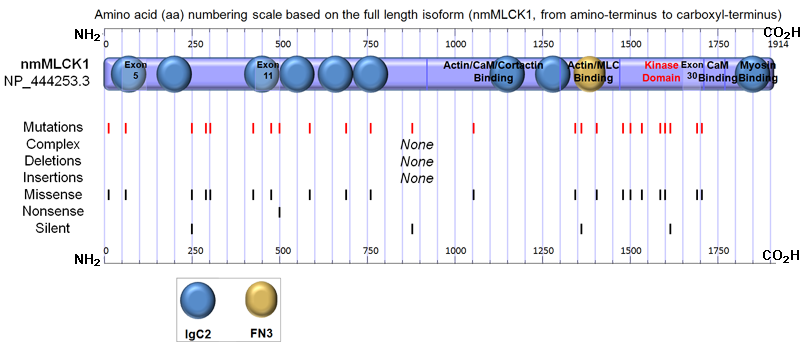
Cancer-associated somatic mutations in MYLK in the protein coding region (Catalogue of Somatic Mutations in Cancer–COSMIC). Abbreviations: CaM, calmodulin; IgC2, immunoglobulin C-2 type domain; FN3, fibronectin type 3 domain; Complex, complex substitutions; Missense, missense substitutions; Nonsense, nonsense substitutions; Silent, silent substitutions.
Implicated in
Entity name
Cancers
Note
Myosin light chain kinase (MLCK) plays a crucial role in the cell migration and tumor metastasis. Some somatic mutations in MYLK are associated with cancers (Greenman et al., 2007). MLCK is critical for adhesion turnover at the cell front, a process central to migration (Webb et al., 2004) and it is involved in membrane blebbing (Godin and Ferguson, 2010). Deficiency in MLC phosphorylation causes cytokinesis failure and multipolarity (hence genomic instability) in cancer cells (Wu et al., 2010).
Entity name
Breast cancer
Note
MLCK activity correlates the recruitment of nonmuscle myosin IIA and myosin IIB into the spreading margin of MDA-MB-231 breast cancer cells, with both myosin isoforms required for cell migration but only myosin IIB critical to lamellar protrusion (Betapudi et al., 2006). MLC phosphorylation by MLCK through β1-integrin is required for actin stress fiber formation and the dormancy-to-proliferation metastatic switch for latent breast cancer cells (Barkan et al., 2008; Barkan et al., 2011). MLCK functions downstream of Ras, MAP kinase kinase (MEK) and extracellular signal regulated kinase (ERK) to promote invasive migration of breast cancer cells in an integrin-selective manner, i.e., mediated by a β1-integrin (probably α5β1) and α5β5, but not by α5β3 (Mierke, 2011; Mierke et al., 2011b; Nguyen et al., 1999; Zhou et al., 2008). Endothelial nmMLCK is activated by invasive breast cancer cells at the invasion site, leading to regional MLC diphosphorylation and myosin contraction. Blocking endothelial MLC diphosphorylation blunts tumor transcellular (i.e., through individual endothelial cells), but not paracellular (i.e., through cell-cell junctions) invasion (Khuon et al., 2010). Human mammary tumor cells exhibit at least two modes of invasive migration, including the extracellular proteolysis-dependent mesenchymal mode (invadopodia-associated extracellular matrix degradation) (Alexander et al., 2008) and the proteolysis-independent amoeboid mode, with both modes mediated by MLCK and Rho kinase ROCK (Alexander et al., 2008; Torka et al., 2006). TNF induction of apoptosis and DNA fragmentation requires MLCK activation in mammary carcinoma and other cancer cell lines (Wright et al., 1993). MLCK is responsible for high proliferative ability of breast cancer cells via anti-apoptosis (Cui et al., 2010). The increase in MLC phosphorylation correlates with apoptotic blebbing (Mills et al., 1998). Subsequent MLC dephosphorylation that results from a proapoptotic agent or MLCK inhibition (inhibitor or antibody) precedes caspase activation (Fazal et al., 2005), which further induces apoptosis in vitro and in vivo, and retards the growth of mammary cancer cells in mice (Fazal et al., 2005; Gu et al., 2006).
Entity name
Lung cancer
Note
The invasiveness of tumor cells depends in part on their motility, which in turn depends on cytoskeletal function (Minamiya et al., 2005). The expression level of MLCK, the cytoskeletal regulator, correlates with disease recurrence and distant metastasis in non-small cell lung cancer (NSCLC) (Minamiya et al., 2005). E1AF, an Ets family transcription factor frequently overexpressed in NSCLCs, induces motility and invasion as well as tumorigenesis and metastasis in NSCLC cells in a MLCK-dependent pathway (Hakuma et al., 2005). A few anti-cancer drug candidates, including glabridin, 7-chloro-6-piperidin-1-yl-quinoline-5,8-dione (PT-262), and all-trans-retinoic acid (ATRA), inhibit cell metastasis by decreasing cancer cell migration and invasion of human lung adenocarcinoma A549 cells via modulation of expression (Gui et al., 2011) or activity (Tsai et al., 2011a; Tsai et al., 2011b) of MLCK. Glycosylphosphatidylinositol-anchored receptor CD24 is found to enhance invasion of A125 human lung cancer cells through increased generation or transmission of contractile forces which is dependent on MLCK activity (Mierke et al., 2011a).
Entity name
Colon cancer
Note
MLCK is differentially expressed in microsatellite stable (MSS) sporadic colon cancer and hereditary nonpolyposis colorectal cancer (HNPCC) (Lee et al., 2008). It is suggested to be a potential colon tumor marker. MLCK regulates transendothelial migration of colon cancer cells in E-selectin-mediated activation of p38 MAPK (Tremblay et al., 2006), and possibly via changing cellular contractility by regulation of adhesion sites and stress fibers (Krndija et al., 2010). Inhibition of MLCK suppresses peripheral accumulation of phospho-MLC and Src-induced formation of integrin-dependent adhesions in KM12C colon cancer cells, whereas at the same time restoring E-cadherin redistribution to regions of cell-cell contact (Avizienyte et al., 2004; Avizienyte et al., 2005; Nguyen et al., 2002).
Entity name
Prostate cancer
Note
Inhibitors of MLCK markedly reduce the invasiveness of prostate cancer cells due to impaired cellular motility (Tohtong et al., 2003). These inhibitors also retard the growth of established prostate tumor in vivo (Gu et al., 2006). MLCK is considered as a central mediator of migration, proliferation and invasion of prostatic adenocarcinoma cell line (Tohtong et al., 2003) downstream of PKC delta (Kharait et al., 2007), boric acid, and phenylboronic acid (McAuley et al., 2011) in DU145 cell line (metastatic prostate cancer cell line). The MYLK gene is one of the top seven most informative genes that discriminate between normal and tumoral prostate conditions by analyzing cDNA microarrays of approximately 25000 genes (Fujita et al., 2008). MLCK is down-regulated by androgens in human prostate cancer cells (Leveille et al., 2009).
Entity name
Other cancers
Note
MLC phosphorylation or MLCK activation is directly involved in the activation of membrane-associated actomyosin required for the collection of surface proteins into a cap structure in mouse T-lymphoma cells (analogous to muscle cell sliding filament contraction) (Bourguignon et al., 1981; Kerrick and Bourguignon., 1984). Inhibitors of MLCK (ML-7 and ML-9) induce differentiation of human monoblastic leukemia U937 cells (Makishima et al., 1991; Makishima et al., 1993; Yamamoto-Yamaguchi et al., 1996). Apoptotic membrane blebbing is accompanied by increased MLC phosphorylation and regulated by MLCK in PC12, a neuroendocrine tumor cell line (Mills et al, 1998). MLCK regulates the activation of volume-sensitive organic osmolyte/anion channels (VSOAC) by mediating hypotonicity-induced Ca2+ entry (not correlating with MLC phosphorylation) in cervical cancer cells (Shen et al., 2002).
Article Bibliography
| Pubmed ID | Last Year | Title | Authors |
|---|---|---|---|
| 18718759 | 2008 | Extracellular matrix rigidity promotes invadopodia activity. | Alexander NR et al |
| 15942195 | 2005 | The SRC-induced mesenchymal state in late-stage colon cancer cells. | Avizienyte E et al |
| 20570886 | 2010 | Metastatic growth from dormant cells induced by a col-I-enriched fibrotic environment. | Barkan D et al |
| 18676848 | 2008 | Inhibition of metastatic outgrowth from single dormant tumor cells by targeting the cytoskeleton. | Barkan D et al |
| 16651425 | 2006 | Distinct roles of nonmuscle myosin II isoforms in the regulation of MDA-MB-231 breast cancer cell spreading and migration. | Betapudi V et al |
| 11113114 | 2001 | Differential regulation of alternatively spliced endothelial cell myosin light chain kinase isoforms by p60(Src). | Birukov KG et al |
| 6976966 | 1981 | Phosphorylation of myosin light chain during capping of mouse T-lymphoma cells. | Bourguignon LY et al |
| 10036190 | 1999 | A genomic region encompassing a cluster of olfactory receptor genes and a myosin light chain kinase (MYLK) gene is duplicated on human chromosome regions 3q13-q21 and 3p13. | Brand-Arpon V et al |
| 20053363 | 2010 | Quantitative distribution and colocalization of non-muscle myosin light chain kinase isoforms and cortactin in human lung endothelium. | Brown M et al |
| 20453870 | 2010 | Myosin light chain kinase is responsible for high proliferative ability of breast cancer cells via anti-apoptosis involving p38 pathway. | Cui WJ et al |
| 8806714 | 1996 | Phosphorylation of calmodulin in the first calcium-binding pocket by myosin light chain kinase. | Davis HW et al |
| 1991350 | 1991 | Effects of antibodies to myosin light chain kinase on contractility and myosin phosphorylation in chemically permeabilized smooth muscle. | De Lanerolle P et al |
| 12408982 | 2002 | Novel interaction of cortactin with endothelial cell myosin light chain kinase. | Dudek SM et al |
| 20861316 | 2010 | Abl tyrosine kinase phosphorylates nonmuscle Myosin light chain kinase to regulate endothelial barrier function. | Dudek SM et al |
| 15056655 | 2004 | Pulmonary endothelial cell barrier enhancement by sphingosine 1-phosphate: roles for cortactin and myosin light chain kinase. | Dudek SM et al |
| 15020676 | 2004 | The N-terminus of the long MLCK induces a disruption in normal spindle morphology and metaphase arrest. | Dulyaninova NG et al |
| 15988034 | 2005 | Inhibiting myosin light chain kinase induces apoptosis in vitro and in vivo. | Fazal F et al |
| 1874791 | 1991 | Microinjection of the catalytic fragment of myosin light chain kinase into dividing cells: effects on mitosis and cytokinesis. | Fishkind DJ et al |
| 17266121 | 2007 | A variant of the myosin light chain kinase gene is associated with severe asthma in African Americans. | Flores C et al |
| 19055846 | 2008 | Multivariate gene expression analysis reveals functional connectivity changes between normal/tumoral prostates. | Fujita A et al |
| 1748667 | 1991 | The carboxyl terminus of the smooth muscle myosin light chain kinase is expressed as an independent protein, telokin. | Gallagher PJ et al |
| 17472811 | 2007 | Polymorphisms in the myosin light chain kinase gene that confer risk of severe sepsis are associated with a lower risk of asthma. | Gao L et al |
| 7775594 | 1995 | Regulation of endothelial cell gap formation and barrier dysfunction: role of myosin light chain phosphorylation. | Garcia JG et al |
| 9160829 | 1997 | Myosin light chain kinase in endothelium: molecular cloning and regulation. | Garcia JG et al |
| 9252554 | 1997 | Mechanisms of ionomycin-induced endothelial cell barrier dysfunction. | Garcia JG et al |
| 10362724 | 1999 | Regulation of endothelial cell myosin light chain kinase by Rho, cortactin, and p60(src). | Garcia JG et al |
| 14741352 | 2004 | Quantitative measurements of Ca(2+)/calmodulin binding and activation of myosin light chain kinase in cells. | Geguchadze R et al |
| 11306802 | 2001 | The functional myosin light chain kinase (MYLK) gene localizes with marker D3S3552 on human chromosome 3q21 in a >5-Mb yeast artificial chromosome region and is not linked to olfactory receptor genes. | Giorgi D et al |
| 20181817 | 2010 | The angiotensin II type 1 receptor induces membrane blebbing by coupling to Rho A, Rho kinase, and myosin light chain kinase. | Godin CM et al |
| 10748018 | 2000 | Phosphorylation of myosin light chain kinase by p21-activated kinase PAK2. | Goeckeler ZM et al |
| 17344846 | 2007 | Patterns of somatic mutation in human cancer genomes. | Greenman C et al |
| 16574402 | 2006 | Inhibiting myosin light chain kinase retards the growth of mammary and prostate cancer cells. | Gu LZ et al |
| 16322223 | 2005 | E1AF/PEA3 activates the Rho/Rho-associated kinase pathway to increase the malignancy potential of non-small-cell lung cancer cells. | Hakuma N et al |
| 21441351 | 2011 | A transcribed pseudogene of MYLK promotes cell proliferation. | Han YJ et al |
| 11481347 | 2001 | Myosin light chain kinase binding to a unique site on F-actin revealed by three-dimensional image reconstruction. | Hatch V et al |
| 16774989 | 2006 | Regulation of myosin light chain kinase and telokin expression in smooth muscle tissues. | Herring BP et al |
| 11331307 | 2001 | Rho-kinase--mediated contraction of isolated stress fibers. | Katoh K et al |
| 6582474 | 1984 | Regulation of receptor capping in mouse lymphoma T cells by Ca2+-activated myosin light chain kinase. | Kerrick WG et al |
| 17408516 | 2007 | Decision tree modeling predicts effects of inhibiting contractility signaling on cell motility. | Kharait S et al |
| 20067998 | 2010 | Myosin light chain kinase mediates transcellular intravasation of breast cancer cells through the underlying endothelial cells: a three-dimensional FRET study. | Khuon S et al |
| 9889833 | 1998 | Structure and function of smooth muscle myosin light chain kinase. | Kishi H et al |
| 20208566 | 2010 | Substrate stiffness and the receptor-type tyrosine-protein phosphatase alpha regulate spreading of colon cancer cells through cytoskeletal contractility. | Krndija D et al |
| 12630709 | 2002 | Smooth muscle myosin filament assembly under control of a kinase-related protein (KRP) and caldesmon. | Kudryashov DS et al |
| 10198165 | 1999 | A single human myosin light chain kinase gene (MLCK; MYLK). | Lazar V et al |
| 17950328 | 2008 | Identification of differentially expressed genes in microsatellite stable HNPCC and sporadic colon cancer. | Lee WS et al |
| 19429448 | 2009 | Androgens down-regulate myosin light chain kinase in human prostate cancer cells. | Léveillé N et al |
| 8471626 | 1993 | Differentiation of human monoblastic leukemia U937 cells induced by inhibitors of myosin light chain kinase and prevention of differentiation by granulocyte-macrophage colony-stimulating factor. | Makishima M et al |
| 12471243 | 2002 | The protein kinase complement of the human genome. | Manning G et al |
| 21396909 | 2011 | Myosin light chain kinases and phosphatase in mitosis and cytokinesis. | Matsumura F et al |
| 21975546 | 2011 | Phenylboronic acid is a more potent inhibitor than boric acid of key signaling networks involved in cancer cell migration. | McAuley EM et al |
| 21828044 | 2011 | Contractile forces contribute to increased glycosylphosphatidylinositol-anchored receptor CD24-facilitated cancer cell invasion. | Mierke CT et al |
| 21224397 | 2011 | Integrin α5β1 facilitates cancer cell invasion through enhanced contractile forces. | Mierke CT et al |
| 21940631 | 2011 | Cancer cells regulate biomechanical properties of human microvascular endothelial cells. | Mierke CT et al |
| 9456322 | 1998 | Apoptotic membrane blebbing is regulated by myosin light chain phosphorylation. | Mills JC et al |
| 15970650 | 2005 | Increased expression of myosin light chain kinase mRNA is related to metastasis in non-small cell lung cancer. | Minamiya Y et al |
| 18053800 | 2008 | Role of non-kinase activity of myosin light-chain kinase in regulating smooth muscle contraction, a review dedicated to Dr. Setsuro Ebashi. | Nakamura A et al |
| 10402467 | 1999 | Myosin light chain kinase functions downstream of Ras/ERK to promote migration of urokinase-type plasminogen activator-stimulated cells in an integrin-selective manner. | Nguyen DH et al |
| 11919159 | 2002 | RhoA- and RhoD-dependent regulatory switch of Galpha subunit signaling by PAR-1 receptors in cellular invasion. | Nguyen QD et al |
| 12631580 | 2003 | Caspase-dependent cleavage of myosin light chain kinase (MLCK) is involved in TNF-alpha-mediated bovine pulmonary endothelial cell apoptosis. | Petrache I et al |
| 11062269 | 2000 | Localization and activity of myosin light chain kinase isoforms during the cell cycle. | Poperechnaya A et al |
| 8575746 | 1995 | The human myosin light chain kinase (MLCK) from hippocampus: cloning, sequencing, expression, and localization to 3qcen-q21. | Potier MC et al |
| 21074048 | 2010 | A family of protein-deglutamylating enzymes associated with neurodegeneration. | Rogowski K et al |
| 10092231 | 1999 | Inhibition of myosin light chain kinase by p21-activated kinase. | Sanders LC et al |
| 11557508 | 2001 | EPEC-activated ERK1/2 participate in inflammatory response but not tight junction barrier disruption. | Savkovic SD et al |
| 11976941 | 2002 | Myosin light chain kinase modulates hypotonicity-induced Ca2+ entry and Cl- channel activity in human cervical cancer cells. | Shen MR et al |
| 20479130 | 2010 | Myosin light chain kinase in microvascular endothelial barrier function. | Shen Q et al |
| 19826488 | 2009 | Arrest defective-1 controls tumor cell behavior by acetylating myosin light chain kinase. | Shin DH et al |
| 8344938 | 1993 | A kinase-related protein stabilizes unphosphorylated smooth muscle myosin minifilaments in the presence of ATP. | Shirinsky VP et al |
| 14506307 | 2003 | Ca2+ sensitivity of smooth muscle and nonmuscle myosin II: modulated by G proteins, kinases, and myosin phosphatase. | Somlyo AP et al |
| 12970723 | 2003 | Dependence of metastatic cancer cell invasion on MLCK-catalyzed phosphorylation of myosin regulatory light chain. | Tohtong R et al |
| 17010335 | 2006 | ROCK signaling mediates the adoption of different modes of migration and invasion in human mammary epithelial tumor cells. | Torka R et al |
| 16715142 | 2006 | Regulation of transendothelial migration of colon cancer cells by E-selectin-mediated activation of p38 and ERK MAP kinases. | Tremblay PL et al |
| 21276421 | 2011 | 7-Chloro-6-piperidin-1-yl-quinoline-5,8-dione (PT-262), a novel ROCK inhibitor blocks cytoskeleton function and cell migration. | Tsai CC et al |
| 21059620 | 2011 | Glabridin inhibits migration, invasion, and angiogenesis of human non-small cell lung cancer A549 cells by inhibiting the FAK/rho signaling pathway. | Tsai YM et al |
| 18375586 | 2008 | Regulation of endothelial junctional permeability. | Vandenbroucke E et al |
| 9806741 | 1998 | Biochemical regulation of the nonmuscle myosin light chain kinase isoform in bovine endothelium. | Verin AD et al |
| 9806740 | 1998 | Expression of a novel high molecular-weight myosin light chain kinase in endothelium. | Verin AD et al |
| 21055718 | 2010 | Mutations in myosin light chain kinase cause familial aortic dissections. | Wang L et al |
| 10536370 | 1999 | Analysis of the kinase-related protein gene found at human chromosome 3q21 in a multi-gene cluster: organization, expression, alternative splicing, and polymorphic marker. | Watterson DM et al |
| 14743221 | 2004 | FAK-Src signalling through paxillin, ERK and MLCK regulates adhesion disassembly. | Webb DJ et al |
| 8263039 | 1993 | Role of protein phosphorylation in TNF-induced apoptosis: phosphatase inhibitors synergize with TNF to activate DNA fragmentation in normal as well as TNF-resistant U937 variants. | Wright SC et al |
| 20498637 | 2010 | Deficiency in myosin light-chain phosphorylation causes cytokinesis failure and multipolarity in cancer cells. | Wu Q et al |
| 8635523 | 1996 | Reversible differentiation of human monoblastic leukemia U937 cells by ML-9, an inhibitor of myosin light chain kinase. | Yamamoto-Yamaguchi Y et al |
| 16474009 | 2006 | Molecular mechanism of tumor necrosis factor-alpha modulation of intestinal epithelial tight junction barrier. | Ye D et al |
| 18363837 | 2008 | Cellular and molecular mechanisms that mediate basal and tumour necrosis factor-alpha-induced regulation of myosin light chain kinase gene activity. | Ye D et al |
| 12065325 | 2002 | Myosin light chain phosphorylation in neutrophil-stimulated coronary microvascular leakage. | Yuan SY et al |
| 18710790 | 2008 | Myosin light-chain kinase contributes to the proliferation and migration of breast cancer cells through cross-talk with activated ERK1/2. | Zhou X et al |
Other Information
Locus ID:
NCBI: 4638
MIM: 600922
HGNC: 7590
Ensembl: ENSG00000065534
Variants:
dbSNP: 4638
ClinVar: 4638
TCGA: ENSG00000065534
COSMIC: MYLK
RNA/Proteins
Expression (GTEx)
Pathways
Protein levels (Protein atlas)
PharmGKB
| Entity ID | Name | Type | Evidence | Association | PK | PD | PMIDs |
|---|---|---|---|---|---|---|---|
| PA161907438 | Thoracic Aortic Aneurysms and Dissections (TAAD) | Disease | DataAnnotation | associated | |||
| PA166123310 | loeys-dietz syndrome | Disease | DataAnnotation | associated | |||
| PA24456 | ACTA2 | Gene | DataAnnotation | associated | |||
| PA28016 | FBN1 | Gene | DataAnnotation | associated | |||
| PA30526 | SMAD3 | Gene | DataAnnotation | associated | |||
| PA31367 | MYH11 | Gene | DataAnnotation | associated | |||
| PA36485 | TGFBR1 | Gene | DataAnnotation | associated | |||
| PA36486 | TGFBR2 | Gene | DataAnnotation | associated | |||
| PA444880 | Marfan Syndrome | Disease | DataAnnotation | associated |
References
| Pubmed ID | Year | Title | Citations |
|---|---|---|---|
| 38081409 | 2024 | The SNHG12/microRNA-15b-5p/MYLK axis regulates vascular smooth muscle cell phenotype to affect intracranial aneurysm formation. | 0 |
| 38081409 | 2024 | The SNHG12/microRNA-15b-5p/MYLK axis regulates vascular smooth muscle cell phenotype to affect intracranial aneurysm formation. | 0 |
| 35537812 | 2023 | Tacrolimus-binding protein FKBP8 directs myosin light chain kinase-dependent barrier regulation and is a potential therapeutic target in Crohn's disease. | 8 |
| 35537812 | 2023 | Tacrolimus-binding protein FKBP8 directs myosin light chain kinase-dependent barrier regulation and is a potential therapeutic target in Crohn's disease. | 8 |
| 35278271 | 2022 | SIK2 promotes ovarian cancer cell motility and metastasis by phosphorylating MYLK. | 8 |
| 36170767 | 2022 | The m(6)A methyltransferase METTL3 promotes trophoblast cell invasion by regulating MYLK expression. | 5 |
| 35278271 | 2022 | SIK2 promotes ovarian cancer cell motility and metastasis by phosphorylating MYLK. | 8 |
| 36170767 | 2022 | The m(6)A methyltransferase METTL3 promotes trophoblast cell invasion by regulating MYLK expression. | 5 |
| 33438217 | 2021 | Silencing of long noncoding RNA MYLK-AS1 suppresses nephroblastoma via down-regulation of CCNE1 through transcription factor TCF7L2. | 8 |
| 33800915 | 2021 | MYLK and PTGS1 Genetic Variations Associated with Osteoporosis and Benign Breast Tumors in Korean Women. | 1 |
| 34000008 | 2021 | A novel tumor suppressor role of myosin light chain kinase splice variants through downregulation of the TEAD4/CD44 axis. | 3 |
| 34056735 | 2021 | CircMYLK promotes the growth, migration, invasion, and survival of bladder cancer cells by upregulating CCND3 level via competitively binding to miR-34a. | 9 |
| 34319762 | 2021 | Myosin light chain kinase-driven myosin II turnover regulates actin cortex contractility during mitosis. | 0 |
| 34588420 | 2021 | CHD1L prevents lipopolysaccharide-induced hepatocellular carcinomar cell death by activating hnRNP A2/B1-nmMYLK axis. | 3 |
| 34747428 | 2021 | Procyanidin A(1) and its digestive products prevent acrylamide-induced intestinal barrier dysfunction via the MAPK-mediated MLCK pathway. | 4 |
Citation
Kui Shen ; Ting Wang ; Joe GN Garcia
MYLK (myosin light chain kinase)
Atlas Genet Cytogenet Oncol Haematol. 2012-06-01
Online version: http://atlasgeneticsoncology.org/gene/43364/mylk
