Identity
HGNC
LOCATION
8q24.22
LOCUSID
ALIAS
CAP43,CMT4D,DRG-1,DRG1,GC4,HMSNL,NDR1,NMSL,PROXY1,RIT42,RTP,TARG1,TDD5
FUSION GENES
DNA/RNA

DNA size: 64.85Kb; mRNA size: 3123 bp (NM_006096.3); 16 exons.
Description
NDRG1 was mapped to human chromosome 8q24 and consists of 64,851 basepairs, starting at basepair 133,237,171 and ending at basepair 133,302,022 from the p-terminus. It is a member of the NDRG family, consisting of NDRG1, NDRG2, NDRG3 and NDRG4 (of which three isoforms exist: NDRG-4B, NDRG-4Bvar and NDRG-4H), which are part of the alpha/beta hydrolase superfamily. The members of the NDRG family share 52-65% amino acid identity. The promoter region of all NDRG family members contain CpG islands (Bandyopadhyay et al., 2004). NDRG1 downregulation has been correlated with DNA hypermethylation in some types of human cancer and cell lineages such as prostate, breast and gastric and also in sclerosis-affected brains (Li et al , 2015; Huynh et al , 2014; Han et al , 2013; Chang et al , 2013).
Transcription
The DNA of NDRG1 contains 16 exons, see diagram for details about their location. The DNA encodes a 3.0 kb mRNA with a coding region of 1.185 kb.
Proteins
Note
Molecular weight: 42,835 KDa, 394aa (NP_001128714.1)
Description
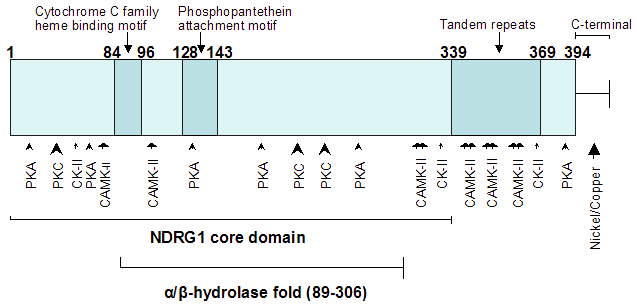
NDRG1 is a ~ 43 kD protein, composed of 394 amino acids, with an iso-electric point of 5.7. NDRG1 has an alpha/beta hydrolase-fold motif, however, without a hydrolytic catalytic activity required to function as hydrolases. The protein has no apparent transmembrane domain (Kokame et al, 1996). NDRG1 has several phosphorylation sites, among others a phosphopantetheine attachment site, protein kinase C, casein kinase II, tyrosine kinase, protein kinase A and calmodulin kinase II. Experimental studies have demonstrated that NRDG1 is phosphorylated by Protein Kinase A and Calmodulin kinase II, and is also a physiological substrate of SGK1 and GSK-3-beta kinase (Figure 1), a kinase involved in cancer growth and progression. he C-terminal region of NDRG1 (residues 339-369) possess three tandem repeats of 10 amino acids, GTRSRSHTSE, (Zhou et al, 2001) not present in the other members of the NDRG family. These repeats with a histidine located between serine and threonine residues act as a binding site for metal ions such as nickel and copper (Zoroddu et al, 2001) (Figure 1). NDRG1 is also target for SOMOylation, preferentially by SUMO-2 isoform, in an acceptor site in residue Lys14. This modification does not affect the subcellular localization of NDRG1 but the protein stability by increasing protein ubiquitination and degradation (Lee and Kim, 2015) (Figure 1).

Figure 1 - Schematic representation of the modular structure of NDRG1 - NDRG1 is target of phosphorylation by PKA, PKC, CaMKII. Residues that are phosphorylated by SGK1 and GSK3 and target of SUMOylation by SUMO-2 are indicated. PKA: Protein Kinase A; PKC: Protein Kinase C; CaMKII: Calmodulin Kinase II; SGK1: serum and glucocorticoid-regulated kinase 1; GSK3- Glycogen synthase kinase 3; SUMO-2: Small Ubiquitin-Like Modifier 2 .
Expression
NDRG1 is relatively ubiquitously expressed in normal human cells, and especially highly expressed in prostate, brain, kidney, placenta, ovarian, thyroid, testicular and intestinal cells. NDRG1 is mostly found in epithelial cells. NDRG1 expression has been shown to be controlled by promoter CpG island methylation and histone acetylation. In addition, several transcription factors have been implicated in the NDRG1 transcriptional regulation, including homo- and heterodimers of MYC, MYCN and MAX, androgen receptor (AR), TP53, and HIF1A.
Localisation
NDRG1 is primarily a cytoplasmic protein. 47.8% of the NDRG1 is expressed in the cytosol, 26.1% in the nucleus (such as in prostate epithelial cells), and 8.7% in the mitochondria (such as in proximal tubule cells in the kidney). NDRG1 is also found in the adherens junctions. Additionally, in intestinal and lactating breast epithelia NDRG1 is located in the plasma membrane. NDRG1 can also be found in vacuoles, the peroxisome, early and recycling endosomes, and the cytoskeleton.
Function
The exact function of NDRG1 is still unclear. The expression of all members of the NDRG1 family has been correlated with different stages of differentiation from birth to adulthood. NDRG1 has been reported to be involved in different biological processes as cell proliferation, differentiation, development, and stress response (Ellen et al., 2008).
There is evidence that NDRG1 expression peaks in the G1 and G2/M phases, and is lowest in the S phase, and that this regulation might be associated to cell growth and differentiation. In fact, NDRG1 has been shown to up regulates p21/WAF1 (Kovacevic et al, 2013) and NDRG1 expression is downregulated under conditions of increased cell proliferation. NDRG1 is also described as a microtubule-associated protein, which may play an important role in maintaining spindle structure during cell division.
The function of NDRG1 may be controlled at least in part by phosphorylation. Phosphorylation at residues Ser330 and Thr346 by SGK-1 is involved in NF-κB signaling pathway inhibition probably affecting cell survival (Murakami et al, 2010).
NDRG1 has also been identified as a stress response gene, upregulated by homocysteine and hypoxia. Hif-1-dependent and independent mechanisms have been implicated in NDRG1 induction. It is also controlled by AP-1 transcription factors. When exposed to stress, for example hypoxia, NDRG1 may play a cytoprotective role in normal healthy cells.
NDRG1 is upregulated during colon epithelial cell differentiation. It is positively or negatively regulated by hormones such as androgens and estradiol, respectively. Small molecules such as N-hydroxy-N-phenol-octane-1,8-diotic acid diamide, calcium ionophores like BAPTA, metal ions such as Nickel and Cobalt, iron chelators and differentiating agents like retinoic acid induce NDRG1 expression. Additionally, NDRG1 is induced during cellular DNA damage and endoplasmic reticulum stress.
In the Schwann cells, NDRG1 is essential for myelin sheath maintenance. Hence, NDRG1 is a multifunctional protein with roles that may be tissue- and/or cell-type specific.
It has been found to be a Rab4a effector protein that recruits to the recycling endosomes in the Trans Golgi network by binding to the lipid phosphotidylinositol 4-phosphate (PI4P), where it plays a role in the recycling of E-cadherin. NDRG1 also interacts with HSP70. NDRG1 co-localizes with APO A-I and A-II, and may be involved in lipid transport.
Evidences obtained from global gene expression analysis of breast cell lines with high endogenous NDRG1 expression transduced with shRNA against NDRG1 suggested an involvement of NDRG1 with vesicle transport (Askautrud et al, 2014).
In cancer, NDRG1 is reported to be a metastasis suppressor gene which is downregulated in prostate, colon and breast cancers. However, up-regulation of NDRG1 has also been associated to poor prognosis in breast, renal, hepatocellular, and colorectal cancer, suggesting that it may play different role depending on cellular type and context (Nagai. et al, 2001; Nishie et al, 2001; Chua et al, 2007; Strzelczyk et al, 2009).
Signaling Pathways
The widespread localization of NDRG1 might impact its involvement with diverse signaling pathways. It has been demonstrated that NDRG1 interacts directly with NF-κB, PI3K/AKT/ mTOR, Ras/Raf/MEK/ERK, TGF-β; and Wnt/β-catenin pathways independently with each pathway or by promoting a crosstalk between them (Sun J et al, 2013). The nuclear translocation of the DNA binding subunit of NFκB, NFKB1 (p50), complexed with RelA is reduced by NDRG1 as a consequence of the induced degradation of IKBKB (IKK&beta), subunit of the IκB kinase complex (Hosoi et al, 2009). The effect of NDRG1 on NFκB signaling pathway seems to be dependent of phosphorylation at residues Ser330 and Thr346 by SGK1 (Murakami et al, 2010).
The expression of PTEN, a tumor suppressor gene described as inactivated in diverse types of human cancers, is also involved in tumor metastasis suppression and it was demonstrated that PTEN targets NDRG1 in a PI3K dependent manner. It was demonstrated that up regulation of PTEN increase the level of NDRG1 and the inhibition of PTEN by shRNA also inhibits NDRG1 expression. This blockage is reverted when the cells are treated with phospho-Akt inhibitor, evidencing a dependency of PI3K/AKT pathway (Bandyopadhyay, et al, 2004). In prostate epithelial cells NDRG1 expression increased phosphorylation of tumorigenic AKT, ERK1/2 and SMAD2L and decreased PTEN levels (Dixon et al, 2013). NDRG1 also has been associated to up-regulation of SMAD4 that is responsible for nuclear translocation of effector SMADs upon TGFβ receptor activation. Up regulation of SMAD4 has a dual role both in TGFβ signaling, intermediating the induction of p21, and also blocking Ras signaling pathway by inhibiting ERK phosphorylation (Kovacevic et al, 2013) (Figure 2).
There is evidence that NDRG1 expression peaks in the G1 and G2/M phases, and is lowest in the S phase, and that this regulation might be associated to cell growth and differentiation. In fact, NDRG1 has been shown to up regulates p21/WAF1 (Kovacevic et al, 2013) and NDRG1 expression is downregulated under conditions of increased cell proliferation. NDRG1 is also described as a microtubule-associated protein, which may play an important role in maintaining spindle structure during cell division.
The function of NDRG1 may be controlled at least in part by phosphorylation. Phosphorylation at residues Ser330 and Thr346 by SGK-1 is involved in NF-κB signaling pathway inhibition probably affecting cell survival (Murakami et al, 2010).
NDRG1 has also been identified as a stress response gene, upregulated by homocysteine and hypoxia. Hif-1-dependent and independent mechanisms have been implicated in NDRG1 induction. It is also controlled by AP-1 transcription factors. When exposed to stress, for example hypoxia, NDRG1 may play a cytoprotective role in normal healthy cells.
NDRG1 is upregulated during colon epithelial cell differentiation. It is positively or negatively regulated by hormones such as androgens and estradiol, respectively. Small molecules such as N-hydroxy-N-phenol-octane-1,8-diotic acid diamide, calcium ionophores like BAPTA, metal ions such as Nickel and Cobalt, iron chelators and differentiating agents like retinoic acid induce NDRG1 expression. Additionally, NDRG1 is induced during cellular DNA damage and endoplasmic reticulum stress.
In the Schwann cells, NDRG1 is essential for myelin sheath maintenance. Hence, NDRG1 is a multifunctional protein with roles that may be tissue- and/or cell-type specific.
It has been found to be a Rab4a effector protein that recruits to the recycling endosomes in the Trans Golgi network by binding to the lipid phosphotidylinositol 4-phosphate (PI4P), where it plays a role in the recycling of E-cadherin. NDRG1 also interacts with HSP70. NDRG1 co-localizes with APO A-I and A-II, and may be involved in lipid transport.
Evidences obtained from global gene expression analysis of breast cell lines with high endogenous NDRG1 expression transduced with shRNA against NDRG1 suggested an involvement of NDRG1 with vesicle transport (Askautrud et al, 2014).
In cancer, NDRG1 is reported to be a metastasis suppressor gene which is downregulated in prostate, colon and breast cancers. However, up-regulation of NDRG1 has also been associated to poor prognosis in breast, renal, hepatocellular, and colorectal cancer, suggesting that it may play different role depending on cellular type and context (Nagai. et al, 2001; Nishie et al, 2001; Chua et al, 2007; Strzelczyk et al, 2009).
Signaling Pathways
The widespread localization of NDRG1 might impact its involvement with diverse signaling pathways. It has been demonstrated that NDRG1 interacts directly with NF-κB, PI3K/AKT/ mTOR, Ras/Raf/MEK/ERK, TGF-β; and Wnt/β-catenin pathways independently with each pathway or by promoting a crosstalk between them (Sun J et al, 2013). The nuclear translocation of the DNA binding subunit of NFκB, NFKB1 (p50), complexed with RelA is reduced by NDRG1 as a consequence of the induced degradation of IKBKB (IKK&beta), subunit of the IκB kinase complex (Hosoi et al, 2009). The effect of NDRG1 on NFκB signaling pathway seems to be dependent of phosphorylation at residues Ser330 and Thr346 by SGK1 (Murakami et al, 2010).
The expression of PTEN, a tumor suppressor gene described as inactivated in diverse types of human cancers, is also involved in tumor metastasis suppression and it was demonstrated that PTEN targets NDRG1 in a PI3K dependent manner. It was demonstrated that up regulation of PTEN increase the level of NDRG1 and the inhibition of PTEN by shRNA also inhibits NDRG1 expression. This blockage is reverted when the cells are treated with phospho-Akt inhibitor, evidencing a dependency of PI3K/AKT pathway (Bandyopadhyay, et al, 2004). In prostate epithelial cells NDRG1 expression increased phosphorylation of tumorigenic AKT, ERK1/2 and SMAD2L and decreased PTEN levels (Dixon et al, 2013). NDRG1 also has been associated to up-regulation of SMAD4 that is responsible for nuclear translocation of effector SMADs upon TGFβ receptor activation. Up regulation of SMAD4 has a dual role both in TGFβ signaling, intermediating the induction of p21, and also blocking Ras signaling pathway by inhibiting ERK phosphorylation (Kovacevic et al, 2013) (Figure 2).
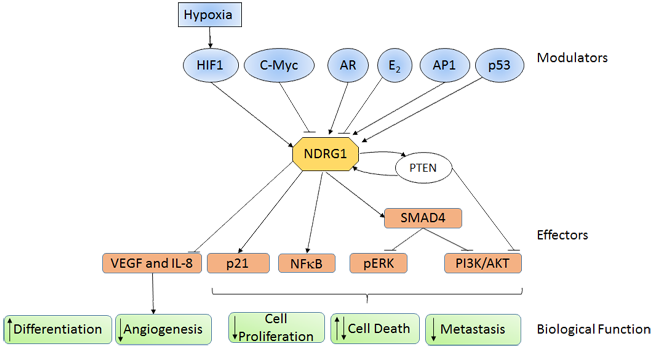
Figure 2 - Modulators and Biological functions of NDRG1 - NDRG1 is involved in a variety of signaling pathways been positively or negatively regulated. As a consequence, diverse biological processes are modulated. HIF1, hypoxia inducible factor 1; c-Myc, v-myc avian myelocytomatosis viral oncogene homolog; AR, Androgen receptor; E2, -17β-estradiol; AP1, activator protein-1, p53, tumor suppressor protein p53; PTEN, phosphatase and tensin homolog; VEGF, vascular endothelial growth factor; CXCL8 (IL-8), interleukin-8; p21, cyclin-dependent kinase inhibitor 1A; NFKB, nuclear factor of kappa light polypeptide gene enhancer in B-cells; pERK, extracellular signal-regulated kinases; SMAD4, SMAD family member 4; PI3K, phosphatidylinositol 3-kinase; AKT, v-akt murine thymoma viral oncogene homolog.
Implicated in
Entity name
Prostatic adenocarcinoma, breast cancer, colorectal cancer, renal cell carcinoma, bladder carcinoma, pancreatic cancer, hepatocellular carcinoma, thyroid carcinoma, and glioma.
Prognosis
The association of NDRG1 and prognosis of cancer patients is controversial. Some studies have found that downregulation of NDRG1 in cancer worsens the prognosis of cancer. There is an inverse relationship in the levels of NDRG1 expression and the Gleason grade of the tumor in prostate cancer. A high PTEN (a tumor suppressor which positively regulates NDRG1) and NDRG1 expression improves survival rates in patients with breast and prostate cancer. In patients with colorectal cancer, the 2 year survival rate for patients with high NDRG1-expression was 82.4%, while for patients with a low NDRG1-expression it was only 69.6%. In pancreatic cancer patients, the median survival time for patients with high NDRG1-expression was 24.7 months, while the median survival time for patients with low NDRG1-expression was only 10.9 months. High expression of NDRG1 in colon tumors was found to correlate with increased resistance to irinotecan.
On the other hand, the positivity for NDRG1 expression was associated to poor disease free and overall survival of breast cancer patients. Also, the positivity of NDRG1 protein observed in breast cancer patients is associated with important clinic-pathological variables for disease outcome, such as large tumor size, advanced clinical stage, lymph node metastasis and high tumor grade (SBR) (Nagai. et al, 2001). An inverse correlation of NDGR1 and ER and/or PR status has also been described (Leth-Larsen et al, 2009; Fotovati et al, 2006).
Increase in protein level has been observed in thyroid carcinomas. Thyroid lesions showed higher immunohistochemical staining of NDRG1 as compared to normal and benign thyroid lesions that was correlated with more advanced tumor stages. This increase of NDRG1 expression was correlated with more advanced TNM stage (stages III and IV) and an AMES high-risk category in patients with thyroid carcinoma (Gerhard et al, 2010).
In hepatocellular carcinoma upregulation of NDRG1 has been correlated with tumour aggressiveness and poor patients survival (Chua et al., 2007).
NDRG1 has been associated to breast cancer cells differentiation both in vitro and in vivo. Endogenous expression of NDRG1 was associated to differentiation status of breast cancer cell lines and when these cells were treated with the cellular differentiation inducer, sodium butyrate, a concomitant increase of NDRG1 and β-casein, a marker of breast cell differentiation, expression was observed. Moreover, the blockage of NDRG1 expression was also followed by β-casein reduction. Also in breast cancer samples a close relationship between NDRG1 and β-casein was found (Fotovati et al, 2011).
NDRG1 has been considered as a possible biomarker to guide the decision of treatment of WHO grade II glioma patients. Time to reintervention, assessed for patients without immediate postoperative genotoxic treatment and known progression and survival status, was significantly longer in the high NDRG1 group. This group of tumors presented growth delay improving progression free surviva (Blaes et al, 2014).
On the other hand, the positivity for NDRG1 expression was associated to poor disease free and overall survival of breast cancer patients. Also, the positivity of NDRG1 protein observed in breast cancer patients is associated with important clinic-pathological variables for disease outcome, such as large tumor size, advanced clinical stage, lymph node metastasis and high tumor grade (SBR) (Nagai. et al, 2001). An inverse correlation of NDGR1 and ER and/or PR status has also been described (Leth-Larsen et al, 2009; Fotovati et al, 2006).
Increase in protein level has been observed in thyroid carcinomas. Thyroid lesions showed higher immunohistochemical staining of NDRG1 as compared to normal and benign thyroid lesions that was correlated with more advanced tumor stages. This increase of NDRG1 expression was correlated with more advanced TNM stage (stages III and IV) and an AMES high-risk category in patients with thyroid carcinoma (Gerhard et al, 2010).
In hepatocellular carcinoma upregulation of NDRG1 has been correlated with tumour aggressiveness and poor patients survival (Chua et al., 2007).
NDRG1 has been associated to breast cancer cells differentiation both in vitro and in vivo. Endogenous expression of NDRG1 was associated to differentiation status of breast cancer cell lines and when these cells were treated with the cellular differentiation inducer, sodium butyrate, a concomitant increase of NDRG1 and β-casein, a marker of breast cell differentiation, expression was observed. Moreover, the blockage of NDRG1 expression was also followed by β-casein reduction. Also in breast cancer samples a close relationship between NDRG1 and β-casein was found (Fotovati et al, 2011).
NDRG1 has been considered as a possible biomarker to guide the decision of treatment of WHO grade II glioma patients. Time to reintervention, assessed for patients without immediate postoperative genotoxic treatment and known progression and survival status, was significantly longer in the high NDRG1 group. This group of tumors presented growth delay improving progression free surviva (Blaes et al, 2014).
Oncogenesis
NDRG1 aberrant expression has been reported in different types of cancer, indication that it plays an important role in the tumorigenic process. However, both tumor suppressive and oncogenic functions have been demonstrated for NDRG1, suggesting an impact of its tissue specific function.
An inverse relationship exists between NDRG1 and the oncogenes N-myc and c-myc, suggesting that members of the MYC family suppress expression of NDRG1. Experimental evidence exist that both N-myc and c-myc downregulate NDRG1 gene expression by directly binding to NDRG1 promoter.
NDRG1 is downregulated in colon, breast, prostate and pancreatic neoplasms, by c-myc and N-myc transcription factors. In cancer cells, NDRG1 expression is consistent through all phases in the cell cycle, instead of the biphasic expression in normal cells. PTEN expression is positively related to NDRG1 expression. NDRG1 is induced in cancer cells by histone deacetylase inhibitors and DNA methyl transferase inhibitors indicating that NDRG1 is regulated by chromatin modulation and DNA methylation.
Although NDRG1 has been reported to be downregulated in a variety of cancers, it has been shown to be upregulated in hepatic, pancreatic and kidney cancers. Induction of NDRG1 in these tumors is speculated to be in response to tumor stress or hypoxia and NDRG1 is proposed as a marker of tumor hypoxia. However, in pancreatic cancer, cellular differentiation and not hypoxia was demonstrated to be the determining factor for NDRG1 expression. In renal cancer, induction of NDRG1 in the tumor tissue was restricted to infiltrating macrophages and not cancer cells.
NDRG1 is suggested to be an early target for p53. Loss of p53 expression in cancer is suggested to reduce NDRG1 expression. However, p53 knockout mice show expression of NDRG1, suggesting that there are other mechanisms regulating NDRG1 levels.
NDRG1 expression plays a role in vitro in primary tumor growth in prostate, breast, and bladder cancer: a higher expression of NDRG1 lowers the proliferation rates of these cancers. In pancreatic and bladder cancer cells, this reduction was proven in vivo: in pancreatic cells it was suggested that the reduced proliferation was caused by NDRG1 by modulating tumor stroma and angiogenesis. NDRG1 can recruit onto the recycling endosome in the Trans-Golgi network by binding to phosphotidylinositol 4-phosphate. There, NDRG1 may be involved in the transport of various cargo back to the cells surface. At the molecular level, NDRG1 may stabilize the E-cadherin molecule by recycling it back to the cells surface, thereby preventing tumor invasion.
An inverse relationship exists between NDRG1 and the oncogenes N-myc and c-myc, suggesting that members of the MYC family suppress expression of NDRG1. Experimental evidence exist that both N-myc and c-myc downregulate NDRG1 gene expression by directly binding to NDRG1 promoter.
NDRG1 is downregulated in colon, breast, prostate and pancreatic neoplasms, by c-myc and N-myc transcription factors. In cancer cells, NDRG1 expression is consistent through all phases in the cell cycle, instead of the biphasic expression in normal cells. PTEN expression is positively related to NDRG1 expression. NDRG1 is induced in cancer cells by histone deacetylase inhibitors and DNA methyl transferase inhibitors indicating that NDRG1 is regulated by chromatin modulation and DNA methylation.
Although NDRG1 has been reported to be downregulated in a variety of cancers, it has been shown to be upregulated in hepatic, pancreatic and kidney cancers. Induction of NDRG1 in these tumors is speculated to be in response to tumor stress or hypoxia and NDRG1 is proposed as a marker of tumor hypoxia. However, in pancreatic cancer, cellular differentiation and not hypoxia was demonstrated to be the determining factor for NDRG1 expression. In renal cancer, induction of NDRG1 in the tumor tissue was restricted to infiltrating macrophages and not cancer cells.
NDRG1 is suggested to be an early target for p53. Loss of p53 expression in cancer is suggested to reduce NDRG1 expression. However, p53 knockout mice show expression of NDRG1, suggesting that there are other mechanisms regulating NDRG1 levels.
NDRG1 expression plays a role in vitro in primary tumor growth in prostate, breast, and bladder cancer: a higher expression of NDRG1 lowers the proliferation rates of these cancers. In pancreatic and bladder cancer cells, this reduction was proven in vivo: in pancreatic cells it was suggested that the reduced proliferation was caused by NDRG1 by modulating tumor stroma and angiogenesis. NDRG1 can recruit onto the recycling endosome in the Trans-Golgi network by binding to phosphotidylinositol 4-phosphate. There, NDRG1 may be involved in the transport of various cargo back to the cells surface. At the molecular level, NDRG1 may stabilize the E-cadherin molecule by recycling it back to the cells surface, thereby preventing tumor invasion.
Entity name
Hereditary Motor and Sensory Neuropathy-Lom (HMSNL) / Charcot-Marie-Tooth Disease (CMT 4D)
Note
Autosomal recessive mutation in NDRG1 is responsible for HMSNL/CMT 4D inheritance. The Gypsy founder mutation, homozygote R148X, also called homozygote C564t is a causative mutation. In patients with CMT disease, apart from the R148X mutation, another disease-causing mutation was identified, namely IVS8-1G>A (g.2290787G>A), which results in skipping of exon 9. The homozygote phenotype of this mutation was very closely related to the phenotype of HMSNL patients.
An increased copy number (chr8: 134265065-134271319) covering NDRGs1 exons 6-8 was detected in CMT individual. Heterozygous individuals for the locus duplication are carriers for the disease while the homozygous are affected. Also, the presence of this duplication leads to a nonsense mutation at codon 223 affecting gene function (Okamoto et al, 2014).
An increased copy number (chr8: 134265065-134271319) covering NDRGs1 exons 6-8 was detected in CMT individual. Heterozygous individuals for the locus duplication are carriers for the disease while the homozygous are affected. Also, the presence of this duplication leads to a nonsense mutation at codon 223 affecting gene function (Okamoto et al, 2014).
Disease
A hereditary autosomal recessive disease, caused by demyelination of peripheral nerves. It is the most common form of demyelinating Charcot-Marie-Tooth disease in the Roma population.
Prognosis
Severe disability in adulthood. It begins consistently in the first decade of life with a gait disorder, followed by upper limb weakness in the second decade and, in most subjects, by deafness setting in in the third decade of life. Sensory loss affecting all modalities is present; both this and the motor involvement predominating distally in the limbs. Skeletal deformity, particularly foot deformities, are frequent.
Entity name
Atherosclerosis
Note
Patients with HMSNL were found to have a high total cholesterol: HDL-C ratio.
Disease
Atherosclerosis is an important factor for the development of cardiovascular diseases, like myocardial infarction and angina pectoris. NDRG1 contributes to HDL-C (high-density lipoprotein-cholesterol) levels most likely by its phosphopantetheine-binding domain interacting with the high-density lipoproteins apolipoprotein A-I and A-II
Article Bibliography
| Pubmed ID | Last Year | Title | Authors |
|---|---|---|---|
| 10860807 | 2000 | Phosphorylation of RTP, an ER stress-responsive cytoplasmic protein. | Agarwala KL et al |
| 24498060 | 2014 | Global gene expression analysis reveals a link between NDRG1 and vesicle transport. | Askautrud HA et al |
| 15520163 | 2004 | PTEN up-regulates the tumor metastasis suppressor gene Drg-1 in prostate and breast cancer. | Bandyopadhyay S et al |
| 24395351 | 2014 | NDRG1 prognosticates the natural course of disease in WHO grade II glioma. | Blaes J et al |
| 15341671 | 2004 | Hypoxia upregulates the expression of the NDRG1 gene leading to its overexpression in various human cancers. | Cangul H et al |
| 23099645 | 2013 | Association of NDRG1 gene promoter methylation with reduced NDRG1 expression in gastric cancer cells and tissue specimens. | Chang X et al |
| 16314423 | 2006 | N-myc down-regulated gene 1 modulates the response of term human trophoblasts to hypoxic injury. | Chen B et al |
| 17170744 | 2007 | Overexpression of NDRG1 is an indicator of poor prognosis in hepatocellular carcinoma. | Chua MS et al |
| 15761963 | 2005 | A microarray-based gastric carcinoma prewarning system. | Cui DX et al |
| 23287991 | 2013 | Dp44mT targets the AKT, TGF-β and ERK pathways via the metastasis suppressor NDRG1 in normal prostate epithelial cells and prostate cancer cells. | Dixon KM et al |
| 17916902 | 2008 | NDRG1, a growth and cancer related gene: regulation of gene expression and function in normal and disease states. | Ellen TP et al |
| 16707596 | 2006 | 17Beta-estradiol induces down-regulation of Cap43/NDRG1/Drg-1, a putative differentiation-related and metastasis suppressor gene, in human breast cancer cells. | Fotovati A et al |
| 20835551 | 2010 | NDRG1 protein overexpression in malignant thyroid neoplasms. | Gerhard R et al |
| 11746822 | 2001 | Regulation of the differentiation-related gene Drg-1 during mouse skin carcinogenesis. | Gómez-Casero E et al |
| 10676663 | 2000 | Drg-1 as a differentiation-related, putative metastatic suppressor gene in human colon cancer. | Guan RJ et al |
| 23899187 | 2013 | Aberrant NDRG1 methylation associated with its decreased expression and clinicopathological significance in breast cancer. | Han LL et al |
| 19491262 | 2009 | N-myc downstream regulated gene 1/Cap43 suppresses tumor growth and angiogenesis of pancreatic cancer through attenuation of inhibitor of kappaB kinase beta expression. | Hosoi F et al |
| 15922294 | 2005 | NDRG1 interacts with APO A-I and A-II and is a functional candidate for the HDL-C QTL on 8q24. | Hunter M et al |
| 12872253 | 2003 | Mutation screening of the N-myc downstream-regulated gene 1 (NDRG1) in patients with Charcot-Marie-Tooth Disease. | Hunter M et al |
| 24270187 | 2014 | Epigenome-wide differences in pathology-free regions of multiple sclerosis-affected brains. | Huynh JL et al |
| 17786215 | 2007 | The N-Myc down regulated Gene1 (NDRG1) Is a Rab4a effector involved in vesicular recycling of E-cadherin. | Kachhap SK et al |
| 10831399 | 2000 | N-myc downstream-regulated gene 1 is mutated in hereditary motor and sensory neuropathy-Lom. | Kalaydjieva L et al |
| 15247272 | 2004 | Function of Drg1/Rit42 in p53-dependent mitotic spindle checkpoint. | Kim KT et al |
| 8939898 | 1996 | Homocysteine-respondent genes in vascular endothelial cells identified by differential display analysis. GRP78/BiP and novel genes. | Kokame K et al |
| 22462691 | 2013 | The iron-regulated metastasis suppressor NDRG1 targets NEDD4L, PTEN, and SMAD4 and inhibits the PI3K and Ras signaling pathways. | Kovacevic Z et al |
| 9766676 | 1998 | Inhibition of tumor cell growth by RTP/rit42 and its responsiveness to p53 and DNA damage. | Kurdistani SK et al |
| 12432451 | 2002 | Expression of NDRG1, a differentiation-related gene, in human tissues. | Lachat P et al |
| 25712528 | 2015 | SUMO modification regulates the protein stability of NDRG1. | Lee JE et al |
| 19321434 | 2009 | Metastasis-related plasma membrane proteins of human breast cancer cells identified by comparative quantitative mass spectrometry. | Leth-Larsen R et al |
| 12962147 | 2003 | The growth-inhibitory Ndrg1 gene is a Myc negative target in human neuroblastomas and other cell types with overexpressed N- or c-myc. | Li J et al |
| 26202882 | 2015 | Downregulation of N-myc downstream regulated gene 1 caused by the methylation of CpG islands of NDRG1 promoter promotes proliferation and invasion of prostate cancer cells. | Li Y et al |
| 16778198 | 2006 | Tumor growth suppression in pancreatic cancer by a putative metastasis suppressor gene Cap43/NDRG1/Drg-1 through modulation of angiogenesis. | Maruyama Y et al |
| 12767066 | 2003 | Downregulation of Cap43 gene by von Hippel-Lindau tumor suppressor protein in human renal cancer cells. | Masuda K et al |
| 20416281 | 2010 | Identification of sites subjected to serine/threonine phosphorylation by SGK1 affecting N-myc downstream-regulated gene 1 (NDRG1)/Cap43-dependent suppression of angiogenic CXC chemokine expression in human pancreatic cancer cells. | Murakami Y et al |
| 20369286 | 2011 | Prognostic value of NDRG1 and SPARC protein expression in breast cancer patients. | Nagai MA et al |
| 11448934 | 2001 | High expression of the Cap43 gene in infiltrating macrophages of human renal cell carcinomas. | Nishie A et al |
| 24136616 | 2014 | Exonic duplication CNV of NDRG1 associated with autosomal-recessive HMSN-Lom/CMT4D. | Okamoto Y et al |
| 15082788 | 2004 | Ndrg1-deficient mice exhibit a progressive demyelinating disorder of peripheral nerves. | Okuda T et al |
| 10395947 | 1999 | Differential expression of the RTP/Drg1/Ndr1 gene product in proliferating and growth arrested cells. | Piquemal D et al |
| 11936845 | 2002 | Characterization and expression of three novel differentiation-related genes belong to the human NDRG gene family. | Qu X et al |
| 11865053 | 2002 | The regulation of hypoxic genes by calcium involves c-Jun/AP-1, which cooperates with hypoxia-inducible factor 1 in response to hypoxia. | Salnikow K et al |
| 15867226 | 2005 | Drg1 expression in 131 colorectal liver metastases: correlation with clinical variables and patient outcomes. | Shah MA et al |
| 10381566 | 1999 | N-myc-dependent repression of ndr1, a gene identified by direct subtraction of whole mouse embryo cDNAs between wild type and N-myc mutant. | Shimono A et al |
| 15377670 | 2004 | NDRG1 is necessary for p53-dependent apoptosis. | Stein S et al |
| 19259744 | 2009 | Identification of high-risk stage II colorectal tumors by combined analysis of the NDRG1 gene expression and the depth of tumor invasion. | Strzelczyk B et al |
| 15133234 | 2004 | N-myc downregulated gene 1 is a phosphorylated protein in mast cells. | Sugiki T et al |
| 23671130 | 2013 | Metastasis suppressor, NDRG1, mediates its activity through signaling pathways and molecular motors. | Sun J et al |
| 12804568 | 2003 | Identification of NDRG1 as an early inducible gene during in vitro maturation of cultured mast cells. | Taketomi Y et al |
| 10428464 | 1999 | The differentiation-related gene 1, Drg1, is markedly upregulated by androgens in LNCaP prostatic adenocarcinoma cells. | Ulrix W et al |
| 11494141 | 2001 | Growth-suppressive effects of BPOZ and EGR2, two genes involved in the PTEN signaling pathway. | Unoki M et al |
| 9605764 | 1998 | Cap43, a novel gene specifically induced by Ni2+ compounds. | Zhou D et al |
| 11352569 | 2001 | Characterization of the human NDRG gene family: a newly identified member, NDRG4, is specifically expressed in brain and heart. | Zhou RH et al |
| 11330481 | 2001 | Ni(II) and Cu(II) binding with a 14-aminoacid sequence of Cap43 protein, TRSRSHTSEGTRSR. | Zoroddu MA et al |
| 9251681 | 1997 | A novel gene which is up-regulated during colon epithelial cell differentiation and down-regulated in colorectal neoplasms. | van Belzen N et al |
Other Information
Locus ID:
NCBI: 10397
MIM: 605262
HGNC: 7679
Ensembl: ENSG00000104419
Variants:
dbSNP: 10397
ClinVar: 10397
TCGA: ENSG00000104419
COSMIC: NDRG1
RNA/Proteins
Expression (GTEx)
Pathways
Protein levels (Protein atlas)
References
| Pubmed ID | Year | Title | Citations |
|---|---|---|---|
| 36718855 | 2024 | ETS1 regulates NDRG1 to promote the proliferation, migration, and invasion of OSCC. | 1 |
| 37854018 | 2024 | Proteomics on malignant pleural effusions reveals ERα loss in metastatic breast cancer associates with SGK1-NDRG1 deregulation. | 0 |
| 38013127 | 2024 | LINC02561 promotes metastasis in HCC via HIF1-α/NDRG1/UPF1 axis. | 0 |
| 38228036 | 2024 | NDRG1 overcomes resistance to immunotherapy of pancreatic ductal adenocarcinoma through inhibiting ATG9A-dependent degradation of MHC-1. | 2 |
| 38271137 | 2024 | Long noncoding RNA MEG3 regulates cell proliferation and apoptosis by disrupting microRNA-9-5p-mediated inhibition of NDRG1 in prostate cancer. | 0 |
| 38815861 | 2024 | Multi-modal mechanisms of the metastasis suppressor, NDRG1: Inhibition of WNT/β-catenin signaling by stabilization of protein kinase Cα. | 0 |
| 36718855 | 2024 | ETS1 regulates NDRG1 to promote the proliferation, migration, and invasion of OSCC. | 1 |
| 37854018 | 2024 | Proteomics on malignant pleural effusions reveals ERα loss in metastatic breast cancer associates with SGK1-NDRG1 deregulation. | 0 |
| 38013127 | 2024 | LINC02561 promotes metastasis in HCC via HIF1-α/NDRG1/UPF1 axis. | 0 |
| 38228036 | 2024 | NDRG1 overcomes resistance to immunotherapy of pancreatic ductal adenocarcinoma through inhibiting ATG9A-dependent degradation of MHC-1. | 2 |
| 38271137 | 2024 | Long noncoding RNA MEG3 regulates cell proliferation and apoptosis by disrupting microRNA-9-5p-mediated inhibition of NDRG1 in prostate cancer. | 0 |
| 38815861 | 2024 | Multi-modal mechanisms of the metastasis suppressor, NDRG1: Inhibition of WNT/β-catenin signaling by stabilization of protein kinase Cα. | 0 |
| 36594086 | 2023 | TGFβ Governs the Pleiotropic Activity of NDRG1 in Triple-Negative Breast Cancer Progression. | 4 |
| 36841367 | 2023 | The role of the NDRG1 in the pathogenesis and treatment of breast cancer. | 7 |
| 37249744 | 2023 | MAOA suppresses the growth of gastric cancer by interacting with NDRG1 and regulating the Warburg effect through the PI3K/AKT/mTOR pathway. | 4 |
Citation
Maria A Nagai ; Flavia R Mangone
NDRG1 (N-myc downstream regulated 1)
Atlas Genet Cytogenet Oncol Haematol. 2015-10-01
Online version: http://atlasgeneticsoncology.org/gene/41512/ndrg1
Historical Card
2009-10-01 NDRG1 (N-myc downstream regulated 1) by Michel Wissing,Nadine Rosmus,Michael Carducci,Sushant Kachhap Affiliation
Johns Hopkins Medical Institute, The Sidney Kimmel Comprehensive Cancer Center, 1650 Orleans Street, CRB-I 162E, Baltimore, MD 21231, USA
