NNMT (nicotinamide N-methyltransferase)
2009-07-01 Monica Emanuelli , Monia Cecati , Davide Sartini , Valentina Pozzi AffiliationDipartimento di Biochimica, Biologia e Genetica, Universita Politecnica delle Marche, Ancona, Italy
Identity

DNA/RNA

Description
Transcription
Pseudogene
Proteins
Note
Description
NNMT was first identified by cDNA cloning from the liver and the protein is predicted to be present in the cytosol (Aksoy et al., 1995).
A radiochemical microassay was developed by Rini et al. (1990) to study selected characteristics of NNMT activity in human liver preparations.
These studies suggested that human hepatic NNMT is a cytoplasmic enzyme with a pH optimum of approximately 7.4. Apparent Km values for its two substrates, nicotinamide and S-adenosyl-L-methionine, are 347 and 1.76 µmol/l, respectively. The enzyme activity is inhibited by the reaction products, N1-methylnicotinamide and S-adenosyl-L-homocysteine, while its activity is not affected by inhibitors of other methyltransferases. Basal enzyme activities, detected in human liver biopsy samples, show large individual variations with a bimodal frequency distribution.
Aksoy et al. (1994) set out to clone and express a cDNA for human liver NNMT to study molecular mechanisms involved in the regulation of individual differences of NNMT activity in humans. The cloning strategy involved purification of human liver NNMT, leading to partial amino acid sequence, followed by direct PCR-based cloning with the use of the rapid amplification of cDNA ends (RACE). The combined use of these techniques resulted in the isolation of a human liver NNMT cDNA that was 969 bp long, with a 792-bp open reading frame that encoded a 264-amino acid protein with a calculated molecular mass of 29,600 Daltons. Transient expression of the protein encoded by this cDNA demonstrated that it catalyzed the methylation of nicotinamide and had biochemical characteristics similar to, or identical with, those of human liver NNMT.
Recently, 2-DE experiments revealed that NNMT exists in multiple spots in gastric tissues and the presence of multiple NNMT spots is highly specific to cancer tissues of stomach. This suggests that NNMT could receive a post-translational modification in cancer-specific manner, but the mechanism by which NNMT is modified is still unknown (Lim et al., 2006).
Expression
Localisation
Function
Homology
Human NNMT shows a very high level of identity to other non-human NNMTs: Sus scrofa (88%), Rattus norvegicus (87%) and Mus musculus (85%).
Mutations
Note
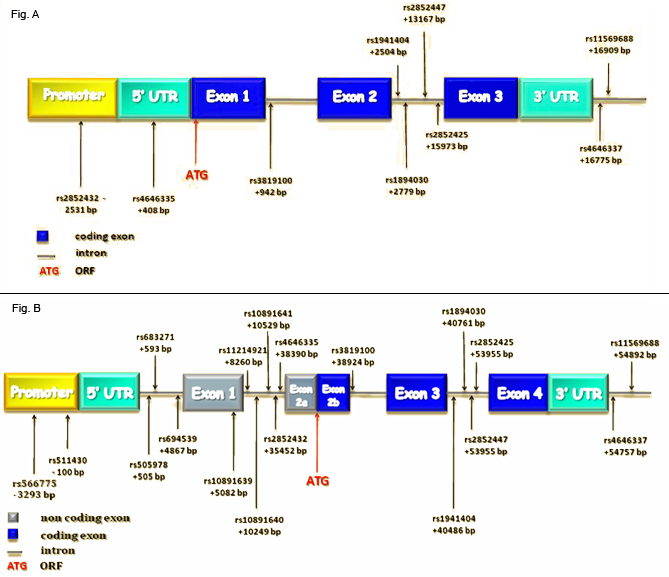
An alternative NNMT gene organization is available at UCSC web site. This sequence, depicted in the figure B below, displays another putative 5UTR region located at 38,732 bp upstream of the open reading frame.
NNMT is one of at least 39 SAM-dependent methyltransferases and is involved in different metabolic pathways such as folate and homocysteine ones. Several independent studies have investigated some NNMT polymorphisms that could reflect differences in catalytic activity or in transcriptional efficiency of gene; however data available in literature are contrasting because some archived SNPs are very rare substitutions or limited to some ethnic group. Yan (Yan et al., 1999) and Smith (Smith et al., 1998) detected no association between SNPs (either insertion/deletion events within exons or into 5 flanking region) and NNMT activity variation in healthy population. Saito (Saito et al., 2001) suggested that some SNPs in the NNMT 5 flanking region may influence its transcriptional efficiency. Several studies about association between NNMT genetic variations and alteration of cellular pathways are present in literature.
Homocysteine (Hcy) pathway. In humans, the only source of Hcy is the demethylation of methionine, through several methyl transferase activities, such as NNMT. Hyperhomocysteinemia is a condition characterized by high plasma level of Hcy and it is implicated in several diseases, as Alzheimer and other clinical status such as atherosclerosis, ischemic strokes (Furie et al., 2006) and osteoporosis. The causes of hyperhomocysteinemia are both genetic and environmental (e.g.: life-style, sex, age), but genetic basis are still poorly understood. Different studies have investigated an association of NNMT polymorphisms with hyperhomocysteinemia. Souto (Souto et al., 2005) carried out the GAIT (Genetic Analysis of Idiopathic Thrombophilia) Project in a Spanish population, where 10 SNPs of NNMT gene were investigated. The results of this study suggested a strong correlation between plasma Hcy level and a specific haplotype. Because these genetic variants are in non-coding regions, they could influence the regulation of transcription but evidence on the functionality of the NNMT polymorphisms is still conflicting.
A consistent study was carried out by Ling Zhang (Zhang et al., 2007) in about three hundred healthy japanese workers. Authors focused on a specific NNMT polymorphism (rs694539) localized in the first intron. The results confirmed that SNPs in non-coding regions affected the regulation of transcription, but they werent the main determinant of the plasma Hcy levels, because other factors were involved: age, sex, plasma folate levels and the associations with MTHFR polymorphisms.
The association between NNMT polymorphisms and hyperhomocysteinemia has been investigated by Bathum (Bathum et al., 2007). Six hundred and three danish adult twin pairs were included in the study. Experimental results suggested that MTHFR C677T is the only SNP responsible for the disease progression, leaving only minor influence to other genetic variations.
Implicated in
de Jonge (de Jonge et al., 2009) investigated the association between folate pathway polymorphisms and susceptibility to lymphoid leukemia in 245 pediatric ALL patients. Authors demonstrated that specific polymorphisms of MTHFR (C677T), RFC1 (G80A) and NNMT (IVS C-151T) and their association are related to ALL risk. Specifically, NNMT IVS -151TT and NNMT IVS -151 CT+TT/ RFC1 80AA subjects showed a 2,2 and 4,2-fold increased ALL risk, respectively, while NNMT IVS -151CC/ MTHFR 677CT+TT patients exhibited a 2-fold reduction in ALL risk. Authors suggested that the mechanism of this increased risk is related to a reduction of cellular folate uptake and change in methylation status.
Giusti and co-workers, using a multiplex PCR oligonucleotide extension approach (Giusti et al., 2008b), investigated the correlation between some genetic variants of fifteen genes involved in the methionine metabolism (including NNMT) and AAA (Giusti et al., 2008a) in 423 subjects affected from AAA. They demonstrated that only seven genes, including NNMT, have at least one specific haplotype that represents a probable risk factor for AAA. They found also that the influence of the single gene in this pathology is independent from the role in homocysteine metabolism.
Several SNPs of NNMT gene have been analysed in 252 cases (infants with spina bifida) and 335 controls (non malformed infants) by Lu (Lu et al., 2008). Findings showed no association between any single genetic variation and NTDs. Only a specific haplotype was significantly associated with decreased risk for spina bifida in non Hispanic Whites.
van Driel (van Driel et al., 2008) investigated the SNP rs694539, probably involved in the regulation of NNMT transcription (Souto et al., 2005). In the analyses, he included two hundred and ninety-two cases and three hundred and sixteen control families. No association between NNMT polymorphism and risk of CHDs was detected. On the other hand, children with the combination of heterozygous or mutant genotype for rs694539, peri-conception medicine use and low dietary nicotinamide intake showed eight-fold increased risk for CHDs.
Article Bibliography
| Pubmed ID | Last Year | Title | Authors |
|---|---|---|---|
| 8575745 | 1995 | Human nicotinamide N-methyltransferase gene: molecular cloning, structural characterization and chromosomal localization. | Aksoy S et al |
| 8182091 | 1994 | Human liver nicotinamide N-methyltransferase. cDNA cloning, expression, and biochemical characterization. | Aksoy S et al |
| 18276994 | 2008 | 1-Methylnicotinamide (MNA) prevents endothelial dysfunction in hypertriglyceridemic and diabetic rats. | Bartuś M et al |
| 17412799 | 2007 | Genetic and environmental influences on plasma homocysteine: results from a Danish twin study. | Bathum L et al |
| 17935712 | 2008 | Anti-inflammatory effect of 1-methylnicotinamide in contact hypersensitivity to oxazolone in mice; involvement of prostacyclin. | Bryniarski K et al |
| 18385449 | 2008 | Therapeutic potential of 1-methylnicotinamide against acute gastric lesions induced by stress: role of endogenous prostacyclin and sensory nerves. | Brzozowski T et al |
| 14832232 | 1951 | Methylation of nicotinamide with soluble enzyme system from rat liver. | CANTONI GL et al |
| 17641676 | 2007 | 1-Methylnicotinamide (MNA), a primary metabolite of nicotinamide, exerts anti-thrombotic activity mediated by a cyclooxygenase-2/prostacyclin pathway. | Chlopicki S et al |
| 8201215 | 1994 | Nicotinamide methylation in patients with cirrhosis. | Cuomo R et al |
| 18415806 | 2008 | Profiling of mRNA expression in quadriceps of patients with COPD and muscle wasting. | Debigaré R et al |
| 16479441 | 2006 | Homocyst(e)ine and stroke. | Furie KL et al |
| 18635682 | 2008 | Genetic analysis of 56 polymorphisms in 17 genes involved in methionine metabolism in patients with abdominal aortic aneurysm. | Giusti B et al |
| 18427977 | 2008 | High-throughput multiplex single-nucleotide polymorphism (SNP) analysis in genes involved in methionine metabolism. | Giusti B et al |
| 1676447 | 1991 | N-methylation of pyridines in Parkinson's disease. | Green S et al |
| 15559763 | 2004 | The differential proteome profile of stomach cancer: identification of the biomarker candidates. | Jang JS et al |
| 12216074 | 2002 | A potential role of heat shock proteins and nicotinamide N-methyl transferase in predicting response to radiation in bladder cancer. | Kassem HSh et al |
| 19216803 | 2009 | Expression of nicotinamide N-methyltransferase in hepatocellular carcinoma is associated with poor prognosis. | Kim J et al |
| 17079861 | 2006 | Overexpression of nicotinamide N-methyltransferase in gastric cancer tissues and its potential post-translational modification. | Lim BH et al |
| 18553462 | 2008 | Nicotinamide N-methyl transferase (NNMT) gene polymorphisms and risk for spina bifida. | Lu W et al |
| 11161003 | 2001 | Differential gene expression profiling in human brain tumors. | Markert JM et al |
| 19307695 | 2009 | Activation of nicotinamide N-methyltrasferase and increased formation of 1-methylnicotinamide (MNA) in atherosclerosis. | Mateuszuk Ł et al |
| 18058603 | 2007 | Reduced TGF-beta1 expression and its target genes in human insulinomas. | Nabokikh A et al |
| 2311261 | 1990 | Human liver nicotinamide N-methyltransferase: ion-pairing radiochemical assay, biochemical properties and individual variation. | Rini J et al |
| 16166432 | 2005 | Identification of nicotinamide N-methyltransferase as a novel serum tumor marker for colorectal cancer. | Roessler M et al |
| 17012836 | 2006 | Differentiating pancreatic lesions by microarray and QPCR analysis of pancreatic juice RNAs. | Rogers CD et al |
| 11558902 | 2001 | Identification of 197 genetic variations in six human methyltranferase genes in the Japanese population. | Saito S et al |
| 17070307 | 2006 | Identification of nicotinamide N-methyltransferase as a novel tumor marker for renal clear cell carcinoma. | Sartini D et al |
| 17622326 | 2007 | Nicotinamide N-methyltransferase upregulation inversely correlates with lymph node metastasis in oral squamous cell carcinoma. | Sartini D et al |
| 9804963 | 1998 | A direct correlation between nicotinamide N-methyltransferase activity and protein levels in human liver cytosol. | Smith ML et al |
| 15849667 | 2005 | A genomewide exploration suggests a new candidate gene at chromosome 11q23 as the major determinant of plasma homocysteine levels: results from the GAIT project. | Souto JC et al |
| 15324696 | 2004 | Predicting drug sensitivity and resistance: profiling ABC transporter genes in cancer cells. | Szakács G et al |
| 19242722 | 2009 | Serum levels of nicotinamide N-methyltransferase in patients with lung cancer. | Tomida M et al |
| 17922140 | 2008 | Stat3 up-regulates expression of nicotinamide N-methyltransferase in human cancer cells. | Tomida M et al |
| 15639403 | 2005 | Autotoxicity, methylation and a road to the prevention of Parkinson's disease. | Williams AC et al |
| 18724390 | 2008 | Overlapping gene expression profiles of cell migration and tumor invasion in human bladder cancer identify metallothionein 1E and nicotinamide N-methyltransferase as novel regulators of cell migration. | Wu Y et al |
| 15486044 | 2005 | Activation of nicotinamide N-methyltransferase gene promoter by hepatocyte nuclear factor-1beta in human papillary thyroid cancer cells. | Xu J et al |
| 16676400 | 2006 | Histone deacetylase inhibitor depsipeptide represses nicotinamide N-methyltransferase and hepatocyte nuclear factor-1beta gene expression in human papillary thyroid cancer cells. | Xu J et al |
| 14557485 | 2003 | Enhanced expression of nicotinamide N-methyltransferase in human papillary thyroid carcinoma cells. | Xu J et al |
| 10471062 | 1999 | Human nicotinamide N-methyltransferase pharmacogenetics: gene sequence analysis and promoter characterization. | Yan L et al |
| 15682440 | 2005 | Gene expression analysis of renal carcinoma: adipose differentiation-related protein as a potential diagnostic and prognostic biomarker for clear-cell renal carcinoma. | Yao M et al |
| 17434578 | 2007 | The relation between nicotinamide N-methyltransferase gene polymorphism and plasma homocysteine concentration in healthy Japanese men. | Zhang L et al |
| 19020309 | 2009 | Polymorphisms in folate-related genes and risk of pediatric acute lymphoblastic leukemia. | de Jonge R et al |
| 18441319 | 2008 | Eight-fold increased risk for congenital heart defects in children carrying the nicotinamide N-methyltransferase polymorphism and exposed to medicines and low nicotinamide. | van Driel LM et al |
Other Information
Locus ID:
NCBI: 4837
MIM: 600008
HGNC: 7861
Ensembl: ENSG00000166741
Variants:
dbSNP: 4837
ClinVar: 4837
TCGA: ENSG00000166741
COSMIC: NNMT
RNA/Proteins
| Gene ID | Transcript ID | Uniprot |
|---|---|---|
| ENSG00000166741 | ENST00000299964 | P40261 |
| ENSG00000166741 | ENST00000299964 | Q6FH49 |
| ENSG00000166741 | ENST00000535401 | P40261 |
| ENSG00000166741 | ENST00000535401 | Q6FH49 |
Expression (GTEx)
Pathways
Protein levels (Protein atlas)
References
| Pubmed ID | Year | Title | Citations |
|---|---|---|---|
| 38126621 | 2024 | NNMT/1-MNA Promote Cell-Cycle Progression of Breast Cancer by Targeting UBC12/Cullin-1-Mediated Degradation of P27 Proteins. | 3 |
| 38126621 | 2024 | NNMT/1-MNA Promote Cell-Cycle Progression of Breast Cancer by Targeting UBC12/Cullin-1-Mediated Degradation of P27 Proteins. | 3 |
| 36633260 | 2023 | Nicotinamide N -methyltransferase promotes M2 macrophage polarization by IL6 and MDSC conversion by GM-CSF in gallbladder carcinoma. | 5 |
| 36817086 | 2023 | NNMT Is an Immune-Related Prognostic Biomarker That Modulates the Tumor Microenvironment in Pan-Cancer. | 4 |
| 36823377 | 2023 | Stromal nicotinamide N-methyltransferase orchestrates the crosstalk between fibroblasts and tumour cells in oral squamous cell carcinoma: evidence from patient-derived assembled organoids. | 4 |
| 36977555 | 2023 | NNMT enriches for AQP5(+) cancer stem cells to drive malignant progression in early gastric cardia adenocarcinoma. | 2 |
| 37423298 | 2023 | Nicotinamide N-methyltransferase mediates lipofibroblast-myofibroblast transition and apoptosis resistance. | 2 |
| 37834386 | 2023 | Proteomics Profiling of Bladder Cancer Tissues from Early to Advanced Stages Reveals NNMT and GALK1 as Biomarkers for Early Detection and Prognosis of BCa. | 1 |
| 37889548 | 2023 | Lipid reprogramming induced by the NNMT-ABCA1 axis enhanced membrane fluidity to promote endometrial cancer progression. | 0 |
| 36633260 | 2023 | Nicotinamide N -methyltransferase promotes M2 macrophage polarization by IL6 and MDSC conversion by GM-CSF in gallbladder carcinoma. | 5 |
| 36817086 | 2023 | NNMT Is an Immune-Related Prognostic Biomarker That Modulates the Tumor Microenvironment in Pan-Cancer. | 4 |
| 36823377 | 2023 | Stromal nicotinamide N-methyltransferase orchestrates the crosstalk between fibroblasts and tumour cells in oral squamous cell carcinoma: evidence from patient-derived assembled organoids. | 4 |
| 36977555 | 2023 | NNMT enriches for AQP5(+) cancer stem cells to drive malignant progression in early gastric cardia adenocarcinoma. | 2 |
| 37423298 | 2023 | Nicotinamide N-methyltransferase mediates lipofibroblast-myofibroblast transition and apoptosis resistance. | 2 |
| 37834386 | 2023 | Proteomics Profiling of Bladder Cancer Tissues from Early to Advanced Stages Reveals NNMT and GALK1 as Biomarkers for Early Detection and Prognosis of BCa. | 1 |
Citation
Monica Emanuelli ; Monia Cecati ; Davide Sartini ; Valentina Pozzi
NNMT (nicotinamide N-methyltransferase)
Atlas Genet Cytogenet Oncol Haematol. 2009-07-01
Online version: http://atlasgeneticsoncology.org/gene/44506/nnmt
