PAK1 (p21/Cdc42/Rac1-activated kinase 1 (STE20 homolog, yeast))
2007-12-01 Dina Stepanova , Jonathan Chernoff AffiliationFox Chase Cancer Center, 333 Cottman Ave, Philadelphia, PA 19111, USA
Identity
HGNC
LOCATION
11q13.5
LOCUSID
ALIAS
IDDMSSD,PAKalpha,alpha-PAK,p65-PAK
FUSION GENES
DNA/RNA
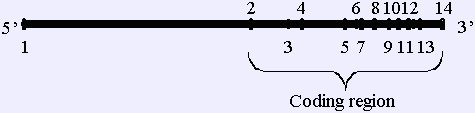
The alignment of PAK1 mRNA to its genomic sequence.
Description
The PAK1 gene contains 14 exons. The sizes of the exons 1-14 are 189, 100, 129, 147, 37, 119, 174, 63, 48, 112, 117, 99, 196, 137, and 86 bps. Exon 2 contains the translation initation ATG, and a few additional codons. Exon 13 contains the stop codon. Other features of the PAK1 gene, such as promoters or enhancer elements, have not been described.
Transcription
PAK1 expression is particularly high in the brain. Other tissues which have reasonably high levels of PAK1 expression include spleen and skeletal muscle. The mRNA size is 1945 bps.
Proteins
Description
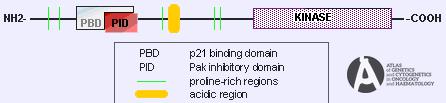
PAK1 is a highly conserved serine/threonine protein kinase of 545 amino acids and is a member of the PAK group of the STE20 family of serine/threonine protein kinases. Pak1 is active in a monomeric form; the non-active form is an autoinhibited homodimer. Pak1 contains a regulatory N-terminal regulatory domain and C-terminal catalytic domain The regulatory domain consists of a p21 GTPase-binding domain (PBD), an inhibitory domain (PID); five SH3-domains; and one non-classical SH3-binding site for the PIX family of proteins (PXP). Pak1 binds to activated forms of the GTPases Cdc42 and Rac. Pak1 homodimerizes through a motif adjacent to the p21-binding domain, and is autoinhibited. Upon binding to Cdc42 or Rac, Pak1 is activated and autophosphorylates. Pak1 has dozens of substrates, activating cytoskeletal and transcription pathways that enhance cell motility, proliferation, and survival.
Expression
PAK1 is highly expressed in epithelium of tongue and larynx and in thyroid gland, expression also found in central nervous system (brain).
Localisation
Under basal conditions, Pak1 localizes to the cytosol. Upon growth factor stimulation, Pak1 is recruited to the plasma membrane as well as the nucleus.
Function
Cell survival and proliferation
Homology
Similar to STE20 in budding yeast and PAK1 in fission yeast. Human PAK1 complements both these yeast genes.
Mutations
Note
No mutations in the PAK1 gene have been reported
Implicated in
Entity name
Cancers
Disease
There is emerging evidence that the Pak family may play a key role in several human malignancies, including breast, ovarian, head and neck, colon, thyroid, and renal cancer. In human breast cancer, the expression level of Pak1 correlates with the tumor grade, with higher expression in less differentiated ductal carcinomas of the breast (grade III tumors) than in grade II and grade I tumors. Pak1 overexpression is also associated with tamoxifen resistance in breast cancer. In human tumors, Pak1 is not itself activated by mutation: rather, Pak1 is overexpressed by unknown mechanisms. Pak1 may also play a role in transformation by Kaposis sarcoma-associated herpes virus, which induces Kaposis sarcoma and primary effusion lymphomas.
Prognosis
Recently, it has been shown that the level of phosphorylated (activated) Pak1 Level in the cytoplasm correlates with shorter survival time in patients with glioblastoma. As noted above, Pak1 expression may also correlate with tamoxifen resistance in breast cancer.
Article Bibliography
| Pubmed ID | Last Year | Title | Authors |
|---|
Other Information
Locus ID:
NCBI: 5058
MIM: 602590
HGNC: 8590
Ensembl: ENSG00000149269
Variants:
dbSNP: 5058
ClinVar: 5058
TCGA: ENSG00000149269
COSMIC: PAK1
RNA/Proteins
Expression (GTEx)
Pathways
Protein levels (Protein atlas)
References
| Pubmed ID | Year | Title | Citations |
|---|---|---|---|
| 38503263 | 2024 | PAK1 Promotes Inflammation Induced by Sepsis through the Snail/CXCL2 Signaling Pathway. | 0 |
| 38720074 | 2024 | Targetable leukaemia dependency on noncanonical PI3Kγ signalling. | 0 |
| 38993552 | 2024 | Deubiquitination of CIB1 by USP14 promotes lenvatinib resistance via the PAK1-ERK1/2 axis in hepatocellular carcinoma. | 0 |
| 38503263 | 2024 | PAK1 Promotes Inflammation Induced by Sepsis through the Snail/CXCL2 Signaling Pathway. | 0 |
| 38720074 | 2024 | Targetable leukaemia dependency on noncanonical PI3Kγ signalling. | 0 |
| 38993552 | 2024 | Deubiquitination of CIB1 by USP14 promotes lenvatinib resistance via the PAK1-ERK1/2 axis in hepatocellular carcinoma. | 0 |
| 36573046 | 2023 | PAK1 Inhibition Suppresses the Proliferation, Migration and Invasion of Glioma Cells. | 0 |
| 37368917 | 2023 | PAK1 copy number in breast cancer-Associations with proliferation and molecular subtypes. | 0 |
| 37564209 | 2023 | PAK1 overexpression promotes myxofibrosarcoma angiogenesis through STAT5B-mediated CSF2 transactivation: clinical and therapeutic relevance of amplification and nuclear entry. | 1 |
| 37581646 | 2023 | A Novel CDC42 Variant with Impaired Thymopoiesis, IL-7R Signaling, PAK1 Binding, and TCR Repertoire Diversity. | 0 |
| 37777103 | 2023 | Activation of oncogenic signaling kinase PAK1 by ionising radiation confers an aggressive phenotype in head and neck squamous cell carcinoma. | 0 |
| 37801909 | 2023 | Clinicopathological significance and the associated signaling pathway of p21-activated kinase 1 (PAK1) in colorectal cancer. | 0 |
| 37820543 | 2023 | A PAK1 Mutational Hotspot Within the Regulatory CRIPaK Domain is Associated With Severe Neurodevelopmental Disorders in Children. | 1 |
| 37830586 | 2023 | PAK1 and Therapy Resistance in Melanoma. | 0 |
| 37967011 | 2023 | PAK1-dependent mechanotransduction enables myofibroblast nuclear adaptation and chromatin organization during fibrosis. | 2 |
Citation
Dina Stepanova ; Jonathan Chernoff
PAK1 (p21/Cdc42/Rac1-activated kinase 1 (STE20 homolog, yeast))
Atlas Genet Cytogenet Oncol Haematol. 2007-12-01
Online version: http://atlasgeneticsoncology.org/gene/41633/pak1
