Atlas of Genetics and Cytogenetics in Oncology and Haematology


Home   Genes   Leukemias   Solid Tumours   Cancer-Prone   Deep Insight   Case Reports   Journals  Portal   Teaching   

X Y 1 2 3 4 5 6 7 8 9 10 11 12 13 14 15 16 17 18 19 20 21 22 NA

PDGFB platelet-derived growth factor beta polypeptide (simian sarcoma viral (v-sis) oncogene homolog)

Identity

Other namesV-sis platelet-derived growth factor beta (simian sarcoma viral oncogene homolog)
HGNC (Hugo) PDGFB
Location 22q12.3-q13.1
Location_base_pair Starts at 37949633 and ends at 37970903 bp from pter ( according to hg18-Mar_2006)  [Mapping]
Local_order Telomeric to TXN2 (thioredoxin, mitochondrial), centromeric to DMC1(dosage suppressor of mck1, yeast homologue meiosis-specific homologous recombination)

DNA/RNA

 
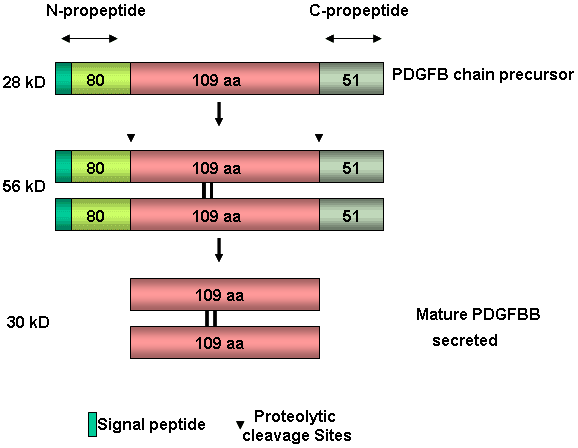
Description The PDGFB gene encodes the human platelet-derived growth factor (PDGF) B chain precursor and is the cellular homologue of the v-sis oncogene. PDGFB gene is 22 kb in size and is composed of 7 exons. The exon 7 and most part of the exon 1 are non coding sequences (white boxes).
Transcription The PDGFB chain precursor is usually translated from a 3.5 kb transcript. The first exon contains the sequence for the signal peptide preceeded by a 1 kb-long untranslated sequence with potent translation inhibitory activity. A 2.6 kb mRNA which initiates at an alternative exon 1, exon 1A, was described in the human choriocarcinoma cell line JEG-3. It initiates an open reading frame that is continuous with the code for the PDGF B chain precursor but lacks the code for the signal peptide.

Protein

 
Description The PDGFB chains are synthesised as 240 amino acids precursors molecules containing amino and carboxy-terminal propeptides, which are removed by site-specific endopeptidases. Two PDGFB precursor chains associate in dimers to form the mature PDGFBB after proteolysis.
Expression First isolated from human platelets, the PDGFBB is synthesized by a variety of different cell lineages.
Localisation Secreted in the extra-cellular medium
Function The homodimer PDGFBB is a potent growth factor that acts as a mitogen and chemo-attractant for a variety of cells from mesenchymal origin. It has various roles in embryonic development, tissue regeneration, osteogenesis, fibrosis, atherosclerosis, and neoplasia.
Homology Member of the PDGF/VEGF family

Implicated in

Entity
  • Dermatofibrosarcoma Protuberans (DP), also called Darier Ferrand tumour or Darier-Hoffmann tumour.
  • Giant cell fibrosarcoma (GCF) (juvenile form of DP).
  • Bednar tumour (pigmented variant of DP)
  • Disease Infiltrative skin tumours of intermediate malignancy
    Prognosis The prognosis is usually favourable. These tumours are locally aggressive and highly recurrent, but metastases or tumour-related deaths are extremely rare.
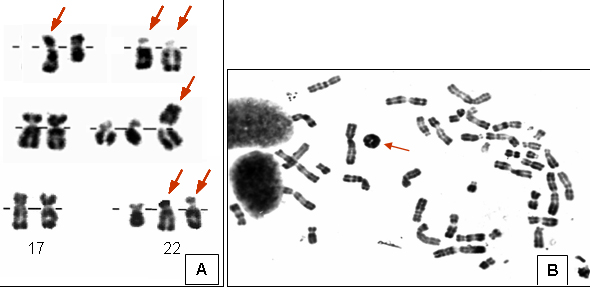
    Cytogenetics Dermatofibrosarcoma Protuberans, Giant Cell fibrosarcoma and Bednar tumours present specific cytogenetic features such as reciprocal translocations t(17;22)(q22;q13.1) ( Fig A) or, more often, supernumerary ring chromosomes derived from t(17;22) (B). As shown by FISH analysis, the ring chromosomes contain chromosome 22 centromere and low-level amplification of 22cen-q13.1 and 17q22-qter sequences. To note, in most cases, the derivative chromosome 17 is not present. In contrast, several copies of the derivative chromosome 22 are generally observed.in addition to two apparently normal chromosomes 17
     
    Hybrid/Mutated Gene
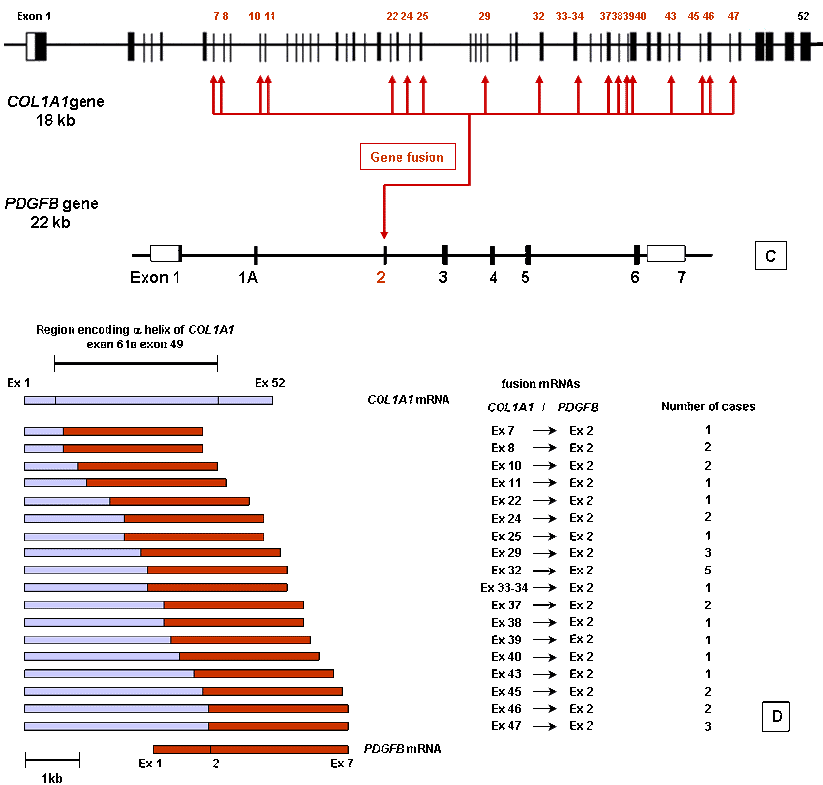
  • Both rings and der(22) translocated chromosomes present a same molecular rearrangement that fuses the collagen type I alpha 1(COL1A1) and the platelet-derived growth factor B chain (PDGFB) genes (C).
  • In all DP and GCF cases studied, the t(17;22)translocation results in chimerical COL1A1/PDGFB mRNA production, in which the PDGFB exon 1 is deleted and replaced by a variable segment of COL1A1 mRNA sequence. In the 32 cases tested the fusion mRNA was an in-frame fusion of one of the COL1A1 exons (varying from exon 7 to exon 47) to PDGFB exon 2 (D).
  • Abnormal Protein
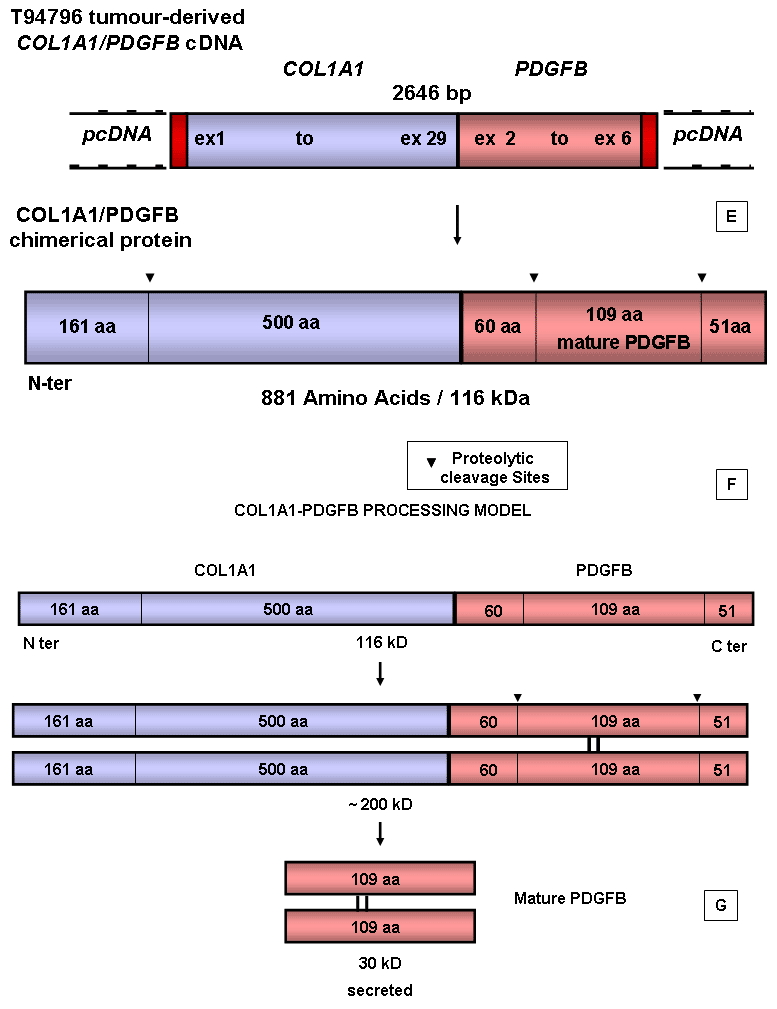
  • COL1A1 and PDGFB are both encoded as pro-peptides, which are processed by proteolytic cleavage at N and C-terminus, to give mature proteins. Sequences analyses of the chimerical COL1A1/PDGFB fusion transcripts showed that the COL1A1/PDGFB putative proteins displayed a pro-peptide structure, which preserved the N-terminus COL1A1 pro-peptide containing the signal peptide and the N and C-terminus PDGFB maturation cleavage sites.
  • The functional and structural properties of the COL1A1/PDGFB fusion protein were characterized by generating stable fibroblastic cell lines that expressed tumour-derived COL1A1/PDGFB chimerical genes. The diagram herein given presents the COL1A1/PDGFB chimerical protein encoded by the T94796 tumour-derived chimerical COL1A1/PDGFB cDNA sequence
  •  
    A chimerical COL1A1/PDGFB cDNA sequence fusing COL1A1 exon 29 to PDGFB exon 2 was isolated from the DP T94796 tumour and stably transfected in the Chinese hamster lung fibroblastic cell line PS200 (E).
    The T94796 COL1A1/PDGFB chimerical protein sequence retained the COL1A1 N-terminus processing site encoded by the COL1A1 exon 6 and the N and C-terminus PDGFB processing sites encoded by the PDGFB exons 3 and 6 respectively (F).
    Mutagenesis experiments and immunodetection with anti-PDGFBB and specific anti-COL1A1/PDGFB antibodies showed that COL1A1/PDGFB expressing cells produced 116 kD chimerical COL1A1/PDGFB precursors chains, which formed dimers and were processed to give active 30 kD PDGFB-like dimers (G).
    Oncogenesis
  • Transfected cells lines expressing the chimerical T94796-COL1A1/PDGFB proteins became independent upon growth factors, including PDGFB, and induced tumours formation in nude mice. In addition, it was shown that the COL1A1/PDGFB stable clones cells contained activated PDGF b-receptors and that the conditioned media from COL1A1/PDGFB transfected cells were able to stimulate fibroblastic cells growth. Anti-PDGFBB antibodies neutralized this effect.
  • These results strongly suggest that the COL1A1/PDGFB chimerical gene expression associated with DP, contributes to tumour formation through ectopic production of mature PDGFB and the formation of an autocrine loop.
  •   

    Breakpoints


    External links

    Nomenclature
    HGNC (Hugo)PDGFB   8800
    Entrez_Gene (NCBI)PDGFB  5155  platelet-derived growth factor beta polypeptide (simian sarcoma viral (v-sis) oncogene homolog)
    Cards
    AtlasPDGFBID155
    GeneCards (Weizmann)PDGFB
    Ensembl (Hinxton)ENSG00000100311 [Gene_View]  PDGFB [Vega]
    AceView (NCBI)PDGFB
    Genatlas (Paris)PDGFB
    euGene (Indiana)5155
    SOURCE (Stanford)NM_002608 NM_033016
    Gene Expression (Array Express) ENSG00000100311
    Genomic and cartography
    GoldenPath (UCSC)PDGFB  -     chr22:37949633-37970903 -  22q12.3-q13.1|22q13.1   [Description]    (hg18-Mar_2006)
    EnsemblPDGFB - 22q12.3-q13.1|22q13.1 [CytoView]
    Mapping of homologs : NCBIPDGFB [Mapview]
    OMIM190040   
    Gene and transcription
    Gene : Genbank (Entrez)AK022920 BC029822 BC077725 BM983641 CR456538
    Reference sequence (RefSeq transcript) :SRSNM_002608 NM_033016
    Reference transcript : EntrezNM_002608 NM_033016
    RefSeq genomic : SRSAC_000065 AC_000154 NC_000022 NG_012111 NT_011520 NW_001838745 NW_927628
    RefSeq genomic : EntrezAC_000065 AC_000154 NC_000022 NG_012111 NT_011520 NW_001838745 NW_927628
    Consensus coding sequences : CCDS NCBIPDGFB
    Cluster EST : UnigeneHs.1976 [ SRS ] Hs.1976 [ NCBI ]
    Alternative Splicing : Fast-db (Paris)6207
    Protein : pattern, domain, 3D structure
    Protein : UniProt/SwissProtP01127 (SRS) P01127 (Expasy) P01127 (Uniprot)
    With graphics : InterProP01127
    Splice isoforms : VarSplice FASTAP01127(VarSplice FASTA)
    Domaine pattern : Prosite (SRS)PDGF_1 (PS00249)    PDGF_2 (PS50278)   
    Domain pattern : Prosite (Expaxy)PDGF_1 (PS00249)    PDGF_2 (PS50278)   
    Domains : Interpro (SRS)PD_growth_factor    PDGF_B    PDGF_N   
    Domains : Interpro (EBI)PD_growth_factor    PDGF_B    PDGF_N   
    Related proteins : CluSTrP01127
    Domain families : Pfam SRSPDGF (PF00341)    PDGF_N (PF04692)   
    Domain families : Pfam SangerPDGF (PF00341)    PDGF_N (PF04692)   
    Domain families : Pfam NCBIpfam00341    pfam04692   
    Domain families : Smart EMBLPDGF (SM00141)  
    Blocks (Seattle)P01127
    Crystal structure of protein : PDB SRS1PDG   
    Crystal structure of protein : PDBSum1PDG   
    Crystal structure of protein : IMB1PDG   
    Crystal structure of protein : PDB RSDB1PDG   
    HPRD01815
    Protein Interaction databases
    DIP (DOE-UCLA)P01127
    IntAct (EBI)P01127
    Polymorphism : SNP, mutations, diseases
    Single Nucleotide Polymorphism (SNP) : dbSNP NCBIPDGFB
    SNP : GeneSNP UtahPDGFB
    SNP : HGBasePDGFB
    Genetic variants : HAPMAPPDGFB
    Cancer Gene: CensusPDGFB 
    Somatic Mutations in Cancer : COSMICPDGFB 
    Translocation Breakpoints in Cancer : TICdbPDGFB 
    Mutations and Diseases : HGMDPDGFB
    Hereditary diseases : OMIM190040   
    Hereditary diseases : GENETests190040   
    Diseases : Genetic AssociationPDGFB
    General knowledge
    Homologs : HomoloGenePDGFB
    Homology/Alignments : Family Browser UCSCPDGFB
    Phylogenetic Trees/Animal Genes : TreeFamPDGFB
    Chemical/Protein Interactions : CTD5155
    Keywords Ontology : AmiGOresponse to hypoxia  positive regulation of endothelial cell proliferation  monocyte chemotaxis  platelet-derived growth factor receptor binding  platelet-derived growth factor receptor binding  platelet-derived growth factor receptor binding  platelet-derived growth factor receptor binding  collagen binding  extracellular region  extracellular region  cytoplasm  substrate-bound cell migration  transforming growth factor beta receptor signaling pathway  growth factor activity  cell surface  response to organic substance  negative regulation of phosphatidylinositol biosynthetic process  negative regulation of platelet activation  positive regulation of smooth muscle cell migration  membrane  cell growth  cell projection assembly  actin cytoskeleton organization  negative regulation of cell migration  platelet dense granule lumen  response to estradiol stimulus  wound healing  protein homodimerization activity  positive regulation of MAP kinase activity  cell surface binding  positive regulation of blood vessel endothelial cell migration  positive regulation of DNA replication  protein heterodimerization activity  platelet-derived growth factor receptor signaling pathway  positive regulation of fibroblast proliferation  platelet-derived growth factor binding  positive regulation of smooth muscle cell proliferation  regulation of peptidyl-tyrosine phosphorylation  positive regulation of chemotaxis  positive regulation of cell division  cell chemotaxis  
    Keywords Ontology : EGO-EBIresponse to hypoxia  positive regulation of endothelial cell proliferation  monocyte chemotaxis  platelet-derived growth factor receptor binding  platelet-derived growth factor receptor binding  platelet-derived growth factor receptor binding  platelet-derived growth factor receptor binding  collagen binding  extracellular region  extracellular region  cytoplasm  substrate-bound cell migration  transforming growth factor beta receptor signaling pathway  growth factor activity  cell surface  response to organic substance  negative regulation of phosphatidylinositol biosynthetic process  negative regulation of platelet activation  positive regulation of smooth muscle cell migration  membrane  cell growth  cell projection assembly  actin cytoskeleton organization  negative regulation of cell migration  platelet dense granule lumen  response to estradiol stimulus  wound healing  protein homodimerization activity  positive regulation of MAP kinase activity  cell surface binding  positive regulation of blood vessel endothelial cell migration  positive regulation of DNA replication  protein heterodimerization activity  platelet-derived growth factor receptor signaling pathway  positive regulation of fibroblast proliferation  platelet-derived growth factor binding  positive regulation of smooth muscle cell proliferation  regulation of peptidyl-tyrosine phosphorylation  positive regulation of chemotaxis  positive regulation of cell division  cell chemotaxis  
    Pathways : BIOCARTATranscriptional activation of dbpb from mRNA [Genes]   
    Pathways : KEGGMAPK signaling pathwayCytokine-cytokine receptor interactionFocal adhesionGap junctionRegulation of actin cytoskeleton
    Other databases
    Probes
    Probes : ImagenesPDGFB Related clones (RZPD - Berlin)
    Literature
    PubMed145 Pubmed reference(s) in Entrez
    PubGenePDGFB

    Bibliography

    Brittle bones--fragile molecules: disorders of collagen gene structure and expression.
    Byers PH
    Trends in genetics : TIG. 1990 ; 6 (9) : 293-300.
    PMID 2238087
     
    Biology of the platelet-derived growth factor.
    Westermark B and Sorg C
    Cytokines. 1993.
     
    Ring 22 chromosomes in dermatofibrosarcoma protuberans are low-level amplifiers of chromosome 17 and 22 sequences.
    Pedeutour F, Simon MP, Minoletti F, Sozzi G, Pierotti MA, Hecht F, Turc-Carel C
    Cancer research. 1995 ; 55 (11) : 2400-2403.
    PMID 7757993
     
    Soft tissue sarcomas in dermatology.
    Fish FS
    Dermatologic surgery : official publication for American Society for Dermatologic Surgery [et al.]. 1996 ; 22 (3) : 268-273.
    PMID 8599739
     
    Translocation, t(17;22)(q22;q13), in dermatofibrosarcoma protuberans: a new tumor-associated chromosome rearrangement.
    Pedeutour F, Simon MP, Minoletti F, Barcelo G, Terrier-Lacombe MJ, Combemale P, Sozzi G, Ayraud N, Turc-Carel C
    Cytogenetics and cell genetics. 1996 ; 72 (2-3) : 171-174.
    PMID 8978765
     
    The human type I collagen mutation database.
    Dalgleish R
    Nucleic acids research. 1997 ; 25 (1) : 181-187.
    PMID 9016532
     
    Deregulation of the platelet-derived growth factor B-chain gene via fusion with collagen gene COL1A1 in dermatofibrosarcoma protuberans and giant-cell fibroblastoma.
    Simon MP, Pedeutour F, Sirvent N, Grosgeorge J, Minoletti F, Coindre JM, Terrier-Lacombe MJ, Mandahl N, Craver RD, Blin N, Sozzi G, Turc-Carel C, O'Brien KP, Kedra D, Fransson I, Guilbaud C, Dumanski JP
    Nature genetics. 1997 ; 15 (1) : 95-98.
    PMID 8988177
     
    Transforming activity of the chimeric sequence formed by the fusion of collagen gene COL1A1 and the platelet derived growth factor b-chain gene in dermatofibrosarcoma protuberans.
    Greco A, Fusetti L, Villa R, Sozzi G, Minoletti F, Mauri P, Pierotti MA
    Oncogene. 1998 ; 17 (10) : 1313-1319.
    PMID 9771975
     
    Signal transduction via platelet-derived growth factor receptors.
    Heldin CH, Ostman A, Rnnstrand L
    Biochimica et biophysica acta. 1998 ; 1378 (1) : F79-113.
    PMID 9739761
     
    Fibrosarcomatous (high-grade) dermatofibrosarcoma protuberans: clinicopathologic and immunohistochemical study of a series of 41 cases with emphasis on prognostic significance.
    Mentzel T, Beham A, Katenkamp D, Dei Tos AP, Fletcher CD
    The American journal of surgical pathology. 1998 ; 22 (5) : 576-587.
    PMID 9591728
     
    COL1A1-PDGFB fusion in a ring chromosome 4 found in a dermatofibrosarcoma protuberans.
    Navarro M, Simon MP, Migeon C, Turc-Carel C, Pedeutour F
    Genes, chromosomes & cancer. 1998 ; 23 (3) : 263-266.
    PMID 9790508
     
    Various regions within the alpha-helical domain of the COL1A1 gene are fused to the second exon of the PDGFB gene in dermatofibrosarcomas and giant-cell fibroblastomas.
    O'Brien KP, Seroussi E, Dal Cin P, Sciot R, Mandahl N, Fletcher JA, Turc-Carel C, Dumanski JP
    Genes, chromosomes & cancer. 1998 ; 23 (2) : 187-193.
    PMID 9739023
     
    The dermatofibrosarcoma protuberans-associated collagen type Ialpha1/platelet-derived growth factor (PDGF) B-chain fusion gene generates a transforming protein that is processed to functional PDGF-BB.
    Shimizu A, O'Brien KP, Sjblom T, Pietras K, Buchdunger E, Collins VP, Heldin CH, Dumanski JP, Ostman A
    Cancer research. 1999 ; 59 (15) : 3719-3723.
    PMID 10446987
     
    Detection of COL1A1-PDGFB fusion transcripts in dermatofibrosarcoma protuberans by reverse transcription-polymerase chain reaction using archival formalin-fixed, paraffin-embedded tissues.
    Wang J, Hisaoka M, Shimajiri S, Morimitsu Y, Hashimoto H
    Diagnostic molecular pathology : the American journal of surgical pathology, part B. 1999 ; 8 (3) : 113-119.
    PMID 10565681
     
    Supernumerary ring chromosome in a Bednar tumor (pigmented dermatofibrosarcoma protuberans) is composed of interspersed sequences from chromosomes 17 and 22: a fluorescence in situ hybridization and comparative genomic hybridization analysis.
    Nishio J, Iwasaki H, Ishiguro M, Ohjimi Y, Yo S, Isayama T, Naito M, Kikuchi M
    Genes, chromosomes & cancer. 2001 ; 30 (3) : 305-309.
    PMID 11170290
     
    Structural and functional analysis of a chimeric protein COL1A1-PDGFB generated by the translocation t(17;22)(q22;q13.1) in Dermatofibrosarcoma protuberans (DP).
    Simon MP, Navarro M, Roux D, Pouyssgur J
    Oncogene. 2001 ; 20 (23) : 2965-2975.
    PMID 11420709
     
    REVIEW articlesautomatic search in PubMed
    Last year publicationsautomatic search in PubMed

    Search in all EBI   NCBI

    Contributor(s)

    Written02-2001Marie-Pierre Simon, Georges Maire, Florence Pedeutour

    Citation

    This paper should be referenced as such :
    Simon MP, Maire G, Pedeutour F . PDGFB platelet-derived growth factor beta polypeptide (simian sarcoma viral (v-sis) oncogene homolog). Atlas Genet Cytogenet Oncol Haematol. February 2001 .
    URL : http://AtlasGeneticsOncology.org/Genes/PDGFBID155.html

    © Atlas of Genetics and Cytogenetics in Oncology and Haematology
    indexed on : Sat Feb 27 10:48:49 CET 2010

    Home   Genes   Leukemias   Solid Tumours   Cancer-Prone   Deep Insight   Case Reports   Journals  Portal   Teaching   

    For comments and suggestions or contributions, please contact us

    jlhuret@AtlasGeneticsOncology.org.