PDX1 (pancreatic and duodenal homeobox 1)
2010-10-01 Guisheng Zhou , F Charles Brunicardi AffiliationMichael E. DeBakey Department of Surgery, Baylor College of Medicine, Houston, Texas 77030, USA
DNA/RNA
Description
PDX-1 gene is located at human chromosome 13q12.1, mouse chromosome 5qG3 and rat chromosome 12, respectively.
PDX-1 gene consists of two exons spanning a region of about 6 kb. In the promoter region of PDX-1, there are three highly conserved regions, termed "Area I-II-III" which are located between -2800 and -1600 base pairs (bp), and a forth distal enhancer element, termed "Area IV" which is located between -6500 and -6045 bp. These enhancer elements harbor binding sites for multiple transcription factors and transcriptional regulators such as HNF-1alpha, HNF-3beta, HNF-6, Foxa1, Foxa2, Pax6, MafA and PDX-1 itself. Areas I and II impart endocrine expression, while Area III confers beta-cell specificity. Area IV is capable of independently directing pancreatic beta-cell-specific reporter gene expression and potentiating the proximal enhancer activity.
PDX-1 gene consists of two exons spanning a region of about 6 kb. In the promoter region of PDX-1, there are three highly conserved regions, termed "Area I-II-III" which are located between -2800 and -1600 base pairs (bp), and a forth distal enhancer element, termed "Area IV" which is located between -6500 and -6045 bp. These enhancer elements harbor binding sites for multiple transcription factors and transcriptional regulators such as HNF-1alpha, HNF-3beta, HNF-6, Foxa1, Foxa2, Pax6, MafA and PDX-1 itself. Areas I and II impart endocrine expression, while Area III confers beta-cell specificity. Area IV is capable of independently directing pancreatic beta-cell-specific reporter gene expression and potentiating the proximal enhancer activity.
Transcription
PDX-1 mRNA has an open reading frame of 849 bp.
Proteins

Figure 1. Schematic representation of functional domains and phosphorylation sites of PDX-1. The numbers indicate the positions of phosphorylation sites and functional domains on the polypeptide chain of human PDX-1. NLS: Nuclear localization signal; PTD: Protein transduction domain; S: Serine; T: Threonine.
Description
Human PDX-1 is a protein of 283 amino acids with a calculated molecular weight of 30.64 kDa. However, endogenous PDX-1 is usually detected as a protein with molecular mass of 46 kDa, likely due to posttranslational modifications such as phosphorylation and sumoylation. The N-terminus of PDX-1 contains a transactivation domain. The middle region contains a homeodomain, which is essential for DNA binding and protein-protein interactions. Within the homeodomain, there is an antennapedia-like protein transduction domain (PTD) which allows PDX-1 to permeate into cells and a nuclear localization signal (NLS) motif, RRMKWKK(197-203aa), which is sufficient for the nuclear import of PDX-1. There is a conserved motif in the C-terminus of PDX-1 that mediates the PDX-1-PCIF1 interaction resulting in the inhibition of PDX-1 transcriptional activity. Several C-terminal residues such as Gly 212, Glu 224 and Pro 239 are essential for full transactivation of PDX-1 as evidenced by the association of their missense mutations with diabetes (Fig. 2). Several potential phosphorylation sites within PDX-1 have been identified, such as Thr 11 by DNA-PK, Ser 61 and 66 by GSK3beta, Thr 152 by PASK, Thr 231 and Ser 232 by CK2 and Ser 268 by AKT-GSK and HIPK2.
Expression
PDX-1 is expressed as early as embryonic day 8.5 (E8.5) in the dorsal and ventral endoderm regions that give rise to pancreatic buds, as well as in the common bile duct, distal stomach, Brunners glands, and duodenal epithelium. During pancreas development, PDX-1 is expressed in all pancreatic precursor cells. PDX-1 expression becomes restricted to beta cells and a small subpopulation of delta and PP cells in adult. Low levels of PDX-1 are also detected in the nuclei of acinar cells. PDX-1 is also expressed in the gastric antrum and duodenum in adult.
The compartmentalization of PDX-1 is lost under pathological conditions. Aberrant overexpression of PDX-1 is observed in a number of human cancers such as pancreatic, gastric, colon, breast, prostate, colorectal, kidney cancer and paediatric solid pseudopapillary tumors. Up-regulated PDX-1 expression is also observed in premalignant metaplastic ductal epithelium during transforming growth factor (TGF)-alpha-induced pancreatic ductal metaplasia and neoplasia.
PDX-1 expression is subject to regulation by glucose, glucagon-like peptide 1 (GLP-1), palmitic acid, peroxisome proliferator-activated receptor-alpha (PPARalpha) and PPARgamma, epidermal growth factor (EGF) and high fat diet.
The compartmentalization of PDX-1 is lost under pathological conditions. Aberrant overexpression of PDX-1 is observed in a number of human cancers such as pancreatic, gastric, colon, breast, prostate, colorectal, kidney cancer and paediatric solid pseudopapillary tumors. Up-regulated PDX-1 expression is also observed in premalignant metaplastic ductal epithelium during transforming growth factor (TGF)-alpha-induced pancreatic ductal metaplasia and neoplasia.
PDX-1 expression is subject to regulation by glucose, glucagon-like peptide 1 (GLP-1), palmitic acid, peroxisome proliferator-activated receptor-alpha (PPARalpha) and PPARgamma, epidermal growth factor (EGF) and high fat diet.
Localisation
PDX-1 is localized in the Nucleus of the cells. In solid pseudopapillary tumors (SPT), however, PDX-1 only exists in the cytoplasm, but not in the nucleus.
Function
Pancreatic and duodenal homeobox-1 (PDX-1) is a homeodomain-containing transcription factor essential for pancreatic development, beta-cell differentiation and the maintenance of mature beta cell function through regulating the expression of key endocrine beta-cell-specific genes such as insulin, glucokinase, islet amyloid polypeptide and the glucose transporter type 2. PDX-1 also regulates the expression of elastase I in pancreatic ductal and acinar cells. PDX-1 is functionally involved in mitochondrial signal generation in the moment-to-moment control of insulin release by regulating mitochondrial transcription factor A (TFAM).
Homology
Human PDX-1 shares a 90% amino acid homology with hamster, 88% with rat, 87% with mouse and 68% with Xenopus. Zebrafish PDX-1 shares a 95% amino acid identity to mammalian PDX-1 in the homeodomain.
Mutations
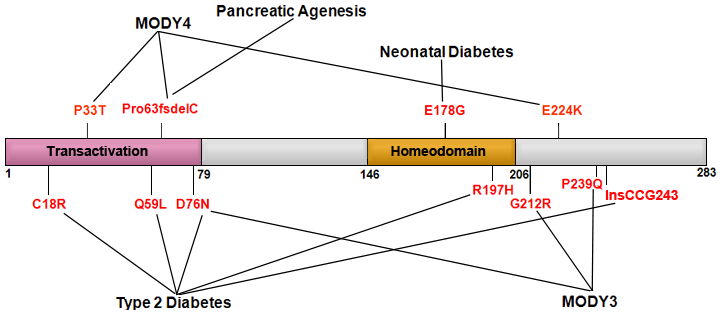
Figure 2. Diabetes-associated genetic mutations of PDX-1. MODY4/3: maturity-onset diabetes of young 43; P: proline; C: cysteine; E: glutamic acid; K: lysine; R: arginine; Q: glutamine; L: leucine; D: aspartic acid; N: asparagine; G: glycine; H: histidine.
Somatic
Pro63fsdelC: a frameshift mutation resulting from a single nucleotide deletion within codon 63 in exon 1 of the coding sequence of PDX-1. The point deletion causes a frame shift resulting in the translation of 59 novel codons before termination and the production of a prematurely terminated truncated protein of 16 kDa.
InsCCG243: an in-frame proline insertion mutation at codon 243 of PDX-1.
Missense mutations: C18R, P33T, Q59L, D76N, E178G, R197H, G212R, E224K and P239Q. These missense mutants show either a decreased binding activity to the insulin gene promoter (C18R, P33T, D76N and R197H) or a reduced transactivity (C18R, P33T, Q59L, D76N, E178G, R197H, G212R, E224K and P239Q) compared to wild-type PDX-1.
InsCCG243: an in-frame proline insertion mutation at codon 243 of PDX-1.
Missense mutations: C18R, P33T, Q59L, D76N, E178G, R197H, G212R, E224K and P239Q. These missense mutants show either a decreased binding activity to the insulin gene promoter (C18R, P33T, D76N and R197H) or a reduced transactivity (C18R, P33T, Q59L, D76N, E178G, R197H, G212R, E224K and P239Q) compared to wild-type PDX-1.
Implicated in
Entity name
Various cancers
Prognosis
Elevated expression of PDX-1 is found in a number of human cancers, including pancreatic, breast, prostate cancer, colorectal cancer, colon cancer, kidney, gastric, paediatric solid pseudopapillary tumors (SPT) and intestinal-type ovarian mucinous neoplasm (OMN). Elevated expression level of PDX-1 in pancreatic cancer is significantly correlated with lymph node metastasis, TNM grading, pathological grading and tumor cell proliferation. PDX-1 expression in pancreatic cancer is an independent survival factor since the patients with positive PDX-1 have a significantly worse prognosis than those patients with negative PDX-1. In colorectal cancer, PDX-1 is highly expressed in hepatic metastasis of colorectal cancer, while lower expression of PDX-1 is found in primary colorectal tumor. Metastatic colorectal adenocarcinoma in the ovarian is also positive for PDX-1. PDX-1 expression also correlates with histological type and depth of invasion of gastric carcinomas.
Entity name
Diabetes
Prognosis
Maturity-onset diabetes of young 4 (MODY4) is a form of early-onset type-II diabetes mellitus in which expression of diabetes occurs later than that observed for MODY1, MODY2 and MODY3. Pro63fsdelC of PDX-1 contributes to the development of MODY4 when the mutation is heterozygous. InsCCG243, PDX-1 P33T and PDX-1 E224K mutations also contribute to the development of MODY4. Two missense mutations (D76N and P239Q) in PDX-1 are found in MODY3 families. Five missense mutations (C18R, Q59L, D76N, E178G and R197H) in PDX-1 are found in patients with Non-MODY type 2 diabetes.
Article Bibliography
| Pubmed ID | Last Year | Title | Authors |
|---|---|---|---|
| 18360684 | 2008 | Pancreatic duodenal homeobox factor-1 and diabetes mellitus type 2 (review). | Al-Quobaili F et al |
| 20637728 | 2010 | Pancreatic and duodenal homeobox 1 (PDX1) phosphorylation at serine-269 is HIPK2-dependent and affects PDX1 subnuclear localization. | An R et al |
| 15028942 | 2004 | PDX-1 and the pancreas. | Ashizawa S et al |
| 18855980 | 2008 | Transcription factor PDX-1 in human colorectal adenocarcinoma: a potential tumor marker? | Ballian N et al |
| 14764823 | 2004 | Insulin promoter factor-1 mutations and diabetes in Trinidad: identification of a novel diabetes-associated mutation (E224K) in an Indo-Trinidadian family. | Cockburn BN et al |
| 18671802 | 2008 | Transcription factors involved in pancreas development are expressed in paediatric solid pseudopapillary tumours. | Galmiche L et al |
| 19656489 | 2009 | PDX1 deficiency causes mitochondrial dysfunction and defective insulin secretion through TFAM suppression. | Gauthier BR et al |
| 16092045 | 2005 | IPF-1/MODY4 gene missense mutation in an Italian family with type 2 and gestational diabetes. | Gragnoli C et al |
| 10545531 | 1999 | Defective mutations in the insulin promoter factor-1 (IPF-1) gene in late-onset type 2 diabetes mellitus. | Hani EH et al |
| 19833727 | 2010 | Glucose regulates steady-state levels of PDX1 via the reciprocal actions of GSK3 and AKT kinases. | Humphrey RK et al |
| 18754323 | 2008 | Expression of PDX-1 in prostate cancer, prostatic intraepithelial neoplasia and benign prostatic tissue. | Jonmarker S et al |
| 17627512 | 2007 | Crucial role of PDX-1 in pancreas development, beta-cell differentiation, and induction of surrogate beta-cells. | Kaneto H et al |
| 16938521 | 2006 | Expression of Pdx-1 in human gastric metaplasia and gastric adenocarcinoma. | Leys CM et al |
| 18665037 | 2008 | Intestinal type and endocervical-like ovarian mucinous neoplasms are immunophenotypically distinct entities. | Lin X et al |
| 20886630 | 2011 | PDX-1: demonstration of oncogenic properties in pancreatic cancer. | Liu SH et al |
| 18477649 | 2008 | Pancreatic duodenal homeobox-1 (PDX1) functions as a tumor suppressor in gastric cancer. | Ma J et al |
| 10974025 | 2000 | Missense mutations in the insulin promoter factor-1 gene predispose to type 2 diabetes. | Macfarlane WM et al |
| 10567702 | 1999 | Identification of a nuclear localization signal, RRMKWKK, in the homeodomain transcription factor PDX-1. | Moede T et al |
| 20009086 | 2010 | A novel hypomorphic PDX1 mutation responsible for permanent neonatal diabetes with subclinical exocrine deficiency. | Nicolino M et al |
| 12829640 | 2003 | PDX-1 protein containing its own antennapedia-like protein transduction domain can transduce pancreatic duct and islet cells. | Noguchi H et al |
| 19077462 | 2009 | The expression pattern of PDX-1, SHH, Patched and Gli-1 is associated with pathological and clinical features in human pancreatic cancer. | Quint K et al |
| 14960508 | 2004 | PDX1 homeobox protein expression in pseudopyloric glands and gastric carcinomas. | Sakai H et al |
| 9649577 | 1998 | Insulin promoter factor-1 gene mutation linked to early-onset type 2 diabetes mellitus directs expression of a dominant negative isoprotein. | Stoffers DA et al |
| 15706433 | 2005 | Tissue MicroArray analyses of pancreatic duodenal homeobox-1 in human cancers. | Wang XP et al |
| 11270685 | 2001 | Functional consequences of mutations in the MODY4 gene (IPF1) and coexistence with MODY3 mutations. | Weng J et al |
Other Information
Locus ID:
NCBI: 3651
MIM: 600733
HGNC: 6107
Ensembl: ENSG00000139515
Variants:
dbSNP: 3651
ClinVar: 3651
TCGA: ENSG00000139515
COSMIC: PDX1
RNA/Proteins
| Gene ID | Transcript ID | Uniprot |
|---|---|---|
| ENSG00000139515 | ENST00000381033 | P52945 |
Expression (GTEx)
Pathways
Protein levels (Protein atlas)
PharmGKB
| Entity ID | Name | Type | Evidence | Association | PK | PD | PMIDs |
|---|---|---|---|---|---|---|---|
| PA24684 | AKT1 | Gene | Pathway | associated |
References
| Pubmed ID | Year | Title | Citations |
|---|---|---|---|
| 38171340 | 2024 | Repression of latent NF-κB enhancers by PDX1 regulates β cell functional heterogeneity. | 1 |
| 38587174 | 2024 | RFX6 regulates human intestinal patterning and function upstream of PDX1. | 0 |
| 38171340 | 2024 | Repression of latent NF-κB enhancers by PDX1 regulates β cell functional heterogeneity. | 1 |
| 38587174 | 2024 | RFX6 regulates human intestinal patterning and function upstream of PDX1. | 0 |
| 34357821 | 2023 | miR-765 targeting PDX1 impairs pancreatic β-cell function to induce type 2 diabetes. | 3 |
| 37652665 | 2023 | Novel pathogenic PDX1 gene variant in a Korean family with maturity-onset diabetes of the young. | 0 |
| 34357821 | 2023 | miR-765 targeting PDX1 impairs pancreatic β-cell function to induce type 2 diabetes. | 3 |
| 37652665 | 2023 | Novel pathogenic PDX1 gene variant in a Korean family with maturity-onset diabetes of the young. | 0 |
| 35169223 | 2022 | Hypermethylation of PDX1, EN2, and MSX1 predicts the prognosis of colorectal cancer. | 9 |
| 35183219 | 2022 | Knockdown of PDX1 enhances the osteogenic differentiation of ADSCs partly via activation of the PI3K/Akt signaling pathway. | 1 |
| 35279781 | 2022 | TAZ promotes PDX1-mediated insulinogenesis. | 2 |
| 36272648 | 2022 | Biophysical insights into glucose-dependent transcriptional regulation by PDX1. | 3 |
| 36496541 | 2022 | STAT3 suppression and β-cell ablation enhance α-to-β reprogramming mediated by Pdx1. | 1 |
| 36718853 | 2022 | Significance of pancreatic duodenal homeobox-1 (PDX-1) genetic polymorphism in insulin secretion in Japanese patients with type 2 diabetes. | 1 |
| 35169223 | 2022 | Hypermethylation of PDX1, EN2, and MSX1 predicts the prognosis of colorectal cancer. | 9 |
Citation
Guisheng Zhou ; F Charles Brunicardi
PDX1 (pancreatic and duodenal homeobox 1)
Atlas Genet Cytogenet Oncol Haematol. 2010-10-01
Online version: http://atlasgeneticsoncology.org/gene/43921/pdx1
