PDZK1IP1 (PDZK1 interacting protein 1)
2011-07-01 Amancio Carnero AffiliationInstituto de Biomedicina de Sevilla, (IBIS\\\/HUVR), Consejo Superior de Investigaciones Cientificas (CSIC), Edificio IBIS, Campus Hospital Universitario Virgen del Rocio, Avda, Manuel Siurot s\\\/n, 41013, Sevilla, Spain
Identity
HGNC
LOCATION
1p33
LOCUSID
ALIAS
DD96,MAP17,SPAP
FUSION GENES
DNA/RNA
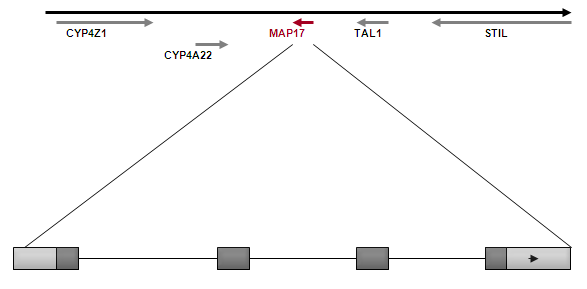
Scheme of the PDZK1IP1/MAP17 locus and transcript.
Transcription
Four coding exons produce a 600 bp transcript only expressed in proximal tubule kidney cells. PDZK1IP1/MAP17 mRNA is overexpressed in a great variety of human carcinomas and strongly correlates with tumoral progression (P
Proteins

Scheme of the PDZK1IP1/MAP17 protein. Blue barrs indicate transmembrane regions. Pink barr indicates PDZ-binding domain.
Description
MAP17 is a small, non-glycosylated membrane-associated protein of 17 kDa, which is located on the plasma membrane and the Golgi apparatus. The protein sequence possesses a hydrophobic amino-terminus containing 13 amino acids that encodes a PDZ-binding domain and two transmembrane regions. MAP17 binds several PDZ domain-containing proteins, including PDZK1, NHERF proteins, NaPiIIa and NHe3. Together with NHRF3 and NHRF4, overexpression of MAP17 in opossum kidney cells leads to internalization of NaPilla to the trans-Golgi network. In normal tissue MAP17 is only expressed in the proximal tubules of kidney cells. The physiological role of MAP17 in proximal tubules is not known, but it stimulates specific Na-dependent transport of mannose and glucose in Xenopus oocytes and some mammary cells.
Expression
MAP17 protein is overexpressed in a great variety of human carcinomas. Immunohistochemical analysis of MAP17 during cancer progression shows, at least in prostate and ovarian carcinomas, that overexpression of the protein strongly correlates with tumoral progression (P
Localisation
Apical end of proximal tubule cells in kidney.
Function
MAP17 binds several PDZ domain-containing proteins, including PDZK1, NHERF proteins, NaPiIIa and NHe3. Overexpression of MAP17 into opossum kidney cells participates, together with NHRF3 and NHRF4 in NaPiIIa internalization to the transgolgi network. The physiological role of MAP17 in proximal tubules is not known but it stimulates specific Na-dependent transport of mannose and glucose in Xenopus oocytes and in mammary cells.
Homology
Higly conserved protein troughout the evolution.
Mutations
Note
Described mutated in malignant mesothelioma tumors with a change of aminoacid (T to I). The functional effect of the change is not known.
Somatic
c403t
Implicated in
Entity name
Cancer
Disease
Carcinomas of different origin, melanoma, etc.
Prognosis
Expression levels increase with stage in most carcinomas.
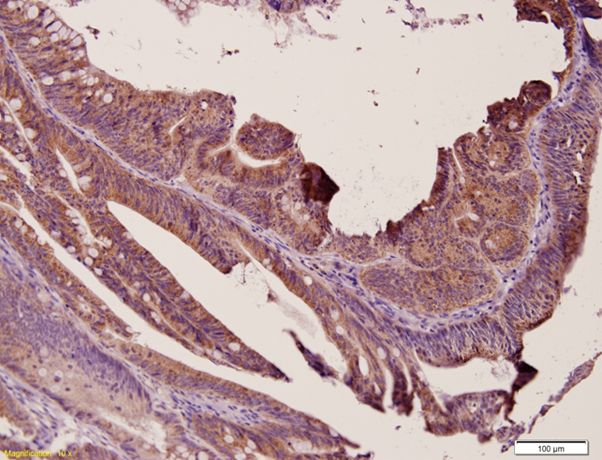
Overexpression of MAP17 in colon carcinoma.
Oncogenesis
MAP17 (PDZK1IP1, DD96) enhances tumorigenic properties of melanoma cells through ROS increase (Guijarro et al., 2007b). Tumor cells that overexpress MAP17 show an increased tumoral phenotype with enhanced proliferative capabilities both in presence or absence of contact inhibition, decreased apoptotic sensitivity and increased migration. MAP17-expressing clones also grow better in nude mice. The increased malignant cell behavior induced by MAP17 are associated with an increase in ROS production, and the treatment of MAP17-expressing cells with antioxidants results in a reduction in the tumorigenic properties of these cells. Treatment of melanoma cells with inhibitors of Na+-coupled co-transporters lead to an inhibition of ROS increase and a decrease in the malignant cell behavior in MAP17-expressing clones. Finally, we show that MAP17-dependent ROS increase and tumorigenesis are dependent on its PDZ-binding domain, since disruption of its sequence by point mutations abolish its ability to enhance ROS production and tumorigenesis.
At the molecular level MAP17 protects Rat1a fibroblasts from Myc-induced apoptosis through ROS-mediated activation of the PI3K/AKT signalling pathway (Guijarro et al., 2007d). A fraction of PTEN undergoes oxidation in MAP17-overexpressing cells. Furthermore, activation of AKT by MAP17 as measured by Thr308 phosphorylation was independent of PI3K activity. Importantly, modulation of ROS by antioxidant treatment prevented activation of AKT, restoring the level of apoptosis in serum starved Rat1/c-Myc fibroblasts (Guijarro et al., 2007d).
MAP17 is overexpressed in a great variety of human carcinomas (Guijarro et al., 2007c). Immunohistochemical analysis of MAP17 during cancer progression shows in prostatic and ovarian carcinomas that overexpression of the protein strongly correlates with tumoral progression (Guijarro et al., 2007c).
At the molecular level MAP17 protects Rat1a fibroblasts from Myc-induced apoptosis through ROS-mediated activation of the PI3K/AKT signalling pathway (Guijarro et al., 2007d). A fraction of PTEN undergoes oxidation in MAP17-overexpressing cells. Furthermore, activation of AKT by MAP17 as measured by Thr308 phosphorylation was independent of PI3K activity. Importantly, modulation of ROS by antioxidant treatment prevented activation of AKT, restoring the level of apoptosis in serum starved Rat1/c-Myc fibroblasts (Guijarro et al., 2007d).
MAP17 is overexpressed in a great variety of human carcinomas (Guijarro et al., 2007c). Immunohistochemical analysis of MAP17 during cancer progression shows in prostatic and ovarian carcinomas that overexpression of the protein strongly correlates with tumoral progression (Guijarro et al., 2007c).
Entity name
Skin diseases
Disease
Abnormal keratinocyte differentiation.
In the meta-analysis of public microarray databases for different skin diseases, Noh and cols (Noh et al., 2010) revealed that MAP17 is commonly up-regulated suggesting that may be potentially associated with the abnormal keratinocyte differentiation. MAP17 was significantly up-regulated in response to interferon-gamma, interleukin 4 (IL-4), IL-6, IL-17A or IL-22 in normal human epidermal keratinocytes (NHEK). Interestingly, the PDZK1 gene is localized within the atopic dermatitis-linked region on human chromosome 1q21. In an attempt to evaluate whether MAP17 regulates the expression of cornified envelope-associated genes at the 1q21 locus, such as filaggrin, loricrin and involucrin, these authors found that the over-expression of MAP17 in HaCaT keratinocytes significantly decreased the expression of filaggrin, a cornified envelope-associated gene. Taken together, the Th cell cytokine-induced up-regulation of MAP17 expression may be linked to the down-regulation of filaggrin, which may be associated with the abnormal epidermal differentiation observed in the dermatological diseases (Noh et al., 2010).
In the meta-analysis of public microarray databases for different skin diseases, Noh and cols (Noh et al., 2010) revealed that MAP17 is commonly up-regulated suggesting that may be potentially associated with the abnormal keratinocyte differentiation. MAP17 was significantly up-regulated in response to interferon-gamma, interleukin 4 (IL-4), IL-6, IL-17A or IL-22 in normal human epidermal keratinocytes (NHEK). Interestingly, the PDZK1 gene is localized within the atopic dermatitis-linked region on human chromosome 1q21. In an attempt to evaluate whether MAP17 regulates the expression of cornified envelope-associated genes at the 1q21 locus, such as filaggrin, loricrin and involucrin, these authors found that the over-expression of MAP17 in HaCaT keratinocytes significantly decreased the expression of filaggrin, a cornified envelope-associated gene. Taken together, the Th cell cytokine-induced up-regulation of MAP17 expression may be linked to the down-regulation of filaggrin, which may be associated with the abnormal epidermal differentiation observed in the dermatological diseases (Noh et al., 2010).
Prognosis
.
Article Bibliography
| Pubmed ID | Last Year | Title | Authors |
|---|---|---|---|
| 12812916 | 2003 | Rat kidney MAP17 induces cotransport of Na-mannose and Na-glucose in Xenopus laevis oocytes. | Blasco T et al |
| 17675338 | 2007 | MAP17 inhibits Myc-induced apoptosis through PI3K/AKT pathway activation. | Guijarro MV et al |
| 10951271 | 2000 | The membrane-associated protein pKe#192/MAP17 in human keratinocytes. | Jaeger C et al |
| 8701988 | 1996 | Identification and partial characterization of a novel membrane-associated protein (MAP17) up-regulated in human carcinomas and modulating cell replication and tumor growth. | Kocher O et al |
| 16926447 | 2007 | Interaction of MAP17 with NHERF3/4 induces translocation of the renal Na/Pi IIa transporter to the trans-Golgi. | Lanaspa MA et al |
| 19601982 | 2010 | MAP17 is associated with the T-helper cell cytokine-induced down-regulation of filaggrin transcription in human keratinocytes. | Noh M et al |
| 12837682 | 2003 | Interactions of MAP17 with the NaPi-IIa/PDZK1 protein complex in renal proximal tubular cells. | Pribanic S et al |
Other Information
Locus ID:
NCBI: 10158
MIM: 607178
HGNC: 16887
Ensembl: ENSG00000162366
Variants:
dbSNP: 10158
ClinVar: 10158
TCGA: ENSG00000162366
COSMIC: PDZK1IP1
RNA/Proteins
| Gene ID | Transcript ID | Uniprot |
|---|---|---|
| ENSG00000162366 | ENST00000294338 | Q13113 |
| ENSG00000162366 | ENST00000371885 | Q13113 |
Expression (GTEx)
Protein levels (Protein atlas)
References
| Pubmed ID | Year | Title | Citations |
|---|---|---|---|
| 36737832 | 2023 | MiR-455-5p suppresses PDZK1IP1 to promote the motility of oral squamous cell carcinoma and accelerate clinical cancer invasion by regulating partial epithelial-to-mesenchymal transition. | 4 |
| 36737832 | 2023 | MiR-455-5p suppresses PDZK1IP1 to promote the motility of oral squamous cell carcinoma and accelerate clinical cancer invasion by regulating partial epithelial-to-mesenchymal transition. | 4 |
| 35727731 | 2022 | PDZK1 Interacting Protein 1 Promotes the Progression of Papillary Thyroid Cancer. | 1 |
| 35727731 | 2022 | PDZK1 Interacting Protein 1 Promotes the Progression of Papillary Thyroid Cancer. | 1 |
| 33280497 | 2021 | MAP17 contributes to non-small cell lung cancer progression via suppressing miR-27a-3p expression and p38 signaling pathway. | 5 |
| 33832535 | 2021 | Hypoxia-dependent expression of MAP17 coordinates the Warburg effect to tumor growth in hepatocellular carcinoma. | 6 |
| 33853080 | 2021 | MAP17 Expression in Colorectal Cancer Is a Prognostic Factor for Disease Recurrence and Dismal Prognosis Already in Early Stage Disease. | 0 |
| 34719205 | 2021 | 80MAP17 promotes the tumorigenesis of papillary thyroid carcinoma by reducing the stability of p53. | 1 |
| 33280497 | 2021 | MAP17 contributes to non-small cell lung cancer progression via suppressing miR-27a-3p expression and p38 signaling pathway. | 5 |
| 33832535 | 2021 | Hypoxia-dependent expression of MAP17 coordinates the Warburg effect to tumor growth in hepatocellular carcinoma. | 6 |
| 33853080 | 2021 | MAP17 Expression in Colorectal Cancer Is a Prognostic Factor for Disease Recurrence and Dismal Prognosis Already in Early Stage Disease. | 0 |
| 34719205 | 2021 | 80MAP17 promotes the tumorigenesis of papillary thyroid carcinoma by reducing the stability of p53. | 1 |
| 32963243 | 2020 | Sarcoma stratification by combined pH2AX and MAP17 (PDZK1IP1) levels for a better outcome on doxorubicin plus olaparib treatment. | 7 |
| 32963243 | 2020 | Sarcoma stratification by combined pH2AX and MAP17 (PDZK1IP1) levels for a better outcome on doxorubicin plus olaparib treatment. | 7 |
| 30718277 | 2019 | PDZK1-interacting protein 1 (PDZK1IP1) traps Smad4 protein and suppresses transforming growth factor-β (TGF-β) signaling. | 8 |
Citation
Amancio Carnero
PDZK1IP1 (PDZK1 interacting protein 1)
Atlas Genet Cytogenet Oncol Haematol. 2011-07-01
Online version: http://atlasgeneticsoncology.org/gene/41268/pdzk1ip1
