PKM (pyruvate kinase isoenzyme type M2)
2008-05-01 Sybille Mazurek , Ferdinand Hugo , Werner Zwerschke AffiliationIdentity
HGNC
LOCATION
15q23
LOCUSID
ALIAS
CTHBP,HEL-S-30,OIP3,PK3,PKM2,TCB,THBP1,p58
FUSION GENES
DNA/RNA
Note
Pyruvate kinase isoenzyme type M2 (alias M2-PK, alias PKM2) is one of four pyruvate kinase isoenzymes which differ widely in their occurrence according to the type of tissue, their kinetic characteristics and regulation mechanisms. The three other pyruvate kinase isoenzymes are type M1, type L and type R. The PKM-gene encodes for pyruvate kinase isoenzyme type M2 as well as pyruvate kinase isoenzyme type M1.
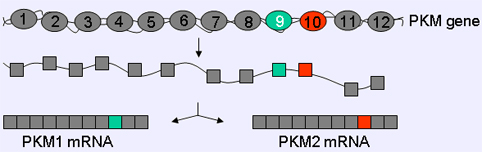
Exon/intron structure of the PKM gene and the PKM1 and PKM2 mRNAs derived by alternative splicing.
Description
The human PKM gene is 32,315 kb long and consists of 12 exons and 11 introns.
Transcription
Pyruvate kinase isoenzymes type M1 and type M2 are different splicing products of the PKM gene (exon 9 for M1-PK and exon 10 for M2-PK). Both mRNAs are 1593 base pairs long and differ from another within 160 nucleotide residues from 1143-1303. The PKM gene is induced by hormones, mitogenic pathways and nutrients. The thyroid gland hormone triiodothyronine (T3) induces PKM gene expression in rat pituitary cells and the monomeric form of the PKM protein has been identified as T3-receptor. Interleukin 2 stimulates PKM transcription in proliferating thymocytes, resulting in increased PKM2 mRNA and protein levels in the S phase of the cell cycle. In NIH3T3 L1 adipocytes PKM gene expression is induced by insulin. Evidence for a role of hypoxia, and the key nutrients glucose and glutamine, in the regulation of PKM gene expression has also been reported. The regulation of the PKM gene at the promoter level is, however, not well understood. The PKM gene contains putative DNA-consensus binding sites for the transcription factors Sp1 and Sp3 (GC-boxes) and Sp1/Sp3-dependent stimulation of PKM gene transcription has been demonstrated. The GC-boxes appear to also play a role in glucose-dependent PKM-gene induction. A carbohydrate-response element (ChoRE), which integrates regulation of many glycolytic genes in response to changes in glucose concentration, has not yet been precisely localized in the PKM promoter region. However, putative consensus DNA-binding elements for USF (Upstream stimulating factor), a transcription factor which is involved in glucose-response, HIF-1alpha (Hypoxia-inducible factor) and the oncogenic transcription factor Myc are present within the PKM promoter region. The USF-box (5-CACGTG-3), the HIF-1alpha DNA-binding consensus element (5-RCGTG-3) as well as the MYC consensus element (E-box; 5-CACGTG-3) match the consensus core DNA-binding sites (5-CACGTG-3) of the ChoRE. However, direct evidence for a role of these transcription factors in the stimulation of PKM gene expression has bot been obtained.
Pseudogene
No Pseudogenes.
Proteins
Note
In various references pyruvate kinase isoenzyme type M2 (abbreviations M2-PK or PKM2) has been termed type III, type A, type B, type K or type K4.
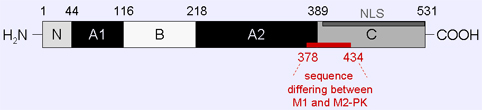
Molecular structure of the human PKM2 protein. NLS = nuclear localization signal.
Description
Each monomer of PKM2 consists of 531 amino acids and can be subdivided into four domains: the N-domain (aa 1-43), the A-domain (aa 44-116 and 219-389), the B-domain (aa 117-218) and the C-domain (aa 390-531). The molecular weight of the M2-PK monomer is 58 kD. In contrast to the other PK isoenzymes which are characterized by a tetrameric quaternary structure, M2-PK occurs in a tetrameric as well as dimeric form. The dimeric form of M2-PK is the result of intracellular contact between the A-domain of two monomers. The tetrameric form occurs by association of the interface of the C-domains of two dimers. The C-domain contains 44 amino acids of the 56 amino acid stretch (aa 378-434) which differs between M1 and M2-PK-isoenzymes and is responsible for the different kinetic characteristics and regulation mechanisms found for M1 and M2-PK, i.e. fructose 1,6-P2 activation and interaction with different oncoproteins. The cleft formed between the A- and B-domain is the location of the active site of the enzyme. The C-domain (aa 393-531) comprises an inducible nuclear translocation signal.
Expression
Pyruvate kinase isoenzyme type M2 is expressed in some differentiated tissues, such as lung, fat tissue, retina, pancreatic islets as well as in all cells with a high rate of nucleic acid synthesis, which include all proliferating cells, such as normal proliferating cells, embryonic cells, adult stem cells and especially tumor cells. In healthy tissues all pyruvate kinase isoenzymes consist of four subunits whereby hybrids of the different forms can also occur. Hybrids between M1 and M2-PK were found in the oesophagus and the stomach. L-PK and M2-PK hybrids were found in the jejunum, colon and rectum. During differentiation of embryonic cells M2-PK is progressively replaced by the respective tissue specific isoenzyme. Conversely, during tumorigenesis the tissue specific isoenzymes disappear and M2-PK is expressed.
Localisation
Pyruvate kinase type M2 is found predominantly in the cytosol and to a minor extent in the nucleus. Cytosolic M2-PK is associated with other glycolytic enzymes, i.e. hexokinase, glyceraldehyde 3-P dehydrogenase, phosphoglycerate kinase, phosphoglyceromutase, enolase and lactate dehydrogenase in a so-called glycolytic enzyme complex.
Function
Pyruvate kinase (ATP: pyruvate O2-phosphotransferase; EC 2.7.1.40) catalyzes the last step within glycolysis, the dephosphorylation of phosphoenolpyruvate (PEP) to pyruvate while producing one mole of ATP per mole of PEP. Depending upon the tetramer to dimer ratio M2-PK plays a bi-functional role within tumor metabolism. The tetrameric form of M2-PK favors the degradation of glucose to pyruvate and lactate with regeneration of energy due to a high affinity to its substrate PEP. The dimeric form is characterized by a low PEP affinity and is nearly inactive at physiological PEP concentrations. This leads to an expansion of all phosphometabolites above the pyruvate kinase reaction and an increased channeling of glucose carbons into synthetic processes, i.e. DNA, phospholipid and amino acid synthesis. Tumor cells contain high levels of dimeric M2-PK, which has therefore been termed Tumor M2-PK.
The M2-PK tetramer to dimer ratio fluctuates in tumor cells depending upon the concentrations of signal metabolites. High fructose 1,6-P2 levels induce the association of the inactive dimeric form of M2-PK to the highly active tetrameric form. When FBP levels drop below a critical value the tetrameric form dissociates to the dimeric form. Dimerization of M2-PK is induced by direct interaction with different oncoproteins, i.e. pp60v-src, A-Raf and HPV-16 E7. The importance of M2-PK for oncogenesis is further underlined by the impairment of the oncogenic activity of activated A-Raf (gag-A-Raf) by a kinase-dead mutant of M2-PK and the enhancement of the transforming activity of gag-A-Raf by ectopically expressed wild type M2-PK. Similarly, a knockdown of M2-PK expression by short hairpin RNA and replacement with M1-PK led to a reduction in tumor growth rate. Peptide aptamers which specifically bind to M2-PK and not to the 96% homologous PK isoenzyme type M1 were found to avoid re-association of M2-PK to the tetrameric form thereby reducing ATP levels and decelerating tumor cell proliferation.
Recent work has shown that the binding of cytosolic promyelocytic leukemia (PML) tumor suppressor protein to M2-PK leads to inhibition of the activity of the tetrameric form of M2-PK which results in a suppression of lactate production. The interaction of M2-PK with HERC-1, PKCdelta and tumor endothelial marker TEM8 has also been reported; however, the physiological functions of these findings are not yet well understood.
Regarding the function of M2-PK in the nucleus both pro-proliferative, but also pro-apoptotic stimuli have been described. Thus, interleukin-3-induced nuclear translocation of M2-PK stimulated cell proliferation, whereas nuclear translocation of M2-PK induced by TT232, H2O2 or UV-irradiation was linked to the induction of caspase independent programmed cell death. Nuclear M2-PK was found to participate in the phosphorylation of histone H1 by direct phosphate transfer from PEP to histone H1. Furthermore, M2-PK was shown to interact with Oct-4 and stimulates transactivation by the transcription factor; however, the functional consequences of these findings have not been elucidated.
The interaction between PKM2 with gonococcal Opa proteins points to a physiological role of M2-PK in bacterial pathogenesis.
The M2-PK tetramer to dimer ratio fluctuates in tumor cells depending upon the concentrations of signal metabolites. High fructose 1,6-P2 levels induce the association of the inactive dimeric form of M2-PK to the highly active tetrameric form. When FBP levels drop below a critical value the tetrameric form dissociates to the dimeric form. Dimerization of M2-PK is induced by direct interaction with different oncoproteins, i.e. pp60v-src, A-Raf and HPV-16 E7. The importance of M2-PK for oncogenesis is further underlined by the impairment of the oncogenic activity of activated A-Raf (gag-A-Raf) by a kinase-dead mutant of M2-PK and the enhancement of the transforming activity of gag-A-Raf by ectopically expressed wild type M2-PK. Similarly, a knockdown of M2-PK expression by short hairpin RNA and replacement with M1-PK led to a reduction in tumor growth rate. Peptide aptamers which specifically bind to M2-PK and not to the 96% homologous PK isoenzyme type M1 were found to avoid re-association of M2-PK to the tetrameric form thereby reducing ATP levels and decelerating tumor cell proliferation.
Recent work has shown that the binding of cytosolic promyelocytic leukemia (PML) tumor suppressor protein to M2-PK leads to inhibition of the activity of the tetrameric form of M2-PK which results in a suppression of lactate production. The interaction of M2-PK with HERC-1, PKCdelta and tumor endothelial marker TEM8 has also been reported; however, the physiological functions of these findings are not yet well understood.
Regarding the function of M2-PK in the nucleus both pro-proliferative, but also pro-apoptotic stimuli have been described. Thus, interleukin-3-induced nuclear translocation of M2-PK stimulated cell proliferation, whereas nuclear translocation of M2-PK induced by TT232, H2O2 or UV-irradiation was linked to the induction of caspase independent programmed cell death. Nuclear M2-PK was found to participate in the phosphorylation of histone H1 by direct phosphate transfer from PEP to histone H1. Furthermore, M2-PK was shown to interact with Oct-4 and stimulates transactivation by the transcription factor; however, the functional consequences of these findings have not been elucidated.
The interaction between PKM2 with gonococcal Opa proteins points to a physiological role of M2-PK in bacterial pathogenesis.
Homology
It is assumed that M1 and M2-PK diverged shortly before the evolution of fish. The pyruvate kinase amino acid sequence is highly conserved. The homology between human M1-PK and human M2-PK is 96%. Comparison of the M2-PK amino acid sequence between different species revealed the following homologies: human and rat: 93%; human and mus musculus: 93 %; rat and mus musculus 98%; human and S. cerevisiae: 50%.
Mutations
Note
There is one report which describes a missense mutation and a frame shift mutation in exon 10 of the M gene in three B-lymphoblastoid cell lines established from three Bloom syndrome patients. Exon 10 encodes for the intersubunit contact domain of the M2-PK protein. These mutations have a dominant negative effect leading to inactivation of M2-PK. However, the relevance of these mutations has not yet been determined.
Implicated in
Entity name
Renal cell carcinoma
Disease
The term renal cell carcinoma (RCC) comprises different histological types whereby the clear cell renal cell carcinoma is the most common histologic variant, accounting for approximately 70% of all cases. Estimated incidences rank RCC as the 13th most common malignancy in men and 15th in women. In addition to sporadic forms, hereditary forms of RCC also occur, e.g. in a high proportion of patients with von Hippel-Lindau disease (VHL).
Oncogenesis
In patients with von Hippel-Lindau disease and in a high percentage of tumors from patients with sporadic clear cell RCC, one inherited allele of the VHL gene - a master regulator of HIF (hypoxia-inducible factor) - is mutated and the second allele is deleted. VHL mutations lead to a pseudo-hypoxic state with overproduction of HIF-1a. The PKM promotor contains a binding site for HIF-1. Hypoxia correlates with an increase in PKM2 mRNA.
Entity name
Tumors of the uterine cervix
Disease
Cervical carcinoma is the 2nd most common cancer in women worldwide. It originates for the most part from the transformation zone of the cervix. The histologic morphology is predominantly of the squamous cell type.
Oncogenesis
Chronic infection with human papillomavirus (HPV) plays a major aetiological role in the evolution of cervical carcinomas. The products of the oncogenes E6 and E7 from HPV 16 are able to form stable complexes with cellular proteins thereby modifying or inactivating their normal functions. It has been shown that the E7 protein physically interacts with and stabilizes the dimeric form of PKM2.
Entity name
Gastric carcinoma
Note
In different gastric carcinoma cell lines cisplatin resistance was found to correlate with low M2-PK protein levels and activities. Lowering of M2-PK expression through antisense transfection increased cisplatin resistance.
Disease
Stomach cancer is the 4th most common cancer worldwide. Helicobacter pylori infection appears to play a pivotal aetiological role in the induction of the intestinal type of gastric carcinoma, whereby its action is probably indirect by provoking an inflammatory response. Thus, gastritis is usually the first step in cancer induction and may lead to multifocal atrophic gastritis followed by intestinal metaplasia as an important precursor lesion.
Entity name
Colon and rectum cancer
Disease
Colorectal cancers rank 4th in frequency in men and 3rd in women. Most carcinomas develop from adenomas, which constitute their precursor lesion. These adenomas may occur sporadically or as part of a polyposis syndrome. More than ninety percent of all large bowel tumors are ordinary adenocarcinomas.
Oncogenesis
Inactivating mutations of the adenomatous polyposis coli (APC) gene is an early event and a key molecular step in adenoma formation. Further progression to colon cancer is a multistep process wherein multiple alterations may be relevant, e.g. mutations in the DCC, k-ras, and/or p53 genes; loss of heterozygosity; and DNA methylations. A recent report described the coexistence of mutational activation of the k-ras gene and HPV high risk types infection in colon cancer. It has been shown that the HPV-16 E7 protein, which cooperates with ras in cell transformation, directly binds to PKM2, thereby inducing and stabilizing the dimeric form of this isoenzyme.
Article Bibliography
| Pubmed ID | Last Year | Title | Authors |
|---|---|---|---|
| 17479666 | 2007 | M2-PK as a novel marker in ovarian cancer. A prospective cohort study. | Ahmed AS et al |
| 15294093 | 2004 | Dominant negative effect of novel mutations in pyruvate kinase-M2. | Anitha M et al |
| 12843653 | 2003 | Insulin stimulates expression of the pyruvate kinase M gene in 3T3-L1 adipocytes. | Asai Y et al |
| 1885610 | 1991 | In vivo regulation of monomer-tetramer conversion of pyruvate kinase subtype M2 by glucose is mediated via fructose 1,6-bisphosphate. | Ashizawa K et al |
| 8180780 | 1994 | L- and M2-pyruvate kinase expression in renal cell carcinomas and their metastases. | Brinck U et al |
| 16672071 | 2006 | Coexistence of K-ras mutations and HPV infection in colon cancer. | Buyru N et al |
| 18337815 | 2008 | Pyruvate kinase M2 is a phosphotyrosine-binding protein. | Christofk HR et al |
| 974119 | 1976 | Purification and properties of pyruvate kinase from human lung. | Corcoran E et al |
| 10098401 | 1999 | Oncogenic alterations of metabolism. | Dang CV et al |
| 9748288 | 1998 | Hypoxia regulates beta-enolase and pyruvate kinase-M promoters by modulating Sp1/Sp3 binding to a conserved GC element. | Discher DJ et al |
| 15996096 | 2005 | Structural basis for tumor pyruvate kinase M2 allosteric regulation and catalysis. | Dombrauckas JD et al |
| 17925540 | 2007 | Antitumor activities of TEM8-Fc: an engineered antibody-like molecule targeting tumor endothelial marker 8. | Duan HF et al |
| 18261916 | 2008 | Tumor type M2-pyruvate-kinase levels in pleural fluid versus plasma in cancer patients: a further tool to define the need for invasive procedures. | Elia S et al |
| 12650930 | 2003 | Interaction between HERC1 and M2-type pyruvate kinase. | Garcia-Gonzalo FR et al |
| 12890838 | 2003 | The von Hippel-Lindau protein, vascular endothelial growth factor, and kidney cancer. | George DJ et al |
| 9438104 | 1997 | Molecular biology of colorectal cancer. | Gryfe R et al |
| 17446165 | 2007 | Regulation of cell proliferation by interleukin-3-induced nuclear translocation of pyruvate kinase. | Hoshino A et al |
| 12628374 | 2003 | The dual activity of pyruvate kinase type M2 from chromatin extracts of neoplastic cells. | Ignacak J et al |
| 15210041 | 2004 | Evaluation of the Pyruvate Kinase isoenzyme tumor (Tu M2-PK) as a tumor marker for cervical carcinoma. | Kaura B et al |
| 15199147 | 2004 | Evaluation of myc E-box phylogenetic footprints in glycolytic genes by chromatin immunoprecipitation assays. | Kim JW et al |
| 9692838 | 1998 | Expression of hypoxia-inducible genes in tumor cells. | Kress S et al |
| 17301655 | 2007 | Tumour M2-pyruvate kinase: a gastrointestinal cancer marker. | Kumar Y et al |
| 11326672 | 2000 | Tumor type M2 pyruvate kinase expression in advanced breast cancer. | Lüftner D et al |
| 12123723 | 2002 | Regulation of glycolysis by Raf protein serine/threonine kinases. | Le Mellay V et al |
| 18191611 | 2008 | Pyruvate kinase isozyme type M2 (PKM2) interacts and cooperates with Oct-4 in regulating transcription. | Lee J et al |
| 3908905 | 1985 | Pancreatic islets contain the M2 isoenzyme of pyruvate kinase. Its phosphorylation has no effect on enzyme activity. | MacDonald MJ et al |
| 2002019 | 1991 | Discovery of a metabolic pathway mediating glucose-induced desensitization of the glucose transport system. Role of hexosamine biosynthesis in the induction of insulin resistance. | Marshall S et al |
| 15908230 | 2005 | Pyruvate kinase type M2 and its role in tumor growth and spreading. | Mazurek S et al |
| 18225557 | 2007 | Regulation of pyruvate kinase type M2 by A-Raf: a possible glycolytic stop or go mechanism. | Mazurek S et al |
| 11687968 | 2001 | Metabolic cooperation between different oncogenes during cell transformation: interaction between activated ras and HPV-16 E7. | Mazurek S et al |
| 10023068 | 1999 | Functional studies by site-directed mutagenesis on the role of Sp1 in the expression of the pyruvate kinase M and aldolase A genes. | Netzker R et al |
| 1556146 | 1992 | Cell cycle-associated expression of M2-type isozyme of pyruvate kinase in proliferating rat thymocytes. | Netzker R et al |
| 9128739 | 1997 | Role of the stimulatory proteins Sp1 and Sp3 in the regulation of transcription of the rat pyruvate kinase M gene. | Netzker R et al |
| 3020052 | 1986 | The M1- and M2-type isozymes of rat pyruvate kinase are produced from the same gene by alternative RNA splicing. | Noguchi T et al |
| 10470201 | 1999 | The pyruvate kinase isoenzyme tumor M2 (Tu M2-PK) as a tumor marker for renal carcinoma. | Oremek GM et al |
| 2369736 | 1990 | Phosphorylation of pyruvate kinase type K in human gliomas by a cyclic adenosine 5'-monophosphate-independent protein kinase. | Weernink PA et al |
| 15761078 | 2005 | Global cancer statistics, 2002. | Parkin DM et al |
| 6245802 | 1980 | Similarities between a phosphoprotein (pp60src)-associated protein kinase of Rous sarcoma virus and a cyclic adenosine 3':5'-monophosphate-independent protein kinase that phosphorylates pyruvate kinase type M2. | Presek P et al |
| 6116351 | 1981 | Immunohistological demonstration of the same type of pyruvate kinase isoenzyme (M2-Pk) in tumors of chicken and rat. | Reinacher M et al |
| 687645 | 1978 | Hybrid isozymes of rat pyruvate kinase. Their subunit structure and developmental changes in the liver. | Saheki S et al |
| 7115773 | 1982 | Purification and properties of pyruvate kinase type M2 from rat lung. | Schering B et al |
| 12017309 | 2002 | Tumor M2-pyruvate kinase in lung cancer patients: immunohistochemical detection and disease monitoring. | Schneider J et al |
| 18298799 | 2008 | Modulation of M2-type pyruvate kinase activity by the cytoplasmic PML tumor suppressor protein. | Shimada N et al |
| 17337233 | 2007 | Use of a novel method to find substrates of protein kinase C delta identifies M2 pyruvate kinase. | Siwko S et al |
| 18425820 | 2008 | Isotype-specific inhibitors of the glycolytic key regulator pyruvate kinase subtype M2 moderately decelerate tumor cell proliferation. | Spoden GA et al |
| 10190300 | 1999 | Expression of pyruvate kinase M2 in preneoplastic hepatic foci of N-nitrosomorpholine-treated rats. | Steinberg P et al |
| 17308100 | 2007 | Nuclear translocation of the tumor marker pyruvate kinase M2 induces programmed cell death. | Steták A et al |
| 2914912 | 1989 | Rat pyruvate kinase M gene. Its complete structure and characterization of the 5'-flanking region. | Takenaka M et al |
| 1003209 | 1976 | Pyruvate kinase isozymes in neurons, glia, neuroblastoma, and glioblastoma. | Tolle SW et al |
| 1577897 | 1992 | Hypothyroidism and autism spectrum disorders. | Gillberg IC et al |
| 4424631 | 1974 | Kinetic evidence for the presence of two forms of M2-type pyruvate kinase in rat small intestine. | van Berkel TJ et al |
| 8125088 | 1994 | Transcriptional regulatory regions for expression of the rat pyruvate kinase M gene. | Wang Z et al |
| 9466265 | 1998 | Using the yeast two-hybrid system to identify human epithelial cell proteins that bind gonococcal Opa proteins: intracellular gonococci bind pyruvate kinase via their Opa proteins and require host pyruvate for growth. | Williams JM et al |
| 14696117 | 2004 | Decreased pyruvate kinase M2 activity linked to cisplatin resistance in human gastric carcinoma cell lines. | Yoo BC et al |
| 9990017 | 1999 | Modulation of type M2 pyruvate kinase activity by the human papillomavirus type 16 E7 oncoprotein. | Zwerschke W et al |
Other Information
Locus ID:
NCBI: 5315
MIM: 179050
HGNC: 9021
Ensembl: ENSG00000067225
Variants:
dbSNP: 5315
ClinVar: 5315
TCGA: ENSG00000067225
COSMIC: PKM
RNA/Proteins
Expression (GTEx)
Pathways
Protein levels (Protein atlas)
References
| Pubmed ID | Year | Title | Citations |
|---|---|---|---|
| 37237135 | 2024 | ERK/PKM2 Is Mediated in the Warburg Effect and Cell Proliferation in Arsenic-Induced Human L-02 Hepatocytes. | 0 |
| 37294531 | 2024 | KAT2A Promotes the Succinylation of PKM2 to Inhibit its Activity and Accelerate Glycolysis of Gastric Cancer. | 2 |
| 37691430 | 2024 | CircAGFG1 absence decreases PKM2 expression to enhance oxaliplatin sensitivity in colorectal cancer in a miR-7-5p-dependent manner. | 0 |
| 38125618 | 2024 | Elevated plasma pyruvate kinase M2 concentrations are associated with the clinical severity and prognosis of coronary artery disease. | 0 |
| 38157121 | 2024 | The Role of PKM2 in Multiple Signaling Pathways Related to Neurological Diseases. | 0 |
| 38218456 | 2024 | LncRNA PWRN1 inhibits the progression of hepatocellular carcinoma by activating PKM2 activity. | 1 |
| 38224012 | 2024 | The HIF-1α/PKM2 Feedback Loop in Relation to EGFR Mutational Status in Lung Adenocarcinoma. | 0 |
| 38288985 | 2024 | PKM2 is a Novel Osteoporosis-Associated Protein in Chinese. | 1 |
| 38293971 | 2024 | [RBMX overexpression inhibits proliferation, migration, invasion and glycolysis of human bladder cancer cells by downregulating PKM2]. | 0 |
| 38301910 | 2024 | PP4R1 promotes glycolysis and gallbladder cancer progression through facilitating ERK1/2 mediated PKM2 nuclear translocation. | 0 |
| 38383342 | 2024 | Long noncoding RNA TMPO-AS1 accelerates glycolysis by regulating the miR-1270/PKM2 axis in colorectal cancer. | 1 |
| 38428341 | 2024 | Modulation of PKM2 inhibits follicular helper T cell differentiation and ameliorates inflammation in lupus-prone mice. | 0 |
| 38431604 | 2024 | PKM2 promotes lymphatic metastasis of hypopharyngeal carcinoma via regulating epithelial-mesenchymal transition: an experimental research. | 0 |
| 38654205 | 2024 | CircPHGDH downregulation decreases papillary thyroid cancer progression through miR-122-5p/PKM2 axis. | 0 |
| 38978246 | 2024 | Expression and Significance of PKM1 in Acute Myeloid Leukaemia. | 0 |
Citation
Sybille Mazurek ; Ferdinand Hugo ; Werner Zwerschke
PKM (pyruvate kinase isoenzyme type M2)
Atlas Genet Cytogenet Oncol Haematol. 2008-05-01
Online version: http://atlasgeneticsoncology.org/gene/41728/pkm
