PLAGL1 (Pleomorphic adenoma gene-like 1)
2007-08-01 Abbas Abdollahi AffiliationSbarro Institute for Cancer Research, Molecular Medicine, College of Science, Technology, BioLife Sciences Building, Suite 446, Temple University, 1900 North 12th Street, Philadelphia, PA 19122, USA
Identity
HGNC
LOCATION
6q24.2
LOCUSID
ALIAS
LOT1,ZAC,ZAC1
FUSION GENES
DNA/RNA
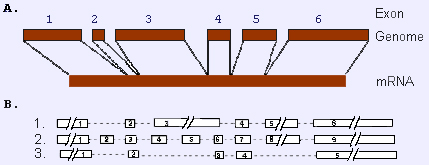
Schematic view of the PLAGL1 gene. A. The six exons, shown in red, are 326; 72; 1443; 75; 475; 2380 bp, respectively. The introns are approximately 39; 2.6; 4.2; 12.5; 5.5 kbp in size, respectively. B. The figure shows three splice variants of PLAGL1; the exons are shown as a box.
Description
The genome is about 64 kbp with six exons and five introns. The major mRNA transcript is about 4.7 kb in size.
Transcription
At least three splicing variants (See Figure, above)
Proteins
Description
The PLAGL1 protein is a seven C2H2-type zinc finger protein. The seven zinc finger domain is located at the amino terminal region, from the amino acid residue 1 to 210. Additional features of note are proline and glutamine rich regions at the carboxyl terminal portion (residues 220 to 444). There are two nuclear localization signals at the amino terminal region.
Expression
Ovary, breast, brain, liver, spleen, thymus, prostate, uterus, testis, intestine, colon, leukocytes.
Localisation
Nuclear
Function
The PLAGL1 protein is a candidate tumor suppressor gene and has been shown to have transactivation and DNA-binding activity and to exhibit antiproliferative activities.
Homology
Homologous to the mouse and Rat plagl1 and to the human PLAG1 and PLAGL2 proteins.
Mutations
Note
Mutation has not been found in the PLAGL1 coding region.
Implicated in
Entity name
Carcinogenicity
Note
Alteration of the gene expression was found to be a potential genetic event silencing the PLAGL1 gene in cancers such as breast primary tumors, ovarian primary tumors and tumor-derived cell lines, basal cell carcinoma, head and neck squamous cell carcinoma (HNSCC), and extraskeletal myxoid chondrosarcoma (EMC). Several mechanisms have been shown to regulate the PLAGL1 gene expression, including growth factor receptor activation, epigenetic factors, maternal imprinting, and loss of heterozygosity (LOH). Allelic deletion of 6q24-q25, the PLAGL1 locus, in the tumor tissues has been shown in the cancers of ovarian, breast, HNSCC, and pheochromocytomas (PCCs).
Disease
Cancer
Entity name
Transient Neonatal Diabetes (TNDM)
Note
Initial reports suggested that transient neonatal diabetes mellitus (TNDM), a rare condition characterized in the patients by intrauterine growth retardation, dehydration, failure to thrive, and hyperglycemia due to a lack of normal insulin secretion, is associated with paternal uniparental disomy (UPD) of chromosome 6 (UPD 6). Later studies showed the involvement of an imprinted gene in this disease within the chromosomal region 6q24.1-q24.3 between markers D6S1699 and D6S1010. Analysis of the CpG islands in the TNDM critical region, using DNA from TNDM patients with paternal UPD 6 and normal controls, suggested PLAGL1/LOT1/ZAC1 as a candidate imprinted gene for this disease.
Disease
Diabetes mellitus
Article Bibliography
| Pubmed ID | Last Year | Title | Authors |
|---|---|---|---|
| 17063461 | 2007 | LOT1 (ZAC1/PLAGL1) and its family members: mechanisms and functions. | Abdollahi A et al |
| 12473647 | 2003 | LOT1 (PLAGL1/ZAC1), the candidate tumor suppressor gene at chromosome 6q24-25, is epigenetically regulated in cancer. | Abdollahi A et al |
| 10936046 | 2000 | A novel imprinted gene, HYMAI, is located within an imprinted domain on human chromosome 6 containing ZAC. | Arima T et al |
| 15888726 | 2005 | ZAC, LIT1 (KCNQ1OT1) and p57KIP2 (CDKN1C) are in an imprinted gene network that may play a role in Beckwith-Wiedemann syndrome. | Arima T et al |
| 16575187 | 2006 | Establishment of the primary imprint of the HYMAI/PLAGL1 imprint control region during oogenesis. | Arima T et al |
| 16928428 | 2006 | The human HYMAI/PLAGL1 differentially methylated region acts as an imprint control region in mice. | Arima T et al |
| 17178896 | 2006 | Peroxisome proliferator-activated receptor gamma is a Zac target gene mediating Zac antiproliferation. | Barz T et al |
| 16179495 | 2005 | The candidate tumor suppressor gene ZAC is involved in keratinocyte differentiation and its expression is lost in basal cell carcinomas. | Basyuk E et al |
| 11313869 | 2001 | Alternative splicing of the imprinted candidate tumor suppressor gene ZAC regulates its antiproliferative and DNA binding activities. | Bilanges B et al |
| 12711370 | 2003 | Developmental expression of the cell cycle and apoptosis controlling gene, Lot1, in the rat cerebellum and in cultures of cerebellar granule cells. | Ciani E et al |
| 16061485 | 2005 | Cyclic AMP-mediated regulation of transcription factor Lot1 expression in cerebellar granule cells. | Contestabile A et al |
| 15581945 | 2004 | Altered expression and loss of heterozygosity of the LOT1 gene in ovarian cancer. | Cvetkovic D et al |
| 9795221 | 1998 | Delayed up-regulation of Zac1 and PACAP type I receptor after transient focal cerebral ischemia in mice. | Gillardon F et al |
| 11888928 | 2002 | The tumorigenic diversity of the three PLAG family members is associated with different DNA binding capacities. | Hensen K et al |
| 16809786 | 2006 | Multitasking C2H2 zinc fingers link Zac DNA binding to coordinated regulation of p300-histone acetyltransferase activity. | Hoffmann A et al |
| 11360197 | 2001 | Enhancement of p53-dependent gene activation by the transcriptional coactivator Zac1. | Huang SM et al |
| 10669760 | 2000 | Mouse Zac1, a transcriptional coactivator and repressor for nuclear receptors. | Huang SM et al |
| 15751035 | 2005 | Epigenetic silencing of the imprinted gene ZAC by DNA methylation is an early event in the progression of human ovarian cancer. | Kamikihara T et al |
| 10655556 | 2000 | The cell cycle control gene ZAC/PLAGL1 is imprinted--a strong candidate gene for transient neonatal diabetes. | Kamiya M et al |
| 9722527 | 1998 | Transcriptional activation capacity of the novel PLAG family of zinc finger proteins. | Kas K et al |
| 15054737 | 2004 | Loss of expression of ZAC/LOT1 in squamous cell carcinomas of head and neck. | Koy S et al |
| 11935319 | 2002 | Relaxation of imprinted expression of ZAC and HYMAI in a patient with transient neonatal diabetes mellitus. | Mackay DJ et al |
| 11156367 | 2000 | The expression of the antiproliferative gene ZAC is lost or highly reduced in nonfunctioning pituitary adenomas. | Pagotto U et al |
| 10757814 | 2000 | Zac1 (Lot1), a potential tumor suppressor gene, and the gene for epsilon-sarcoglycan are maternally imprinted genes: identification by a subtractive screen of novel uniparental fibroblast lines. | Piras G et al |
| 16112421 | 2005 | The PLAGL1 gene is down-regulated in human extraskeletal myxoid chondrosarcoma tumors. | Poulin H et al |
| 12119104 | 2002 | The mouse Zac1 locus: basis for imprinting and comparison with human ZAC. | Smith RJ et al |
| 9184226 | 1997 | Regulation of apoptosis and cell cycle arrest by Zac1, a novel zinc finger protein expressed in the pituitary gland and the brain. | Spengler D et al |
| 11578877 | 2001 | Expression pattern of Zac1 mouse gene, a new zinc-finger protein that regulates apoptosis and cellular cycle arrest, in both adult brain and along development. | Valente T et al |
| 15350644 | 2004 | Zac1 is up-regulated in neural cells of the limbic system of mouse brain following seizures that provoke strong cell activation. | Valente T et al |
| 15844099 | 2005 | Zac1 is expressed in progenitor/stem cells of the neuroectoderm and mesoderm during embryogenesis: differential phenotype of the Zac1-expressing cells during development. | Valente T et al |
| 17341487 | 2007 | Tissue-specific imprinting of the ZAC/PLAGL1 tumour suppressor gene results from variable utilization of monoallelic and biallelic promoters. | Valleley EM et al |
| 17084362 | 2006 | Zac1 regulates an imprinted gene network critically involved in the control of embryonic growth. | Varrault A et al |
| 17697379 | 2007 | DFsn collaborates with Highwire to down-regulate the Wallenda/DLK kinase and restrain synaptic terminal growth. | Wu C et al |
| 17376404 | 2007 | Physical and functional interactions of human papillomavirus E2 protein with nuclear receptor coactivators. | Wu MH et al |
Other Information
Locus ID:
NCBI: 5325
MIM: 603044
HGNC: 9046
Ensembl: ENSG00000118495
Variants:
dbSNP: 5325
ClinVar: 5325
TCGA: ENSG00000118495
COSMIC: PLAGL1
RNA/Proteins
Expression (GTEx)
Pathways
References
| Pubmed ID | Year | Title | Citations |
|---|---|---|---|
| 38581034 | 2024 | CNS tumors with PLAGL1-fusion: beyond ZFTA and YAP1 in the genetic spectrum of supratentorial ependymomas. | 0 |
| 38639853 | 2024 | Central nervous system embryonal tumors with EWSR1-PLAGL1 rearrangements reclassified as INI-1 deficient tumors at relapse. | 0 |
| 38581034 | 2024 | CNS tumors with PLAGL1-fusion: beyond ZFTA and YAP1 in the genetic spectrum of supratentorial ependymomas. | 0 |
| 38639853 | 2024 | Central nervous system embryonal tumors with EWSR1-PLAGL1 rearrangements reclassified as INI-1 deficient tumors at relapse. | 0 |
| 36437415 | 2023 | Amplification of the PLAG-family genes-PLAGL1 and PLAGL2-is a key feature of the novel tumor type CNS embryonal tumor with PLAGL amplification. | 8 |
| 36600208 | 2023 | PLAGL1 is associated with prognosis and cell proliferation in pancreatic adenocarcinoma. | 1 |
| 36437415 | 2023 | Amplification of the PLAG-family genes-PLAGL1 and PLAGL2-is a key feature of the novel tumor type CNS embryonal tumor with PLAGL amplification. | 8 |
| 36600208 | 2023 | PLAGL1 is associated with prognosis and cell proliferation in pancreatic adenocarcinoma. | 1 |
| 34355256 | 2021 | Recurrent fusions in PLAGL1 define a distinct subset of pediatric-type supratentorial neuroepithelial tumors. | 24 |
| 34355256 | 2021 | Recurrent fusions in PLAGL1 define a distinct subset of pediatric-type supratentorial neuroepithelial tumors. | 24 |
| 32678267 | 2020 | Gene expression profiling identifies the role of Zac1 in cervical cancer metastasis. | 11 |
| 32693431 | 2020 | Imprinting aberrations of SNRPN, ZAC1 and INPP5F genes involved in the pathogenesis of congenital heart disease with extracardiac malformations. | 7 |
| 33171905 | 2020 | Transcription Factor PLAGL1 Is Associated with Angiogenic Gene Expression in the Placenta. | 6 |
| 32678267 | 2020 | Gene expression profiling identifies the role of Zac1 in cervical cancer metastasis. | 11 |
| 32693431 | 2020 | Imprinting aberrations of SNRPN, ZAC1 and INPP5F genes involved in the pathogenesis of congenital heart disease with extracardiac malformations. | 7 |
Citation
Abbas Abdollahi
PLAGL1 (Pleomorphic adenoma gene-like 1)
Atlas Genet Cytogenet Oncol Haematol. 2007-08-01
Online version: http://atlasgeneticsoncology.org/gene/41737/plagl1
