PTPN11 (Protein tyrosine phosphatase, non-receptor type, 11)
2005-02-01 Marco Tartaglia , Bruce D Gelb AffiliationDipartimento di Biologia Cellulare e Neuroscienze, Istituto Superiore di Sanitö, Rome, Italy
Identity
HGNC
LOCATION
12q24.13
LOCUSID
ALIAS
BPTP3,CFC,JMML,METCDS,NS1,PTP-1D,PTP2C,SH-PTP2,SH-PTP3,SHP2
FUSION GENES
DNA/RNA
Description
The PTPN11 gene is divided in 16 exons. Exon 1 contains the 5 untranslated region and the translation initiation ATG, and a few additional codons. Exon 15 contains the stop codon and exon 16 contains a major portion of the 3 untranslated region. Other features of the PTPN11 gene, such as the promoter region and enhancer elements have not been delineated.
Transcription
A 7.0-kb transcript is detected in several tissues (heart, brain, lung, liver, skeletal muscle, kidney, and pancreas) with highest steady-state levels in heart and skeletal muscle. The predominant human PTPN11 mRNA contains an open reading frame of 1,779 bases, resulting in a predicted protein of 593 amino acid residues. A second mRNA containing 12 additional base pairs (exon 11) has been identified. Little additional information is available about this alternative transcript.
Pseudogene
A number of PTPN11-related processed pseudogenes, i.e. with no apparent exon structure, have been documented in the human genome. All the pseudogenes share >92% nucleotide identity with the PTPN11 cDNA (including the 5-UTR and 3-UTR), but harbour frameshift mutations and multiple stop codons. Three of the five pseudogenes appear to be expressed with distinct tissue distributions and expression levels.
Proteins
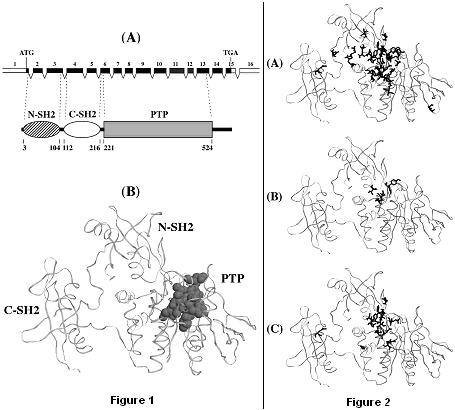
PTPN11 genomic organization and SHP-2 domain structure:
Figure 1 : (A) The PTPN11 gene and SHP-2 domain characterization. The coding exons are shown as numbered filled boxes. The functional domains of the protein, comprising two tandemly arranged SH2 domains at the N terminus (N-SH2 and C-SH2) followed by a protein tyrosine phosphatase (PTP) domain, are shown below. Numbers below the domain structure indicate the amino-acid boundaries of those domains. (B) Three-dimensional structure of SHP-2 in its catalytically inactive conformation, as determined by Hof et al. (1998). Residues involved in catalysis are shown (space fill).
Figure 2 : Location of SHP-2 mutated residues in human disease. (A) Noonan syndrome and LEOPARD syndrome (germ-line origin; N=224); (B) Noonan syndrome with juvenile myelomonocytic leukemia (germ-line origin; N=11); (C) hematologic malignancies, including juvenile myelomonocytic leukemia, acute myeloid leukemia, acute lymphoblastic leukemia, myelodysplastic syndromes and chronic myelomonocytic leukemia (somatic origin; N=97). The pictures show the C trace of SHP-2 in its catalytically inactive conformation. Affected residues are indicated with their side chains as black sticks.
Description
SHP-2 is a member of a small subfamily of cytoplasmic Src homology 2 (SH2) domain-containing protein tyrosine phosphatases. Both the N-SH2 and C-SH2 domains selectively bind to short amino acid motifs containing a phosphotyrosyl residue and promote SHP-2 association with activated receptors and other signaling partners. Crystallographic data indicate that the N-SH2 domain also interacts with the PTP domain using a separate site. As these subdomains show negative cooperativity, the N-SH2 domain functions as an intramolecular switch controlling SHP-2 catalytic activation. Specifically, the N-SH2 domain interacts with the PTP domain basally, blocking the catalytic site. Binding of the N-SH2 phosphopeptide-binding site to the phosphotyrosyl ligand promotes a conformational change of the domain that weakens the auto-inhibiting intramolecular interaction, making the catalytic site available to substrate, thereby activating the phosphatase.
Expression
Widely expressed in both embryonic and adult tissues.
Localisation
Cytoplasmic. It binds to activated cell surface receptors, cell adhesion molecules and scaffolding adapters.
Function
SHP-2 functions as an intracellular signal transducer. It positively modulates signal flow in most circumstances, but can also function as negative regulator depending upon its binding partner and interactions with downstream signaling networks. SHP-2 positively controls the activation of the RAS/MAPK cascade induced by several growth factors, and negatively regulates JAK/STAT signaling. In most cases, SHP-2s function in intracellular signaling appears to be immediately proximal to activated receptors and upstream to RAS. The mechanisms of SHP-2s action and its physiological substrates are still poorly defined. However, both membrane translocation and PTPase activity are required for SHP-2 function. SHP-2 is required during development. Embryos nullizygous for Shp-2 have defects in gastrulation and mesodermal patterning resulting in severe abnormalities in axial and paraxial mesodermal structures. Shp-2 function is also required for development of terminal and skeletal structures, semilunar valvulogenesis in the heart, and hematopoiesis.
Homology
PTPN6 (protein tyrosine phosphatase, non-receptor type, 6) previously known as SHP1 or SHP-1 (Src homology 2 domain-containing protein tyrosine phosphatase, 1).
Mutations
Note
At least two distinct classes of PTPN11 mutations have been identified in humans.
The first group, which has germ-line origin, causes Noonan syndrome and closely related developmental disorders.
The second group, acquired as a somatic event, has been documented in a heterogeneous group of hematologic malignancies and pre-leukemic disorders, and rarely in certain solid tumors.
The vast majority of mutations affect residues residing at or close to the interface between the N-SH2 and PTP domains. Increasing evidence supports that both germ-line and somatic mutations promote SHP-2 gain-of-function by destabilizing the catalytically inactive conformation of the protein, and prolong signal flux through the RAS/MAPK pathway in a ligand-dependent manner.
A mouse model bearing the NS-causative D61G mutation in the Ptpn11 gene has been recently generated and characterized. The Ptpn11D61G/D61G genotype is embryonic lethal. At day E13.5, these embryos are grossly edematous and hemorrhagic, have diffuse liver necrosis and severe cardiac defects. Heterozygous embryos exhibit cardiac defects, proportionate growth failure and perturbed craniofacial development. Hematologic anomalies include a mild myeloproliferative disease. Ptpn11D61G/+ embryonic fibroblasts exhibit a three-fold increased Shp-2 activity and increased association of Shp-2 with Gab1 after stimulation with EGF. Cell culture and whole embryo studies reveal that increased RAS/MAPK signaling is variably present, appearing to be cell-context specific.
The vast majority of mutations affect residues residing at or close to the interface between the N-SH2 and PTP domains. Increasing evidence supports that both germ-line and somatic mutations promote SHP-2 gain-of-function by destabilizing the catalytically inactive conformation of the protein, and prolong signal flux through the RAS/MAPK pathway in a ligand-dependent manner.
A mouse model bearing the NS-causative D61G mutation in the Ptpn11 gene has been recently generated and characterized. The Ptpn11D61G/D61G genotype is embryonic lethal. At day E13.5, these embryos are grossly edematous and hemorrhagic, have diffuse liver necrosis and severe cardiac defects. Heterozygous embryos exhibit cardiac defects, proportionate growth failure and perturbed craniofacial development. Hematologic anomalies include a mild myeloproliferative disease. Ptpn11D61G/+ embryonic fibroblasts exhibit a three-fold increased Shp-2 activity and increased association of Shp-2 with Gab1 after stimulation with EGF. Cell culture and whole embryo studies reveal that increased RAS/MAPK signaling is variably present, appearing to be cell-context specific.
Germinal
Selection: 124A>G (T42A), 179-181delGTG (delGly60), 181-183delGAT (delAsp61), 182A>G (D61G), 184T>G (Y62D), 188A>G (Y63C), 214G>T (A72S), 215C>G (A72G), 218C>T (T73I), 228G>T,C (E76D), 236A>G (N79R), 317A>C (D106A), 836A>G (Y279C), 922A>G (N308D), 1403C>T (T468M), 1510A>G (M504V).
Somatic
Selection: 181G>T (D61Y), 182A>T (D61V), 205G>A (E69K), 211-213TTT>AAA (F71K), 214G>A (A72T), 215C>T (A72V), 226G>A (E76K), 226G>C (E76Q), 227A>T (E76V), 227A>G (E76G), 227A>C (E76A), 1471C>T (P491S), 1472C>T (P491L), 1504T>C (S502P), 1504T>G (S502A), 1520C>A (T507K), 1528C>A (Q510K).
Implicated in
Entity name
Noonan syndrome, Noonan-like/multiple giant cell lesion syndrome and LEOPARD syndrome.
Note
Germ-line origin. Gain-of-function mutations. Increased basal protein tyrosine phosphatase activity. Prolonged ligand-dependent activation of the RAS/MAPK cascade.
Disease
Noonan syndrome is a genetically heterogeneous and clinically variable developmental disorder defined by short stature, facial dysmorphism and a wide spectrum of congenital heart defects. The distinctive facial features consist of a broad forehead, hypertelorism, down-slanting palpebral fissures, ptosis, high-arched palate and low-set, posteriorly rotated ears. Cardiovascular abnormalities, primarily pulmonic stenosis and hypertrophic cardiomyopathy, are present in up to 85% of affected individuals. Additional relatively frequent features are multiple skeletal defects, webbed neck, mental retardation, cryptorchidism and bleeding diathesis. Children with Noonan syndrome are predisposed to a spectrum of hematologic abnormalities, including transient monocytosis, thrombocytopenia and rarely juvenile myelomonocytic leukemia and acute leukemia.
Entity name
Juvenile myelomonocytic leukemia, acute myeloid leukemia, acute lymphoblastic leukemia, myelodysplastic syndromes, chronic myelomonocytic leukemia, melanoma, neuroblastoma, lung adenocarcinoma, colon cancer.
Note
Somatic origin.
Prognosis
No data are currently available.
Oncogenesis
Gain-of-function mutations. Increased basal protein tyrosine phosphatase activity. Prolonged ligand-dependent activation of the RAS/MAPK cascade.
Article Bibliography
| Pubmed ID | Last Year | Title | Authors |
|---|---|---|---|
| 7681589 | 1993 | A widely expressed human protein-tyrosine phosphatase containing src homology 2 domains. | Ahmad S et al |
| 14718383 | 2004 | A genomic perspective on protein tyrosine phosphatases: gene structure, pseudogenes, and genetic disease linkage. | Andersen JN et al |
| 15273746 | 2004 | Mouse model of Noonan syndrome reveals cell type- and gene dosage-dependent effects of Ptpn11 mutation. | Araki T et al |
| 15604238 | 2004 | Activating mutations of the noonan syndrome-associated SHP2/PTPN11 gene in human solid tumors and adult acute myelogenous leukemia. | Bentires-Alj M et al |
| 12058348 | 2002 | Grouping of multiple-lentigines/LEOPARD and Noonan syndromes on the PTPN11 gene. | Digilio MC et al |
| 14974085 | 2004 | Noonan syndrome-associated SHP2/PTPN11 mutants cause EGF-dependent prolonged GAB1 binding and sustained ERK2/MAPK1 activation. | Fragale A et al |
| 9491886 | 1998 | Crystal structure of the tyrosine phosphatase SHP-2. | Hof P et al |
| 12161596 | 2002 | PTPN11 mutations in LEOPARD syndrome. | Legius E et al |
| 15385933 | 2004 | PTPN11 mutations in pediatric patients with acute myeloid leukemia: results from the Children's Cancer Group. | Loh ML et al |
| 14644997 | 2004 | Mutations in PTPN11 implicate the SHP-2 phosphatase in leukemogenesis. | Loh ML et al |
| 12826400 | 2003 | The 'Shp'ing news: SH2 domain-containing tyrosine phosphatases in cell signaling. | Neel BG et al |
| 16053901 | 2005 | Germ-line and somatic PTPN11 mutations in human disease. | Tartaglia M et al |
| 15001945 | 2004 | Genotype-phenotype correlations in Noonan syndrome. | Zenker M et al |
Other Information
Locus ID:
NCBI: 5781
MIM: 176876
HGNC: 9644
Ensembl: ENSG00000179295
Variants:
dbSNP: 5781
ClinVar: 5781
TCGA: ENSG00000179295
COSMIC: PTPN11
RNA/Proteins
Expression (GTEx)
Pathways
Protein levels (Protein atlas)
References
| Pubmed ID | Year | Title | Citations |
|---|---|---|---|
| 37688767 | 2024 | Synergistic effects of BTN3A1, SHP2, CD274, and STAT3 gene polymorphisms on the risk of systemic lupus erythematosus: a multifactorial dimensional reduction analysis. | 1 |
| 37786383 | 2024 | Progesterone and cAMP synergistically induce SHP2 expression via PGR and CREB1 during uterine stromal decidualization. | 0 |
| 37847107 | 2024 | Clinical Variability in a Family with Noonan Syndrome with a Homozygous PTPN11 Gene Variant in Two Individuals. | 0 |
| 37923938 | 2024 | Mutations in PTPN11 could lead to a congenital myasthenic syndrome phenotype: a Noonan syndrome case series. | 0 |
| 38211682 | 2024 | Plasma-derived exosomal protein SHP2 deficiency induces neutrophil hyperactivation in Behcet's uveitis. | 1 |
| 38251939 | 2024 | Single Ion Pair Is Essential for Stabilizing SHP2's Open Conformation. | 1 |
| 38358185 | 2024 | High expression of SHP2 predicts a promising prognosis in colorectal cancer. | 0 |
| 38394639 | 2024 | Macrophage SHP2 Deficiency Alleviates Diabetic Nephropathy via Suppression of MAPK/NF-κB- Dependent Inflammation. | 0 |
| 38540404 | 2024 | Spectrum of Mutations in PTPN11 in Russian Cohort. | 0 |
| 38657042 | 2024 | SHP2 regulates GluA2 tyrosine phosphorylation required for AMPA receptor endocytosis and mGluR-LTD. | 0 |
| 38924432 | 2024 | MEK-SHP2 inhibition prevents tibial pseudarthrosis caused by NF1 loss in Schwann cells and skeletal stem/progenitor cells. | 0 |
| 38965223 | 2024 | SHP2 as a primordial epigenetic enzyme expunges histone H3 pTyr-54 to amend androgen receptor homeostasis. | 0 |
| 37688767 | 2024 | Synergistic effects of BTN3A1, SHP2, CD274, and STAT3 gene polymorphisms on the risk of systemic lupus erythematosus: a multifactorial dimensional reduction analysis. | 1 |
| 37786383 | 2024 | Progesterone and cAMP synergistically induce SHP2 expression via PGR and CREB1 during uterine stromal decidualization. | 0 |
| 37847107 | 2024 | Clinical Variability in a Family with Noonan Syndrome with a Homozygous PTPN11 Gene Variant in Two Individuals. | 0 |
Citation
Marco Tartaglia ; Bruce D Gelb
PTPN11 (Protein tyrosine phosphatase, non-receptor type, 11)
Atlas Genet Cytogenet Oncol Haematol. 2005-02-01
Online version: http://atlasgeneticsoncology.org/gene/41910/ptpn11
