PTPN13 (Protein tyrosine phosphatase, non-receptor type 13)
2008-09-01 Alessandro Beghini, PhD AffiliationUniversity of Milan, Medical Faculty, Department of Biology, Genetics for Medical Sciences, via Viotti 5, 20133-Milan, Italy
Identity
HGNC
LOCATION
4q21.3
IMAGE

LEGEND
Genomic view
LOCUSID
ALIAS
FAP-1,PNP1,PTP-BAS,PTP-BL,PTP1E,PTPL1,PTPLE,hPTP1E
FUSION GENES
DNA/RNA
Description
The gene covers 220.87 kb (from 87734485 to 87955350-NCBI) and contains 48 exons and 51 different introns (49 gt-ag, 2 gc-ag), initiates transcription within exon 2 and terminates in exon 48.
Transcription
Transcription produces 13 different mRNAs, 9 alternatively spliced variants and 4 unspliced forms. RefSeq annotates 4 representative transcripts, but Homo sapiens cDNA sequences in GenBank support at least 9 spliced variants.
Proteins
Description
The protein encoded by this gene is a member of the protein tyrosine phosphatase (PTP) family. PTPs are known to be signaling molecules that regulate a variety of cellular processes including cell growth, differentiation, mitotic cycle, and oncogenic transformation. This PTP is a large protein that possesses a PTP domain at C-terminus, and multiple noncatalytic domains, which include a domain with similarity to band 4.1 superfamily of cytoskeletal-associated proteins, a region consisting of five PDZ domains, and a leucine zipper motif. This PTP was found to interact with, and dephosphorylate Fas receptor, as well as IkappaBalpha through the PDZ domains, which suggested its role in Fas mediated programmed cell death. This PTP was also shown to interact with GTPase-activating protein, and thus may function as a regulator of Rho signaling pathway. Eight spliced and the unspliced mRNAs putatively encode good proteins.

Schematic representation of PTPN13 structure and boxes represent functional domains. The KIND domain has been identified in silico by sequence homology.
Expression
In all human normal tissues, including lymph node and peripheral blood mononuclear cells samples, PTPN13 is ubiquitously expressed.
Localisation
The FERM domain binds to phosphatidylinositol 4,5-biphosphate leading to the enrichment of PTPN13 at a juxtamembrane localization. However, the PTPN13 protein is also detected throughout the cytoplasm. In HeLa cells, PTPN13 localizes to the centrosomes during metaphase.
Function
Functionally, the gene has been tested for association to diseases (Bone Neoplasms; Carcinoma; Colorectal Neoplasms; Liver Neoplasms; lymphoma; Sarcoma, Ewings ), proposed to participate in a pathway (FAS signaling pathway ( CD95 )) and a process (protein amino acid dephosphorylation). Proteins are expected to have molecular functions (non-membrane spanning protein tyrosine phosphatase activity, hydrolase activity, protein binding, structural molecule activity) and to localize in various compartments (nucleus, cytoplasm, cytoskeleton).
Mutations
Note
Different somatic mutations was identified in colorectal tumors (19% of the colorectal cancer samples analyzed), predicted to result in missense or non-sense mutations. Some of these mutant proteins led to reduce phosphatase activity.
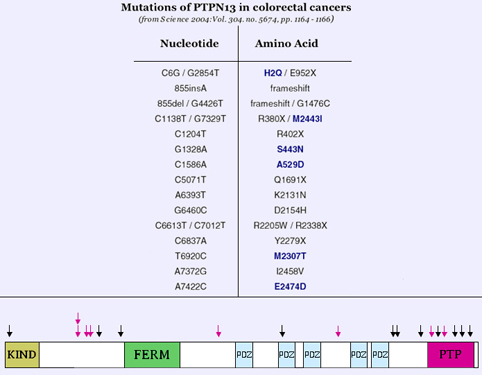
Distribution of mutations in PTPN13, black arrows indicate location of missense mutations, red arrows indicate location of nonsense mutations or frameshifts.
Implicated in
Entity name
Colorectal cancers
Disease
A large-scale study that looked at the mutations in the tyrosine phosphatome from colorectal cancers identified PTPN13. The authors identified 19 mutations, non-sense and missense, seven of which were in the PTP domain.
Entity name
Lymphomas (Hodgkin and non-Hodgkin), gastric and hepatocellular tumors
Disease
Hypermethylation of the PTPN13 promoter or allelic loss was observed leading to downregulation of PTPN13 mRNA.
Article Bibliography
| Pubmed ID | Last Year | Title | Authors |
|---|---|---|---|
| 18265946 | 2008 | PTPL1: a large phosphatase with a split personality. | Abaan OD et al |
| 8071359 | 1994 | A novel protein-tyrosine phosphatase with homology to both the cytoskeletal proteins of the band 4.1 family and junction-associated guanylate kinases. | Banville D et al |
| 8824809 | 1996 | PTPN13, a fas-associated protein tyrosine phosphatase, is located on the long arm of chromosome 4 at band q21.3. | Inazawa J et al |
| 8287977 | 1994 | Molecular cloning of a novel protein-tyrosine phosphatase containing a membrane-binding domain and GLGF repeats. | Maekawa K et al |
| 7929060 | 1994 | Cloning and characterization of PTPL1, a protein tyrosine phosphatase with similarities to cytoskeletal-associated proteins. | Saras J et al |
| 15155950 | 2004 | Mutational analysis of the tyrosine phosphatome in colorectal cancers. | Wang Z et al |
| 16489062 | 2006 | Genetic characterization of fas-associated phosphatase-1 as a putative tumor suppressor gene on chromosome 4q21.3 in hepatocellular carcinoma. | Yeh SH et al |
| 16572203 | 2006 | Epigenetic disruption of two proapoptotic genes MAPK10/JNK3 and PTPN13/FAP-1 in multiple lymphomas and carcinomas through hypermethylation of a common bidirectional promoter. | Ying J et al |
| 12436199 | 2002 | Head-to-head juxtaposition of Fas-associated phosphatase-1 (FAP-1) and c-Jun NH2-terminal kinase 3 (JNK3) genes: genomic structure and seven polymorphisms of the FAP-1 gene. | Yoshida S et al |
| 8893825 | 1996 | The gene (PTPN13) encoding the protein tyrosine phosphatase PTP-BL/PTP-BAS is located in mouse chromosome region 5E/F and human chromosome region 4q21. | van den Maagdenberg AM et al |
Other Information
Locus ID:
NCBI: 5783
MIM: 600267
HGNC: 9646
Ensembl: ENSG00000163629
Variants:
dbSNP: 5783
ClinVar: 5783
TCGA: ENSG00000163629
COSMIC: PTPN13
RNA/Proteins
Expression (GTEx)
Pathways
Protein levels (Protein atlas)
References
| Pubmed ID | Year | Title | Citations |
|---|---|---|---|
| 38967523 | 2024 | METTL1/FOXM1 promotes lung adenocarcinoma progression and gefitinib resistance by inhibiting PTPN13 expression. | 0 |
| 38967523 | 2024 | METTL1/FOXM1 promotes lung adenocarcinoma progression and gefitinib resistance by inhibiting PTPN13 expression. | 0 |
| 38039548 | 2023 | PTPN13 rs989902 and CHEK2 rs738722 are associated with esophageal cancer. | 0 |
| 38039548 | 2023 | PTPN13 rs989902 and CHEK2 rs738722 are associated with esophageal cancer. | 0 |
| 35643866 | 2022 | Germline PTPN13 mutations in patients with bone marrow failure and acute lymphoblastic leukemia. | 1 |
| 36193770 | 2022 | Protein tyrosine phosphatase PTPL1 suppresses lung cancer through Src/ERK/YAP1 signaling. | 3 |
| 35643866 | 2022 | Germline PTPN13 mutations in patients with bone marrow failure and acute lymphoblastic leukemia. | 1 |
| 36193770 | 2022 | Protein tyrosine phosphatase PTPL1 suppresses lung cancer through Src/ERK/YAP1 signaling. | 3 |
| 33051595 | 2021 | Anti-oncogene PTPN13 inactivation by hepatitis B virus X protein counteracts IGF2BP1 to promote hepatocellular carcinoma progression. | 15 |
| 33536603 | 2021 | PTPL1 suppresses lung cancer cell migration via inhibiting TGF-β1-induced activation of p38 MAPK and Smad 2/3 pathways and EMT. | 8 |
| 33051595 | 2021 | Anti-oncogene PTPN13 inactivation by hepatitis B virus X protein counteracts IGF2BP1 to promote hepatocellular carcinoma progression. | 15 |
| 33536603 | 2021 | PTPL1 suppresses lung cancer cell migration via inhibiting TGF-β1-induced activation of p38 MAPK and Smad 2/3 pathways and EMT. | 8 |
| 31938048 | 2020 | PTPN13 induces cell junction stabilization and inhibits mammary tumor invasiveness. | 9 |
| 32919955 | 2020 | PTPN13 acts as a tumor suppressor in clear cell renal cell carcinoma by inactivating Akt signaling. | 7 |
| 31938048 | 2020 | PTPN13 induces cell junction stabilization and inhibits mammary tumor invasiveness. | 9 |
Citation
Alessandro Beghini, PhD
PTPN13 (Protein tyrosine phosphatase, non-receptor type 13)
Atlas Genet Cytogenet Oncol Haematol. 2008-09-01
Online version: http://atlasgeneticsoncology.org/gene/41912/ptpn13
