PTPRD (protein tyrosine phosphatase, receptor type, D)
2009-01-01 Laavanya Parthasarathi , Raymond L Stallings AffiliationRoyal College of Surgeons in Ireland, Childrens Research Centre, Our Ladys Childrens Hospital, Crumlin, Dublin, Ireland
Identity
HGNC
LOCATION
9p24.1
LOCUSID
ALIAS
HPTP,HPTPD,HPTPDELTA,PTPD,R-PTP-delta,RPTPDELTA
FUSION GENES
DNA/RNA
Description
The PTPRD gene is composed of 36 coding sequence exons and a 5 UTR spliced together from 11 non-coding exons.
Transcription
There are five known transcript variants for PTPRD.
Transcript Variant 1: This variant encodes the longest isoform 1 and is 10078 bp in length (Figure A).
Transcript Variant 2: This variant lacks two separate internal segments within the coding region. It thus encodes a protein that lacks a 9 aa, and a 4 aa internal fragments, as compared to isoform 1 and is 10039 bp in length (Figure C).
Transcript Variant 3: This variant lacks an internal segment within the coding region. It thus encodes a protein that lacks a 9 aa internal fragment, as compared to isoform 1 and is 10051 bp in length (Figure D).
Transcript Variant 4: This variant lacks an internal segment within the coding region. It thus encodes a protein that lacks a 411 aa internal fragment, and has one amino acid change, as compared to isoform 1 and is 8845 bp in length (Figure B).
Transcript Variant 5: This variant omits several exons, and utilizes an alternate exon, in the coding region. The resulting protein (isoform 5) retains the same reading frame and has the same N- and C-terminus as isoform 1. This variant is 8848 bp in length (Figure E).
Transcript Variant 1: This variant encodes the longest isoform 1 and is 10078 bp in length (Figure A).
Transcript Variant 2: This variant lacks two separate internal segments within the coding region. It thus encodes a protein that lacks a 9 aa, and a 4 aa internal fragments, as compared to isoform 1 and is 10039 bp in length (Figure C).
Transcript Variant 3: This variant lacks an internal segment within the coding region. It thus encodes a protein that lacks a 9 aa internal fragment, as compared to isoform 1 and is 10051 bp in length (Figure D).
Transcript Variant 4: This variant lacks an internal segment within the coding region. It thus encodes a protein that lacks a 411 aa internal fragment, and has one amino acid change, as compared to isoform 1 and is 8845 bp in length (Figure B).
Transcript Variant 5: This variant omits several exons, and utilizes an alternate exon, in the coding region. The resulting protein (isoform 5) retains the same reading frame and has the same N- and C-terminus as isoform 1. This variant is 8848 bp in length (Figure E).
Pseudogene
No pseudogenes have been reported.
Proteins
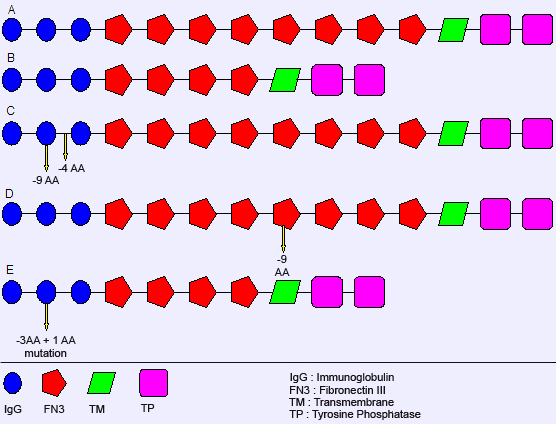
Figure A - E: Illustrates the differences between the known PTPRD isoforms, as described in the text.
Description
Amino acids: 1912.
Molecular Weight: 214760 Da.
The PTPRD gene belongs to the receptor class 2A subfamily of the protein-tyrosine phosphatases. It contains an extracellular region composed of 8 fibronectin type-III domains and 3 Ig-like C2-type (immunoglobulin-like) domains, a single transmembrane segment and two tandem intracytoplasmic tyrosine-protein phosphatase domains.
Molecular Class: Receptor Tyrosine Phosphatase.
Molecular Function: Receptor Signalling Protein Tyrosine Phosphatase Activity.
Biological Process: Cell Communication ; Signal Transduction.
Molecular Weight: 214760 Da.
The PTPRD gene belongs to the receptor class 2A subfamily of the protein-tyrosine phosphatases. It contains an extracellular region composed of 8 fibronectin type-III domains and 3 Ig-like C2-type (immunoglobulin-like) domains, a single transmembrane segment and two tandem intracytoplasmic tyrosine-protein phosphatase domains.
Molecular Class: Receptor Tyrosine Phosphatase.
Molecular Function: Receptor Signalling Protein Tyrosine Phosphatase Activity.
Biological Process: Cell Communication ; Signal Transduction.
Expression
Brain, Kidney.
Multiple isoforms are generated by either alternate splicing or by alternate transcriptional start sites in a tissue specific manner. The predominant isoform in brain has an extended 711 base pair 5 UTR (L isoform), while the isoform (S) expressed in kidney lacks the extended 5 UTR. In addition, the brain isoform is characterized by the absence of exons 14 to 18 corresponding to amino acid residues 568 to 978 of the 4th through 7th fibronectin III-like domain and by the insertion of a 12 base pair mini-exon sequence between exons 23 and 24 (Nair et al., 2008).
The full length PTPRD isoform has an extracellular region containing three Ig-like and eight FN-III like domains connected via a transmembrane peptide to an intracellular region with two PTPase domains (A), whereas another isoform lacks four of the eight FN-III like domains (B). Furthermore, other PTPRD isoforms exist that lack 9 AA within the second Ig-like domain and 4 AA at the junction of the 2nd and 3rd Ig-like domains (C) or 9 AAs within the 5th FN-III like domain (D). The fifth isoform lacks four of the eight FN-III like domains and has mutation in the second Ig-like domain (E). RT-PCR analysis demonstrated that PTPRD isoforms lacking these short peptides are expressed in kidney, whereas isoforms containing these peptides are expressed in the brain (Pulido et al., 1995).
Multiple isoforms are generated by either alternate splicing or by alternate transcriptional start sites in a tissue specific manner. The predominant isoform in brain has an extended 711 base pair 5 UTR (L isoform), while the isoform (S) expressed in kidney lacks the extended 5 UTR. In addition, the brain isoform is characterized by the absence of exons 14 to 18 corresponding to amino acid residues 568 to 978 of the 4th through 7th fibronectin III-like domain and by the insertion of a 12 base pair mini-exon sequence between exons 23 and 24 (Nair et al., 2008).
The full length PTPRD isoform has an extracellular region containing three Ig-like and eight FN-III like domains connected via a transmembrane peptide to an intracellular region with two PTPase domains (A), whereas another isoform lacks four of the eight FN-III like domains (B). Furthermore, other PTPRD isoforms exist that lack 9 AA within the second Ig-like domain and 4 AA at the junction of the 2nd and 3rd Ig-like domains (C) or 9 AAs within the 5th FN-III like domain (D). The fifth isoform lacks four of the eight FN-III like domains and has mutation in the second Ig-like domain (E). RT-PCR analysis demonstrated that PTPRD isoforms lacking these short peptides are expressed in kidney, whereas isoforms containing these peptides are expressed in the brain (Pulido et al., 1995).
Localisation
Membrane; Single-pass type I membrane protein.
Function
A cleavage occurs, separating the extracellular domain from the transmembrane segment. This process called ectodomain shedding is thought to be involved in receptor desensitization, signal transduction and/or membrane localization. Plays key role in promoting neurite growth and regulating axon guidance.
Homology
PTPRD shares a PTP domain, involved in dephosphorylating phosphorylated tyrosine residues, with the other receptor-like protein tyrosine phosphatases. The human and mouse PTPRD sequences are 93% identical and 95% homologous.
Implicated in
Entity name
Lung Adenocarcinoma
Disease
Early evidence for the involvement of PTPRD in lung adenocarcinoma came from the detection of homozygous deletions in both primary tumours and cell lines representing both small cell lung carcinoma and non-small cell lung carcinoma (Cox et al., 2005; Zhao et al., 2005; Sato et al., 2005; Nagayama et al., 2007). In addition, somatically acquired PTPRD mutations were found in 11 out of 188 lung adenocarcinoma samples (Weir et al., 2007). Notably, three of the mutations encode predicated inactivating changes in the tyrosine phosphatase domain. Screening for somatic mutations in 623 candidate genes using 188 primary lung adenocarcinoma tissues also revealed sequence changes in PTPRD (Ding et al., 2008).
Entity name
Neuroblastoma
Disease
High resolution a CGH analysis of neuroblastoma (NBL) tumours and cell lines identified homozygous and hemizygous intragenic deletions of the PTPRD gene, implicating the gene as a candidate tumor suppressor gene in this type of cancer (Stallings et al., 2006). In addition, the 5 UTR of PTPRD, consisting of 11 noncoding exons, was found to be aberrantly spliced in > 50% of NBL primary tumors and cell lines (Nair et al., 2008). mRNA levels were determined to be significantly reduced in unfavorable tumour subtypes relative to more favorable tumor subtypes.
Entity name
Squamous Cell Carcinoma
Disease
Both homozygous and hemizygous deletions affecting the PTPRD gene have been reported in squamous cell carcinoma (Purdie et al., 2007).
Entity name
Colorectal Carcinoma
Disease
PTPRD was found to be somatically mutated in colorectal carcinoma with the sequence changes, R28Q, L276P, V901A (Sjoblom et al., 2006).
Entity name
Glioblastoma Multiforme and Malignant Melanoma
Disease
A high frequency of deletions in the PTPRD gene were detected in glioblastoma multiforme (GBM) tumours using Affymetrix 250K single nucleotide polymorphism arrays (Solomon et al., 2008). Missense and nonsense mutations of PTPRD were also identified in a subset of the samples lacking deletions, including an inherited mutation with somatic loss of the wild-type allele. The same group also identified 10 somatically acquired mutations in PTPRD among 7 of 57 melanoma tumors (12%). Ectopic reconstitution of wild-type PTPRD expression in GBM and melanoma cell lines harboring deletions or mutations of the endogenous PTPRD gene led to growth suppression and apoptosis, indicating that this gene functions as a tumour suppressor in multiple forms of cancer (Solomon et al., 2008).
Entity name
Restless Leg Syndrome (RLS)
Disease
Genome-wide association study of RLS identified three SNPs within the PTPRD gene in the chromosome 9 linkage region (RLS3) as nominally significant (Winkelmann et al., 2007). PTPRD is identified as the fourth genome-wide significant locus for RLS from the genome wide association study in 2458 affected individuals and 4749 controls from Germany, Austria, Czech Republic and Canada (Schormair et al., 2008).
Entity name
Pediatric Asthma
Disease
A whole-genome linkage disequilibrium mapping study for asthma on 190 allergic and nonallergic asthma children in Taiwan revealed that polymorphisms of PTPRD are strongly associated with pediatric bronchial asthma in the Taiwanese population (Shyur et al., 2008).
Article Bibliography
| Pubmed ID | Last Year | Title | Authors |
|---|---|---|---|
| 16338072 | 2006 | Protein tyrosine-phosphatase expression profiling in gastric cancer tissues. | Wu CW et al |
| 12376545 | 2002 | Intra- and intermolecular interactions between intracellular domains of receptor protein-tyrosine phosphatases. | Blanchetot C et al |
| 15761058 | 2005 | A survey of homozygous deletions in human cancer genomes. | Cox C et al |
| 18948947 | 2008 | Somatic mutations affect key pathways in lung adenocarcinoma. | Ding L et al |
| 10080191 | 1999 | Neuroendocrine dysplasia in mice lacking protein tyrosine phosphatase sigma. | Elchebly M et al |
| 16507138 | 2006 | Genome-wide review of transcriptional complexity in mouse protein kinases and phosphatases. | Forrest AR et al |
| 18034317 | 2009 | Screening of AMP-activated protein kinase alpha2 subunit interacting proteins by bacterial two-hybrid system. | Fu QY et al |
| 15684034 | 2005 | Receptor tyrosine phosphatase-dependent cytoskeletal remodeling by the hedgehog-responsive gene MIM/BEG4. | Gonzalez-Quevedo R et al |
| 18618226 | 2008 | Genomic changes in progression of low-grade gliomas. | Idbaih A et al |
| 12237861 | 2002 | Protein tyrosine phosphatase sigma-deficient mice show aberrant cytoarchitecture and structural abnormalities in the central nervous system. | Meathrel K et al |
| 7988677 | 1994 | Developmental regulation of gene expression for the MPTP delta isoforms in the central nervous system and the immune system. | Mizuno K et al |
| 17674361 | 2007 | Homozygous deletion scanning of the lung cancer genome at a 100-kb resolution. | Nagayama K et al |
| 18050303 | 2008 | Aberrant splicing of the PTPRD gene mimics microdeletions identified at this locus in neuroblastomas. | Nair P et al |
| 8524829 | 1995 | The LAR/PTP delta/PTP sigma subfamily of transmembrane protein-tyrosine-phosphatases: multiple human LAR, PTP delta, and PTP sigma isoforms are expressed in a tissue-specific manner and associate with the LAR-interacting protein LIP.1. | Pulido R et al |
| 17420988 | 2007 | Allelic imbalances and microdeletions affecting the PTPRD gene in cutaneous squamous cell carcinomas detected using single nucleotide polymorphism microarray analysis. | Purdie KJ et al |
| 16114034 | 2005 | Identification of chromosome arm 9p as the most frequent target of homozygous deletions in lung cancer. | Sato M et al |
| 18660810 | 2008 | PTPRD (protein tyrosine phosphatase receptor type delta) is associated with restless legs syndrome. | Schormair B et al |
| 18414509 | 2008 | The polymorphisms of protein-tyrosine phosphatase receptor-type delta gene and its association with pediatric asthma in the Taiwanese population. | Shyur SD et al |
| 16959974 | 2006 | The consensus coding sequences of human breast and colorectal cancers. | Sjöblom T et al |
| 16585193 | 2006 | High-resolution analysis of chromosomal breakpoints and genomic instability identifies PTPRD as a candidate tumor suppressor gene in neuroblastoma. | Stallings RL et al |
| 17363583 | 2007 | Genome-wide loss of heterozygosity and copy number analysis in melanoma using high-density single-nucleotide polymorphism arrays. | Stark M et al |
| 16738228 | 2006 | Mammalian motoneuron axon targeting requires receptor protein tyrosine phosphatases sigma and delta. | Uetani N et al |
| 10856223 | 2000 | Impaired learning with enhanced hippocampal long-term potentiation in PTPdelta-deficient mice. | Uetani N et al |
| 9472099 | 1998 | The selective reduction in PTPdelta expression in hepatomas. | Urushibara N et al |
| 9762470 | 1998 | Protein phosphatase 1 delta is associated with focal adhesions. | Villa-Moruzzi E et al |
| 10080192 | 1999 | Neuronal defects and posterior pituitary hypoplasia in mice lacking the receptor tyrosine phosphatase PTPsigma. | Wallace MJ et al |
| 10588391 | 1999 | Receptor tyrosine phosphatase-delta is a homophilic, neurite-promoting cell adhesion molecular for CNS neurons. | Wang J et al |
| 17982442 | 2007 | Characterizing the cancer genome in lung adenocarcinoma. | Weir BA et al |
| 17637780 | 2007 | Genome-wide association study of restless legs syndrome identifies common variants in three genomic regions. | Winkelmann J et al |
| 12570871 | 2003 | MIM-B, a putative metastasis suppressor protein, binds to actin and to protein tyrosine phosphatase delta. | Woodings JA et al |
| 15994928 | 2005 | Homozygous deletions and chromosome amplifications in human lung carcinomas revealed by single nucleotide polymorphism array analysis. | Zhao X et al |
Other Information
Locus ID:
NCBI: 5789
MIM: 601598
HGNC: 9668
Ensembl: ENSG00000153707
Variants:
dbSNP: 5789
ClinVar: 5789
TCGA: ENSG00000153707
COSMIC: PTPRD
RNA/Proteins
Expression (GTEx)
Pathways
| Pathway | Source | External ID |
|---|---|---|
| Neuronal System | REACTOME | R-HSA-112316 |
| SALM protein interactions at the synapses | REACTOME | R-HSA-8849932 |
| Protein-protein interactions at synapses | REACTOME | R-HSA-6794362 |
Protein levels (Protein atlas)
PharmGKB
| Entity ID | Name | Type | Evidence | Association | PK | PD | PMIDs |
|---|---|---|---|---|---|---|---|
| PA164712445 | Antihypertensives | Chemical | ClinicalAnnotation | associated | PD | ||
| PA443890 | Diabetes Mellitus, Type 2 | Disease | ClinicalAnnotation | associated | PD | ||
| PA444552 | Hypertension | Disease | ClinicalAnnotation | associated | PD | 26425837 | |
| PA450970 | pioglitazone | Chemical | ClinicalAnnotation | associated | PD | ||
| PA451737 | trandolapril | Chemical | ClinicalAnnotation | associated | PD | 26425837 | |
| PA451868 | verapamil | Chemical | ClinicalAnnotation | associated | PD | 26425837 |
References
| Pubmed ID | Year | Title | Citations |
|---|---|---|---|
| 36906292 | 2023 | Metastasis suppressor 1 interacts with protein tyrosine phosphatase receptor-δ to regulate adipogenesis. | 1 |
| 36906292 | 2023 | Metastasis suppressor 1 interacts with protein tyrosine phosphatase receptor-δ to regulate adipogenesis. | 1 |
| 34863978 | 2022 | Structure-activity studies of PTPRD phosphatase inhibitors identify a 7-cyclopentymethoxy illudalic acid analog candidate for development. | 3 |
| 35603359 | 2022 | An integrative prognostic and immune analysis of PTPRD in cancer. | 2 |
| 35848503 | 2022 | Methylation-mediated silencing of PTPRD induces pulmonary hypertension by promoting pulmonary arterial smooth muscle cell migration via the PDGFRB/PLCγ1 axis. | 6 |
| 35982066 | 2022 | PTPRD and CNTNAP2 as markers of tumor aggressiveness in oligodendrogliomas. | 4 |
| 34863978 | 2022 | Structure-activity studies of PTPRD phosphatase inhibitors identify a 7-cyclopentymethoxy illudalic acid analog candidate for development. | 3 |
| 35603359 | 2022 | An integrative prognostic and immune analysis of PTPRD in cancer. | 2 |
| 35848503 | 2022 | Methylation-mediated silencing of PTPRD induces pulmonary hypertension by promoting pulmonary arterial smooth muscle cell migration via the PDGFRB/PLCγ1 axis. | 6 |
| 35982066 | 2022 | PTPRD and CNTNAP2 as markers of tumor aggressiveness in oligodendrogliomas. | 4 |
| 34299935 | 2021 | DIAPH2, PTPRD and HIC1 Gene Polymorphisms and Laryngeal Cancer Risk. | 5 |
| 34615542 | 2021 | Identification and validation of tissue or ctDNA PTPRD phosphatase domain deleterious mutations as prognostic and predictive biomarkers for immune checkpoint inhibitors in non-squamous NSCLC. | 9 |
| 34299935 | 2021 | DIAPH2, PTPRD and HIC1 Gene Polymorphisms and Laryngeal Cancer Risk. | 5 |
| 34615542 | 2021 | Identification and validation of tissue or ctDNA PTPRD phosphatase domain deleterious mutations as prognostic and predictive biomarkers for immune checkpoint inhibitors in non-squamous NSCLC. | 9 |
| 32151175 | 2020 | MiR-324-5p/PTPRD/CEBPD axis promotes papillary thyroid carcinoma progression via microenvironment alteration. | 11 |
Citation
Laavanya Parthasarathi ; Raymond L Stallings
PTPRD (protein tyrosine phosphatase, receptor type, D)
Atlas Genet Cytogenet Oncol Haematol. 2009-01-01
Online version: http://atlasgeneticsoncology.org/gene/41927/ptprd
