PTPRJ (protein tyrosine phosphatase, receptor type, J)
2011-03-01 Francesca Sacco , Savatore Corallino , Luisa Castagnoli AffiliationDepartment of Biology, University of Rome Tor Vergata, via ricerca scientifica, 00133 Rome, Italy
Identity
HGNC
LOCATION
11p11.2
LOCUSID
ALIAS
CD148,DEP1,HPTPeta,R-PTP-ETA,SCC1
FUSION GENES
DNA/RNA
Description
Gene ENSG00000149177 has 24 alternate exons.
Transcription
Multiple transcript variants encoding different isoforms have been found for this gene. Three transcripts are described in Ensembl (ID: ENSG00000149177).
The first (ENST00000418331) represents the longer isoform and encodes a protein that consists of an extracellular fibronectin type 3 domain and a cytosolic catalytic domain. The second isoform (ENST00000440289) has multiple differences in the presence and absence of exons at its 3 end, compared to the first isoform. These differences produce a unique 3 UTR and the encoded protein is shorter and consists of the extracellular fibronectin type 3 domain without the cytosolic catalytic region. The third transcript (ENST00000278456) has the same length as the first, but it encodes a truncated protein, that consists of fibronectin type 3 domains. Only the first two isoforms are members of the human CCDS set and have been described in NCBI (IDs: NM_001098503.1, NM_001098503.1).
The cDNA encoding PTPRJ/DEP-1 was isolated from a HeLa cell library (Ostman et al., 1994). The expression level and the activity of DEP-1 increase with cell density. This increase occurs gradually with increasing cell contact and is initiated before saturation cell density is reached. These observations suggest that DEP-1 may contribute to the mechanism of contact inhibition of cell growth.
The first (ENST00000418331) represents the longer isoform and encodes a protein that consists of an extracellular fibronectin type 3 domain and a cytosolic catalytic domain. The second isoform (ENST00000440289) has multiple differences in the presence and absence of exons at its 3 end, compared to the first isoform. These differences produce a unique 3 UTR and the encoded protein is shorter and consists of the extracellular fibronectin type 3 domain without the cytosolic catalytic region. The third transcript (ENST00000278456) has the same length as the first, but it encodes a truncated protein, that consists of fibronectin type 3 domains. Only the first two isoforms are members of the human CCDS set and have been described in NCBI (IDs: NM_001098503.1, NM_001098503.1).
The cDNA encoding PTPRJ/DEP-1 was isolated from a HeLa cell library (Ostman et al., 1994). The expression level and the activity of DEP-1 increase with cell density. This increase occurs gradually with increasing cell contact and is initiated before saturation cell density is reached. These observations suggest that DEP-1 may contribute to the mechanism of contact inhibition of cell growth.
Proteins
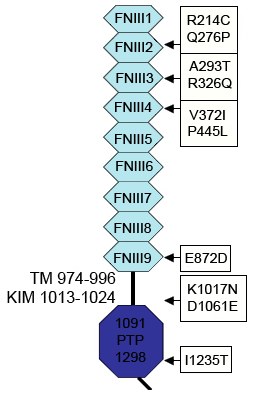
DEP-1: location of SNPs and mutations reported in human cancer. DEP-1 sequence is according to UniProtKB/Swiss-Prot: PTPRJ_HUMAN, Q12913. FNIII: Fibronectin domain, TM: Trans-membrane, KIM: Kinase Interaction Motif, PTP: Protein Tyrosine Phosphatase.
Description
DEP-1 corresponds to a single-pass, type I membrane receptor-type protein tyrosine phosphatase; it is a 200-250 kDa transmembrane molecule with a 35 residue signal peptide, 940 residue extracellular portion, 21 residues in helical transmembrane region and 341 aminoacids in the intracytoplasmic tail, with a single catalytic domain at the carbossi-terminus.
The protein N-terminus has nine fibronectin type III (FNIII) repeats, contains 34 potential N-linked glycosylation sites and it was found glycosylated in seven asparagine residues by mass spectrometry (Liu et al., 2005; Chen et al., 2009). DEP-1 can dimerize (binding site 972-996) through the transmembrane domain (Chin et al., 2005) but it is unclear whether it can exist as dimers, physiologically. Sedimentation velocity measurements show that DEP1, along with other single-domain receptor phosphatases (e.g., IA2, IA2beta, GLEPP1 and STEP) is monomeric in solution (Barr et al., 2009).
The regulation of receptor-like protein tyrosine phosphatases is generally poorly understood. Sorby et al. have identified MatrigelTM (a preparation of extracellular matrix proteins) as a source of DEP-1 ligand(s) and agonist(s) (Sorby et al., 2001).
The protein N-terminus has nine fibronectin type III (FNIII) repeats, contains 34 potential N-linked glycosylation sites and it was found glycosylated in seven asparagine residues by mass spectrometry (Liu et al., 2005; Chen et al., 2009). DEP-1 can dimerize (binding site 972-996) through the transmembrane domain (Chin et al., 2005) but it is unclear whether it can exist as dimers, physiologically. Sedimentation velocity measurements show that DEP1, along with other single-domain receptor phosphatases (e.g., IA2, IA2beta, GLEPP1 and STEP) is monomeric in solution (Barr et al., 2009).
The regulation of receptor-like protein tyrosine phosphatases is generally poorly understood. Sorby et al. have identified MatrigelTM (a preparation of extracellular matrix proteins) as a source of DEP-1 ligand(s) and agonist(s) (Sorby et al., 2001).
Expression
DEP-1 is expressed in several cell types, including endothelial, epithelial, and in all haematopoietic lineages. It was found to be present on many epithelial cell types with glandular and endocrine differentiation as well as on fibrocytes, melanocytes and Schwann cells (Autschbach et al., 1999). It is widely expressed on B and T cells, granulocytes, macrophages, certain dendritic cells as well as mature thymocytes and it was shown to negatively regulate T cell receptor and terminating its response to stimulation. DEP-1 is thought to play a role in the down regulation of T cell activation and signalling, by interfering with the phosphorylation of Phospholipase C Gamma 1 and Linker for Activation of T Cells (LAT) and by reducing TCR-induced transcription factor (nuclear factor of activated T cells) (Lin and Weiss, 2003; Lin et al., 2004; Zhu et al., 2008; Tangye et al., 1998; Baker et al., 2001). DEP-1 expression is regulated during T cell activation and is constitutive in autoimmune murine T cells. These expression data suggest that DEP-1 plays a regulatory role to control an immune response and the proposed model of action describes DEP-1 as excluded from the immunologic synapse (i.e., the site of APC and T cell contact) during early T cell-APC (Antigen Presenting Cell) interactions. After T cell-APC disengagement, DEP-1 is no longer excluded by the synapse and can access and dephosphorylate substrates to down-regulate prolongation of the response (Lin et al., 2004).
It is interesting to note that the expression patterns of DEP-1 are different between humans and mice, where the expression in the T cell lineage is more restricted (Lin et al., 2004). Recently, DEP-1 is indicated as the phosphatase that can compensate for the absence of CD45, the prototypical receptor-like PTP expressed on immune cells (Zhu et al., 2008).
It is interesting to note that the expression patterns of DEP-1 are different between humans and mice, where the expression in the T cell lineage is more restricted (Lin et al., 2004). Recently, DEP-1 is indicated as the phosphatase that can compensate for the absence of CD45, the prototypical receptor-like PTP expressed on immune cells (Zhu et al., 2008).
Function
DEP-1 is a member of the protein tyrosine phosphatase (PTP) family. Since its expression is increased with increasing cell density, it is strongly suggested that DEP-1 may contribute to the mechanism of contact inhibition of cell growth (Ostman et al., 1994). It seems to be involved in protein tyrosine kinase signaling, cell-cell signaling, vasculogenesis and heart development (Takahashi et al., 2003).
Implicated in
Entity name
Thyroid cancer
Note
Allelic loss of this gene is involved in thyroid carcinogenesis: the loss of heterozygosity (LOH) of PTPRJ is detected in 11/76 (14,5%) thyroid tumors (adenomas and carcinomas). DEP-1 overexpression in a malignant rat thyroid cell line was reported to specifically induce dephosphorylation of the Src-inhibitory Y529 and thus to increase Src activity. In addition, there are data suggesting that PTPRJ polymorphisms can affect susceptibility to thyroid carcinomas: DEP-1 homozygous for the Gln276Pro, Arg326Gln and the Glu872Asp allele were more frequent in thyroid carcinoma patients than in healthy individuals. Moreover, PTPRJ LOH was more frequent in thyroid carcinomas of heterozygotes for Gln276Pro and Arg326Gln compared with homozygotes, suggesting that the presence of hemizygosity for these polymorphisms in the tumor facilitates tumor progression (Iuliano et al., 2004). It was recently reported that the homozygous genotype PTPRJ/DEP-1 for Glu872Asp is associated with an increased risk to develop papillary thyroid carcinoma (Iuliano et al., 2010).
DEP-1 can dephosphorylate the single-pass transmembrane tyrosine kinase receptor RET, impairing its signaling. Iervolino et al. show that Tyr1062 is critical for the binding of RET to DEP-1 and that DEP-1 can dephosphorylate the Tyr905 and Tyr1062 of the mutant RET bearing a germ-line Cys634Arg point mutation, responsible for the inheritance of multiple endocrine neoplasia types 2A (RET-MEN2A) and of the RET/PTC (papillary thyroid carcinoma) chimeric oncoprotein (Iervolino et al., 2006). The authors also show a DEP-1 dose dependent reduction of the transforming activity of RET-MEN2A. Furthermore, Iervolino et al. verified that the conformationally altered RET, bearing the mutation Met918Threo, responsible for MEN2B, does not bind or is dephosphorylated by DEP-1. This resistance to DEP-1 may account for the high oncogenic activity of the MEN2B RET alleles.
The rat protein tyrosine phosphatase eta, homologue of DEP-1, suppresses the neoplastic phenotype of retrovirally transformed thyroid cell, causing G1 growth arrest, by increasing the cyclin-dependent kinase inhibitor p27Kip1 protein level, through reduction of its proteasome-dependent degradation rate (Trapasso et al., 2000).
DEP-1 can dephosphorylate the single-pass transmembrane tyrosine kinase receptor RET, impairing its signaling. Iervolino et al. show that Tyr1062 is critical for the binding of RET to DEP-1 and that DEP-1 can dephosphorylate the Tyr905 and Tyr1062 of the mutant RET bearing a germ-line Cys634Arg point mutation, responsible for the inheritance of multiple endocrine neoplasia types 2A (RET-MEN2A) and of the RET/PTC (papillary thyroid carcinoma) chimeric oncoprotein (Iervolino et al., 2006). The authors also show a DEP-1 dose dependent reduction of the transforming activity of RET-MEN2A. Furthermore, Iervolino et al. verified that the conformationally altered RET, bearing the mutation Met918Threo, responsible for MEN2B, does not bind or is dephosphorylated by DEP-1. This resistance to DEP-1 may account for the high oncogenic activity of the MEN2B RET alleles.
The rat protein tyrosine phosphatase eta, homologue of DEP-1, suppresses the neoplastic phenotype of retrovirally transformed thyroid cell, causing G1 growth arrest, by increasing the cyclin-dependent kinase inhibitor p27Kip1 protein level, through reduction of its proteasome-dependent degradation rate (Trapasso et al., 2000).
Entity name
Colon rectal cancer
Note
DEP-1 is a candidate human homologue of the mouse colon cancer susceptibility locus SCC1.
Germline allele-specific epigenetic silencing of the gene PTPRJ, encoding DEP-1, is described in early-onset familial colorectal cancer, due to a 170-kb intragenic duplication affecting the 5 end of the phosphatase gene PTPRJ the tandem duplication in a head-to-tail orientation (Venkatachalam et al., 2010; Ruivenkamp et al., 2002; Ruivenkamp et al., 2003a; Ruivenkamp et al., 2003b). PTPRJ is frequently deleted in human colon, lung and breast carcinomas or it shows allelic imbalance in loss of heterozygosity (LOH) and missense mutations. LOH of PTPRJ occurs early in progressed colorectal adenoma. Ruivenkamp et al. (2002) identified 5 somatic missense mutations in the PTPRJ gene, in colon cancer. All are localized in the extracellular fibronectin domains, two, Arg214Cys and Arg326Gln, result in loss of a positive charge. Mita et al. show, in their association study, that the Arg326Gln SNP demonstrates a close association with colon rectal cancer risk (Mita et al., 2010).
Nutrients, which are considered to be chemoprotective with respect to colon cancer development, including butyrate, green tea and apple polyphenols, seem to elevate transcription of endogenous DEP-1 mRNA and expression of DEP-1 protein. Upregulation of DEP-1 expression with a consequent inhibition of cell growth and migration may present a mechanism of chemoprevention by nutrients (Balavenkatraman et al., 2006).
Germline allele-specific epigenetic silencing of the gene PTPRJ, encoding DEP-1, is described in early-onset familial colorectal cancer, due to a 170-kb intragenic duplication affecting the 5 end of the phosphatase gene PTPRJ the tandem duplication in a head-to-tail orientation (Venkatachalam et al., 2010; Ruivenkamp et al., 2002; Ruivenkamp et al., 2003a; Ruivenkamp et al., 2003b). PTPRJ is frequently deleted in human colon, lung and breast carcinomas or it shows allelic imbalance in loss of heterozygosity (LOH) and missense mutations. LOH of PTPRJ occurs early in progressed colorectal adenoma. Ruivenkamp et al. (2002) identified 5 somatic missense mutations in the PTPRJ gene, in colon cancer. All are localized in the extracellular fibronectin domains, two, Arg214Cys and Arg326Gln, result in loss of a positive charge. Mita et al. show, in their association study, that the Arg326Gln SNP demonstrates a close association with colon rectal cancer risk (Mita et al., 2010).
Nutrients, which are considered to be chemoprotective with respect to colon cancer development, including butyrate, green tea and apple polyphenols, seem to elevate transcription of endogenous DEP-1 mRNA and expression of DEP-1 protein. Upregulation of DEP-1 expression with a consequent inhibition of cell growth and migration may present a mechanism of chemoprevention by nutrients (Balavenkatraman et al., 2006).
Entity name
Meningiomas
Note
Suppressor of epithelial tumor.
LOH of the PTPRJ gene are observed in average 38% of human meningiomas of all grades (Petermann et al., 2010). Also, RNAi-mediated suppression of DEP-1, in DEP-1 positive meningioma cell lines (i.e., KT21, SF3061), causes enhanced motility and colony formation in semi-solid media (Petermann et al., 2010). It is therefore suggested that DEP-1 acts as a negative regulator of PDGF signaling and as a positive regulator of adhesion signalling, cooperating in inhibition of cell motility and tumor invasiveness and behaving as a positive regulator of paxillin tyrosine phosphorylation in epithelial cells. DEP-1 negatively affects PDGF stimulated activation of inositol trisphosphate formation, Erk1/Erk2, p21Ras, and Src. Activation of receptor-associated PI3K activity and of Akt/PKB are weakly attenuated at early time points of PDGF stimulation (Jandt et al., 2003). PDGFR and DEP-1 physically interact and there is a site-specific reduction in tyrosine phosphorylation of the PDGF b-receptor after in vivo and in vitro exposure to DEP-1. In fact, DEP-1 dephosphorylates the PDGFb-receptor P-Tyr751 and P-Tyr1009/1021, which are required for activation of PI3-K and PLCgamma, respectively, while the PDGFR regulatory P-Tyr857 is less affected (Kovalenko et al., 2000). Moreover, DEP-1 interacts with and dephosphorylates the p85 subunit of PI3K, bound to PDGFR (Tsuboi et al., 2008).
LOH of the PTPRJ gene are observed in average 38% of human meningiomas of all grades (Petermann et al., 2010). Also, RNAi-mediated suppression of DEP-1, in DEP-1 positive meningioma cell lines (i.e., KT21, SF3061), causes enhanced motility and colony formation in semi-solid media (Petermann et al., 2010). It is therefore suggested that DEP-1 acts as a negative regulator of PDGF signaling and as a positive regulator of adhesion signalling, cooperating in inhibition of cell motility and tumor invasiveness and behaving as a positive regulator of paxillin tyrosine phosphorylation in epithelial cells. DEP-1 negatively affects PDGF stimulated activation of inositol trisphosphate formation, Erk1/Erk2, p21Ras, and Src. Activation of receptor-associated PI3K activity and of Akt/PKB are weakly attenuated at early time points of PDGF stimulation (Jandt et al., 2003). PDGFR and DEP-1 physically interact and there is a site-specific reduction in tyrosine phosphorylation of the PDGF b-receptor after in vivo and in vitro exposure to DEP-1. In fact, DEP-1 dephosphorylates the PDGFb-receptor P-Tyr751 and P-Tyr1009/1021, which are required for activation of PI3-K and PLCgamma, respectively, while the PDGFR regulatory P-Tyr857 is less affected (Kovalenko et al., 2000). Moreover, DEP-1 interacts with and dephosphorylates the p85 subunit of PI3K, bound to PDGFR (Tsuboi et al., 2008).
Entity name
Various cancers
Note
EGFR and DEP-1
EGFR and DEP-1 physically associate, and EGFR phosphorylates a substrate-trapping mutant of DEP-1. Sacco et al. suggest that DEP-1 could act on EGFR phospho-Tyr998 (Sacco et al., 2009). Tarcic et al. suggest a mechanism by which DEP-1 affects EGFR trafficking and signaling. They show that DEP-1 dephosphorylates EGFR at the cell surface and affects the major phosphorylation site on CBL (at Tyr731), thus hampering EGFR ability to associate with the dedicated ubiquitin ligase complex (i.e., CBL-GRB2). This blocks EGFR ubiquitinylation, translocation to endosomes and, consequently, downstream signalling. DEP-1 silencing, on the contrary, enhances tyrosine phosphorylation of endosomal EGFRs, accelerates degradation of EGFR and increases cell proliferation (Tarcic et al., 2009). Consistent with this observation and with the induction of DEP-1 expression in contact-inhibited cells, the gene encoding DEP-1 is often deleted or mutated in carcinomas (Ruivenkamp et al., 2003a).
A genomic analysis of four different DNA samples (peripheral blood, primary tumor, brain metastasis and an early passage xenograft) from a patient with basal-like breast cancer (i.e., ERBB2 and ER negative), identify a missense mutation (K1017N) in DEP1/PTPRJ that is highly enriched during disease progression, since it is found enriched in metastasis and in the human-in-mouse xenograft, compared to primary tumor (Ding et al., 2010). The mutation site is in the juxtamembrane domain (a basic residue motif) and is in close proximity to the tyrosine-protein phosphatase domain (aa 1041-1298). Sacco et al. reported that the DEP-1 charged peptide 1013-IKPKKSKLIRVE-1024 is responsible for interaction with its substrates, such as ERK1/2 (Sacco et al., 2009). The K1017N mutation found in the basal tumor and the K1016A mutation described in Saccos report, both describe a change of a basic residue into a neutral residue. The DEP-1 positively charged peptide has a loose resemblance to the KIM domains that is essential to bind the common docking domain of ERK1/2 proteins. Therefore, a mutation in the DEP-1 KIM domain affects ERK1/2 recruitment, thus impacting specifically on phospho-Tyr204 ERK1/2 dephosphorylation efficiency. DEP-1 can therefore suppress proliferation by sequestering ERK1/2, irrespective of ERK1/2 phosphorylation state and by dephosphorylating the ERK1/2 activation loop.
Loss of heterozygosity, and missense mutations in the DEP-1 gene have been identified in several human cancers including colon, lung, and breast, which have also been associated with aberrant Hepatocyte Growth Factor Receptor Tyrosine Kinase (Met) signaling. Palka et al. identify the hepatocyte growth factor/scatter factor receptor Met, the adapter protein GAB1 and the junctional component p120 catenin as potential DEP-1 substrates. Moreover, they show that DEP-1 preferentially dephosphorylates Met at sites involved in Met signaling: a GAB1 binding site (Tyr1349) and a COOH-terminal tyrosine implicated in morphogenesis (Tyr1365), while leaving unaltered the phosphorylation at the Met activation loop (Palka et al., 2003; Wang et al., 2010). A phosphatome RNAi (RNA interference) screen in A549 cells (lung adenocarcinoma) designed to identify phosphatases that behave as key negative regulators of oncogenic Ras signalling, characterized DEP-1 as a specific inhibitor of oncogenic K-Ras activation of Akt. The basis for this may be due to the role of DEP-1 in dephosphorylating residues within the p85 subunit of PI3K, resulting in attenuated PI3K/Akt activation (Omerovic et al., 2010).
DEP-1 and VEGFR
Whether or not DEP-1 plays a role in hematologic malignancies is not clear.
DEP1 targets VEGFR2 phospho-tyrosines: In contact-inhibited endothelial cells, the phosphatase DEP-1, by binding beta-catenin and p120, may associate with the cadherin-receptor complex and dephosphorylate VEGFR-2 that is in complex with VEC (vascular endothelial cadherin). Retention of VEGFR-2 at the membrane by VEC and its dephosphorylation by DEP-1 limits its internalization and signaling (Lampugnani et al., 2003; Holsinger et al., 2002; Lampugnani et al., 2006; Lampugnani and Dejana, 2007a; Lampugnani and Dejana, 2007b; Dejana et al., 2008).
Despite its negative role on global VEGFR2 phosphorylation, DEP-1 is a positive regulator of VEGF mediated Src and Akt activation and endothelial cell survival.
In fact, when DEP-1 is depleted, inhibitory Src Y529 phosphorylation is increased and consequently, Src activation is impaired. Reduced Src activity correlates with decreased phosphorylation of GAB1 that cannot associate with PI3K (phosphatidylinositol 3-kinase), thus impairing AKT activation (Chabot et al., 2009).
EGFR and DEP-1 physically associate, and EGFR phosphorylates a substrate-trapping mutant of DEP-1. Sacco et al. suggest that DEP-1 could act on EGFR phospho-Tyr998 (Sacco et al., 2009). Tarcic et al. suggest a mechanism by which DEP-1 affects EGFR trafficking and signaling. They show that DEP-1 dephosphorylates EGFR at the cell surface and affects the major phosphorylation site on CBL (at Tyr731), thus hampering EGFR ability to associate with the dedicated ubiquitin ligase complex (i.e., CBL-GRB2). This blocks EGFR ubiquitinylation, translocation to endosomes and, consequently, downstream signalling. DEP-1 silencing, on the contrary, enhances tyrosine phosphorylation of endosomal EGFRs, accelerates degradation of EGFR and increases cell proliferation (Tarcic et al., 2009). Consistent with this observation and with the induction of DEP-1 expression in contact-inhibited cells, the gene encoding DEP-1 is often deleted or mutated in carcinomas (Ruivenkamp et al., 2003a).
A genomic analysis of four different DNA samples (peripheral blood, primary tumor, brain metastasis and an early passage xenograft) from a patient with basal-like breast cancer (i.e., ERBB2 and ER negative), identify a missense mutation (K1017N) in DEP1/PTPRJ that is highly enriched during disease progression, since it is found enriched in metastasis and in the human-in-mouse xenograft, compared to primary tumor (Ding et al., 2010). The mutation site is in the juxtamembrane domain (a basic residue motif) and is in close proximity to the tyrosine-protein phosphatase domain (aa 1041-1298). Sacco et al. reported that the DEP-1 charged peptide 1013-IKPKKSKLIRVE-1024 is responsible for interaction with its substrates, such as ERK1/2 (Sacco et al., 2009). The K1017N mutation found in the basal tumor and the K1016A mutation described in Saccos report, both describe a change of a basic residue into a neutral residue. The DEP-1 positively charged peptide has a loose resemblance to the KIM domains that is essential to bind the common docking domain of ERK1/2 proteins. Therefore, a mutation in the DEP-1 KIM domain affects ERK1/2 recruitment, thus impacting specifically on phospho-Tyr204 ERK1/2 dephosphorylation efficiency. DEP-1 can therefore suppress proliferation by sequestering ERK1/2, irrespective of ERK1/2 phosphorylation state and by dephosphorylating the ERK1/2 activation loop.
Loss of heterozygosity, and missense mutations in the DEP-1 gene have been identified in several human cancers including colon, lung, and breast, which have also been associated with aberrant Hepatocyte Growth Factor Receptor Tyrosine Kinase (Met) signaling. Palka et al. identify the hepatocyte growth factor/scatter factor receptor Met, the adapter protein GAB1 and the junctional component p120 catenin as potential DEP-1 substrates. Moreover, they show that DEP-1 preferentially dephosphorylates Met at sites involved in Met signaling: a GAB1 binding site (Tyr1349) and a COOH-terminal tyrosine implicated in morphogenesis (Tyr1365), while leaving unaltered the phosphorylation at the Met activation loop (Palka et al., 2003; Wang et al., 2010). A phosphatome RNAi (RNA interference) screen in A549 cells (lung adenocarcinoma) designed to identify phosphatases that behave as key negative regulators of oncogenic Ras signalling, characterized DEP-1 as a specific inhibitor of oncogenic K-Ras activation of Akt. The basis for this may be due to the role of DEP-1 in dephosphorylating residues within the p85 subunit of PI3K, resulting in attenuated PI3K/Akt activation (Omerovic et al., 2010).
DEP-1 and VEGFR
Whether or not DEP-1 plays a role in hematologic malignancies is not clear.
DEP1 targets VEGFR2 phospho-tyrosines: In contact-inhibited endothelial cells, the phosphatase DEP-1, by binding beta-catenin and p120, may associate with the cadherin-receptor complex and dephosphorylate VEGFR-2 that is in complex with VEC (vascular endothelial cadherin). Retention of VEGFR-2 at the membrane by VEC and its dephosphorylation by DEP-1 limits its internalization and signaling (Lampugnani et al., 2003; Holsinger et al., 2002; Lampugnani et al., 2006; Lampugnani and Dejana, 2007a; Lampugnani and Dejana, 2007b; Dejana et al., 2008).
Despite its negative role on global VEGFR2 phosphorylation, DEP-1 is a positive regulator of VEGF mediated Src and Akt activation and endothelial cell survival.
In fact, when DEP-1 is depleted, inhibitory Src Y529 phosphorylation is increased and consequently, Src activation is impaired. Reduced Src activity correlates with decreased phosphorylation of GAB1 that cannot associate with PI3K (phosphatidylinositol 3-kinase), thus impairing AKT activation (Chabot et al., 2009).
Entity name
Cogans syndrome
Note
DEP-1 has been implicated in an autoimmune disease, the Cogans syndrome, which is a chronic inflammatory disease characterized by sensorineural hearing loss, keratitis, and vasculitis. A screen for autoantigens in this disease revealed antibodies to DEP-1, which is expressed on the sensory epithelia of the inner ear and on endothelial cells (Lunardi et al., 2002). These autoantibodies inhibit proliferation of DEP-1 expressing cells and can replicate the hearing loss feature of Cogans disease, when infused into mice. It is not determined whether these antibodies are causative for this autoimmune disease and/or others (e.g., pseudo-Pendred syndrome) (Davis et al., 2006).
Article Bibliography
| Pubmed ID | Last Year | Title | Authors |
|---|---|---|---|
| 10599888 | 1999 | Expression of the membrane protein tyrosine phosphatase CD148 in human tissues. | Autschbach F et al |
| 11259588 | 2001 | Protein tyrosine phosphatase CD148-mediated inhibition of T-cell receptor signal transduction is associated with reduced LAT and phospholipase Cgamma1 phosphorylation. | Baker JE et al |
| 16682945 | 2006 | DEP-1 protein tyrosine phosphatase inhibits proliferation and migration of colon carcinoma cells and is upregulated by protective nutrients. | Balavenkatraman KK et al |
| 19167335 | 2009 | Large-scale structural analysis of the classical human protein tyrosine phosphatome. | Barr AJ et al |
| 18936167 | 2009 | New role for the protein tyrosine phosphatase DEP-1 in Akt activation and endothelial cell survival. | Chabot C et al |
| 19159218 | 2009 | Glycoproteomics analysis of human liver tissue by combination of multiple enzyme digestion and hydrazide chemistry. | Chen R et al |
| 15978577 | 2005 | Transmembrane homodimerization of receptor-like protein tyrosine phosphatases. | Chin CN et al |
| 16582570 | 2006 | Sensori-neural deafness and hypothyroidism: autoimmunity causing 'pseudo-Pendred syndrome'. | Davis N et al |
| 18565824 | 2008 | The role of adherens junctions and VE-cadherin in the control of vascular permeability. | Dejana E et al |
| 20393555 | 2010 | Genome remodelling in a basal-like breast cancer metastasis and xenograft. | Ding L et al |
| 12370829 | 2002 | The transmembrane receptor protein tyrosine phosphatase DEP1 interacts with p120(ctn). | Holsinger LJ et al |
| 7994032 | 1994 | Molecular cloning, characterization, and chromosomal localization of a novel protein-tyrosine phosphatase, HPTP eta. | Honda H et al |
| 16778204 | 2006 | The receptor-type protein tyrosine phosphatase J antagonizes the biochemical and biological effects of RET-derived oncoproteins. | Iervolino A et al |
| 15378013 | 2004 | The tyrosine phosphatase PTPRJ/DEP-1 genotype affects thyroid carcinogenesis. | Iuliano R et al |
| 20823296 | 2010 | Role of PTPRJ genotype in papillary thyroid carcinoma risk. | Iuliano R et al |
| 12833140 | 2003 | The protein-tyrosine phosphatase DEP-1 modulates growth factor-stimulated cell migration and cell-matrix adhesion. | Jandt E et al |
| 10821867 | 2000 | Site-selective dephosphorylation of the platelet-derived growth factor beta-receptor by the receptor-like protein-tyrosine phosphatase DEP-1. | Kovalenko M et al |
| 18023702 | 2007 | Adherens junctions in endothelial cells regulate vessel maintenance and angiogenesis. | Lampugnani MG et al |
| 12913111 | 2003 | The tyrosine phosphatase CD148 is excluded from the immunologic synapse and down-regulates prolonged T cell signaling. | Lin J et al |
| 15294945 | 2004 | Regulated expression of the receptor-like tyrosine phosphatase CD148 on hemopoietic cells. | Lin J et al |
| 16335952 | 2005 | Human plasma N-glycoproteome analysis by immunoaffinity subtraction, hydrazide chemistry, and mass spectrometry. | Liu T et al |
| 12354474 | 2002 | Autoantibodies to inner ear and endothelial antigens in Cogan's syndrome. | Lunardi C et al |
| 19672627 | 2010 | Missense polymorphisms of PTPRJ and PTPN13 genes affect susceptibility to a variety of human cancers. | Mita Y et al |
| 19922411 | 2010 | Phosphatome profiling reveals PTPN2, PTPRJ and PTEN as potent negative regulators of PKB/Akt activation in Ras-mutated cancer cells. | Omerovic J et al |
| 7937872 | 1994 | Expression of DEP-1, a receptor-like protein-tyrosine-phosphatase, is enhanced with increasing cell density. | Ostman A et al |
| 12475979 | 2003 | Hepatocyte growth factor receptor tyrosine kinase met is a substrate of the receptor protein-tyrosine phosphatase DEP-1. | Palka HL et al |
| 21091576 | 2011 | Loss of the protein-tyrosine phosphatase DEP-1/PTPRJ drives meningioma cell motility. | Petermann A et al |
| 14562056 | 2003 | Five new mouse susceptibility to colon cancer loci, Scc11-Scc15. | Ruivenkamp CA et al |
| 19494114 | 2009 | Tumor suppressor density-enhanced phosphatase-1 (DEP-1) inhibits the RAS pathway by direct dephosphorylation of ERK1/2 kinases. | Sacco F et al |
| 11526512 | 2001 | An extracellular ligand increases the specific activity of the receptor-like protein tyrosine phosphatase DEP-1. | Sörby M et al |
| 12588999 | 2003 | A mutant receptor tyrosine phosphatase, CD148, causes defects in vascular development. | Takahashi T et al |
| 9780142 | 1998 | Negative regulation of human T cell activation by the receptor-type protein tyrosine phosphatase CD148. | Tangye SG et al |
| 19836242 | 2009 | An unbiased screen identifies DEP-1 tumor suppressor as a phosphatase controlling EGFR endocytosis. | Tarcic G et al |
| 11094075 | 2000 | Rat protein tyrosine phosphatase eta suppresses the neoplastic phenotype of retrovirally transformed thyroid cells through the stabilization of p27(Kip1). | Trapasso F et al |
| 18348712 | 2008 | The tyrosine phosphatase CD148 interacts with the p85 regulatory subunit of phosphoinositide 3-kinase. | Tsuboi N et al |
| 21036128 | 2010 | Germline epigenetic silencing of the tumor suppressor gene PTPRJ in early-onset familial colorectal cancer. | Venkatachalam R et al |
| 20432459 | 2010 | Involvement of receptor tyrosine phosphatase DEP-1 mediated PI3K-cofilin signaling pathway in sorafenib-induced cytoskeletal rearrangement in hepatoma cells. | Wang Z et al |
| 18249142 | 2008 | Structurally distinct phosphatases CD45 and CD148 both regulate B cell and macrophage immunoreceptor signaling. | Zhu JW et al |
Other Information
Locus ID:
NCBI: 5795
MIM: 600925
HGNC: 9673
Ensembl: ENSG00000149177
Variants:
dbSNP: 5795
ClinVar: 5795
TCGA: ENSG00000149177
COSMIC: PTPRJ
RNA/Proteins
Expression (GTEx)
Pathways
Protein levels (Protein atlas)
References
| Pubmed ID | Year | Title | Citations |
|---|---|---|---|
| 34791835 | 2022 | The effects of CD148 Q276P/R326Q polymorphisms in A431D epidermoid cancer cell proliferation and epidermal growth factor receptor signaling. | 2 |
| 35791609 | 2022 | PTPRJ is downregulated in cervical squamous cell carcinoma. | 2 |
| 35850306 | 2022 | Phagocytosis mediated by the human granulocyte receptor CEACAM3 is limited by the receptor-type protein tyrosine phosphatase PTPRJ. | 1 |
| 34791835 | 2022 | The effects of CD148 Q276P/R326Q polymorphisms in A431D epidermoid cancer cell proliferation and epidermal growth factor receptor signaling. | 2 |
| 35791609 | 2022 | PTPRJ is downregulated in cervical squamous cell carcinoma. | 2 |
| 35850306 | 2022 | Phagocytosis mediated by the human granulocyte receptor CEACAM3 is limited by the receptor-type protein tyrosine phosphatase PTPRJ. | 1 |
| 33455071 | 2021 | The relative expression levels of CD148 and CD180 on clonal B cells and CD148/CD180 median fluorescence intensity ratios are useful in the characterization of mature B cell lymphoid neoplasms infiltrating blood and bone marrow - Results from a single centre pilot study. | 4 |
| 33784491 | 2021 | CD148 Deficiency in Fibroblasts Promotes the Development of Pulmonary Fibrosis. | 15 |
| 33455071 | 2021 | The relative expression levels of CD148 and CD180 on clonal B cells and CD148/CD180 median fluorescence intensity ratios are useful in the characterization of mature B cell lymphoid neoplasms infiltrating blood and bone marrow - Results from a single centre pilot study. | 4 |
| 33784491 | 2021 | CD148 Deficiency in Fibroblasts Promotes the Development of Pulmonary Fibrosis. | 15 |
| 31715329 | 2020 | Loss of PTPRJ/DEP-1 enhances NF2/Merlin-dependent meningioma development. | 7 |
| 31715329 | 2020 | Loss of PTPRJ/DEP-1 enhances NF2/Merlin-dependent meningioma development. | 7 |
| 30591527 | 2019 | Loss-of-function mutations in PTPRJ cause a new form of inherited thrombocytopenia. | 26 |
| 30661225 | 2019 | Meta-analysis of association between Arg326Gln (rs1503185) and Gln276Pro (rs1566734) polymorphisms of PTPRJ gene and cancer risk. | 6 |
| 30591527 | 2019 | Loss-of-function mutations in PTPRJ cause a new form of inherited thrombocytopenia. | 26 |
Citation
Francesca Sacco ; Savatore Corallino ; Luisa Castagnoli
PTPRJ (protein tyrosine phosphatase, receptor type, J)
Atlas Genet Cytogenet Oncol Haematol. 2011-03-01
Online version: http://atlasgeneticsoncology.org/gene/41932/ptprj
