DNA/RNA
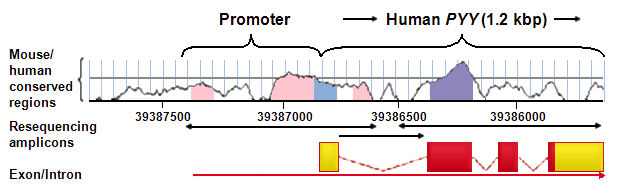
Human peptide YY (PYY). Adapted from Shih et al., 2009.
Description
PYY gene is composed of 4 exons and 3 introns that span approximately 51732 bases (start 42030106 bp to end 42081837 bp from pter) oriented at the minus strand.
Transcription
Two transcript variants (1048 bp and 1048 bp in length).
Proteins
Description
Size: 97 amino acids; 11046 Da.
Expression
PYY is expressed predominantly in endocrine L-cells that line the distal small bowel and colon.
Localisation
Extracellular, subcellular location: secreted granules. Co-localized with proglucagon products, glicentin and glucagon-like peptide-1 (GLP-1) and GLP-2. PYY is a gastrointestinal track-derived hormone synthesized by endocrine cells of terminal ileum and colon, involved in the regulation of food intake.
Function
Enteroendocrine L-cells release two circulating forms of PYY in the distal gut: PYY1-36 and PYY3-36. The latter form is considered the predominant form in both fasted and fed states and is produced by the cleavage of the N-terminal Tyr-Pro residues from PYY1-36 by dipeptidyl-peptidase IV (DPPIV). PYY exerts its inhibitory actions via various Y receptors, including Y1 receptor-mediated epithelial responses and Y2 receptor-mediated neuronal effects. It inhibits food intake via NPY-2 receptors expressed by neurons of the arcuate nucleus of the hypothalamus. Generally, it is considered to act in the hypothalamus as a signal of satiety. Other inhibitory actions include slowing gastric emptying; increasing nutrient absorption, inducing intestinal anion and electrolytic secretion as well as slowing small intestine motility. In addition, it has been shown to decrease exocrine pancreatic secretion and act as an appetite suppressant in the fasting state at physiological concentrations.
Mutations
Note
Common polymorphisms: Arg72Thr, which has been associated with type-2 diabetes and in some cases with enhanced body mass. Other variants: Gln62Pro and Leu73Pro associated with body mass and obesity, respectively as well as A-23G,C888T and 3 UTR variant C+1134A. The latter has been related to enhanced body mass.
Implicated in
Entity name
Colon cancer
Note
Loss of PYY expression has been implicated in the development and progression to colon adenocarcinoma. PYY expression has been associated with elevated differentiation, whilst PYY treatment of colon cancers resulted in selected overexpression of enzymes frequently identified in the normal colonocytic phenotype. The colon cancer growth regulatory effects of PYY might be dose dependent.
Entity name
Pancreatic cancer and pancreatitis
Note
PYY suppresses growth and levels of intracellular cyclic adenosine monophosphate (cAMP) in pancreatic adenocarcinoma. It is considered to have a therapeutic value for pancreatic cancer and pancreatitis, since it exerts its immune function by altering transcription factors vital for cell signaling pathways. In addition, administration of PYY has been shown to improve amylase and cytokine release in pancreatitis cases. It has also been suggested that PYY in combination with vitamin E exhibit a significantly increased inhibitory effect on pancreatic cancer in vitro.
Entity name
Breast cancer
Note
PYY inhibits in vitro growth of breast cancer cells, however the exact mechanism of antitumor activity remains unknown. Previous studies have proposed that PYY reduces intracellular levels of cAMP in breast carcinoma cells. Moreover, it has been reported that combination of PYY with vitamin E results in a significant additive inhibition of breast carcinoma cells.
Entity name
Cancer cachexia
Note
Cancer cachexia is generally characterized by decreased protein synthesis and loss in the small bowel. PYY has been shown to increase small bowel weight and protein content. However, the exact role of PYY on cancer cachexia has not yet been clarified.
Entity name
Body weight
Note
PYY-36 plays a role in long-term body weight regulation, due to the negative correlation between PYY concentrations and adiposity markers in humans, such that PYY levels increase with weight loss and when leptin levels are low.
Entity name
Obesity and type II diabetes
Note
Low endogenous PYY levels in obese individuals, have previously suggested that PYY deficiency may contribute to hyperinsulinemia and insulin resistance and predispose obesity and type II diabetes.
Article Bibliography
| Pubmed ID | Last Year | Title | Authors |
|---|---|---|---|
| 16368708 | 2006 | A PYY Q62P variant linked to human obesity. | Ahituv N et al |
| 17045646 | 2006 | Low serum PYY is linked to insulin resistance in first-degree relatives of subjects with type 2 diabetes. | Boey D et al |
| 20519124 | 2010 | Peptide YY is critical for acylethanolamine receptor Gpr119-induced activation of gastrointestinal mucosal responses. | Cox HM et al |
| 18662856 | 2008 | Endogenous PYY and NPY mediate tonic Y1- and Y2-mediated absorption in human and mouse colon. | Cox HM et al |
| 10090823 | 1999 | Peptide YY inhibits growth of human breast cancer in vitro and in vivo. | Grisé KR et al |
| 10816343 | 2000 | Peptide YY and vitamin E inhibit hormone-sensitive and -insensitive breast cancer cells. | Heisler T et al |
| 20179246 | 2010 | Ghrelin and PYY in the regulation of energy balance and metabolism: lessons from mouse mutants. | Kirchner H et al |
| 19820013 | 2009 | Effects of meals high in carbohydrate, protein, and fat on ghrelin and peptide YY secretion in prepubertal children. | Lomenick JP et al |
| 19011469 | 2008 | Serial plasma concentrations of PYY and ghrelin during chemotherapy in children with acute lymphoblastic leukemia. | Moschovi M et al |
| 17119001 | 2007 | Effect of human body weight changes on circulating levels of peptide YY and peptide YY3-36. | Pfluger PT et al |
| 19820027 | 2009 | Peptide YY (PYY) gene polymorphisms in the 3'-untranslated and proximal promoter regions regulate cellular gene expression and PYY secretion and metabolic syndrome traits in vivo. | Shih PA et al |
| 15983231 | 2005 | Evidence of an association between the Arg72 allele of the peptide YY and increased risk of type 2 diabetes. | Torekov SS et al |
| 11825654 | 2002 | Peptide YY and cancer: current findings and potential clinical applications. | Tseng WW et al |
| 17194501 | 2007 | PYY and the pancreas: inhibition of tumor growth and inflammation. | Vona-Davis L et al |
Other Information
Locus ID:
NCBI: 5697
MIM: 600781
HGNC: 9748
Ensembl: ENSG00000131096
Variants:
dbSNP: 5697
ClinVar: 5697
TCGA: ENSG00000131096
COSMIC: PYY
RNA/Proteins
| Gene ID | Transcript ID | Uniprot |
|---|---|---|
| ENSG00000131096 | ENST00000360085 | P10082 |
| ENSG00000131096 | ENST00000592796 | P10082 |
Expression (GTEx)
Pathways
Protein levels (Protein atlas)
PharmGKB
| Entity ID | Name | Type | Evidence | Association | PK | PD | PMIDs |
|---|---|---|---|---|---|---|---|
| PA258 | NPY1R | Gene | Pathway | associated | |||
| PA31741 | NPY2R | Gene | Pathway | associated |
References
| Pubmed ID | Year | Title | Citations |
|---|---|---|---|
| 37995867 | 2024 | RET Signaling Persists in the Adult Intestine and Stimulates Motility by Limiting PYY Release From Enteroendocrine Cells. | 0 |
| 37995867 | 2024 | RET Signaling Persists in the Adult Intestine and Stimulates Motility by Limiting PYY Release From Enteroendocrine Cells. | 0 |
| 36525977 | 2023 | Structural basis for Y2 receptor-mediated neuropeptide Y and peptide YY signaling. | 4 |
| 37380814 | 2023 | Peptide YY inhibits transcription and replication of hepatitis B virus by suppressing promoter/enhancer activity. | 0 |
| 36525977 | 2023 | Structural basis for Y2 receptor-mediated neuropeptide Y and peptide YY signaling. | 4 |
| 37380814 | 2023 | Peptide YY inhibits transcription and replication of hepatitis B virus by suppressing promoter/enhancer activity. | 0 |
| 35180645 | 2022 | Crystal structures of human neuropeptide Y (NPY) and peptide YY (PYY). | 2 |
| 36088864 | 2022 | Emerging evidence of the relationship between fat-free mass and ghrelin, glucagon-like peptide-1, and peptide-YY. | 1 |
| 35180645 | 2022 | Crystal structures of human neuropeptide Y (NPY) and peptide YY (PYY). | 2 |
| 36088864 | 2022 | Emerging evidence of the relationship between fat-free mass and ghrelin, glucagon-like peptide-1, and peptide-YY. | 1 |
| 33933736 | 2021 | Single nucleotide polymorphism in CD36: Correlation to peptide YY levels in obese and non-obese adults. | 3 |
| 33933736 | 2021 | Single nucleotide polymorphism in CD36: Correlation to peptide YY levels in obese and non-obese adults. | 3 |
| 30991633 | 2019 | Intermittent Hypoxia Up-Regulates Gene Expressions of Peptide YY (PYY), Glucagon-like Peptide-1 (GLP-1), and Neurotensin (NTS) in Enteroendocrine Cells. | 14 |
| 30991633 | 2019 | Intermittent Hypoxia Up-Regulates Gene Expressions of Peptide YY (PYY), Glucagon-like Peptide-1 (GLP-1), and Neurotensin (NTS) in Enteroendocrine Cells. | 14 |
| 29412828 | 2018 | Emerging therapeutic potential for peptide YY for obesity-diabetes. | 21 |
Citation
Maria Braoudaki ; Fotini Tzortzatou-Stathopoulou
PYY (peptide YY)
Atlas Genet Cytogenet Oncol Haematol. 2011-01-01
Online version: http://atlasgeneticsoncology.org/gene/46182/pyy
