Identity
HGNC
LOCATION
17q21.2
IMAGE

LEGEND
c-RARA (17q21) in normal cells: PAC 833D9 - Courtesy Mariano Rocchi, Resources for Molecular Cytogenetics.
IMAGE

LEGEND
RARA (Retinoic acid receptor, alpha) Hybridization with LSI RARA Dual Color, Break Apart Rearrangement Probe (Abbott Molecular, US), showing the RARA gene on 17q21.2 (red-green or a fused yellow signal - Courtesy Adriana Zamecnikova.
LOCUSID
ALIAS
NR1B1,RAR
FUSION GENES
Abstract
Review on RARA with data on DNA, on the protein encoded, and where the gene is implicated.
DNA/RNA
Description
9 exons; total gene sequence: 7450 bp.
Transcription
2.8 and 3.6 kb transcripts.
Proteins
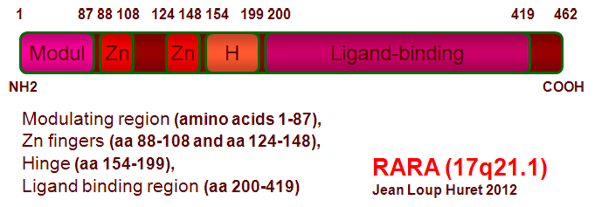
RARA protein and domains.
Description
462 amino acids - 6 evolutionarily conserved domains - 5 functional domains : N-terminal A/B domain (transcriptional regulation AF1), C (DNA binding domain, contains 2 zinc fingers motifs, necessary for binding to RARE DNA sequence), D (cellular localization signal), E (ligand-binding domain, transcriptional regulation AF2) and F (function not well understood today)..
Expression
RARA is expressed in hematopoietic cells.
Localisation
Nuclear localisation.
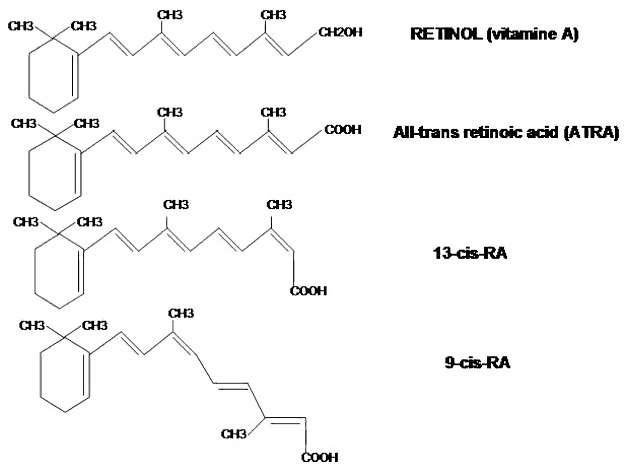
Retinoid structures.
Function
Ligand-dependent transcription factor activated by all-trans retinoic acid (ATRA), specifically involved in hematopoietic stem cells differentiation and maturation = receptor for all-trans retinoic acid (ATRA) and 9-cis RA which are intracellular metabolites of vitamine A, active in cellular differentiation and morphogenesis. The gene response to RARA binding is modulated by a series of co-repressors and co-activators.
Retinol (vitamin A) is strictly furnished by the nutrition. The active retinol product is the retinoic acid (RA) which plays a great role as modulator of proliferation and differentiation in numerous tissues. In target cells retinol is oxidized as retinal with the help of an alcohol dehydrogenase. Then retinal is oxidized as ATRA by a retinal dehydrogenase (ALDH1A2 or RALDH). ATRA gives rise to 9-cis-RA, 11-cis-RA and 13-cis-RA, via an isomerase. All these isoforms are members of the retinoids, acting in different tissues after linkage with specific nuclear protein receptors. There are two families of RA receptors, the RARs (retinoic acid receptor α, β, and γ: RARA, RARB, RARG) and the RXRs (retinoid X receptor α, β and γ: RXRA, RXRB, RXRG). RARA (RARα) is involved essentially in hematopoiesis, while RARγ (RARG) is assigned to the skin. To be activated RARs can bind to ATRA or 9-cis-RA while RXRs bind only to 9-cis-RA (Allenby G et al., 1993).
Wild type RARA binds to DNA by its C domain, as a heterodimer with a related retinoid X receptor (RXR). The site of binding is a specific DNA sequence, the RA response element (RARE). The RARE domain is located in the promoter of target genes, it is composed classically of two direct repeats of a consensus sequence 5-PuG(G/T)CA-3, separated by 1, 2 or 5 base pairs named respectively DR1, DR2 and DR5 (Umesono K et al., 1991). In the absence of ligand the AF2 domain of the RARA protein associates with corepressors NCOR2 (also called SMRT: silencing mediator of retinoid thyroid hormones) and/or N-CoR (nuclear corepressor) which are members of a multiprotein repressor complex. In this complex SMRT and N-Cor associate with the Sin3 proteins (SIN3A and SIN3B) which then links to histone deacetylases HDAC1 and/or HDAC2. Histone deacetylation would produce a local structural modification of the chromatin with an arrest of transcription initiation (Beato M et al., 1995; Pazin MJ and Kadonaga JT, 1997; Melnick A and Licht JD, 1999).
Transport of the ligands ATRA and 9-cis-RA, and their link with RAR/RXR heterodimer are facilitated by another family of receptors, CRABP1 and CRABP2 (cellular retinoic acid binding proteins) (Bastie JN et al., 2001).
When the ligand reaches its target it binds to RARA on the AF2 domain and modifies the molecular conformation of the receptor, so that the repressor complex dissociates from the molecule and is replaced by coactivator proteins which can bind at the same site (Chambon P, 1996; Wade PA and Wolffe AP, 1997). These coactivators involve TRIM24 (also called TIF1), PSMC5 (also called TRIP1 or SUG1), NCOA2 (TIF2), NCOA3 (ACTR), NCOA1 (SRC-1), TAF4 (TAFII135), and CREBBP (CBP). PSMC5 has a DNA helicase activity, able to unwind DNA. CREBBP and NCOA3 have an histone acetylase activity, they bind to KAT2B (P/CAF) which is also an histone acetylase. Consequently, when RARA binds to its ligand ATRA, it becomes the member of a multiprotein complex, in association with RXR and a number of coactivators. The result is a local histone reacetylation leading to the modification of chromatin conformation and stimulation of transcription machinery.
The activity of many genes involved in myeloid maturation, including transcription factors, may be potentially triggered by this coactivators complex, resulting in the arrest of cell growth, terminal differentiation and production of mature granulocytes.
Retinol (vitamin A) is strictly furnished by the nutrition. The active retinol product is the retinoic acid (RA) which plays a great role as modulator of proliferation and differentiation in numerous tissues. In target cells retinol is oxidized as retinal with the help of an alcohol dehydrogenase. Then retinal is oxidized as ATRA by a retinal dehydrogenase (ALDH1A2 or RALDH). ATRA gives rise to 9-cis-RA, 11-cis-RA and 13-cis-RA, via an isomerase. All these isoforms are members of the retinoids, acting in different tissues after linkage with specific nuclear protein receptors. There are two families of RA receptors, the RARs (retinoic acid receptor α, β, and γ: RARA, RARB, RARG) and the RXRs (retinoid X receptor α, β and γ: RXRA, RXRB, RXRG). RARA (RARα) is involved essentially in hematopoiesis, while RARγ (RARG) is assigned to the skin. To be activated RARs can bind to ATRA or 9-cis-RA while RXRs bind only to 9-cis-RA (Allenby G et al., 1993).
Wild type RARA binds to DNA by its C domain, as a heterodimer with a related retinoid X receptor (RXR). The site of binding is a specific DNA sequence, the RA response element (RARE). The RARE domain is located in the promoter of target genes, it is composed classically of two direct repeats of a consensus sequence 5-PuG(G/T)CA-3, separated by 1, 2 or 5 base pairs named respectively DR1, DR2 and DR5 (Umesono K et al., 1991). In the absence of ligand the AF2 domain of the RARA protein associates with corepressors NCOR2 (also called SMRT: silencing mediator of retinoid thyroid hormones) and/or N-CoR (nuclear corepressor) which are members of a multiprotein repressor complex. In this complex SMRT and N-Cor associate with the Sin3 proteins (SIN3A and SIN3B) which then links to histone deacetylases HDAC1 and/or HDAC2. Histone deacetylation would produce a local structural modification of the chromatin with an arrest of transcription initiation (Beato M et al., 1995; Pazin MJ and Kadonaga JT, 1997; Melnick A and Licht JD, 1999).
Transport of the ligands ATRA and 9-cis-RA, and their link with RAR/RXR heterodimer are facilitated by another family of receptors, CRABP1 and CRABP2 (cellular retinoic acid binding proteins) (Bastie JN et al., 2001).
When the ligand reaches its target it binds to RARA on the AF2 domain and modifies the molecular conformation of the receptor, so that the repressor complex dissociates from the molecule and is replaced by coactivator proteins which can bind at the same site (Chambon P, 1996; Wade PA and Wolffe AP, 1997). These coactivators involve TRIM24 (also called TIF1), PSMC5 (also called TRIP1 or SUG1), NCOA2 (TIF2), NCOA3 (ACTR), NCOA1 (SRC-1), TAF4 (TAFII135), and CREBBP (CBP). PSMC5 has a DNA helicase activity, able to unwind DNA. CREBBP and NCOA3 have an histone acetylase activity, they bind to KAT2B (P/CAF) which is also an histone acetylase. Consequently, when RARA binds to its ligand ATRA, it becomes the member of a multiprotein complex, in association with RXR and a number of coactivators. The result is a local histone reacetylation leading to the modification of chromatin conformation and stimulation of transcription machinery.
The activity of many genes involved in myeloid maturation, including transcription factors, may be potentially triggered by this coactivators complex, resulting in the arrest of cell growth, terminal differentiation and production of mature granulocytes.
Homology
RARA shares homology with RARB and RARG, 9-cis RA receptors (RXRs) and receptors for thyroid and steroid hormones and for vitamine D3 ( VDR)
Implicated in
Top note
In oncogenesis, RARA has been primarily implicated in acute promyelocytic leukaemia (APL) induction, via the expression of the PML/RARA fusion gene. Apart from its fusion with PML, RARA gene may be seldom fused by translocation, with a great variety of genes (Chen Z et al., 1996; Redner RL, 2002; Adams J and Nassiri M, 2015; Yan W and Zhang G, 2016) and all these fusion genes contain the RARA C-terminal B through F domains, encoding DNA binding, retinoid X receptor (RXR) heterodimerization, ligand binding, and co-repressor and co-activator interaction functions of RARA, leading invariably and specifically to the development of an APL. In all the variant translocations the functional activity of PML is not altered showing the crucial role of RARA in the leukemogenesis process. On other part it was observed recently that RARB or RARG, instead of RARA, could exceptionally fuse with various genes, giving rise to an APL responding poorly to ATRA therapy (Osumi T et al., 2018; Miller CA et al.; 2018; Chen X et al., 2019)
Entity name
Note
The translocation fuses the promyelocytic leukaemia gene (PML) at 15q24 with RARA (Kakizuka A et al., 1991; de Thé H et al., 1991).
Disease
Typical APL (or M3 AML, FAB classification), approximately 98% of APL cases; arrest of the white blood cells maturation at the promyelocytic stage giving an accumulation of abnormal promyelocytes with Auer rods and bundles (faggots); disruption of the PODs with a microspeckeled pattern; maturation response to all-trans retinoic acid (ATRA) therapy.
Prognosis
Immediate prognosis is impaired by intravascular disseminated coagulopathy; long term prognosis is favorable with treatment combining ATRA and/or arsenic trioxide (ATO) plus anthracycline chemotherapy (Wang Z-Y and Chen Z, 2008; Testa U and Lo-Coco F, 2016).
Treatment: More than 90% of complete remission with ATRA plus ATO. Additional gene(s) alterations, involving mainly FLT3, KRAS or CMYC, are considered as progression factors (de Thé H, 2018).
Treatment: More than 90% of complete remission with ATRA plus ATO. Additional gene(s) alterations, involving mainly FLT3, KRAS or CMYC, are considered as progression factors (de Thé H, 2018).
Cytogenetics
Variant or complex t(15;17) translocation in 5% of cases, no known prognosis implication; secondary chromosomal abnormalities in 30 to 35% of APL at diagnosis; association with +8 in 17 to 28% of cases; other associations are rare but recurrent: del(7q), del(9q), ider(17)t(15;17), +21. Rarely the t(15;17) is not detectable cytogenetically, resulting from a cryptic molecular insertion; if the insertion is too small, FISH analysis may be negative and the molecular analysis only will be able to detect the PML-RARA transcripts.
Hybrid gene
The crucial fusion transcript is 5PML-3RARA, encoded by der(15) chromosome; the counterpart 5RARA-3PML encoded by der(17) is inconstant.
The breakpoint in RARA gene is always located in intron between A and B domains.
PML gene is composed of approximately 53.000 bp with 9 exons; the PML protein is member of a multiprotein complex composing the matrix-associated nuclear bodies, which are dynamic nuclear components of 0.1 to 1.0 m in size. PML works as a tumour suppressor gene, the protein is implicated in a wide variety of cellular functions: apoptosis, differentiation, genome stability (Bernardi R and Pandolfi PP, 2007; Hsu K-S and Kao H-Y, 2018). There are three breakpoint clusters in PML gene: bcr1 (70% of patients), bcr2 (10%) and bcr3 (20%), giving rise respectively to the long (L), intermediate (V) and short (S) length hybrid PML-RARA transcripts; in the 3 types of proteins the coiled-coil domain of PML, which is an element of the ring-B box-CC/tripartite domain, is conserved; V form would be linked to ATRA with a decreased sensitivity and S form would be associated to an excess of secondary chromosome changes.
The breakpoint in RARA gene is always located in intron between A and B domains.
PML gene is composed of approximately 53.000 bp with 9 exons; the PML protein is member of a multiprotein complex composing the matrix-associated nuclear bodies, which are dynamic nuclear components of 0.1 to 1.0 m in size. PML works as a tumour suppressor gene, the protein is implicated in a wide variety of cellular functions: apoptosis, differentiation, genome stability (Bernardi R and Pandolfi PP, 2007; Hsu K-S and Kao H-Y, 2018). There are three breakpoint clusters in PML gene: bcr1 (70% of patients), bcr2 (10%) and bcr3 (20%), giving rise respectively to the long (L), intermediate (V) and short (S) length hybrid PML-RARA transcripts; in the 3 types of proteins the coiled-coil domain of PML, which is an element of the ring-B box-CC/tripartite domain, is conserved; V form would be linked to ATRA with a decreased sensitivity and S form would be associated to an excess of secondary chromosome changes.
Fusion protein
106 Kda fusion protein; role in the leukemogenic process through two main pathways: 1) interference with the signalling pathway controlled by RARA and involved in differentiation and maturation of myeloid precursors (mainly dysregulation of retinoid-inducible genes responsible for in myeloid differentiation). 2) disruption of the PML nuclear bodies (PML-NBs) which control the P53 pathway and many other cellular functions involved in genome stability, apoptosis, cellular senescence, differentiation, angiogenesis.
In contrast with wild type RARA which only forms heterodimers with RXRA, the fusion protein PML/RARA can form homodimers through the coiled-coil domain of PML, which is the critical domain for the transformation of PML/RARA into an oncoprotein (Lin RJ and Evans RM, 2000; Occhionorelli M et al., 2011). The homodimer can link to the DNA, independently from RXR. The expression of PML/RARA homodimer is sufficient ex vivo to operate the cellular transformation, however the PML/RARA homodimer is quasi always linked in vivo to RXRA which is necessary to an efficient DNA binding. It results in a dominant negative control of both native PML and RARA functions (de Thé H et al., 1991; Melnick A and Licht JD, 1999; Occhionorelli M et al., 2011). Binding of the homodimer, by the RARA domain of PML-RARA, with DNA sites located in the promoter region of target genes, and multimerisation owing to the coiled-coil domain of PML, enhances the recruitment of co repressor proteins and of histone deacetylases (HDACs), leading to a gene repression via DNA methylation (Di Croce L et al., 2002; Martens JH et al., 2010; Occhionorelli M et al., 2011). The classical consequences are a block of myeloid differentiation at the promyelocytic stage. A second activity of PML-RARA is to disrupts the PML nuclear-bodies involved in many cellular regulations, particularly TP53 activation, leading to an increase of progenitors self renewal (Bernardi R and Pandolfi PP, 2007; Nasr R et al., 2008).
In contrast with wild type RARA which only forms heterodimers with RXRA, the fusion protein PML/RARA can form homodimers through the coiled-coil domain of PML, which is the critical domain for the transformation of PML/RARA into an oncoprotein (Lin RJ and Evans RM, 2000; Occhionorelli M et al., 2011). The homodimer can link to the DNA, independently from RXR. The expression of PML/RARA homodimer is sufficient ex vivo to operate the cellular transformation, however the PML/RARA homodimer is quasi always linked in vivo to RXRA which is necessary to an efficient DNA binding. It results in a dominant negative control of both native PML and RARA functions (de Thé H et al., 1991; Melnick A and Licht JD, 1999; Occhionorelli M et al., 2011). Binding of the homodimer, by the RARA domain of PML-RARA, with DNA sites located in the promoter region of target genes, and multimerisation owing to the coiled-coil domain of PML, enhances the recruitment of co repressor proteins and of histone deacetylases (HDACs), leading to a gene repression via DNA methylation (Di Croce L et al., 2002; Martens JH et al., 2010; Occhionorelli M et al., 2011). The classical consequences are a block of myeloid differentiation at the promyelocytic stage. A second activity of PML-RARA is to disrupts the PML nuclear-bodies involved in many cellular regulations, particularly TP53 activation, leading to an increase of progenitors self renewal (Bernardi R and Pandolfi PP, 2007; Nasr R et al., 2008).
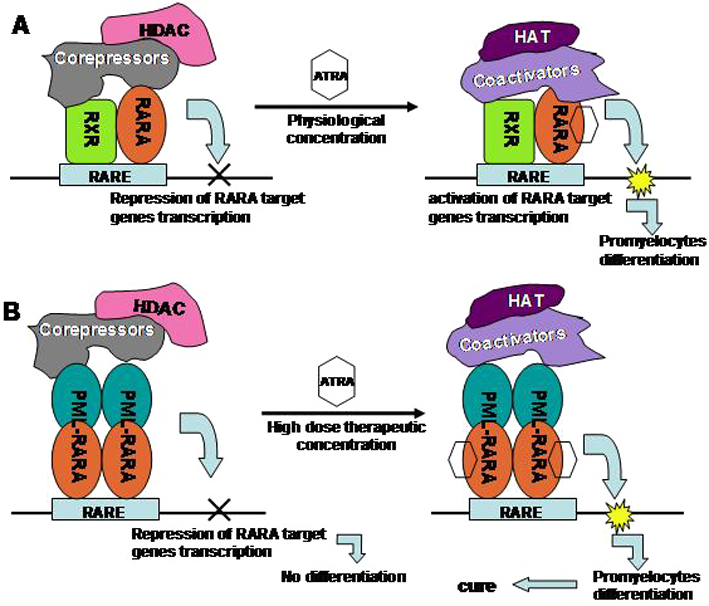
Molecular pathogenesis of APL.
Entity name
Note
Described in Chen Z et al., 1994; Licht JD et al., 1995; Melnick A and Licht JD, 1999; Sainty D et al., 2000. ZBTB16 is also named PLZF, ZNF145.
Disease
Variant acute promyelocytic leukemia (APL) form with atypical cytologic aspects: intermediate morphology between M2 and M3, less or not bilobed promyelocyte nucleus, no Auer rods, the hypogranular form is predominant with coarse granules, absence of faggot cells, increased number of hypogranular pseudo-Pelger neutrophils and increased CD56 expression; generally no response to ATRA therapy; however some cases achieved a remission with a treatment combining ATRA and chemotherapy or ATRA and G-CSF; worse prognostic than APL with t(15;17), whatever the treatment. Found in less than 1% of APL cases.
Cytogenetics
In some cases the translocation may be cryptic.
Hybrid gene
Native ZBTB16 (zinc finger and BTB domain containing 16) has 7 exons, 3 alternative transcripts; encodes a 673 amino acids zinc finger protein, containing one N-terminal POZ-BTB domain (Pox virus and Zinc finger domain also called Broad Complex, tramtrack, Bric a Brac ), one RD2 domain and 9 C-terminal zinc finger motifs. The native protein is involved as transcriptional repressor in a number of pathways during development (Liu et al., 2016). The t(11;17) results in two reciprocal transcripts, encoding in the same reading frame ZBTB16/RARA and RARA/ZBTB16 proteins. ZBTB16/RARA contains the same RARA domains as in PML/RARA.
Resistance to ATRA therapy is caused by the insensibility to ATRA of the corepressors-ZBTB16-/RARA complex, in which N-CoR/SMRT co repressor proteins maintain there link with the ZBTB16 part of ZBTB16/RARA, even with therapeutic levels of ATRA.
Resistance to ATRA therapy is caused by the insensibility to ATRA of the corepressors-ZBTB16-/RARA complex, in which N-CoR/SMRT co repressor proteins maintain there link with the ZBTB16 part of ZBTB16/RARA, even with therapeutic levels of ATRA.
Entity name
Note
Described in Corey SJ et al., 1994; Redner RL et al., 1996; Rush EA et al., 2013. The translocation fuses the nucleophosmin gene (NPM1) with RARA. It is the second most frequent variant translocation after the t(11;17)(q23;q21). Apart from NPM1/RARA two other translocation / fusion gene involve NPM1 in haematological neoplasms: t(2;5)(p23;q35) NPM1/ALK fusion in anaplastic large cell lymphoma and t(3;5)(q25;q35) NPM1/MLF1 fusion in MDS and AML. Down or up regulation of NPM1 caused by mutations lead also to solid tumors (Grisendi S et al., 2006).
Disease
Exceptional; expresses overall similar morphologic and immunophenotypic features as classical APL; respond to ATRA treatment.
Hybrid gene
NPM1 encodes a nucleolar phosphoprotein mainly involved in ribosomal particles assembly and regulation of centrosome duplication. It is also implicated in the regulation of stability and activity of various tumor suppressor proteins, including TP53. It plays a crucial role in cell growth regulation and genomic stability. According to the physiological or physiopathological conditions NPM1 should be considered either as an oncoprotein or as a tumor suppressor (Grisendi S et al., 2006). The t(5;17) produces both NPM1/RARA and, inconstantly, RARA/NPM1 transcripts. Only NPM1/RARA protein is responsible for APL disease. As for PML/RARA and ZBTB16/RARA fusion genes the breakpoint in RARA occurs in the second intron so that its B-F domain is fused to the N-terminal domains of NPM1, in the same reading frame. The analysis of the initial published case (Redner RL et al., 1996) showed two different breakpoint in NPM1, generating two transcripts of 2.3 kb and 2.4 kb. Both coded two proteins of 520 and 563 amino acids respectively, with the same level of expression. These two fusion proteins had a RA-dependent transcriptional activity.
Entity name
Note
Described in Wells RA et al., 1996, 1997, the third variant translocation to be described. Only one case reported to date, in a 6-month old male infant.
Disease
Presentation as a quite classical APL who expressed, however, multiple unexpected cutaneous lesions but peripheral blood smears and cellular immunophenotype were typical of APL. Respond to ATRA treatment and there was no relapse at 3 years after autologous bone marrow transplantation.
Hybrid gene
The NUMA1 gene (nuclear mitotic apparatus) located at 11q13, encodes NuMA, a high molecular weight (238 kDa) coiled-coil protein component of the nuclear matrix at interphase and associated with the spindle poles during mitosis. It is involved in the processes of mitosis and in the nuclear reconstructing after mitosis. NUMA1 is composed of a large coiled-col interstitial domain of approximately 1500 amino acids involved in homo-heterodimerization, encompassed with two globular C-terminal and N-terminal domains. The C-terminal domain contains a nuclear localization signal (NLS), a microtubule binding domain (MT), a LGN binding sequence and 4 phosphorylation sites. This complex domain is necessary for localization to the nucleus and mitotic spindle functioning. The N-terminal domain is required for post mitotic nuclear reassociation. Both N- and C-terminal domains contain DNA-binding S/TPXX motifs (Melnick A and Licht JD, 1999; Radulescu AE and Cleveland DW, 2010).
The t(11;17)(q13;q21) gave rise to a 2286 amino acids NUMA1/RARA fusion protein, linking in the same reading frame the B-F domain of RARA to the N-terminal globular and the coiled coil domains of NUMA1. No alternative RARA/ NUMA1 protein could be detected. NUMA1/RARA plays a role of dominant negative RA receptor. It is able to bind to quite the same RARE sites as PML/RARA, equally as a homodimer or a heterodimer with RXR but more stable as a RXR heterodimeric complex (Dong S et al., 2003).
The t(11;17)(q13;q21) gave rise to a 2286 amino acids NUMA1/RARA fusion protein, linking in the same reading frame the B-F domain of RARA to the N-terminal globular and the coiled coil domains of NUMA1. No alternative RARA/ NUMA1 protein could be detected. NUMA1/RARA plays a role of dominant negative RA receptor. It is able to bind to quite the same RARE sites as PML/RARA, equally as a homodimer or a heterodimer with RXR but more stable as a RXR heterodimeric complex (Dong S et al., 2003).
Note
The STAT5B/RARA fusion gene is a rare event, no more than 12 cases were published in 2018. It results probably from a variable rearrangement of 17q, interstitial deletion, duplication, inversion or other more complex rearrangement, undetectable by conventional and molecular cytogenetic. However FISH with a commercial RARA dual colour or break apart probe is able sometimes to give informations, mainly in case of deletion of the 3-RARA sequences. In the first published case (Arnould C et al., 1999) der(17) resulted from a duplication of the 17q21.3-q23 segment.
Disease
Male predominance, only two female cases reported. Clinical and cytological data compatibles with variant APL or sometimes quite atypical for APL. Very poor response to ATRA and/or ATO therapy. No one long term complete remission could be obtained (Zang C et al., 2018).
Hybrid gene
The STAT5B gene (signal transducer and activator of transcription 5B) is located at 17q21.2, it contains 19 exons and a total of 5090 coding nucleotides. It is a member of the STAT family, it encodes a 92 kD S STAT5B protein which contains STAT proteins conserved domains: a N- terminal coiled coil domain, a DNA binding domain, a SH2 domain and a C-terminal transactivation domain. STAT5B is a signal transducer and activator of transcription, acting in the janus kinase (JAK)-STAT signaling pathway. It is activated by tyrosine-phosphorylation, permitting homo- or heteridimerization. Located inactive in the cytoplasm, the protein is rapidly translocated to the nucleus after dimerization and binds to DNA to activate its target genes (Del Rosario AM et al., 2012).
The STAT5B/RARA fusion protein is composed of the N- terminal coiled-coil domain necessary for dimerization, the DNA binding domain, the SH2 and a part of the SH3 domains of STAT5B, fused in the same reading frame to the B to F domains of RARA. No alterne RARA/ STAT5B protein is produced. Like PML/RARA, STAT5B /RARA binds to RARE as a homodimer or heterodimer with RXR. It works as a competitive inhibitor of transcriptional activity of RARA-RXR. This inhibition depends essentially on the presence of the coiled coil domain of STAT5B. When this domain is absent, in transfection experiments with modified STAT5B /RARA protein, STAT5B/RARA expresses the same transcriptional activity as wild type RARA (Dong S and Tweardy DJ, 2002; Huret JL, 2010).
The STAT5B/RARA fusion protein is composed of the N- terminal coiled-coil domain necessary for dimerization, the DNA binding domain, the SH2 and a part of the SH3 domains of STAT5B, fused in the same reading frame to the B to F domains of RARA. No alterne RARA/ STAT5B protein is produced. Like PML/RARA, STAT5B /RARA binds to RARE as a homodimer or heterodimer with RXR. It works as a competitive inhibitor of transcriptional activity of RARA-RXR. This inhibition depends essentially on the presence of the coiled coil domain of STAT5B. When this domain is absent, in transfection experiments with modified STAT5B /RARA protein, STAT5B/RARA expresses the same transcriptional activity as wild type RARA (Dong S and Tweardy DJ, 2002; Huret JL, 2010).
Entity name
Note
Described in Yamamoto Y et al., 2000. Only two cases reported to date, the first in a 45-year-old man with a 45,-Y, t(X;17)(p11;q21) karyotype.
Disease
First case clinical presentation as a variant APL, with 83% of promyelocytes in a hypercellular bone marrow and a coagulopathy, but with unusual rectangular and round cytoplasmic inclusion bodies in promyelocytes. Patient responded to ATRA therapy but was resistant to ATO.
Hybrid gene
The BCOR gene (BCL6 co repressor) located at Xp11.4 encodes a 180 kDa nuclear protein which is a component of a polycomb complex acting as a transcription suppressor. The BCOR/RARA fusion protein has a self association capacity through its BCOR-S region and ankyrin-repeat domain. It can also form a heterodimer with RXR to bind with RARE, acting as a dominant negative factor of RARA transcription.
Note
Described in Catalano A et al., 2007. Only one case published in a 66-year-old man. Karyotype showed only a trisomy 22. RARA break apart FISH showed a deletion of the 5-RARA probe on a der(17). A dual colour PML/RARA FISH showed a split of the RARA signal on der(17) and normal PML signals. Later on FISH with RARA and PRKAR1A probes confirmed the split of RARA and the PRKAR1A/RARA fusion on the der(17).
Disease
The patient was investigated for fatigue and anorexia. No signs of coagulopathy were observed, hypercellular bone marrow contained 83% of hypergranular promyelocytes, but without Auer rods or fagot cells. Patient responded well to ATRA and ATO.
Hybrid gene
PRKAR1A (protein kinase A regulatory subunit1) is located at 17q24.2. The protein is involved in the regulation of cAMP-dependent PRKA enzymatic activity. PRKAR1A/RARA binds to a number of RARE sequences, either as a homodimer or as a heterodimer with RXR. However, only the interaction of RXR with PRKAR1A/RARA is critical for leukemic transformation (Qiu JJ et al., 2010).
Entity name
Note
Described in Kondo T et al., 2008, Zamecnikova A, 2015. Seventh variant translocation to be described, three APL cases published, however the FIP1L1/RARA fusion was previously reported in one case of juvenile myelomonocytic leukaemia (Buijs A and Bruin M, 2007).
Disease
The first patient, a 90-year old woman, responded to ATRA therapy.
Hybrid gene
RARA breakpoint was, as expected, up side of exon 3 and it fused with exon 15 or exon 13 of FIP1 motif.
Entity name
Note
Described in Won D et al., 2013; Zamecnikova A, 2018.
Disease
Only one case described to date, a 59-year old man who achieved complete remission with ATRA followed by chemotherapy and allogenic bone marrow stem cells transplantation.
Hybrid gene
NABP1 (nucleic acid binding protein 1) also named OBFC2A (oligonucleotides / oligosaccharide binding fold containing 2A) is located at 2q32.3, it is involved in DNA damage response and genome stability. In the NABP1/RARA fusion gene exon 5 of the NABP1 gene is fused with the exon 3 of RARA.
Entity name
Note
Described in Chen Y et al., 2014; Zamecnikova A, 2018.
Disease
Fusion gene detected in a patient with a complex translocation t(3;17)(q26;q21), t(7;17)(q11.2;q21). Three cases known to date. Response to ATRA therapy.
Hybrid gene
TBL1XR1/RARA (transducin beta-like 1 X-linked receptor 1) also known as TBLR1 (transducin beta-like protein 1-related protein). The TBL1XR1protein contains a LisH domain which is necessary for homo or heterodimerization, it could be involved in the TBL1XR1/RARA homodimerization.
Entity name
Note
Described in Yin CC et al., 2015 ; Shimomura Y et al., 2016 ; Jovanovic JV et al., 2017 ; Zamecnikova A, 2017 ; Mazharuddin S et al., 2018.
Disease
Four cases described in 2018, all with clinical, cytological and immunophenotypic features compatibles with APL. Two patients at least responded to ATRA therapy.
Hybrid gene
Breakpoint in IRF2BP2 (interferon regulatory factor 2 binding protein 2) exon 2 and in RARA intron 2.
Entity name
Note
Described in Li J et al., 2015.
Disease
One case reported in a 35-year-old APL man which did not respond to ATRA therapy.
Hybrid gene
The t(7;17) unbalanced translocation resulted in a fusion between exon 6 of GTF2I and common exon 3 of RARA. GTF2I protein (general transcription factor 2I) is a members of the transcription factor 2I family. It contains a leucine zipper for homodimerization and a DNA binding domain. There are 4 human GTF2I isoforms which are expressed in various tissues.
Prognosis
In APL, resistance to ATRA was studied on GTF2I/RARA-transfected HL60 cells. It showed that the resistance was associated to the interaction between GTF2I/RARA and the RING finger protein 8 (RFN8) (Yan W et al., 2019).
Note
Described in Cheng CK et al., 2017.
Disease
One case in a 36-year-old man. Cytology and immunophenotype were compatible with APL and patient responded to ATRA followed by chemotherapy and a complete remission was obtained at day 30, however patient relapsed at 8 months.
Hybrid gene
At the karyotypic level the translocation was the same as the t(3;17)(26;q21) which produce the TBLR1XR1/RARA fusion. DNA sequencing showed the FNDC3B/RARA fusion between exon 24 of FNDC3B and exon3 of RARA. Two reciprocal RARA-FNDC3B transcripts were detected. FNDC3B (fibronectin type III domain containing 3B) is implicated in protein interactions, particularly it has a role in granulocytic differentiation and it was involved in an APL-like leukaemia without RARA intervention (Wang HY et al., 2016)
Note
Described in Chong ML et al., 2018.
Disease
One case published in a 16-year-old man with a t(3;14;17) complex translocation. Bone marrow hypergranular promyelocytes and immunophenotype diagnosed an APL which responded to ATRA therapy.
Hybrid gene
RNA and cDNA sequencing showed a TFG/RARA fusion. TFG (TRK-fused gene) is located at 3q12.2, breakpoints of the fusion gene occurred in TFG exon 7 and RARA exon 3.
Entity name
Non APL malignancies
Disease
Mutations in the ligand binding domain of RARA, associated with MED12 gene mutations, were frequently observed in breast fibroadenoma and phyllode tumors (Tan J et al., 2015).
A super enhancer (SE) was observed at the RARA locus, in a subset of patients with AML other than APL. This SE was associated with a high RARA expression and evidences of differentiation in AML cell lines, leading to the hypothesis that non-APL AML patients with such a SE could be sensitive to RA therapy (McKeown MR et al.; 2017).
t(11;17)(q23;q12) / M5 acute myeloid leukemia --> KMT2A / RARA 1 case to date (Shekhter-Levin et al.2000); not found in APL; belongs to the MLL/11q23 leukemias
A super enhancer (SE) was observed at the RARA locus, in a subset of patients with AML other than APL. This SE was associated with a high RARA expression and evidences of differentiation in AML cell lines, leading to the hypothesis that non-APL AML patients with such a SE could be sensitive to RA therapy (McKeown MR et al.; 2017).
t(11;17)(q23;q12) / M5 acute myeloid leukemia --> KMT2A / RARA 1 case to date (Shekhter-Levin et al.2000); not found in APL; belongs to the MLL/11q23 leukemias
Breakpoints
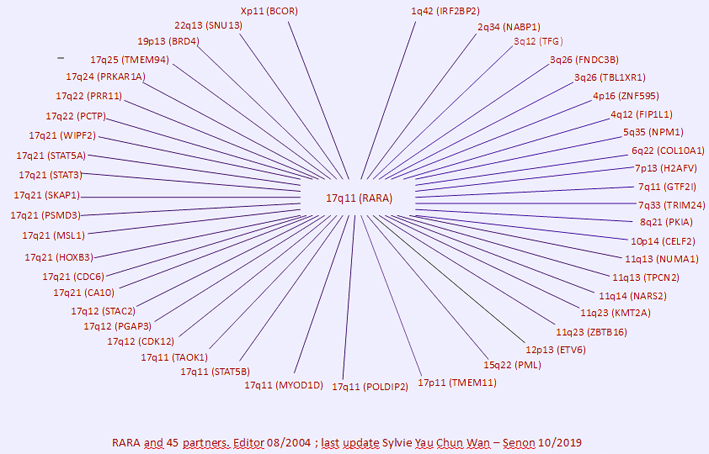
Article Bibliography
| Pubmed ID | Last Year | Title | Authors |
|---|---|---|---|
| 26414475 | 2015 | Acute Promyelocytic Leukemia: A Review and Discussion of Variant Translocations. | Adams J et al |
| 8380496 | 1993 | Retinoic acid receptors and retinoid X receptors: interactions with endogenous retinoic acids. | Allenby G et al |
| 10441338 | 1999 | The signal transducer and activator of transcription STAT5b gene is a new partner of retinoic acid receptor alpha in acute promyelocytic-like leukaemia. | Arnould C et al |
| 11682061 | 2001 | The novel co-activator CRABPII binds to RARalpha and RXRalpha via two nuclear receptor interacting domains and does not require the AF-2 'core'. | Bastie JN et al |
| 8521509 | 1995 | Steroid hormone receptors: many actors in search of a plot. | Beato M et al |
| 17928811 | 2007 | Structure, dynamics and functions of promyelocytic leukaemia nuclear bodies. | Bernardi R et al |
| 17301809 | 2007 | Fusion of FIP1L1 and RARA as a result of a novel t(4;17)(q12;q21) in a case of juvenile myelomonocytic leukemia. | Buijs A et al |
| 17712046 | 2007 | The PRKAR1A gene is fused to RARA in a new variant acute promyelocytic leukemia. | Catalano A et al |
| 22480366 | 2012 | Deletions in chromosome 6p22.3-p24.3, including ATXN1, are associated with developmental delay and autism spectrum disorders. | Celestino-Soper PB et al |
| 8801176 | 1996 | A decade of molecular biology of retinoic acid receptors. | Chambon P et al |
| 29736267 | 2018 | Long non-coding RNAs: crucial regulators of gastrointestinal cancer cell proliferation. | Chen J et al |
| 30996344 | 2019 | A novel NPM1-RARG-NPM1 chimeric fusion in acute myeloid leukaemia resembling acute promyelocytic leukaemia but resistant to all-trans retinoic acid and arsenic trioxide. | Chen X et al |
| 24782508 | 2014 | TBLR1 fuses to retinoid acid receptor α in a variant t(3;17)(q26;q21) translocation of acute promyelocytic leukemia. | Chen Y et al |
| 8302850 | 1994 | PLZF-RAR alpha fusion proteins generated from the variant t(11;17)(q23;q21) translocation in acute promyelocytic leukemia inhibit ligand-dependent transactivation of wild-type retinoic acid receptors. | Chen Z et al |
| 8721678 | 1996 | Retinoic acid regulatory pathways, chromosomal translocations, and acute promyelocytic leukemia. | Chen Z et al |
| 28314734 | 2017 | FNDC3B is another novel partner fused to RARA in the t(3;17)(q26;q21) variant of acute promyelocytic leukemia. | Cheng CK et al |
| 14519448 | 2003 | Direct and biochemical interaction between dopamine D3 receptor and elongation factor-1Bbetagamma. | Cho DI et al |
| 26472928 | 2015 | Assembly of Multi-tRNA Synthetase Complex via Heterotetrameric Glutathione Transferase-homology Domains. | Cho HY et al |
| 30292835 | 2018 | TFG-RARA: A novel fusion gene in acute promyelocytic leukemia that is responsive to all-trans retinoic acid. | Chong ML et al |
| 8057672 | 1994 | A non-classical translocation involving 17q12 (retinoic acid receptor alpha) in acute promyelocytic leukemia (APML) with atypical features. | Corey SJ et al |
| 11834837 | 2002 | Methyltransferase recruitment and DNA hypermethylation of target promoters by an oncogenic transcription factor. | Di Croce L et al |
| 12584566 | 2003 | Essential role for the dimerization domain of NuMA-RARalpha in its oncogenic activities and localization to NuMA sites within the nucleus. | Dong S et al |
| 11929748 | 2002 | Interactions of STAT5b-RARalpha, a novel acute promyelocytic leukemia fusion protein, with retinoic acid receptor and STAT3 signaling pathways. | Dong S et al |
| 22685290 | 2012 | Elevation of highly up-regulated in liver cancer (HULC) by hepatitis B virus X protein promotes hepatoma cell proliferation via down-regulating p18. | Du Y et al |
| 31059041 | 2019 | Screening of underlying genetic biomarkers for ankylosing spondylitis. | Fan X et al |
| 12533789 | 2003 | Genomic screen for genes involved in mammalian craniofacial development. | Fowles LF et al |
| 29617662 | 2018 | Driver Fusions and Their Implications in the Development and Treatment of Human Cancers. | Gao Q et al |
| 16794633 | 2006 | Nucleophosmin and cancer. | Grisendi S et al |
| 24917520 | 2015 | Loss of expression of the tumour suppressor gene AIMP3 predicts survival following radiotherapy in muscle-invasive bladder cancer. | Gurung PM et al |
| 29342219 | 2018 | The expression profile and prognostic significance of eukaryotic translation elongation factors in different cancers. | Hassan MK et al |
| 29337901 | 2018 | Transcriptional-Readthrough RNAs Reflect the Phenomenon of "A Gene Contains Gene(s)" or "Gene(s) within a Gene" in the Human Genome, and Thus Are Not Chimeric RNAs. | He Y et al |
| 30071685 | 2018 | Role of Pseudogenes in Tumorigenesis. | Hu X et al |
| 22944692 | 2012 | A catalogue of putative HIV-1 protease host cell substrates. | Impens F et al |
| 22646717 | 2012 | Effects on human transcriptome of mutated BRCA1 BRCT domain: a microarray study. | Iofrida C et al |
| 22190034 | 2011 | Global landscape of HIV-human protein complexes. | Jäger S et al |
| 27872498 | 2017 | The cryptic IRF2BP2-RARA fusion transforms hematopoietic stem/progenitor cells and induces retinoid-sensitive acute promyelocytic leukemia. | Jovanovic JV et al |
| 1652368 | 1991 | Chromosomal translocation t(15;17) in human acute promyelocytic leukemia fuses RAR alpha with a novel putative transcription factor, PML. | Kakizuka A et al |
| 22867704 | 2012 | AIMP3/p18 controls translational initiation by mediating the delivery of charged initiator tRNA to initiation complex. | Kang T et al |
| 30250065 | 2018 | AIMP3 depletion causes genome instability and loss of stemness in mouse embryonic stem cells. | Kim SM et al |
| 21789020 | 2011 | Expression of AIMP1, 2 and 3, the scaffolds for the multi-tRNA synthetase complex, is downregulated in gastric and colorectal cancer. | Kim SS et al |
| 18603554 | 2008 | The seventh pathogenic fusion gene FIP1L1-RARA was isolated from a t(4;17)-positive acute promyelocytic leukemia. | Kondo T et al |
| 25284716 | 2015 | GTF2I-RARA is a novel fusion transcript in a t(7;17) variant of acute promyelocytic leukaemia with clinical resistance to retinoic acid. | Li J et al |
| 7849296 | 1995 | Clinical and molecular characterization of a rare syndrome of acute promyelocytic leukemia associated with translocation (11;17). | Licht JD et al |
| 10882118 | 2000 | Acquisition of oncogenic potential by RAR chimeras in acute promyelocytic leukemia through formation of homodimers. | Lin RJ et al |
| 26676652 | 2016 | Concise Review: Balancing Stem Cell Self-Renewal and Differentiation with PLZF. | Liu TM et al |
| 9653160 | 1998 | Identification of genes expressed in human CD34(+) hematopoietic stem/progenitor cells by expressed sequence tags and efficient full-length cDNA cloning. | Mao M et al |
| 20159609 | 2010 | PML-RARalpha/RXR Alters the Epigenetic Landscape in Acute Promyelocytic Leukemia. | Martens JH et al |
| 29350080 | 2018 | IRF2BP2-RARA t(1;17)(q42.3;q21.2) APL blasts differentiate in response to all-trans retinoic acid. | Mazharuddin S et al |
| 28729405 | 2017 | Superenhancer Analysis Defines Novel Epigenomic Subtypes of Non-APL AML, Including an RARα Dependency Targetable by SY-1425, a Potent and Selective RARα Agonist. | McKeown MR et al |
| 10233871 | 1999 | Deconstructing a disease: RARalpha, its fusion partners, and their roles in the pathogenesis of acute promyelocytic leukemia. | Melnick A et al |
| 29891591 | 2018 | A case of acute myeloid leukemia with promyelocytic features characterized by expression of a novel RARG-CPSF6 fusion. | Miller CA et al |
| 28271488 | 2017 | The Aminoacyl-tRNA Synthetase Complex. | Mirande M et al |
| 15504251 | 2004 | Distinct pattern of gene expression in pyothorax-associated lymphoma (PAL), a lymphoma developing in long-standing inflammation. | Nishiu M et al |
| 21331069 | 2011 | The self-association coiled-coil domain of PML is sufficient for the oncogenic conversion of the retinoic acid receptor (RAR) alpha. | Occhionorelli M et al |
| 20726853 | 2010 | Downregulation of lamin A by tumor suppressor AIMP3/p18 leads to a progeroid phenotype in mice. | Oh YS et al |
| 29921692 | 2018 | Recurrent RARB Translocations in Acute Promyelocytic Leukemia Lacking RARA Translocation. | Osumi T et al |
| 15680327 | 2005 | The haploinsufficient tumor suppressor p18 upregulates p53 via interactions with ATM/ATR. | Park BJ et al |
| 16849534 | 2006 | AIMP3 haploinsufficiency disrupts oncogene-induced p53 activation and genomic stability. | Park BJ et al |
| 9150131 | 1997 | What's up and down with histone deacetylation and transcription? | Pazin MJ et al |
| 19095653 | 2009 | Coordination of eukaryotic translation elongation factor 1A (eEF1A) function in actin organization and translation elongation by the guanine nucleotide exchange factor eEF1Balpha. | Pittman YR et al |
| 19965660 | 2010 | Leukemic transformation by the APL fusion protein PRKAR1A-RAR{alpha} critically depends on recruitment of RXR{alpha}. | Qiu JJ et al |
| 8849690 | 1996 | The p18 component of the multisynthetase complex shares a protein motif with the beta and gamma subunits of eukaryotic elongation factor 1. | Quevillon S et al |
| 20137953 | 2010 | NuMA after 30 years: the matrix revisited. | Radulescu AE et al |
| 12357344 | 2002 | Variations on a theme: the alternate translocations in APL. | Redner RL et al |
| 8562957 | 1996 | The t(5;17) variant of acute promyelocytic leukemia expresses a nucleophosmin-retinoic acid receptor fusion. | Redner RL et al |
| 24183235 | 2013 | Interaction with RXR is necessary for NPM-RAR-induced myeloid differentiation blockade. | Rush EA et al |
| 10942370 | 2000 | A new morphologic classification system for acute promyelocytic leukemia distinguishes cases with underlying PLZF/RARA gene rearrangements. | Sainty D et al |
| 17303557 | 2007 | Characterization of p43(ARF), a derivative of the p43 component of multiaminoacyl-tRNA synthetase complex released during apoptosis. | Shalak V et al |
| 27193600 | 2016 | New variant of acute promyelocytic leukemia with IRF2BP2-RARA fusion. | Shimomura Y et al |
| 21291286 | 2011 | Epigenetic changes in individuals with arsenicosis. | Smeester L et al |
| 26437033 | 2015 | Genomic landscapes of breast fibroepithelial tumors. | Tan J et al |
| 28797100 | 2017 | Mapping the contact surfaces in the Lamin A:AIMP3 complex by hydrogen/deuterium exchange FT-ICR mass spectrometry. | Tao Y et al |
| 26920716 | 2016 | Prognostic factors in acute promyelocytic leukemia: strategies to define high-risk patients. | Testa U et al |
| 1648450 | 1991 | Direct repeats as selective response elements for the thyroid hormone, retinoic acid, and vitamin D3 receptors. | Umesono K et al |
| 9081669 | 1997 | Histone acetyltransferases in control. | Wade PA et al |
| 26147192 | 2016 | Novel FNDC3B and MECOM fusion and WT1 L378fs* 7 frameshift mutation in an acute myeloid leukaemia patient with cytomorphological and immunophenotypic features reminiscent of acute promyelocytic leukaemia. | Wang HY et al |
| 18299451 | 2008 | Acute promyelocytic leukemia: from highly fatal to highly curable. | Wang ZY et al |
| 9288109 | 1997 | Fusion of retinoic acid receptor alpha to NuMA, the nuclear mitotic apparatus protein, by a variant translocation in acute promyelocytic leukaemia. | Wells RA et al |
| 8618456 | 1996 | A new variant translocation in acute promyelocytic leukaemia: molecular characterization and clinical correlation. | Wells RA et al |
| 11896579 | 2002 | Involvement of intact HPV16 E6/E7 gene expression in head and neck cancers with unaltered p53 status and perturbed pRb cell cycle control. | Wiest T et al |
| 23287866 | 2013 | OBFC2A/RARA: a novel fusion gene in variant acute promyelocytic leukemia. | Won D et al |
| 20807888 | 2010 | BCOR as a novel fusion partner of retinoic acid receptor alpha in a t(X;17)(p11;q12) variant of acute promyelocytic leukemia. | Yamamoto Y et al |
| 30992691 | 2019 | RNF8 is responsible for ATRA resistance in variant acute promyelocytic leukemia with GTF2I/RARA fusion, and inhibition of the ubiquitin-proteasome pathway contributes to the reversion of ATRA resistance. | Yan W et al |
| 27089249 | 2016 | Molecular Characteristics and Clinical Significance of 12 Fusion Genes in Acute Promyelocytic Leukemia: A Systematic Review. | Yan W et al |
| 25583766 | 2015 | Identification of a novel fusion gene, IRF2BP2-RARA, in acute promyelocytic leukemia. | Yin CC et al |
| 25500544 | 2015 | The landscape and therapeutic relevance of cancer-associated transcript fusions. | Yoshihara K et al |
| 27781386 | 2017 | HULC: an oncogenic long non-coding RNA in human cancer. | Yu X et al |
| 29030091 | 2018 | Clinical characteristics of acute promyelocytic leukemia with the STAT5B-RARA fusion gene. | Zhang C et al |
| 1652369 | 1991 | The PML-RAR alpha fusion mRNA generated by the t(15;17) translocation in acute promyelocytic leukemia encodes a functionally altered RAR. | de Thé H et al |
Other Information
Locus ID:
NCBI: 5914
MIM: 180240
HGNC: 9864
Ensembl: ENSG00000131759
Variants:
dbSNP: 5914
ClinVar: 5914
TCGA: ENSG00000131759
COSMIC: RARA
RNA/Proteins
Expression (GTEx)
Pathways
PharmGKB
| Entity ID | Name | Type | Evidence | Association | PK | PD | PMIDs |
|---|---|---|---|---|---|---|---|
| PA448486 | arsenic trioxide | Chemical | LabelAnnotation | associated | |||
| PA451746 | tretinoin | Chemical | LabelAnnotation | associated |
References
| Pubmed ID | Year | Title | Citations |
|---|---|---|---|
| 38418133 | 2024 | Clinical Relevance of Differential RARα and PPARβ/δ Expression in Myelodysplastic Syndromes. | 0 |
| 38648485 | 2024 | PML::RARA and GATA2 proteins interact via DNA templates to induce aberrant self-renewal in mouse and human hematopoietic cells. | 1 |
| 38418133 | 2024 | Clinical Relevance of Differential RARα and PPARβ/δ Expression in Myelodysplastic Syndromes. | 0 |
| 38648485 | 2024 | PML::RARA and GATA2 proteins interact via DNA templates to induce aberrant self-renewal in mouse and human hematopoietic cells. | 1 |
| 36216898 | 2023 | Hyperthermia promotes degradation of the acute promyelocytic leukemia driver oncoprotein ZBTB16/RARα. | 0 |
| 36759620 | 2023 | Multi-omics and machine learning reveal context-specific gene regulatory activities of PML::RARA in acute promyelocytic leukemia. | 3 |
| 36216898 | 2023 | Hyperthermia promotes degradation of the acute promyelocytic leukemia driver oncoprotein ZBTB16/RARα. | 0 |
| 36759620 | 2023 | Multi-omics and machine learning reveal context-specific gene regulatory activities of PML::RARA in acute promyelocytic leukemia. | 3 |
| 35622143 | 2022 | PRMT5-mediated RNF4 methylation promotes therapeutic resistance of APL cells to As(2)O(3) by stabilizing oncoprotein PML-RARα. | 2 |
| 35622143 | 2022 | PRMT5-mediated RNF4 methylation promotes therapeutic resistance of APL cells to As(2)O(3) by stabilizing oncoprotein PML-RARα. | 2 |
| 32735792 | 2021 | No prognostic significance of normalized copy number of PML-RARA transcript at diagnosis in patients with acute promyelocytic leukemia. | 1 |
| 32854112 | 2021 | A PML/RARα direct target atlas redefines transcriptional deregulation in acute promyelocytic leukemia. | 31 |
| 33647291 | 2021 | Structural Insights into the Interaction of the Intrinsically Disordered Co-activator TIF2 with Retinoic Acid Receptor Heterodimer (RXR/RAR). | 7 |
| 33935126 | 2021 | Impact of RARα and miR-138 on retinoblastoma etoposide resistance. | 2 |
| 34042280 | 2021 | Mutational profile of ZBTB16-RARA-positive acute myeloid leukemia. | 9 |
Citation
Franck Vigué
RARA (Retinoic acid receptor, alpha)
Atlas Genet Cytogenet Oncol Haematol. 2020-03-01
Online version: http://atlasgeneticsoncology.org/gene/46/rara
Historical Card
2000-10-01 RARA (Retinoic acid receptor, alpha) by Franck Vigué Affiliation
