RARRES1 (retinoic acid receptor responder (tazarotene induced) 1)
2007-01-01 Kwok-Wai Lo , Grace TY Chung AffiliationState Key Laboratory in Cancer in South China, Department of Anatomical and Cellular Pathology, Prinve of Wales Hospital, The Chinese University of Hong Kong, Shatin, N.T., Hong Kong, China
Identity
HGNC
LOCATION
3q25.32
LOCUSID
ALIAS
LXNL,PERG-1,TIG1
FUSION GENES
DNA/RNA
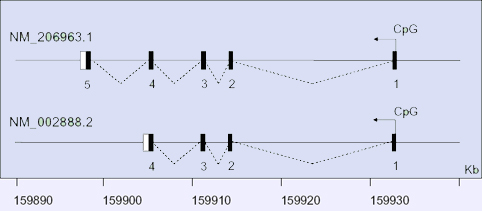
Two transcript variants (isoform 1: NM_206963.1 and isoform 2: NM_002888.2) are shown. Black boxes represent the exons of RARRES1. CpG: location of CpG island.
Description
The RARRES1 gene contains 6 exons and spans 35377 bases.
Transcription
Two alternatively spliced transcripts were identified (isoform 1 and isoform 2). Exons 1 to 4 are common to both isoforms. Exon 5 and 6 are present in isoform 1 (NM_206963.1) only. The cDNA of isoform 1 is 1545 bp while isoform 2 is 886 bp.
Pseudogene
No known pseudogenes
Proteins
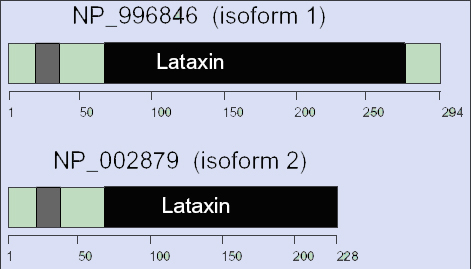
The gray box indicates the single membrane-spanning hydrophobic region. Lataxin domain for 2 RARRES1 isoforms is shown as black box.
Description
Called Retinoic acid receptor responder protein 1 (synonyms: Tazarotene-induced gene 1 protein/RAR-responsive protein TIG1); Two isoform, isoform 1 (NP_996846) and isoform 2 (NP_002879), produced by alternative splicing were reported. Isoforms 1 and 2 contain 294 and 228 amino acids respectively. Molecular weight of Isoform 1 is 33258 Da. The two isoforms show difference in the 3end-region. RARRES1 is predicted to be a transmembrane protein with a small N-terminal intracellular regions, a single membrane-spanning hydrophobic region, and a large C-terminal extracellular region containing a glycosylation signal.
Expression
High level of RARRES1 transcripts was detected in multiple tissues including prostate, heart, lung, liver, colon and small intestine. Expression of RARRES1 protein was demonstrated in colorectal tissues.
Localisation
Based on the predicted amino acid sequence, RARRES1 is suspected to be a transmembrane protein. However, immunohistochemical analysis showed that RARRES1 protein localizes at the supranuclear regions of colorectal adenocarcinoma, adenoma and adjacent normal epithelial cells. The precise localization of RARRES1 protein needed to be further investigated.
Function
RARRES1 was suggested to be a tumor suppressor of a variety of human cancers. Inactivation of RARRES1 is involved in the malignant progression of prostate cancer. Restoration of RARRES1 expression in malignant prostate cell lines led to a decrease of invasiveness and tumorigenicity in nude mice. It is speculated that RARRES1 may function as a cell adhesion molecule. Since the protein shows sequence similarity to Latexin, the only known mammalian carboxypeptidase inhibitor, RARRES1 may also have protease inhibitor activity and inhibit the degradation of extracellular matrix.
Homology
RARRES1 belongs to the proteinase inhibitor I47 (latexin) family, its c-terminal region shows 30% sequence similarity with Latexin.
Mutations
Note
No germline or somatic mutation associated with disease is reported.
Implicated in
Entity name
A variety of human cancers
Note
The association of RARRES1 with human cancer was first revealed by the subtractive differential gene display analysis of benign and malignant prostate cell lines. The gene was expressed in benign prostate cell lines and not in malignant ones. It is now considered as a putative tumor suppressor gene in a variety of human cancers although its function remains unclear. Its expression is commonly suppressed in prostate carcinoma, lung cancer, nasopharyngeal carcinoma, and leukemia by promoter hypermethylation. Restoring RARRES1 expression in prostate cancer cells resulted in decrease of in vitro invasiveness and in vivo tumorigenicity. RARRES1 also implicated in therapeutic effects of retinoic acid in psoriasis.
Disease
prostate carcinoma, nasopharyngeal carcinoma, head and neck cancer, lung cancer, gastric carcinoma, colorectal adenocarcinoma, endometrial cancer, breast cancer, acute myeloid leukemia, Chronic myeloid leukemia.
Prognosis
down-regulation of RARRES1 is significantly related with the late stage colorectal adenocarcinoma (Dukess stage D). However, no difference in survival was found comparing patient with negative, weak and strong RARRES1 expression in tumors.
Cytogenetics
No translocations and amplifications of this gene have been reported
Hybrid gene
No hybrid gene involving RARRES1 has been described.
Breakpoints
Note
No breakpoints involving this gene have been described.
Article Bibliography
| Pubmed ID | Last Year | Title | Authors |
|---|---|---|---|
| 15698574 | 2005 | An inflammatory role for the mammalian carboxypeptidase inhibitor latexin: relationship to cystatins and the tumor suppressor TIG1. | Aagaard A et al |
| 9270552 | 1997 | Molecular mechanisms of tazarotene action in psoriasis. | Duvic M et al |
| 11493603 | 2001 | Ovocalyxin-32, a novel chicken eggshell matrix protein. isolation, amino acid sequencing, cloning, and immunocytochemical localization. | Gautron J et al |
| 12952168 | 2003 | Purification of ovocalyxin-32, a novel chicken eggshell matrix protein. | Hincke MT et al |
| 11929948 | 2002 | Tazarotene-induced gene 1 (TIG1) expression in prostate carcinomas and its relationship to tumorigenicity. | Jing C et al |
| 15455391 | 2005 | Silencing of the retinoid response gene TIG1 by promoter hypermethylation in nasopharyngeal carcinoma. | Kwong J et al |
| 11929940 | 2002 | Is TIG1 a new tumor suppressor in prostate cancer? | Lotan R et al |
| 16128742 | 2005 | DNA methylation of genes linked to retinoid signaling in squamous cell carcinoma of the esophagus: DNA methylation of CRBP1 and TIG1 is associated with tumor stage. | Mizuiri H et al |
| 14987796 | 2004 | Microdissection, mRNA amplification and microarray: a study of pleural mesothelial and malignant mesothelioma cells. | Mohr S et al |
| 8601727 | 1996 | Tazarotene-induced gene 1 (TIG1), a novel retinoic acid receptor-responsive gene in skin. | Nagpal S et al |
| 16322291 | 2005 | Promoter hypermethylation as an independent prognostic factor for relapse in patients with prostate cancer following radical prostatectomy. | Rosenbaum E et al |
| 16134180 | 2005 | DNA methylation of genes linked with retinoid signaling in gastric carcinoma: expression of the retinoid acid receptor beta, cellular retinol-binding protein 1, and tazarotene-induced gene 1 genes is associated with DNA methylation. | Shutoh M et al |
| 16952303 | 2006 | Multiple tumor suppressor genes are increasingly methylated with age in non-neoplastic gastric epithelia. | So K et al |
| 15886297 | 2005 | Discovery of epigenetically masked tumor suppressor genes in endometrial cancer. | Takai N et al |
| 15328191 | 2004 | Optimal use of a panel of methylation markers with GSTP1 hypermethylation in the diagnosis of prostate adenocarcinoma. | Tokumaru Y et al |
| 16728587 | 2006 | Effects of oestrogen on gene expression in epithelium and stroma of normal human breast tissue. | Wilson CL et al |
| 14996990 | 2004 | DNA microarray analysis of vitamin D-induced gene expression in a human colon carcinoma cell line. | Wood RJ et al |
| 16426842 | 2006 | RARRES1 expression is significantly related to tumour differentiation and staging in colorectal adenocarcinoma. | Wu CC et al |
| 15059893 | 2004 | Hypermethylation and silencing of the putative tumor suppressor Tazarotene-induced gene 1 in human cancers. | Youssef EM et al |
| 14691453 | 2004 | Methylation of the retinoid response gene TIG1 in prostate cancer correlates with methylation of the retinoic acid receptor beta gene. | Zhang J et al |
| 15897880 | 2005 | All-trans retinoic acid treatment of Wilms tumor cells reverses expression of genes associated with high risk and relapse in vivo. | Zirn B et al |
Other Information
Locus ID:
NCBI: 5918
MIM: 605090
HGNC: 9867
Ensembl: ENSG00000118849
Variants:
dbSNP: 5918
ClinVar: 5918
TCGA: ENSG00000118849
COSMIC: RARRES1
RNA/Proteins
| Gene ID | Transcript ID | Uniprot |
|---|---|---|
| ENSG00000118849 | ENST00000237696 | P49788 |
| ENSG00000118849 | ENST00000479756 | P49788 |
Expression (GTEx)
Protein levels (Protein atlas)
References
| Pubmed ID | Year | Title | Citations |
|---|---|---|---|
| 38697478 | 2024 | Podocyte-derived soluble RARRES1 drives kidney disease progression through direct podocyte and proximal tubular injury. | 0 |
| 38898266 | 2024 | RARRES1 identified by comprehensive bioinformatic analysis and experimental validation as a promising biomarker in Skin Cutaneous Melanoma. | 0 |
| 38940043 | 2024 | Tazarotene-induced Gene 1 Induces Melanoma Cell Death by Triggering Endoplasmic Reticulum Stress Response. | 0 |
| 38697478 | 2024 | Podocyte-derived soluble RARRES1 drives kidney disease progression through direct podocyte and proximal tubular injury. | 0 |
| 38898266 | 2024 | RARRES1 identified by comprehensive bioinformatic analysis and experimental validation as a promising biomarker in Skin Cutaneous Melanoma. | 0 |
| 38940043 | 2024 | Tazarotene-induced Gene 1 Induces Melanoma Cell Death by Triggering Endoplasmic Reticulum Stress Response. | 0 |
| 37224335 | 2023 | GDF15 Mediates the Effect of Skeletal Muscle Contraction on Glucose-Stimulated Insulin Secretion. | 7 |
| 37247911 | 2023 | TIG1 Inhibits the mTOR Signaling Pathway in Malignant Melanoma Through the VAC14 Protein. | 1 |
| 37224335 | 2023 | GDF15 Mediates the Effect of Skeletal Muscle Contraction on Glucose-Stimulated Insulin Secretion. | 7 |
| 37247911 | 2023 | TIG1 Inhibits the mTOR Signaling Pathway in Malignant Melanoma Through the VAC14 Protein. | 1 |
| 35152215 | 2022 | Involvement of miR-769-5p/Retinoic Acid Receptor Responder 1 Axis in the Progression of Osteosarcoma: Characterization of Potential Therapeutic Targets. | 1 |
| 36353618 | 2022 | Interaction of RARRES1 with ICAM1 modulates macrophages to suppress the progression of kidney renal clear cell carcinoma. | 5 |
| 35152215 | 2022 | Involvement of miR-769-5p/Retinoic Acid Receptor Responder 1 Axis in the Progression of Osteosarcoma: Characterization of Potential Therapeutic Targets. | 1 |
| 36353618 | 2022 | Interaction of RARRES1 with ICAM1 modulates macrophages to suppress the progression of kidney renal clear cell carcinoma. | 5 |
| 34314079 | 2021 | Tazarotene-induced gene 1 interacts with Polo-like kinase 2 and inhibits cell proliferation in HCT116 colorectal cancer cells. | 3 |
Citation
Kwok-Wai Lo ; Grace TY Chung
RARRES1 (retinoic acid receptor responder (tazarotene induced) 1)
Atlas Genet Cytogenet Oncol Haematol. 2007-01-01
Online version: http://atlasgeneticsoncology.org/gene/42050/rarres1
